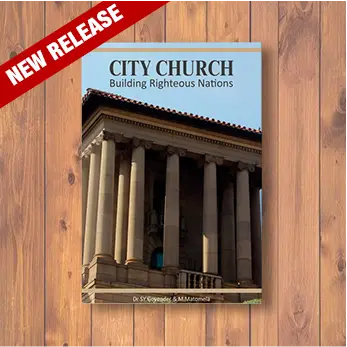
THE CITY CHURCH CONCEPT – ONENESS VS. UNITY AND THE RESISTANCE OF CHURCH LEADERSHIP
INTRODUCTION
The prayer of Jesus in John 17 reveals Heaven’s highest ecclesial priority: oneness. Yet, across cities and regions, the visible expression of the Church remains fractured, competitive, and siloed. While Scripture presents one Body in one city, modern Christianity has largely normalized denominationalism, ministerial isolation, and independent church empires.
This document provides an apologetic framework for the City Church concept, clarifies the biblical distinction between oneness and unity, and addresses the common excuses used by pastors and church leaders to resist embracing and actively participating in this Kingdom mandate.
THE CITY CHURCH CONCEPT: A BIBLICAL OVERVIEW
2.1 The Church in Scripture Is City-Based, Not Brand-Based
In the New Testament, the Church is consistently described as one Church in one city:
- “The church of God which is at Corinth”
1 Corinthians 1:2 NKJV
(2) To the church of God which is at Corinth, to those who are sanctified in Christ Jesus, called to be saints, with all who in every place call on the name of Jesus Christ our Lord, both theirs and ours:
- “To the church of the Thessalonians”
1 Thessalonians 1:1 NKJV
(1) Paul, Silvanus, and Timothy, To the church of the Thessalonians in God the Father and the Lord Jesus Christ: Grace to you and peace from God our Father and the Lord Jesus Christ.
- “The churches of Galatia”
Galatians 1:2 NKJV
(2) and all the brethren who are with me, To the churches of Galatia:
There is no biblical evidence of multiple competing churches within the same city operating as isolated entities. Rather, Scripture presents:
- Plurality of leadership
- Diversity of gifts
- Singularity of identity
The City Church is therefore not an organizational merger, but a spiritual reality requiring visible expression.
ONENESS VS. UNITY: A CRITICAL DISTINCTION
3.1 Unity Is Agreement; Oneness Is Shared Life
Unity is relational alignment without shared identity.
Oneness is covenantal participation in the same Body.
- Unity allows independence.
- Oneness demands interdependence.
Jesus did not pray for unity alone:
John 17:21 NKJV
(21) that they all may be one, as You, Father, are in Me, and I in You; that they also may be one in Us, that the world may believe that You sent Me.
The Father and Son are not merely unified—they are indivisible in essence, purpose, authority, and glory. This is the model given to the Church.
3.2 Unity Can Exist Without Sacrifice; Oneness Cannot
Unity allows:
- Cooperation without accountability
- Fellowship without submission
- Events without shared governance
Oneness requires:
- Shared responsibility
- Mutual submission
- Sacrificial relinquishing of autonomy
This is precisely why oneness is resisted.
WHY THE CITY CHURCH MATTERS THEOLOGICALLY
4.1 Oneness Is the Witness of Christ to the World
Jesus ties the credibility of the Gospel to oneness:
John 17:21 NKJV
(21) that they all may be one, as You, Father, are in Me, and I in You; that they also may be one in Us, that the world may believe that You sent Me.
Fragmentation weakens evangelistic authority. A divided Church presents a divided Christ.
4.2 Spiritual Authority Is Corporate, Not Independent
In Scripture:
- Authority flows through alignment
- Power flows through corporate obedience
- Government flows through apostolic order
Isolation leads to:
- Doctrinal drift
- Spiritual vulnerability
- Limited Kingdom impact
COMMON EXCUSES USED BY PASTORS AND LEADERS
Below are the most frequently cited objections—and their theological rebuttals.
Excuse 1: “We Are Already Unified in Spirit”
Reality: Spiritual unity without practical expression is disobedience.
Biblical oneness was:
- Visible (Read Acts 2)
- Functional (shared resources, leadership, mission)
- Governed (apostles and elders)
Invisible unity without visible obedience is theological convenience.
Excuse 2: “Our Doctrine Is Different”
Reality: Diversity of doctrine did not prevent apostolic fellowship.
The early Church navigated:
- Jewish and Gentile believers
- Cultural and theological tensions
- Different ministry emphases
Yet they maintained one Body under apostolic oversight.
Doctrine becomes an excuse when it masks fear of accountability.
Excuse 3: “We Don’t Want to Lose Our Identity”
Reality: Kingdom identity precedes ministry identity.
Paul never identified himself as:
- “Leader of the Corinthian brand”
- “Founder of the Ephesian ministry”
He identified as:
- A servant of Christ
- A steward of mysteries
- A member of the Body
Fear of losing identity reveals ownership issues, not Kingdom sonship.
Excuse 4: “We’ve Been Hurt Before”
Reality: Wounds are healed in covenant, not isolation.
While abuse and manipulation must be addressed, Scripture never presents withdrawal from the Body as the solution. Healing comes through:
- Proper spiritual fathering
- Restored trust
- Mature apostolic structures
Pain does not nullify obedience.
Excuse 5: “God Called Me to My Church”
Reality: God calls people to cities, not private empires.
Paul was called:
- To regions
- To peoples
- To cities
Local assignment does not equal independent ownership.
Calling is stewarded within the Body, not above it.
THE REAL ISSUE: CONTROL VS. COVENANT
At its core, resistance to the City Church is not theological—it is governmental.
Oneness requires:
- Shared leadership
- Relational accountability
- Apostolic humility
Many leaders prefer unity without submission, because it preserves control while appearing spiritual.
A CALL TO REPENTANCE AND REFORMATION

The City Church is not optional—it is eschatological.
As the Church moves toward maturity:
- Apostolic alignment will increase
- Lone-ranger ministries will diminish
- Kingdom structures will replace personality-driven systems
Ephesians 4:11-13 NKJV
(11) And He Himself gave some to be apostles, some prophets, some evangelists, and some pastors and teachers,
(12) for the equipping of the saints for the work of ministry, for the edifying of the body of Christ,
(13) till we all come to the unity of the faith and of the knowledge of the Son of God, to a perfect man, to the measure of the stature of the fullness of Christ;
Maturity is corporate, not individual.
CONCLUSION
The City Church concept is not a threat to pastors—it is a restoration of biblical order.
Oneness is not the loss of ministry—it is the fulfilment of Christ’s prayer.
The excuses must fall.
The fear must be confronted.
The Church must rise as one Body in every city.
Only then will the world believe.