INTRODUCTION:
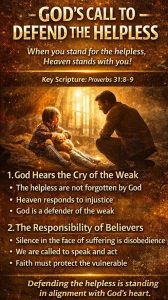
Weak believers will be in your church and household. As mature believers we have a responsibility toward such weak believers. This is a command from the Lord.
Proverbs 31:8-9 NKJV
(8) Open your mouth for the speechless, In the cause of all who are appointed to die.
(9) Open your mouth, judge righteously, And plead the cause of the poor and needy.
One of the greatest marks of spiritual maturity is not merely revelation, gifting, or ministry influence, but the ability to carry and restore weak believers with love, patience, and compassion. In every local church there are believers at different levels of growth, understanding, healing, and stability. The Kingdom of God is not built merely by celebrating the strong, but by strengthening the weak.
The Lord Jesus Christ consistently demonstrated compassion toward the broken, rejected, and struggling. He restored Peter after failure, received Thomas in his doubt, and pursued the sheep that wandered away. The Church today is called to reflect that same heart.
1 Thessalonians 5:11 NKJV
(11) Therefore comfort each other and edify one another, just as you also are doing.
Spiritually weak believers are not enemies of the faith; they are members of the Body who require support, guidance, healing, and restoration. Many believers who appear weak outwardly are often carrying deep wounds, disappointments, confusion, bondage, or isolation. Rather than condemning them, Scripture commands us to strengthen and edify them.
Romans 15:1 NKJV
(1) We then who are strong ought to bear with the scruples of the weak, and not to please ourselves.
WHO ARE THE SPIRITUALLY WEAK BELIEVERS?
The spiritually weak may include:
- New believers who are still learning the foundations of the faith.
- Bruised believers who have been wounded by the world, leadership failures, rejection, or church hurt.
- Those lacking fellowship and spiritual covering — the “lost sheep.”
- Believers struggling with recurring weaknesses or patterns of failure.
- Those under traditional or ceremonial bondage who have not yet understood their liberty in Christ.
- Those weakened by tribulation, suffering, persecution, or difficult seasons of life.
Galatians 6:1 NKJV
(1) Brethren, if a man is overtaken in any trespass, you who are spiritual restore such a one in a spirit of gentleness, considering yourself lest you also be tempted.
These believers require spiritual care, not criticism. The Church must become a place of restoration rather than rejection.
Isaiah 42:3 NKJV
(3) A bruised reed He will not break, And smoking flax He will not quench; He will bring forth justice for truth.
STEPS TO EMBRACE AND DEVELOP WEAK BELIEVERS
-
WELCOME WEAK BELIEVERS

Romans 14:1 (NKJV)
Receive one who is weak in the faith, but not to disputes over doubtful things.
Paul addressed a conflict between strong believers who understood their liberty in Christ and weaker believers who were still bound by ceremonial practices and personal convictions. Instead of mocking or rejecting them, the Church was commanded to receive them with love.
The word “receive” means to warmly accept, embrace, and bring near. Weak believers should never feel unwelcome in the house of God. Sadly, many wounded believers leave churches not because of doctrine, but because of condemnation, criticism, and harsh treatment.
A mature believer understands that spiritual growth is a process. Every believer was once immature and incomplete in understanding. The strong must therefore extend grace and patience toward those still growing.
Paul further warns:
Romans 14:4 (NKJV)
“Who are you to judge another’s servant? To his own master he stands or falls.”
This scripture clearly shows that believers belong to God and are accountable to Him. Our role is not condemnation, but helping others stand through encouragement, restoration, and grace.
Another powerful supporting scripture is:
Galatians 6:1-2 NKJV
(1) Brethren, if a man is overtaken in any trespass, you who are spiritual restore such a one in a spirit of gentleness, considering yourself lest you also be tempted.
(2) Bear one another’s burdens, and so fulfill the law of Christ.
This emphasizes that spiritual maturity is demonstrated through restoration and burden-bearing rather than judgment and rejection.
Weak believers belong to God, not to us. We are called to help restore them, not to sit as judges over them.
Practical Application
- Welcome struggling believers without prejudice.
- Create an atmosphere of grace and healing.
- Avoid arguments over non-essential issues.
- Allow people room to grow spiritually.
-
EDIFY WEAK BELIEVERS
Romans 14:19 (NKJV)
Let us therefore pursue the things which make for peace and the things by which one may edify another.
The goal of Christian fellowship is not competition but edification. To edify means to build up spiritually, strengthen, encourage, and establish another believer.
Many believers are torn down by criticism, gossip, comparison, and legalism. The mature believer must become a spiritual builder.
Edification produces:
- Stability
- Healing
- Spiritual confidence
- Growth in faith
- Restoration of identity
The spiritually weak do not primarily need condemnation; they need strengthening through truth, love, and encouragement.
Ephesians 4:15 NKJV
(15) but, speaking the truth in love, may grow up in all things into Him who is the head—Christ—
This scripture reveals that truth must be administered in love so that believers can grow and become spiritually strengthened.
-
EDIFY WEAK BELIEVERS BY UPHOLDING THEM
1 Thessalonians 5:14 (NKJV)
Now we exhort you, brethren, warn those who are unruly, comfort the fainthearted, uphold the weak, be patient with all.
Paul gives specific instructions concerning different kinds of believers. Some need warning, some need comfort, and some need support.
The phrase “uphold the weak” means to hold firmly to them so they do not collapse spiritually. Mature believers must not abandon people in their weakest moments.
Patience is essential in restoration ministry. Growth takes time. Healing takes time. Deliverance from old patterns sometimes takes time. Impatience can destroy a believer who is trying to recover spiritually.
Isaiah 40:11 NKJV
(11) He will feed His flock like a shepherd; He will gather the lambs with His arm, And carry them in His bosom, And gently lead those who are with young.
This scripture reveals the heart of God toward the weak and vulnerable — He leads them gently, not harshly.
Practical Application
- Encourage believers going through trials.
- Pray consistently for weaker believers.
- Walk alongside them instead of distancing yourself.
- Avoid harsh and impatient attitudes.
-
DO NOT BECOME A STUMBLING BLOCK TO WEAK BELIEVERS
1 Corinthians 8:11–13 (NKJV)
(11) And because of your knowledge shall the weak brother perish, for whom Christ died?
(12) But when you thus sin against the brethren, and wound their weak conscience, you sin against Christ.
(13) Therefore, if food makes my brother stumble, I will never again eat meat, lest I make my brother stumble.
Paul teaches that spiritual liberty must always be governed by love. Even if something is lawful, it may not be beneficial if it causes another believer to stumble.
A mature believer must ask:
- Will my conduct weaken another believer?
- Will my words confuse or discourage them?
- Will my example draw them closer to Christ or away from Him?
Christian maturity is not merely about exercising rights; it is about walking in love.
Romans 14:21 (NKJV)
It is good neither to eat meat nor drink wine nor do anything by which your brother stumbles.
Love willingly limits itself for the sake of another person’s spiritual growth.
Practical Application
- Avoid careless behaviour that confuses weaker believers.
- Use wisdom in exercising Christian liberty.
- Protect the conscience of new believers.
- Live as an example worthy of imitation.
-
PLEASE OTHERS RATHER THAN YOURSELF
Romans 15:1–2 (NKJV)
(1) We then who are strong ought to bear with the scruples of the weak, and not to please ourselves.
(2) Let each of us please his neighbour for his good, leading to edification.
Kingdom maturity is revealed through selflessness. Strong believers are called to carry the burdens and weaknesses of others rather than living selfishly.
Jesus Himself modelled this lifestyle. He bore our griefs, carried our sorrows, and laid down His life for humanity. Likewise, believers are called to become burden-bearers.
Isaiah 53:4-5 NKJV
(4) Surely He has borne our griefs And carried our sorrows; Yet we esteemed Him stricken, Smitten by God, and afflicted.
(5) But He was wounded for our transgressions, He was bruised for our iniquities; The chastisement for our peace was upon Him, And by His stripes we are healed.
Edification often requires sacrifice:
- Sacrificing convenience
- Sacrificing time
- Sacrificing comfort
- Sacrificing personal preference
John 15:13 NKJV
(13) Greater love has no one than this, than to lay down one’s life for his friends.
The Church becomes powerful when believers prioritize one another’s spiritual welfare.
-
VISIT WEAK BELIEVERS
Matthew 25:36 (NKJV)
“I was sick and you visited Me; I was in prison and you came to Me.”
Jesus reveals that caring for people is ministry unto Him personally. Visitation is a powerful ministry that communicates love, value, and concern.
Many weak believers drift away because nobody checked on them during difficult seasons. Sometimes a phone call, visit, prayer meeting, or word of encouragement can restore a believer who was ready to quit.
Visitation demonstrates:
- Compassion
- Accountability
- Fellowship
- Spiritual oversight
- Genuine love
Practical Application
- Visit absent believers.
- Follow up with struggling members.
- Pray with people in difficult seasons.
- Build meaningful fellowship beyond church meetings.
-
SUPPORT WEAK BELIEVERS
Acts 20:35 (NKJV)
“I have shown you in every way, by laboring like this, that you must support the weak.”
Supporting weak believers involves practical and spiritual assistance. Some believers are emotionally weak, financially burdened, spiritually discouraged, or mentally exhausted.
The early Church demonstrated practical support through generosity, fellowship, prayer, and encouragement. Christianity is not merely preaching sermons; it is carrying one another’s burdens.
Support may include:
- Prayer
- Counselling
- Financial assistance
- Mentorship
- Discipleship
- Fellowship
- Encouragement
The strong are called to become pillars that help stabilize others.
-
ADAPT IN ORDER TO WIN WEAK BELIEVERS OVER
1 Corinthians 9:22 (NKJV)
“To the weak I became as weak, that I might win the weak.”
Paul understood the importance of relating to people wisely and compassionately. He adapted culturally and personally where Scripture permitted in order to reach people effectively.
Examples include:
- Paul shaving his head (Acts 21:24)
Acts 21:24 NKJV
(24) Take them and be purified with them, and pay their expenses so that they may shave their heads, and that all may know that those things of which they were informed concerning you are nothing, but that you yourself also walk orderly and keep the law.
- Timothy being circumcised to reach Jewish communities
Acts 16:3 NKJV
(3) Paul wanted to have him go on with him. And he took him and circumcised him because of the Jews who were in that region, for they all knew that his father was Greek.
Paul was not compromising truth; he was removing unnecessary barriers to ministry.
However, adaptation must remain within biblical boundaries. We never compromise holiness or truth to gain acceptance.
Practical Application
- Learn to communicate with wisdom and sensitivity.
- Understand the struggles of different believers.
- Remove unnecessary religious barriers.
- Minister with compassion rather than superiority.
-
KNOW THE FLOCK
Acts 20:28 (NKJV)
(28) Therefore take heed to yourselves and to all the flock, among which the Holy Spirit has made you overseers, to shepherd the church of God which He purchased with His own blood.
1 Peter 5:2 (NKJV)
(2) Shepherd the flock of God which is among you, serving as overseers, not by compulsion but willingly, not for dishonest gain but eagerly;
Spiritual leaders and mature believers must know the condition of the flock. Effective shepherding requires relationship, discernment, and oversight.
A shepherd who does not know the sheep cannot effectively protect, feed, or restore them.
Knowing the flock involves:
- Understanding their struggles
- Recognizing spiritual weaknesses
- Identifying isolation
- Detecting discouragement early
- Providing timely care and instruction
The Church should never become so large or program-driven that people suffer silently without care.
True shepherding reflects the heart of Christ — the Good Shepherd who knows His sheep by name.
CONCLUSION
The Kingdom of God is strengthened when mature believers take responsibility for restoring, encouraging, and supporting weaker believers. Spiritual weakness should never become an excuse for rejection, but an opportunity for ministry.
Jesus came for the broken, wounded, and lost. The Church must carry that same burden. Every believer has a responsibility to welcome, edify, support, uphold, and strengthen others in love.
Strong believers must remember that strength is not given for superiority but for service. God strengthens us so that we may strengthen others.
When the Church embraces this responsibility, it becomes a place of healing, restoration, discipleship, and spiritual growth — a true reflection of the heart of Christ.
OTHER PUBLICATIONS BY THIS AUTHOR CAN BE FOUND AT: