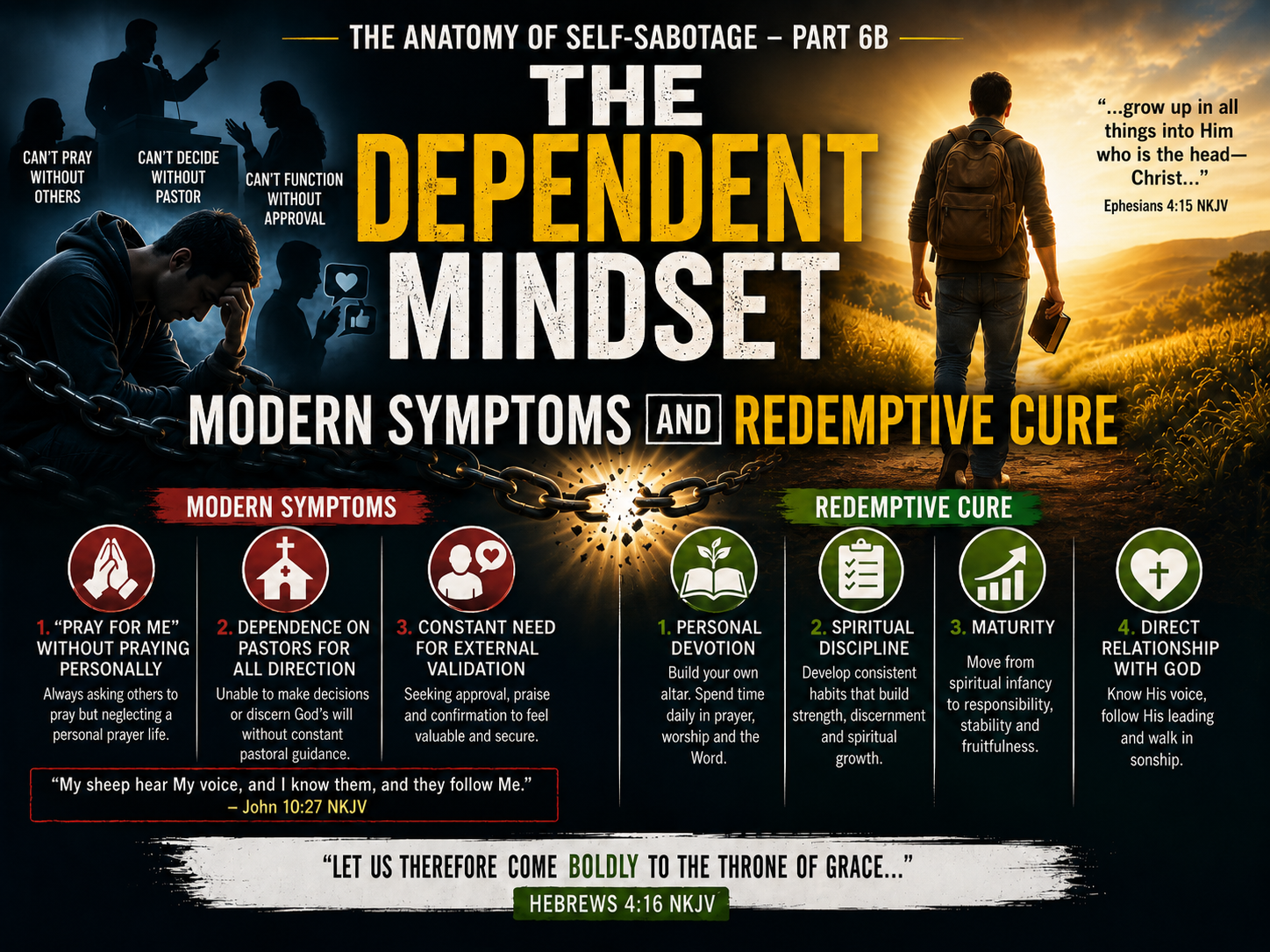
THE ANATOMY OF SELF-SABOTAGE – PART 6B
THE DEPENDENT MINDSET – PART 6B – MODERN SYMPTOMS OF A DEPENDENT MINDSET
INTRODUCTION
The dependent mindset is not only seen in biblical history. It is also visible in the modern church. It often hides behind spiritual language, but its fruit is passivity, immaturity, and an inability to walk with God personally.
A believer with a dependent mindset may appear sincere, but they constantly outsource spiritual responsibility. Instead of growing in prayer, discernment, decision-making, obedience, and confidence before God, they remain dependent on others to carry their walk for them.
This does not mean believers should never ask for prayer, seek pastoral counsel, or receive encouragement. The Body of Christ exists for mutual support, instruction, strengthening, and accountability. However, there is a difference between receiving help and refusing to grow. There is a difference between asking for guidance and needing someone else to make every decision. There is a difference between receiving encouragement and being unable to function without constant validation.
SYMPTOMS OF THE DEPENDANT MINDSET
The following symptoms reveal how the dependent mindset often operates today.
“Pray for Me” Without Praying Personally
One of the most common symptoms of a dependent mindset is the repeated request, “Pray for me,” while the person does not develop a

personal prayer life. There is nothing wrong with asking others to pray. Scripture encourages believers to pray for one another.
James 5:16 NKJV
(16) Confess your trespasses to one another, and pray for one another, that you may be healed. The effective, fervent prayer of a righteous man avails much.
This verse confirms that mutual prayer is biblical and powerful. However, it does not remove the believer’s responsibility to pray personally. Asking others to pray should strengthen personal prayer, not replace it.
The danger begins when “Pray for me” becomes a substitute for “I will seek the Lord.” Some believers want others to carry them in prayer, but they do not build their own altar. They depend on the intercessor, pastor, prophet, spiritual parent, or prayer group to do what they refuse to cultivate in private.
Jesus taught personal prayer as a normal part of the believer’s life.
Matthew 6:6 NKJV
(6) But you, when you pray, go into your room, and when you have shut your door, pray to your Father who is in the secret place; and your Father who sees in secret will reward you openly.
Jesus did not say, “If you pray.” He said, “When you pray.” Prayer is not reserved for leaders, pastors, or intercessors. Prayer is the privilege and responsibility of every believer.
A dependent mindset says, “Let someone else pray until something changes.” A mature mindset says, “Pray with me, but I will also stand before God myself.”
The believer who only asks for prayer but never prays personally remains spiritually weak. They may receive temporary encouragement from others, but they do not develop inner strength. They may feel lifted after a powerful prayer meeting, but they collapse again when they are alone because they have not built a personal relationship with God.
The dependent believer wants prayer support without prayer discipline. They want breakthrough without intimacy. They want peace without surrender. They want direction without seeking God. They want someone else to enter the secret place on their behalf. But no one can have your relationship with God for you.
Others can pray for you, but they cannot replace your communion with the Father. Others can stand with you, but they cannot build your private altar for you. Others can intercede for you, but they cannot surrender your heart for you.
The writer of Hebrews calls believers to come personally before God.
Hebrews 4:16 NKJV
(16) Let us therefore come boldly to the throne of grace, that we may obtain mercy and find grace to help in time of need.
This invitation is not only for spiritual leaders. It is for every believer. Every son and daughter of God has access to the throne of grace through Jesus Christ. The dependent mindset must be healed by recovering confidence in personal access to God.
A healthy believer can say, “Please pray with me,” not because they are avoiding prayer, but because they are standing in prayer already. They do not ask others to replace their responsibility; they ask others to agree with their faith.
Maturity does not stop asking for prayer. Maturity stops using other people’s prayers as an excuse for prayerlessness.
2. Dependence on Pastors for All Direction
Another modern symptom of a dependent mindset is dependence on pastors for all direction. This happens when a believer cannot make decisions, discern God’s will, or take responsibility without constantly asking a pastor what to do.
Pastoral leadership is biblical. God gives pastors and teachers to feed, guide, equip, protect, and mature the saints.
Ephesians 4:11-13 NKJV
(11) And He Himself gave some to be apostles, some prophets, some evangelists, and some pastors and teachers,
(12) for the equipping of the saints for the work of ministry, for the edifying of the body of Christ,
(13) till we all come to the unity of the faith and of the knowledge of the Son of God, to a perfect man, to the measure of the stature of the fullness of Christ;
This passage shows the purpose of leadership. Leaders are given to equip the saints, not to create permanent dependency. The pastor’s role is not to make every decision for every believer. The pastor’s role is to help believers grow into maturity, responsibility, discernment, and Christlikeness.
A dependent mindset turns pastors into personal decision-makers. The believer asks the pastor about everything: whom to marry, where to work, when to move, what to buy, which opportunity to take, how to respond to every conflict, and what to do in every situation. Counsel is valuable, but when a person cannot make any decision without pastoral approval, their spiritual maturity is underdeveloped.
This places an unhealthy burden on leaders and keeps believers immature.
There is a difference between seeking counsel and refusing responsibility. Seeking counsel is wise.
Scripture says:
Proverbs 11:14 NKJV
(14) Where there is no counsel, the people fall; But in the multitude of counselors there is safety.
Counsel provides wisdom, perspective, warning, and confirmation. But counsel does not remove personal responsibility before God. A pastor can advise, but the believer must still pray, discern, obey Scripture, and make responsible decisions.
A dependent mindset says, “Pastor, tell me what to do.” A mature mindset says, “Pastor, please help me discern wisely as I seek to obey God.”
God does not want His people to be mindless followers of men. He wants sons and daughters who are led by His Spirit.
Romans 8:14 NKJV
(14) For as many as are led by the Spirit of God, these are sons of God.
This does not mean believers reject leadership. It means leadership should help them become more sensitive to the Spirit, not more dependent on human control.
When believers depend on pastors for all direction, they may become fearful of making decisions. They may avoid responsibility by saying, “Pastor said.” They may blame the leader when things do not work out. They may also become vulnerable to manipulation if they give a human being authority that belongs only to God.
A pastor is a shepherd, not a replacement for the Holy Spirit. A pastor is a teacher, not a substitute for Scripture. A pastor is a guide, not the owner of another person’s conscience.
Mature pastoral ministry should lead people toward God, not toward unhealthy dependence on the leader. The goal is not to keep believers permanently attached to the pastor’s voice. The goal is to train them to know the voice of the Shepherd.
Jesus said:
John 10:27 NKJV
(27) My sheep hear My voice, and I know them, and they follow Me.
The dependent mindset must learn that pastoral counsel is a gift, but personal relationship with Christ is essential. The believer must grow in Scripture, prayer, wisdom, discernment, and obedience so that they can make decisions in a way that honours God.
The pastor may help guide the sheep, but the sheep must know the voice of Christ.
3. Constant Need for External Validation

A third modern symptom of the dependent mindset is the constant need for external validation. This happens when a believer cannot remain faithful, confident, obedient, or secure unless someone is continually affirming them.
Such a person may constantly need approval, praise, recognition, attention, compliments, reassurance, prophetic confirmation, or emotional support. If they are not noticed, they feel rejected. If they are not praised, they feel discouraged. If they are corrected, they feel attacked. If someone does not affirm them, they begin to question their worth, calling, or place in the Body.
This is a dangerous form of dependency because the believer’s identity becomes controlled by human response instead of God’s truth.
Paul addressed this issue clearly.
Galatians 1:10 NKJV
(10) For do I now persuade men, or God? Or do I seek to please men? For if I still pleased men, I would not be a bondservant of Christ.
A believer cannot live as a servant of Christ while being controlled by the need to please people. When external validation becomes too important, obedience becomes compromised. The person begins to ask, “What will people think?” instead of “What has God said?”
The constant need for validation can produce spiritual instability. If people approve, the believer feels strong. If people are silent, the believer feels forgotten. If people criticise, the believer collapses. If people celebrate them, they feel called. If people overlook them, they feel worthless.
This reveals that their foundation is not yet secure in Christ. The Bible teaches that our approval must ultimately come from God.
2 Corinthians 10:18 NKJV
(18) For not he who commends himself is approved, but whom the Lord commends.
Human encouragement is valuable, but human approval is not the foundation of identity. A believer must learn to stand in the approval of God. If God has called, accepted, forgiven, and placed you, then your worth cannot be determined by applause, recognition, or attention from people.
The constant need for external validation also affects service. Some people only serve faithfully when they are praised. They only give when they are noticed. They only continue when someone thanks them. They only remain committed when they feel celebrated. But mature service is done unto the Lord, not merely for human recognition.
Colossians 3:23-24 NKJV
(23) And whatever you do, do it heartily, as to the Lord and not to men,
(24) knowing that from the Lord you will receive the reward of the inheritance; for you serve the Lord Christ.
This Scripture heals the validation addiction by redirecting the heart. The believer must learn to serve before God, not before the eyes of people. When God becomes the audience of our obedience, we are freed from the prison of constant human approval.
External validation becomes unhealthy when it replaces internal conviction. A mature believer does not need constant applause to obey. They do not need constant recognition to serve. They do not need constant reassurance to remain faithful. They do not need constant compliments to know they are loved by God.
This does not mean encouragement is wrong. Encouragement is biblical and necessary. The church should strengthen one another, honour one another, and build one another up. But encouragement must not become emotional oxygen without which a believer cannot breathe spiritually.
The dependent mindset says, “I cannot continue unless people affirm me.” The renewed mind says, “I am accepted in Christ, and I will obey God whether people notice or not.”
The constant need for validation is often rooted in insecurity, rejection, comparison, fear of man, or unresolved wounds. God heals this by establishing the believer in sonship.
When a person knows they are accepted by the Father, they no longer have to beg people for identity.
Ephesians 1:6 NKJV
(6) to the praise of the glory of His grace, by which He made us accepted in the Beloved.
This is the foundation of spiritual security. The believer is accepted in the Beloved. That acceptance is not based on popularity, performance, applause, titles, position, or recognition. It is based on the grace of God in Christ.
A mature believer can receive encouragement with gratitude, correction with humility, silence without offence, and rejection without losing identity. They are no longer controlled by the approval of people because they are rooted in the love and acceptance of God.
To Summarize
The modern symptoms of a dependent mindset reveal a believer who has not yet taken full responsibility for personal growth. They may ask for prayer but neglect their own prayer life. They may depend on pastors for every direction but fail to develop discernment. They may constantly seek validation but remain insecure in their identity.
The redemptive answer is maturity. God calls believers to pray personally, receive counsel wisely, follow the Spirit faithfully, serve unto the Lord, and find identity in Christ.
The Body of Christ is there to strengthen us, but it must never replace our personal walk with God. Leaders may guide us, believers may pray with us, and the church may encourage us, but every believer must learn to stand before God with devotion, obedience, and spiritual responsibility.
REDEMPTIVE CURE FOR THE DEPENDENT MINDSET
The dependent mindset is not healed by rebellion, isolation, or rejecting spiritual leadership. God never calls believers to become independent from the Body of Christ or dishonouring toward those He has placed in their lives. The cure is not independence from authority; the cure is maturity under God.
A dependent believer must learn to move from being constantly carried by others to being strengthened in the Lord. They must move from borrowed conviction to personal conviction, from second-hand spirituality to personal devotion, from passive receiving to active obedience, and from dependence on personalities to a direct relationship with God.
The redemptive cure for the dependent mindset includes personal devotion, spiritual discipline, maturity, and a direct relationship with God.
-
Personal Devotion
Personal devotion is the foundation of spiritual stability. It is the private life of the believer before God. It is where prayer, worship,

meditation on Scripture, repentance, surrender, and obedience are cultivated away from public attention.
The dependent mindset often survives because the believer has no personal altar. They may attend church, listen to sermons, receive ministry, and ask for prayer, but they do not consistently meet with God personally. Their spiritual life depends on public gatherings because there is no private devotion.
Jesus taught that every believer must have a secret place.
Matthew 6:6 NKJV
(6) But you, when you pray, go into your room, and when you have shut your door, pray to your Father who is in the secret place; and your Father who sees in secret will reward you openly.
This verse reveals that personal prayer is not optional. Jesus said, “when you pray,” not “if you pray.” The secret place is where the believer learns to relate to the Father directly. It is where dependence on people is replaced by dependence on God.
A believer who has personal devotion is not easily shaken when others are absent. They may appreciate encouragement, but they do not collapse without it. They may honour leaders, but they do not substitute leaders for God. They may receive prophetic ministry, but they are not addicted to external voices because they are grounded in the Word and the presence of God.
David understood personal devotion.
Psalm 63:1 NKJV
(1) A Psalm of David When He Was in the Wilderness of Judah. O God, You are my God; Early will I seek You; My soul thirsts for You; My flesh longs for You In a dry and thirsty land Where there is no water.
David did not only know God through priests, prophets, or public worship. He had a personal hunger for God. He could say, “You are my God.” This is the language of personal devotion.
The dependent mindset says, “Someone must help me find God.” The renewed mind says, “I will seek the Lord for myself.”
Personal devotion does not remove the need for corporate fellowship. It strengthens it. A believer who meets with God privately comes into the gathering with spiritual substance. They do not come only to be filled; they also come ready to worship, serve, encourage, and contribute.
The cure begins when the believer establishes a daily altar with God. This may include reading Scripture, praying honestly, worshipping sincerely, journaling what God is dealing with in the heart, repenting quickly, and obeying what the Holy Spirit reveals.
Personal devotion breaks dependency because it teaches the believer to draw strength from God directly.
-
Spiritual Discipline
Spiritual discipline is the structure that protects devotion. Many believers desire intimacy with God, but without discipline, desire remains inconsistent. Spiritual discipline helps the believer move beyond emotion into faithful practice.
The dependent mindset often lacks discipline. It waits to feel inspired before praying, waits to be motivated before reading Scripture, waits for crisis before fasting, waits for church meetings before worshipping, and waits for someone else to initiate obedience. This produces unstable spirituality.
Paul instructed Timothy:
1 Timothy 4:7-8 NKJV
(7) But reject profane and old wives’ fables, and exercise yourself toward godliness.
(8) For bodily exercise profits a little, but godliness is profitable for all things, having promise of the life that now is and of that which is to come.
The phrase “exercise yourself toward godliness” shows that spiritual growth requires intentional practice. Godliness does not develop accidentally. It is cultivated through repeated obedience, repeated surrender, repeated prayer, repeated study, and repeated choices that honour God.
Spiritual discipline includes setting consistent time for prayer, studying the Word, attending fellowship faithfully, fasting when led, serving responsibly, guarding the heart, renewing the mind, and practising obedience in everyday life.
Discipline is not legalism when it flows from love for God. Legalism tries to earn acceptance through religious performance. Spiritual discipline responds to the grace of God by ordering one’s life around Him.
Paul also wrote:
Romans 12:11 NKJV
(1) I beseech you therefore, brethren, by the mercies of God, that you present your bodies a living sacrifice, holy, acceptable to God, which is your reasonable service.
This verse confronts spiritual passivity. The believer must not be lazy in diligence. They must remain fervent in spirit. They must serve the Lord with commitment and responsibility.
Spiritual discipline cures the dependent mindset because it trains the believer to take initiative. Instead of waiting for a pastor to call a prayer meeting, the believer prays. Instead of waiting for a prophet to give direction, the believer studies Scripture. Instead of waiting for someone to notice their condition, the believer brings their heart before God. Instead of waiting for pressure, the believer obeys.
Discipline also develops discernment.
Hebrews 5:14 NKJV
(14) But solid food belongs to those who are of full age, that is, those who by reason of use have their senses exercised to discern both good and evil.
Discernment is developed “by reason of use.” This means maturity comes through practice. The believer must practise truth, practise obedience, practise prayer, practise wise decision-making, and practise submitting their thoughts to the Word of God.
A disciplined believer does not depend on emergency spirituality. They do not only pray when they are desperate. They do not only seek God when trouble comes. They do not only attend when life is falling apart. They build consistency before crisis arrives.
The dependent mindset says, “I will move when someone moves me.” The disciplined believer says, “I will obey because God is worthy.”
-
Maturity
Maturity is the ultimate goal of the redemptive cure. God does not want believers to remain spiritual infants who must constantly be fed, carried, corrected, reminded, and rescued. He wants sons and daughters who are growing into the measure of Christ.
Spiritual leadership exists to produce maturity, not permanent dependence.
Ephesians 4:11-15 NKJV
(11) And He Himself gave some to be apostles, some prophets, some evangelists, and some pastors and teachers,
(12) for the equipping of the saints for the work of ministry, for the edifying of the body of Christ,
(13) till we all come to the unity of the faith and of the knowledge of the Son of God, to a perfect man, to the measure of the stature of the fullness of Christ;
(14) that we should no longer be children, tossed to and fro and carried about with every wind of doctrine, by the trickery of men, in the cunning craftiness of deceitful plotting,
(15) but, speaking the truth in love, may grow up in all things into Him who is the head—Christ—
This passage gives a clear picture of God’s intention. The saints must be equipped. The Body must be edified. Believers must grow into the measure of the stature of the fullness of Christ. They must no longer remain children, unstable and easily moved.
A dependent mindset keeps a believer childlike. It constantly needs someone else to provide direction, motivation, correction, and validation. Maturity, however, causes the believer to become stable, discerning, responsible, and fruitful.
Maturity does not mean the believer no longer needs others. Mature believers still receive counsel, correction, impartation, fellowship, and encouragement. The difference is that mature believers do not use others as a substitute for their own obedience.
Paul rebuked prolonged immaturity in the Corinthian church.
1 Corinthians 3:1-3 NKJV
(1) Though I speak with the tongues of men and of angels, but have not love, I have become sounding brass or a clanging cymbal.
(2) And though I have the gift of prophecy, and understand all mysteries and all knowledge, and though I have all faith, so that I could remove mountains, but have not love, I am nothing.
(3) And though I bestow all my goods to feed the poor, and though I give my body to be burned, but have not love, it profits me nothing.
The problem was not that they had once been babes in Christ. Every believer begins as a spiritual child. The problem was that they remained immature when they should have grown.
The dependent mindset must be confronted because it delays growth. It keeps the believer needing milk when they should be handling meat. It keeps them asking the same questions, repeating the same cycles, needing the same rescue, and falling into the same weaknesses.
Maturity asks different questions. It no longer only asks, “Who can help me?” It also asks, “What must I take responsibility for?” It no longer only asks, “Who will pray for me?” It also asks, “How must I build my prayer life?” It no longer only asks, “Who will guide me?” It also asks, “How must I grow in discernment?”
Maturity is the place where the believer accepts responsibility for growth.
Hebrews 6:1 NKJV
(1) Therefore, leaving the discussion of the elementary principles of Christ, let us go on to perfection, not laying again the foundation of repentance from dead works and of faith toward God,
The phrase “let us go on to perfection” speaks of moving forward into maturity. The believer must not live permanently in foundational instability. Foundations are important, but foundations are meant to support growth.
Maturity is seen when a believer can remain faithful even when no one is watching. It is seen when they can obey God without constant reminders. It is seen when they can receive correction without offence. It is seen when they can serve without applause. It is seen when they can pray without being pushed. It is seen when they can discern without always demanding external confirmation.
The dependent mindset says, “Carry me.” Maturity says, “Equip me so I can walk.”
-
Direct Relationship with God
The deepest cure for the dependent mindset is a direct relationship with God. Every believer must come to know the Lord personally, not merely through another person’s relationship, revelation, prayer life, or leadership.
God uses leaders, but leaders are not mediators between God and the believer in the place of Christ. Jesus is the Mediator. Through Him, every believer has access to the Father.
1 Timothy 2:5 NKJV
(5) For there is one God and one Mediator between God and men, the Man Christ Jesus,
This truth is essential. No pastor, prophet, apostle, teacher, mentor, or spiritual father can take the place of Christ. Leaders may guide, teach, equip, correct, and strengthen, but they cannot become the believer’s access point to God.
Through Jesus, the believer can come boldly before the Father.
Hebrews 4:14-16 NKJV
(14) Seeing then that we have a great High Priest who has passed through the heavens, Jesus the Son of God, let us hold fast our confession.
(15) For we do not have a High Priest who cannot sympathize with our weaknesses, but was in all points tempted as we are, yet without sin.
(16) Let us therefore come boldly to the throne of grace, that we may obtain mercy and find grace to help in time of need.
The dependent mindset often feels unqualified to approach God personally. It may think, “The pastor must hear God for me,” or “The prophet must tell me what God is saying,” or “The intercessor must carry me into God’s presence.” But Scripture says, “Let us therefore come boldly.”
This does not produce arrogance. It produces confidence in Christ. The believer does not come to God because of personal perfection. The believer comes because Jesus has opened the way.
A direct relationship with God also means learning to hear and follow the voice of Christ.
John 10:27 NKJV
(27) My sheep hear My voice, and I know them, and they follow Me.
Jesus did not say, “My sheep only hear the voice of their leaders.” He said, “My sheep hear My voice.” Spiritual leaders help believers discern, understand, and obey, but every believer must learn to recognise the voice of the Shepherd.
A direct relationship with God also develops personal conviction. The believer no longer lives only on borrowed faith. They become rooted in what God has revealed through His Word and confirmed by His Spirit.
Romans 8:14-16 NKJV
(14) For as many as are led by the Spirit of God, these are sons of God.
(15) For you did not receive the spirit of bondage again to fear, but you received the Spirit of adoption by whom we cry out, “Abba, Father.”
(16) The Spirit Himself bears witness with our spirit that we are children of God,
CONCLUSION: FROM DEPENDENCY TO SPIRITUAL RESPONSIBILITY
The dependent mindset is one of the most subtle forms of spiritual self-sabotage because it often hides behind sincere need, honour for leadership, desire for prayer, and appreciation for spiritual guidance. Yet when these things replace personal responsibility, the believer remains immature. God gives leaders, pastors, prophets, teachers, fathers, and mentors to equip the saints, but He never intended them to become substitutes for a believer’s own walk with Him.
Israel after Moses and the repeated failures in the Book of Judges reveal the same dangerous pattern. When visible leadership was absent, the people collapsed. Their obedience was too connected to a person and not deeply rooted in personal covenant with God. They experienced deliverance, but they did not develop maturity. They received help, but they did not take responsibility. They were rescued from oppression, but they repeatedly returned to the same cycles because inward transformation had not been established.
This is the warning for every believer today. It is possible to sit under strong teaching, receive prayer, hear prophetic words, attend powerful services, and still remain spiritually underdeveloped. If there is no personal devotion, no prayer life, no discipline, no initiative, and no direct relationship with God, then the believer becomes dependent on external voices to do what God has called them to cultivate inwardly.
The answer is not isolation from the Body of Christ. The answer is not rebellion against leadership. The answer is not spiritual independence that rejects counsel, correction, or accountability. The redemptive cure is maturity. God wants believers who can honour leaders without idolising them, receive prayer without becoming prayerless, seek counsel without surrendering responsibility, and receive prophetic encouragement without neglecting Scripture and obedience.
True maturity begins when the believer stops saying, “Someone must carry me,” and begins to say, “Lord, strengthen me to walk with You.” It begins when the believer moves from borrowed conviction to personal conviction, from second-hand spirituality to personal devotion, from passive receiving to active obedience, and from dependence on personalities to dependence on Christ.
Ephesians 4:14-15 NKJV
(14) that we should no longer be children, tossed to and fro and carried about with every wind of doctrine, by the trickery of men, in the cunning craftiness of deceitful plotting,
(15) but, speaking the truth in love, may grow up in all things into Him who is the head—Christ—
This is the call of God: that we should no longer be children, but grow up into Christ. The dependent mindset keeps believers unstable, waiting, needing, and repeating the same cycles. The renewed mind grows into responsibility, discernment, discipline, obedience, and intimacy with God.
Every believer must learn to build a personal altar. Every believer must learn to pray. Every believer must learn to study the Word. Every believer must learn to obey God when no one is watching. Every believer must learn to follow the voice of the Shepherd. Every believer must learn to stand in the grace of God and walk in spiritual responsibility.
The Body of Christ is there to strengthen us, but it must never replace our personal walk with God. Leaders may equip us, but they cannot mature us without our participation. Prophetic words may encourage us, but they cannot replace obedience. Pastoral counsel may guide us, but it cannot substitute discernment. Prayer from others may support us, but it cannot replace our own communion with the Father.
The dependent mindset is broken when the believer accepts the call to grow. It is broken when prayer becomes personal, discipline becomes consistent, obedience becomes intentional, and relationship with God becomes direct. It is broken when the believer no longer collapses in the absence of people because they have learned to stand in the presence of God.
Hebrews 4:16 NKJV
(16) Let us therefore come boldly to the throne of grace, that we may obtain mercy and find grace to help in time of need.
The invitation is open. Every believer can come boldly. Every believer can receive mercy. Every believer can find grace. Every believer can grow. The throne of grace is not reserved only for leaders, intercessors, or prophets. It is available to every son and daughter of God through Jesus Christ.
Therefore, the journey out of dependency is a journey into sonship. It is the movement from being carried by others to being strengthened by God. It is the movement from spiritual passivity to spiritual responsibility. It is the movement from needing constant external motivation to living from inward conviction.
The dependent believer waits for someone else to move. The mature believer responds to God.
The dependent believer keeps asking for someone to carry them. The mature believer says, “Teach me, equip me, and strengthen me so that I may walk.”
The dependent believer lives from borrowed fire. The mature believer builds an altar and keeps the fire burning.
May the Lord deliver His people from every unhealthy dependency that delays growth, weakens responsibility, and replaces personal devotion. May He raise believers who are rooted in Christ, disciplined in devotion, stable in truth, and mature in obedience. May the Church become a people who honour leadership rightly, walk with God personally, and grow up into the fullness of Christ.
The cure for the dependent mindset is not simply to become stronger in oneself. It is to become deeply rooted in the Lord. For when a believer is rooted in Christ, they can receive help without becoming helpless, honour leaders without idolising them, walk with others without losing personal responsibility, and stand faithfully even when visible support is removed.
This is the call of maturity:
- to know God personally,
- to walk with Him faithfully,
- to obey Him responsibly,
- and to grow up into Christ in all things.
OTHER PUBLICATIONS BY THIS AUTHOR CAN BE FOUND AT: