THE ANATOMY OF SELF-SABOTAGE – PART 7
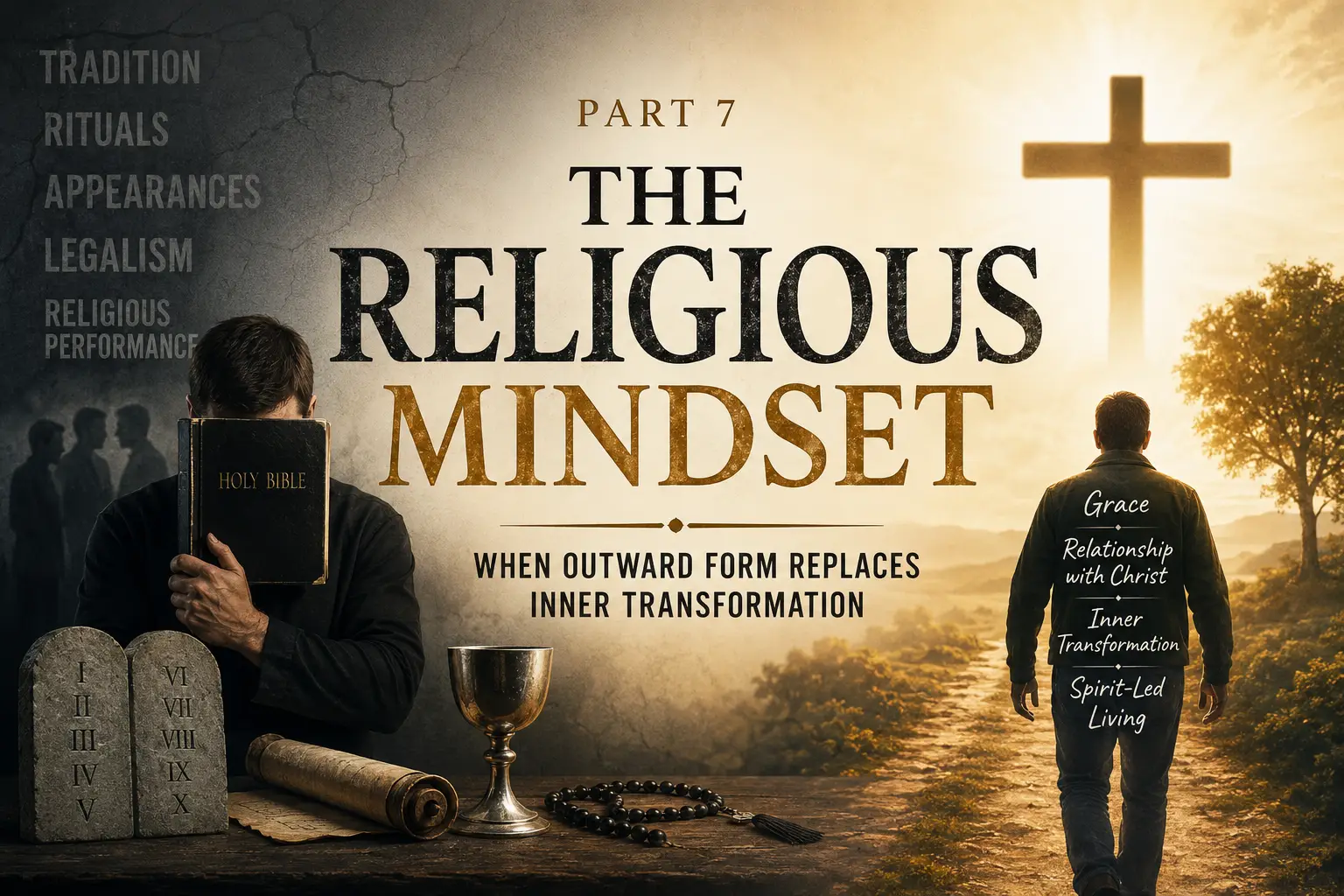
THE RELIGIOUS MINDSET – PART 7 – WHEN OUTWARD FORM REPLACES INNER TRANSFORMATION
INTRODUCTION
One of the most dangerous mindsets in the life of a believer is not always obvious rebellion, open sin, or visible disobedience. Sometimes the most dangerous mindset hides behind religious language, spiritual activity, church attendance, rituals, traditions, and outward appearances.
This is what makes the religious mindset so deceptive.
A person can look spiritual on the outside while remaining unchanged on the inside. They can know the right words, follow the right routines, attend the right meetings, and still resist the transforming work of God in the heart. They may appear disciplined but not surrendered. They may appear holy, but not humble. They may appear faithful to form, but distant from the life of Christ.
Jesus warned strongly against this kind of religion.
Matthew 15:8–9 says:

(8) ‘THESE PEOPLE DRAW NEAR TO ME WITH THEIR MOUTH, AND HONOR ME WITH THEIR LIPS, BUT THEIR HEART IS FAR FROM ME.
(9) AND IN VAIN THEY WORSHIP ME, TEACHING AS DOCTRINES THE COMMANDMENTS OF MEN.’ ”
This Scripture reveals the heart of the religious mindset. It is possible to honour God with words while the heart remains far from Him. It is possible to worship outwardly while inwardly resisting truth. It is possible to elevate human traditions until they begin to replace the commandments and heart of God.
The religious mindset is dangerous because it creates the appearance of spiritual maturity without the substance of inner transformation. It replaces relationship with ritual, obedience with performance, conviction with control, and grace with human effort.
DEFINITION OF THE RELIGIOUS MINDSET
The religious mindset is a mindset that prioritizes rituals, traditions, appearances, and outward forms above genuine relationship with God and inward transformation by the Holy Spirit.
It is not wrong to have spiritual disciplines. It is not wrong to gather with believers, pray, fast, give, serve, worship, or honour godly order. These things can be powerful when they flow from faith, love, humility, and obedience.
The problem begins when the external activity replaces the internal reality.
Religion becomes dangerous when people trust the form more than the Father, the method more than the Messiah, the tradition more than truth, and the appearance more than transformation.
2 Timothy 3:5 speaks of people:
2 Timothy 3:5 NKJV
(5) having a form of godliness but denying its power. And from such people turn away!
This is the religious mindset in one sentence: form without power, structure without life, activity without transformation, and appearance without inward surrender.
THE CORE PROBLEM: FORM WITHOUT LIFE
The religious mindset keeps the shell but loses the substance.
- It keeps the vocabulary but loses the heart.
- It keeps the ceremony but loses the presence.
- It keeps the appearance but loses the transformation.
- It keeps the rules but loses the relationship.
A form is not automatically wrong. Prayer has form. Worship has expression. Communion has practice. Giving has method. Gathering has order. The problem is not form itself. The problem is empty form.
God is not against spiritual discipline. He is against spiritual activity that is disconnected from love, faith, obedience, and a transformed heart.
Isaiah 1:11-17 NKJV
(11) “To what purpose is the multitude of your sacrifices to Me?” Says the LORD. “I have had enough of burnt offerings of rams And the fat of fed cattle. I do not delight in the blood of bulls, Or of lambs or goats.
(12) “When you come to appear before Me, Who has required this from your hand, To trample My courts?
(13) Bring no more futile sacrifices; Incense is an abomination to Me. The New Moons, the Sabbaths, and the calling of assemblies—I cannot endure iniquity and the sacred meeting.
(14) Your New Moons and your appointed feasts My soul hates; They are a trouble to Me, I am weary of bearing them.
(15) When you spread out your hands, I will hide My eyes from you; Even though you make many prayers, I will not hear. Your hands are full of blood.
(16) “Wash yourselves, make yourselves clean; Put away the evil of your doings from before My eyes. Cease to do evil,
(17) Learn to do good; Seek justice, Rebuke the oppressor; Defend the fatherless, Plead for the widow.
Scripture shows that God rejected religious sacrifices when the hearts and lives of the people were corrupt. They were still bringing offerings, observing assemblies, and performing religious acts, yet God called them to repentance, justice, and cleansing.
This shows us that God does not merely ask, “Did you perform the ritual?”
He asks, “Is your heart right before Me?”
Biblical Example 1: The Pharisees
The Pharisees are one of the clearest biblical examples of the religious mindset. They were committed to religious law, public holiness, separation, tradition, and visible righteousness. Yet Jesus gave some of His strongest rebukes to them.
In Matthew 23, Jesus exposed the danger of outward religion without inward life.
Matthew 23:25-28 NKJV
(25) “Woe to you, scribes and Pharisees, hypocrites! For you cleanse the outside of the cup and dish, but inside they are full of extortion and self-indulgence.
(26) Blind Pharisee, first cleanse the inside of the cup and dish, that the outside of them may be clean also.
(27) “Woe to you, scribes and Pharisees, hypocrites! For you are like whitewashed tombs which indeed appear beautiful outwardly, but inside are full of dead men’s bones and all uncleanness.
(28) Even so you also outwardly appear righteous to men, but inside you are full of hypocrisy and lawlessness.
This is a sobering picture. The Pharisees looked clean externally, but their hearts were not surrendered to God. Their religion had become image management.
- They knew Scripture, but many failed to recognise Christ.
- They defended tradition but missed truth.
- They valued visible righteousness, but neglected mercy.
- They honoured the letter but missed the spirit.
- They were careful about outward details, but careless with the condition of the heart.
Matthew 23:23 says they paid attention to smaller religious details but neglected “the weightier matters of the law: justice and mercy and faith.”
Matthew 23:23 NKJV
(23) “Woe to you, scribes and Pharisees, hypocrites! For you pay tithe of mint and anise and cummin, and have neglected the weightier matters of the law: justice and mercy and faith. These you ought to have done, without leaving the others undone.
This is one of the most common signs of the religious mindset. It becomes strict in smaller external matters while neglecting the deeper matters of God’s heart.
A person may be very particular about clothing, religious language, church customs, protocols, titles, and outward practices while lacking humility, mercy, forgiveness, compassion, and love.
That is not Christlikeness. That is religious performance.
Biblical Example 2: Saul Before His Conversion
Before he became Paul the apostle, Saul was a deeply religious man. He was zealous, disciplined, educated, and devoted to the traditions of his fathers.
Philippians 3:4-6 NKJV
(4) though I also might have confidence in the flesh. If anyone else thinks he may have confidence in the flesh, I more so:
(5) circumcised the eighth day, of the stock of Israel, of the tribe of Benjamin, a Hebrew of the Hebrews; concerning the law, a Pharisee;
(6) concerning zeal, persecuting the church; concerning the righteousness which is in the law, blameless.
Philippians 3:4–6 records Paul’s former confidence in religious credentials. He described himself as circumcised according to the law, of the tribe of Benjamin, a Hebrew of the Hebrews, a Pharisee, zealous, and outwardly blameless concerning the law.
From a human religious perspective, Saul had an impressive record. Yet his zeal was not aligned with Christ.
- He was sincere, but sincerely wrong.
- He was disciplined, but not yet transformed.
- He was religious, but not yet submitted to the revelation of Jesus.
Acts 9 shows that Saul was persecuting the church while believing he was defending God’s truth. His religious mindset blinded him to the very move of God in his generation.
This is a serious warning. Religious zeal without revelation can become destructive. A person can defend a system while resisting Christ. A person can protect tradition while opposing transformation. A person can be passionate for religion and still be blind to the Spirit of God.
After Saul encountered Jesus on the road to Damascus, his whole value system changed.
Philippians 3:7-8 NKJV
(7) But what things were gain to me, these I have counted loss for Christ.
(8) Yet indeed I also count all things loss for the excellence of the knowledge of Christ Jesus my Lord, for whom I have suffered the loss of all things, and count them as rubbish, that I may gain Christ
The cure for Saul’s religious mindset was not more performance. It was an encounter with Christ. He moved from religious confidence to Christ-centered surrender.
Biblical Example 3: Cain
Cain is another early biblical example of religion without a right heart.
Genesis 4 tells us that Cain brought an offering to the Lord, but God did not respect Cain and his offering. Abel’s offering was accepted, but Cain became angry instead of repentant.
The issue was not merely that Cain brought something. The deeper issue was the condition of his heart.
Genesis 4:6-7 NKJV
(6) So the LORD said to Cain, “Why are you angry? And why has your countenance fallen?
(7) If you do well, will you not be accepted? And if you do not do well, sin lies at the door. And its desire is for you, but you should rule over it.”
Cain performed a religious act, but when God confronted the heart behind the act, Cain resisted correction. Instead of allowing God to deal with him, he became offended, jealous, and eventually murderous.
Cain shows us that religious activity without humility can become dangerous. When the heart is not surrendered, even worship can become a place of comparison, anger, and offence.
The religious mindset often becomes angry when it is corrected. It does not ask, “Lord, what must change in me?” It asks, “Why was I not recognised?”
Biblical Example 4: Nadab and Abihu
Nadab and Abihu, the sons of Aaron, provide another sobering example. In Leviticus 10, they offered “profane fire” before the Lord, which He had not commanded them.
Leviticus 10:1 NKJV
(1) Then Nadab and Abihu, the sons of Aaron, each took his censer and put fire in it, put incense on it, and offered profane fire before the LORD, which He had not commanded them.
They were involved in priestly activity, but their worship was not according to God’s instruction. They approached holy things casually and presumptuously.
This teaches us that not every religious expression is acceptable simply because it uses spiritual language or religious symbols. Worship must be governed by reverence, obedience, and the fear of the Lord.
The religious mindset can become careless with holy things. It may assume that because something looks spiritual, sounds spiritual, or feels spiritual, it must be acceptable to God. But God desires worship that is both sincere and obedient.
John 4:23–24 reminds us that the Father seeks those who worship Him “in spirit and truth.”
John 4:23-24 NKJV
(23) But the hour is coming, and now is, when the true worshipers will worship the Father in spirit and truth; for the Father is seeking such to worship Him.
(24) God is Spirit, and those who worship Him must worship in spirit and truth.”
- Not spirit without truth.
- Not truth without spirit.
- But spirit and truth together.
Biblical Example 5: The Elder Brother
The elder brother in Luke 15 also reveals the religious mindset.
In the parable of the prodigal son, the younger son was openly rebellious, but the elder brother was inwardly resentful. He remained in the father’s house, but he did not share the father’s heart.
He served, but without joy. He obeyed, but without intimacy. He stayed near the father, but lived like a servant instead of a son.
When the father showed mercy to the younger son, the elder brother became angry. He could not celebrate restoration because he was measuring relationship through performance.
Luke 15:29 records his complaint:
Luke 15:29 NKJV
(29) So he answered and said to his father, ‘Lo, these many years I have been serving you; I never transgressed your commandment at any time; and yet you never gave me a young goat, that I might make merry with my friends.
This is the language of the religious mindset. It says, “I served. I obeyed. I performed. Therefore, I deserve.”
The elder brother did not understand the father’s heart because his identity was rooted in service rather than sonship.
The religious mindset struggles with grace because grace feels unfair to those who trust in performance. It struggles to rejoice when mercy is shown to others because it believes reward should be based on religious record.
The father’s response is powerful. He reminded the elder brother that he had always been with him and that all he had was available to him.
The cure was not merely better behaviour. The cure was a restored understanding of sonship.
Biblical Example 6: Martha
Martha, in Luke 10:38–42, shows another expression of religious pressure. She was serving, but she became distracted, anxious, and troubled.
Luke 10:38-42 NKJV
(38) Now it happened as they went that He entered a certain village; and a certain woman named Martha welcomed Him into her house.
(39) And she had a sister called Mary, who also sat at Jesus’ feet and heard His word.
(40) But Martha was distracted with much serving, and she approached Him and said, “Lord, do You not care that my sister has left me to serve alone? Therefore tell her to help me.”
(41) And Jesus answered and said to her, “Martha, Martha, you are worried and troubled about many things.
(42) But one thing is needed, and Mary has chosen that good part, which will not be taken away from her.”
Mary sat at Jesus’ feet and heard His word. Martha was busy serving, but her service became burdened with frustration.
Jesus said to Martha:
“Martha, Martha, you are worried and troubled about many things. But one thing is needed.”
This does not mean serving is wrong. Serving is good and necessary. But service becomes unhealthy when activity replaces intimacy.
Martha represents the danger of religious busyness. A person can be active for the Lord while neglecting the Lord Himself.
The religious mindset often measures spirituality by busyness. It assumes that more activity means more maturity. But Jesus showed that sitting at His feet is essential.
Before we work for Him, we must be with Him.
Biblical Example 7: The Church at Laodicea
The church at Laodicea in Revelation 3 is another powerful picture. They thought they were rich, increased with goods, and in need of nothing. Yet Jesus said they were spiritually poor, blind, and naked.
Revelation 3:17 NKJV
(17) Because you say, ‘I am rich, have become wealthy, and have need of nothing’—and do not know that you are wretched, miserable, poor, blind, and naked—
This church had an inflated view of itself. Outwardly, it appeared successful. Inwardly, it was spiritually lukewarm.
This is one of the dangers of the religious mindset: it can create a false sense of spiritual security.
People may assume they are healthy because they are active, visible, respected, gifted, or established. Yet Christ may be standing outside, calling them back to true fellowship.
Revelation 3:20 NKJV
(20) Behold, I stand at the door and knock. If anyone hears My voice and opens the door, I will come in to him and dine with him, and he with Me.
This verse was spoken to a church. That means it is possible to have church activity while Christ is not truly central.
The cure for Laodicea was repentance, humility, and restored fellowship with Jesus.
CHARACTERISTICS OF THE RELIGIOUS MINDSET
-
Traditionalism
Traditionalism is when human tradition is elevated to the level of divine command.
Tradition is not always wrong. Some traditions preserve wisdom, honour, order, and continuity. The danger begins when tradition becomes more authoritative than Scripture.
Jesus confronted this in Mark 7:8:
Mark 7:8 NKJV
(8) For laying aside the commandment of God, you hold the tradition of men—the washing of pitchers and cups, and many other such things you do.”
This is a strong warning. The religious mindset can lay aside God’s commandment while defending human tradition.
Traditionalism says:
- “This is how we have always done it.”
- “Our way is the only right way.”
- “Anything unfamiliar must be wrong.”
- “Change is rebellion.”
But true faith honours what is biblical, not merely what is familiar.
Legalism is the attempt to gain acceptance, righteousness, or spiritual status through human effort, rule-keeping, or religious performance.
Legalism does not simply value obedience. Biblical obedience is good. The problem is when obedience becomes a basis for boasting or a means of earning righteousness.
Ephesians 2:8-9 NKJV
(8) For by grace you have been saved through faith, and that not of yourselves; it is the gift of God,
(9) not of works, lest anyone should boast.
Grace removes boasting. Legalism feeds boasting.
Legalism creates pressure, fear, comparison, and pride. It causes some people to feel superior because they believe they are succeeding, while others feel condemned because they know they are failing.
Colossians 2:20–23 also warns against man-made regulations that appear wise but lack true power to transform the flesh.
Colossians 2:20-23 NKJV
(20) Therefore, if you died with Christ from the basic principles of the world, why, as though living in the world, do you subject yourselves to regulations—
(21) “Do not touch, do not taste, do not handle,”
(22) which all concern things which perish with the using—according to the commandments and doctrines of men?
(23) These things indeed have an appearance of wisdom in self-imposed religion, false humility, and neglect of the body, but are of no value against the indulgence of the flesh.
Legalism may control behaviour for a time, but it cannot renew the heart. Only Christ can do that.
The religious mindset is often inflexible. It struggles to discern the difference between eternal truth and changeable methods.
God’s truth does not change. His Word remains. His nature remains. But methods, structures, seasons, and assignments may change.
Jesus addressed this principle through the picture of wineskins.
Mark 2:22 NKJV
(22) And no one puts new wine into old wineskins; or else the new wine bursts the wineskins, the wine is spilled, and the wineskins are ruined. But new wine must be put into new wineskins.”
The new wine does not represent a change in God’s truth. It represents the fresh work of God that requires renewed capacity.
The religious mindset says, “God must move the way He moved before.”
A renewed mind says, “Lord, help me remain faithful to Your truth while discerning Your present leading.”
-
External Holiness
External holiness is when holiness is reduced to visible appearance, public conduct, and outward separation while the inner life remains neglected.
Biblical holiness is not merely external. It is a life set apart for God from the inside out.
1 Samuel 16:7 NKJV
(7) But the LORD said to Samuel, “Do not look at his appearance or at his physical stature, because I have refused him. For the LORD does not see as man sees; for man looks at the outward appearance, but the LORD looks at the heart.”
This does not mean outward conduct is unimportant. True inward transformation will affect outward behaviour. But outward appearance alone is not proof of inward transformation.
A person can dress modestly and still be proud.
A person can attend church faithfully and still be unteachable.
A person can pray publicly and still lack private intimacy with God.
A person can know doctrine and still lack love.
True holiness is not performance before people. It is surrender before God.
The religious mindset often uses fear to control people.
Instead of leading people into loving obedience, it pressures them through shame, intimidation, rejection, and spiritual manipulation.
Fear-based control says:
- “Do not ask questions.”
- “Do not grow beyond our system.”
- “Do not challenge tradition.”
- “Your acceptance depends on your compliance.”
But this is not the leadership of Christ.
2 Corinthians 3:17 NKJV
(17) Now the Lord is the Spirit; and where the Spirit of the Lord is, there is liberty.
The liberty of the Spirit is not lawlessness. It is freedom from bondage, fear, manipulation, and dead religion so that believers may obey God from the heart.
Healthy spiritual authority does not keep people immature and afraid. It equips them to grow in Christ.
MODERN EXPRESSIONS OF THE RELIGIOUS MINDSET
-
Dress-Code Righteousness
Dress-code righteousness happens when people measure holiness mainly by outward appearance.
Modesty, honour, and appropriate presentation matter. However, clothing must never become the primary measurement of righteousness.
God looks deeper than fabric, style, and outward presentation. He looks at the heart.
Matthew 23 shows that external cleanliness can hide inward corruption. Therefore, outward appearance must never replace inward transformation.
-
Ritual Dependence
Ritual dependence is when people trust the act itself more than the God to whom the act should point.
Prayer, fasting, communion, giving, baptism, worship, and laying on of hands are biblical and meaningful. But when they are practised mechanically, superstitiously, or without faith and repentance, they become empty rituals.
Isaiah 1 reveals that God rejected religious gatherings when the people refused justice, repentance, and cleansing.
The religious mindset asks, “Did I complete the ritual?”
The renewed mind asks, “Did this draw me into deeper surrender, obedience, and relationship with God?”
-
Formula Christianity
Formula Christianity reduces faith to steps, techniques, declarations, and methods.
It says:
- “Say these words and God must respond.”
- “Follow this method and breakthrough is guaranteed.”
- “Use this formula and the result is automatic.”
But God is not a machine. Prayer is not manipulation. Faith is not magic. Obedience is not a transaction to control heaven.
Romans 11:33 reminds us of the depth of God’s wisdom and ways. We follow principles, but we trust the Person of God.
Romans 11:33 NKJV
(33) Oh, the depth of the riches both of the wisdom and knowledge of God! How unsearchable are His judgments and His ways past finding out!
True faith is not built on formulas. It is built on trust in the character of God.
-
Performance Spirituality
Performance spirituality is when people measure spiritual worth by visible activity, religious achievement, public ministry, or human approval.
Jesus warned about doing righteous acts to be seen by people.
Matthew 6:1 NKJV
(1) “Take heed that you do not do your charitable deeds before men, to be seen by them. Otherwise you have no reward from your Father in heaven.
Performance spirituality produces exhaustion because the person is always trying to prove something.
But in Christ, we do not serve to become loved. We serve because we are loved.
We do not obey to earn belonging. We obey because we belong.
We do not perform for acceptance. We live from acceptance in Christ.
HOW THE RELIGIOUS MINDSET CAUSES SELF-SABOTAGE
The religious mindset sabotages spiritual growth in several ways.
First, it blinds people to their true condition. Because they are outwardly active, they may assume they are inwardly healthy.
Second, it creates pride. People begin to compare themselves with others and feel superior because of their practices, discipline, knowledge, or traditions.
Third, it resists correction. Religious people often defend their image instead of receiving truth.
Fourth, it produces fear instead of love. When people serve God mainly from fear, they struggle to experience joy, intimacy, and confidence in the Father.
Fifth, it blocks grace. The religious mindset struggles to receive grace because grace removes boasting.
Sixth, it becomes harsh toward others. A person who lives under performance often places the same burden on others.
Seventh, it can oppose genuine moves of God. Because the religious mindset protects form, it may reject anything that challenges its system.
THE REDEMPTIVE CURE
The religious mindset is not healed by becoming careless, rebellious, or anti-church. The answer to dead religion is not lawlessness. The answer is life in Christ.
The cure is not to abandon holiness, discipline, order, doctrine, or spiritual practices. The cure is to return these things to their proper foundation: grace, relationship, inward transformation, and Spirit-led living.
Grace is the beginning of freedom from the religious mindset.
Titus 2:11–12 says that the grace of God brings salvation and teaches us to deny ungodliness and live soberly, righteously, and godly.
Titus 2:11-12 NKJV
(11) For the grace of God that brings salvation has appeared to all men,
(12) teaching us that, denying ungodliness and worldly lusts, we should live soberly, righteously, and godly in the present age,
Grace does not produce spiritual laziness. True grace trains us in godliness. But grace changes the foundation of obedience.
The religious mindset says, “I must prove myself.”
Grace says, “Christ is enough, and now I respond to Him with love and obedience.”
-
Relationship with Christ
The religious mindset is healed through a living relationship with Jesus Christ.
Christianity is not merely a belief system, moral code, church culture, or set of rituals. It is union with Christ.
John 15:5 NKJV
(5) “I am the vine, you are the branches. He who abides in Me, and I in him, bears much fruit; for without Me you can do nothing.
Fruit comes from abiding, not performing.
The religious mindset works hard to produce fruit without abiding in Christ. But true fruit comes from living connection with Him.
The cure is to return to Jesus Himself.
- Not merely to ministry.
- Not merely to meetings.
- Not merely to systems.
- Not merely to traditions.
But To Christ.
-
Inner Transformation
Romans 12:2 NKJV
(2) And do not be conformed to this world, but be transformed by the renewing of your mind, that you may prove what is that good and acceptable and perfect will of God.
The religious mindset tries to change the outside first and hopes the inside will follow. The gospel transforms the heart, renews the mind, and then produces outward fruit.
Inner transformation includes repentance from pride, healing from fear, deliverance from performance, renewal of motives, restoration of love, growth in humility, obedience from the heart, and conformity to Christ.
The question is not only, “What do I do?”
The deeper question is, “Who am I becoming?”
A religious person is satisfied with correct appearance. A transformed disciple desires Christlike character.
-
Spirit-Led Living
The religious mindset is often rule-led, fear-led, tradition-led, and appearance-led. The cure is Spirit-led living.

Galatians 5:16 NKJV
(16) I say then: Walk in the Spirit, and you shall not fulfill the lust of the flesh.
Spirit-led living does not mean rejecting Scripture, order, wisdom, or accountability. The Holy Spirit never leads contrary to the Word of God. Rather, Spirit-led living means walking in fellowship with God, responding to His conviction, following His direction, and bearing His fruit.
Galatians 5:22–23 describes the fruit of the Spirit as love, joy, peace, longsuffering, kindness, goodness, faithfulness, gentleness, and self-control.
Galatians 5:22-23 NKJV
(22) But the fruit of the Spirit is love, joy, peace, longsuffering, kindness, goodness, faithfulness,
(23) gentleness, self-control. Against such there is no law.
A religious mindset may produce outward conformity, but only the Spirit produces true fruit.
PRACTICAL SIGNS THAT YOU ARE BEING FREED FROM THE RELIGIOUS MINDSET
You are being freed from the religious mindset when your obedience flows more from love than fear.
You are being freed when you care more about pleasing God than impressing people.
You are being freed when you can receive correction without defending your image.
You are being freed when you stop measuring others by your personal traditions.
You are being freed when your spiritual disciplines lead you into deeper humility and intimacy.
You are being freed when you value mercy, justice, faith, and love as much as visible order.
You are being freed when your identity rests in Christ and not in your performance.
You are being freed when you can honour tradition without becoming enslaved to it.
You are being freed when you can discern the difference between biblical conviction and cultural preference.
You are being freed when the fruit of the Spirit becomes more visible than the form of religion.
REFLECTION QUESTIONS
- Have I allowed outward religious activity to replace personal relationship with Christ?
- Do I measure my spirituality more by appearance, tradition, and performance than by love, humility, obedience, and transformation?
- Do I judge others by biblical truth or by personal preferences and inherited customs?
- Am I more concerned with looking right before people than being right before God?
- Do my spiritual disciplines draw me closer to Christ, or have they become empty routines?
- Have I used fear, shame, or control in the name of spirituality?
- Am I willing to let the Holy Spirit renew my mind, purify my motives, and transform my heart?
CONCLUSION
The religious mindset is one of the most subtle forms of self-sabotage because it can look spiritual while resisting true transformation. It preserves outward form while neglecting inward life. It values tradition above truth, appearance above authenticity, performance above grace, and control above relationship.
Jesus did not come to produce religious actors. He came to raise sons and daughters who worship the Father in spirit and truth.
The cure for the religious mindset is not the rejection of spiritual discipline, but the restoration of spiritual life. Grace must replace striving. Relationship with Christ must replace empty ritual. Inner transformation must replace outward performance. Spirit-led living must replace fear-based control.
When Christ becomes the centre again, religion loses its grip.
The believer no longer lives to impress people, protect an image, or perform for acceptance. The believer lives from the life of Christ within, being transformed daily into His image.
This is true freedom: not merely looking spiritual but becoming Christlike.
OTHER PUBLICATIONS BY THIS AUTHOR CAN BE FOUND AT: