There are lessons God teaches us from Scripture, lessons He teaches us through people, and sometimes lessons come through the ordinary relationships and experiences of life.
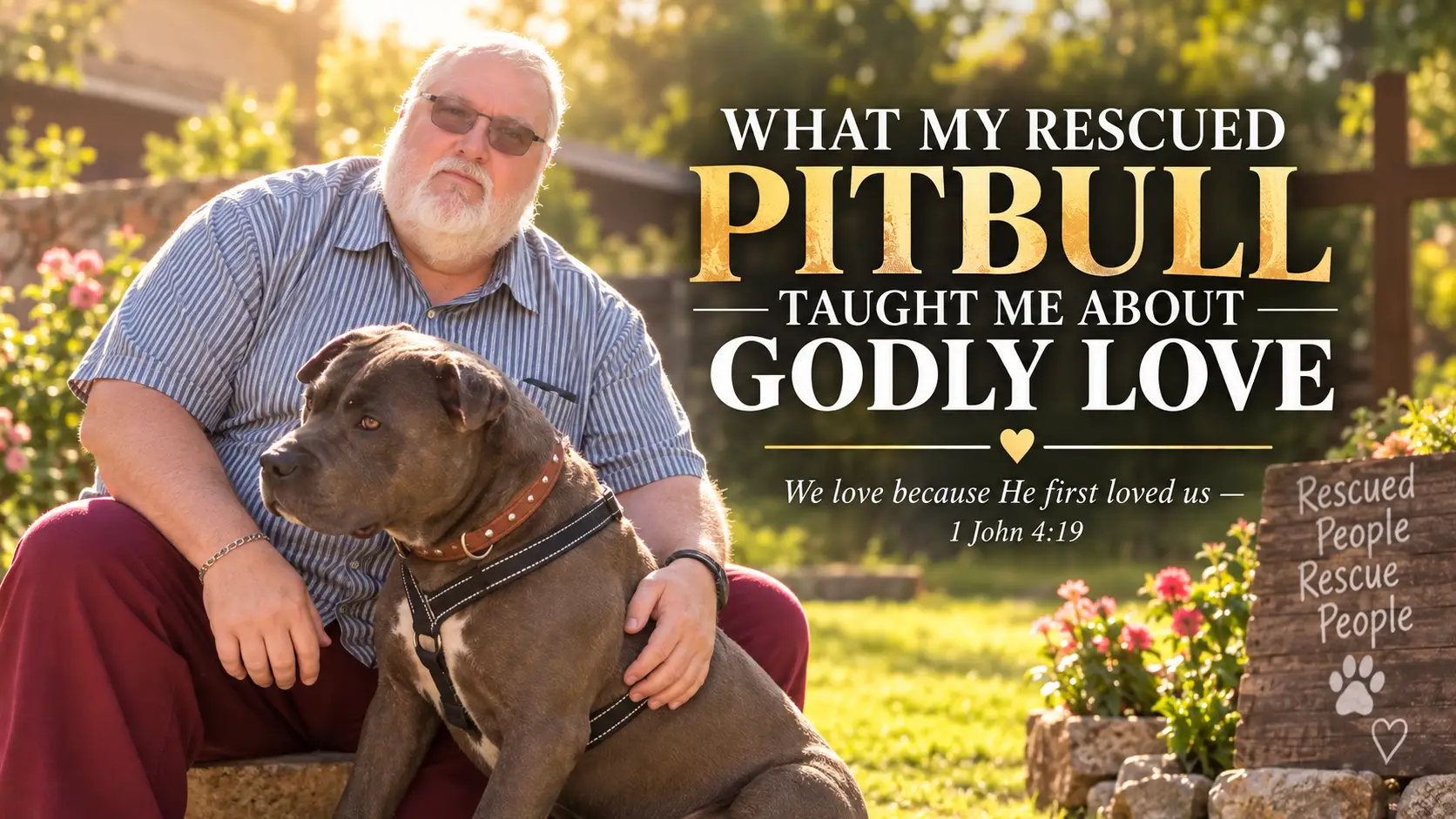
One of those lessons came to me through a pitbull called Pablo I rescued.
PABLO’S BACKGROUND
He had been abandoned. From what I understood of his past, he had also been used in dog fighting. When he came to me, he was not the confident, strong animal people normally associate with the pitbull breed.
He was fearful.
His confidence had been broken.

He did not know whether people could be trusted.
Something had happened to him that had taught him that life was dangerous and that those around him might hurt rather than protect him.
PABLOS HEALING JOURNEY
But something remarkable happened over time.
He discovered that my hands were not going to hurt him.
He discovered that my voice did not mean danger.
He discovered that there would be food.
There would be shelter.
There would be protection.
There would be affection.
There would be companionship.
Most importantly, he discovered that he was loved.
And slowly the fearful dog began to change.
His confidence returned.
His personality emerged.
Eventually, something beautiful happened: he seemed almost to return to his “puppy brain.” The playfulness, innocence and joy that fear had suppressed began appearing again.
Love created an environment in which what had been damaged could begin to live again.
LOVE DEMONSTRATED
Today he follows me almost everywhere I go.
When I move, he moves.
When I sit down, he wants to be nearby.
When I leave to go fishing, he noticeably misses my presence.
I rescued him—but somewhere along the journey he also began teaching me.
LOVE CAN RESTORE WHAT FEAR HAS DAMAGED.
Fear had shaped much of this dog’s behaviour.
Love gradually reshaped it.
That makes me think about the way God works with people.
Many people come into the Kingdom carrying wounds that other people cannot see.
Some have experienced rejection.
Some have experienced abandonment.
Some have experienced betrayal.
Some have even been wounded by those who claimed to represent God.
They may love God and still struggle to trust.
They may hear the word “Father” but have no healthy understanding of fatherhood.
They may enter relationships expecting eventually to be rejected because rejection is what their history has taught them.
But Scripture tells us:
1 John 4:18 BSB
“There is no fear in love, but perfect love drives out fear, because fear involves punishment. The one who fears has not been perfected in love.”
Love creates an environment in which fear begins losing its authority.
My pitbull did not overcome his fear because I explained fear to him.
He overcame much of his fear because, day after day, his experience began telling him:
You are safe here.
You belong here.
You are loved here.
Perhaps there is a lesson for the Church in that.
Not every wounded person needs another sermon first.
Sometimes they need an environment where the truth we preach becomes something they can actually experience.
LOVE SAYS, “YOU BELONG”
When I rescued this dog, I did not merely give him food.
I gave him a place.
He became part of the household.
There is a significant difference between receiving assistance and receiving belonging.
God does not merely rescue us from something.
He brings us into something.
Romans 8:15 BSB
“For you did not receive a spirit of slavery that returns you to fear, but you received the Spirit of sonship, by whom we cry, ‘Abba! Father!’”
The Gospel is not merely the story of sinners escaping judgment.
It is the story of sons being brought home.
God takes people whose lives have been shaped by fear, bondage and rejection and says:
You belong to Me.
That sense of belonging begins changing the way we live.
LOVE PRODUCES TRUST
My dog did not trust me completely on the first day.
Trust developed through consistency.
Every day that I fed him reinforced something.
Every time I protected him reinforced something.
Every time I approached without hurting him reinforced something.
Every time I returned after leaving reinforced something.
Eventually, accumulated experiences of faithfulness created trust.
There is a profound spiritual principle here.
God repeatedly reveals Himself in Scripture as faithful.
Lamentations 3:22–23 BSB
“Because of the loving devotion of the LORD we are not consumed, for His mercies never fail. They are new every morning; great is Your faithfulness!”
Our trust in God deepens as we discover His faithfulness.
There are times when we do not understand what God is doing.
There are times when circumstances are difficult.
But maturity develops when we have walked with Him long enough to say:
I may not understand everything, but I know the character of the One I am following.
LOVE DESIRES PRESENCE
Perhaps one of the things that touches me most about my dog is that he simply wants to be where I am.
He does not always want something from me.
Sometimes he simply wants me.
If I move to another part of the house, he follows.
If I sit somewhere, he settles close by.
His affection expresses itself through presence.
That challenges me spiritually.
How much of our relationship with God revolves around what we want God to give us?
We ask for provision.
We ask for healing.
We ask for protection.
We ask for breakthroughs.
We ask for answers.
There is nothing wrong with bringing our needs before our Father.
But there must eventually develop something deeper:
Lord, even if I need nothing from Your hand today, I still desire Your presence.
David understood this.
Psalm 27:4 BSB
“One thing I have asked of the LORD; this is what I desire: to dwell in the house of the LORD all the days of my life, to gaze on the beauty of the LORD and seek Him in His temple.”
Mature love does not merely seek what God can give.
Mature love seeks God Himself.
LOVE FOLLOWS
My pitbull follows me.
That simple behaviour reminds me of one of the most repeated invitations of Jesus:
“Follow Me.”
Matthew 4:19 BSB
“Come, follow Me,” Jesus said, “and I will make you fishers of men.”
Christianity is ultimately not merely believing certain doctrines.
It is following a Person.
Jesus did not simply say:
“Study Me.”
“Discuss Me.”
“Sing about Me.”
“Build organisations around Me.”
He said:
Follow Me.
Where He goes, we go.
What He loves, we learn to love.
What He values, we learn to value.
What He rejects, we learn to leave behind.
There is something beautifully uncomplicated about a dog following the one he loves.
Perhaps discipleship sometimes becomes complicated because we have forgotten how simple its foundation is.
Stay close to Jesus and follow where He leads.
RESTORED LOVE BECOMES CHILDLIKE AGAIN
One of the most remarkable changes in my dog has been watching that frightened animal become playful again.
Somewhere underneath the fear was still the puppy.
It had simply been buried beneath trauma.
When safety returned, play returned.
When trust returned, curiosity returned.
When love became established, joy returned.
That speaks deeply to me.
There are people whose joy has not died.
It has simply become buried beneath disappointment.
Their tenderness has not disappeared.
It has been protected behind walls.
Their ability to trust has not necessarily been destroyed.
It may simply be waiting for an environment safe enough to emerge again.
Jesus said:
Matthew 18:3 BSB
“Truly I tell you, unless you change and become like little children, you will never enter the kingdom of heaven.”
There is something Kingdom-like about restored simplicity.
The longer we walk with God, the goal should not be to become harder, more cynical and more suspicious.
We should become wiser—but still tender.
Discerning—but still loving.
Mature—but still capable of wonder.
Strong—but still capable of joy.
LOVE REMEMBERS WHO RESCUED IT
I sometimes wonder what goes through my dog’s mind when he looks at me.
He cannot tell me.
But his behaviour communicates something.
He stays close to the person who took him out of the environment in which he had been suffering.
That raises a question for every believer:
Have we forgotten where God found us?
The longer people are saved, the easier it sometimes becomes to forget what they were rescued from.
Grace becomes familiar.
Salvation becomes theological vocabulary.
Mercy becomes something we preach rather than something that overwhelms us.
But Paul never forgot.
1 Corinthians 15:10 BSB
“But by the grace of God I am what I am, and His grace to me was not in vain.”
We should never become so accustomed to salvation that we stop being amazed that God rescued us.
THOSE WHO HAVE BEEN LOVED SHOULD LEARN TO LOVE
There is another lesson here.
The love my dog now gives is, in many ways, a response to the love he received.
Scripture says something infinitely greater about us:
1 John 4:19 BSB
“We love because He first loved us.”
This is one of the foundational principles of Kingdom relationships.
God loved us first.
God pursued us first.
God showed mercy first.
God extended grace first.
God initiated reconciliation.
And because we have received that love, we are called to become carriers of it.
The Church should therefore become one of the safest environments in which wounded people can rediscover trust.
Not an environment without truth.
Not an environment without correction.
Not an environment without accountability.
But an environment where truth is administered through love.
Ephesians 5:1–2 BSB
“Be imitators of God, therefore, as beloved children, and walk in love, just as Christ loved us and gave Himself up for us as a fragrant sacrificial offering to God.”
PERHAPS THIS IS WHAT DISCIPLESHIP SHOULD LOOK LIKE
My pitbull’s restoration did not happen in one dramatic moment.
It happened through relationship.
Day after day.
Meal after meal.
Touch after touch.
Walk after walk.
Moment after moment.
Trust accumulated.
Fear diminished.
Identity changed.
Confidence returned.
Joy emerged.
Perhaps we sometimes expect discipleship to happen too quickly.
We want transformation without relationship.
We want maturity without process.
We want people to trust before we have demonstrated that we are trustworthy.
But Jesus discipled people through life together.
They walked with Him.
They ate with Him.
They watched Him.
They asked questions.
They made mistakes.
They were corrected.
They were restored.
And eventually they became carriers of the very life they had encountered.
A DOG CANNOT EXPLAIN LOVE—BUT HE CAN DEMONSTRATE SOMETHING ABOUT IT
My pitbull cannot preach a sermon about love.
He cannot explain covenant.
He cannot teach Greek words for love.
He cannot discuss discipleship.
Yet every time he follows me from room to room, I am reminded of something.
Love stays close.
Love trusts.
Love remembers.
Love responds to faithfulness.
Love desires presence.
Love creates belonging.
And genuine love can help restore what fear has damaged.
Perhaps the greatest lesson he has taught me is this:
Those who know they have been rescued love their rescuer differently.
May we never forget that we too were rescued.
May we never become casual about grace.
May we never become so busy working for God that we stop simply wanting to be with Him.
And may the people who encounter us discover something of the same environment that caused a frightened, broken dog to become playful again:
You are safe enough to heal.
You are valued enough to belong.
You are loved enough to become who you were meant to be.
Because ultimately, this is the testimony of every believer:
We love because He first loved us.
— Herman Bouwer
Reflection Questions
- Do I desire God’s presence, or mostly what God can provide for me?
- Have I forgotten what God rescued me from?
- Does my presence help fearful and wounded people feel safe enough to heal?
- Am I demonstrating consistent love that enables people to trust again?
- Am I still following Jesus closely, or have I become occupied with things around Him?
- Has disappointment caused me to lose the childlike joy God wants to restore?
- Can people encounter the love of Christ through the way I treat them?
Closing Scripture
1 John 4:19 BSB
“We love because He first loved us.”