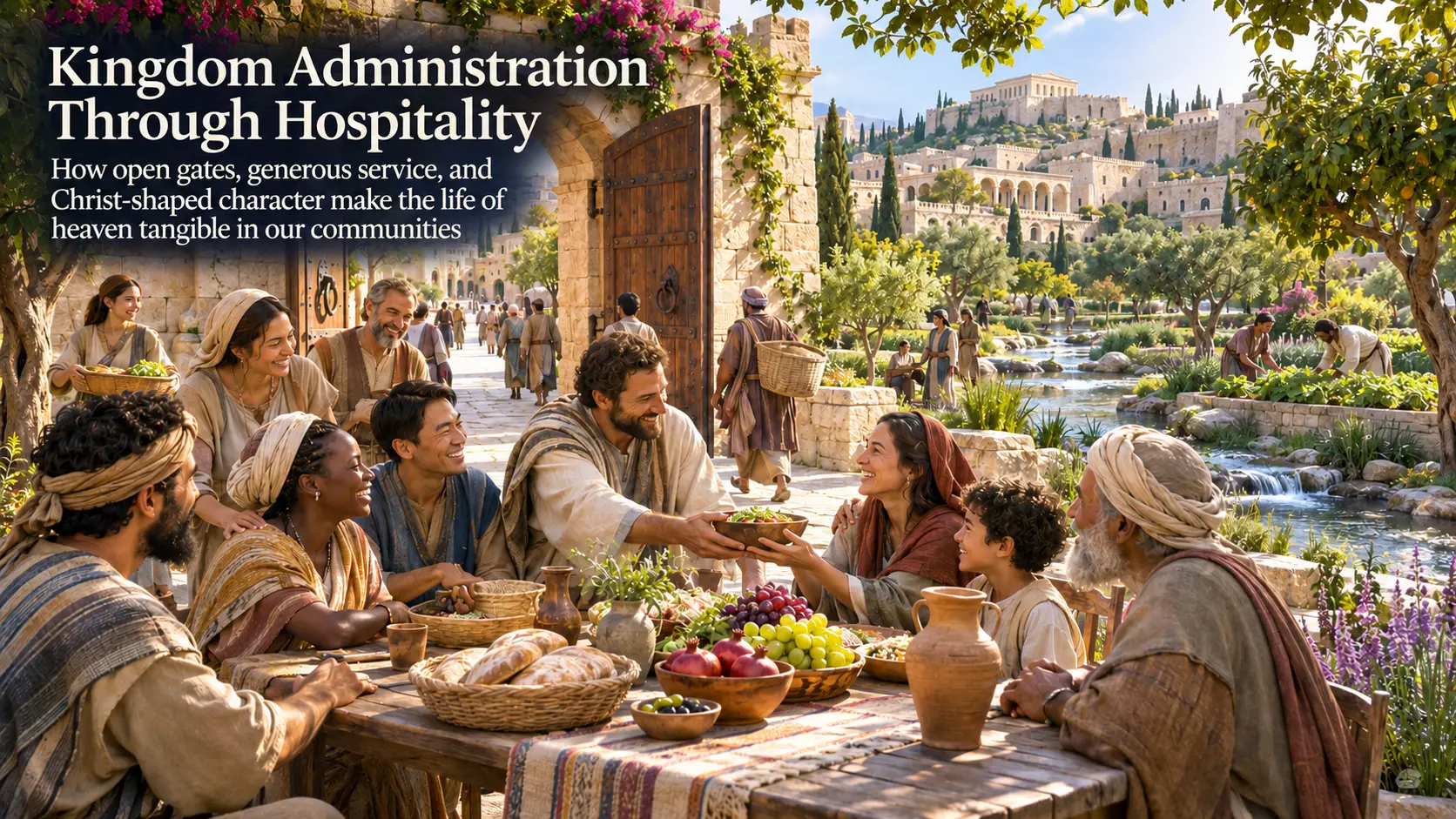
A city that welcomes
Hospitality is often reduced to entertaining guests or offering a meal. Scripture gives us a larger picture. Hospitality is the way a household, church, or community makes room for others to encounter the goodness, wisdom, and care of God. It is a practical expression of kingdom administration: the way we receive people, share what has been entrusted to us, and shape an environment where life can grow.
Revelation ends with a city coming down from God, a picture of heaven’s order taking visible form among people. Revelation 21 describes gates that remain open and nations bringing their glory into the city; Revelation 22 shows the river of life and the tree whose fruit and leaves serve the healing of the nations. Read through the lens of hospitality, these images describe a community marked by access, provision, healing, and welcome. The question is not simply whether our doors are open, but what people meet when they come through them.
The living water begins with Christ
Every healthy city needs a source of life. The biblical vision begins with God and the Lamb at the throne, from which the river of life flows (Revelation 22:1). The river is clear and life-giving because its source is God. Jesus also speaks of the living water he gives, which becomes in the believer a spring welling up to eternal life (John 4:10–14). Ezekiel’s vision of water flowing from the temple and bringing life wherever it goes offers a related picture (Ezekiel 47:1–12).
For kingdom hospitality, this matters: what we offer must flow from Christ. A welcome shaped by the Word, the Spirit, and the character of Jesus can refresh people; hospitality built only on performance or a desire to impress quickly becomes tiring. We receive from Christ first, then carry his life into our homes, congregations, workplaces, and neighborhoods. The invitation is to become people through whom truth, encouragement, practical help, and wise counsel can reach places that feel dry or overlooked.
From a garden to a city of fruitfulness
In Revelation 22:2, the tree of life stands beside the river and bears fruit, while its leaves are for the healing of the nations. The vision joins spiritual nourishment with the flourishing of a whole community. The city is not a private garden enjoyed by a few; its life is made available for the good of many.
This image also calls us to sustained fruitfulness. The tree bears fruit in every season, suggesting a life that keeps giving according to its source. In practical terms, fruitfulness may look like dependable care, patient teaching, honest work, generous sharing, and the use of our abilities to strengthen others. The passage does not invite us to measure people by productivity or to discard those who are struggling. It invites each of us to remain rooted in Christ and to cultivate the conditions in which others can flourish.
Ecclesiastes 10:15 observes that a person can become so weary in foolish labor that they do not know the way to the city. The image can prompt a spiritual question: are we learning how to build life together, or are we isolated and unable to find our way into community? Cities are formed by relationships and households. A welcoming community helps people find belonging, direction, and a place to contribute.
Open gates and wise stewardship
Revelation 21:25 says the city’s gates are not shut by day, and there is no night there. The open gates portray security and welcome: the city is not ruled by panic, possessiveness, or fear that there will not be enough. Its openness creates access for people to encounter the life of the kingdom.
Hospitality is therefore a form of stewardship. A host is entrusted with space, time, food, attention, knowledge, and influence. The question becomes: how can these resources serve people well? Openhearted welcome does not mean abandoning wisdom, safety, or appropriate boundaries. It means refusing needless barriers and treating each person with dignity, while caring responsibly for everyone in the household and community.
Abraham’s welcome of three visitors in Genesis 18 shows a household making room for strangers and receiving an unexpected encounter. Lydia’s open home in Acts 16:14–15, 40 helped provide a base for fellowship and ministry in Philippi. These examples show hospitality as more than a warm feeling: it turns a place into a setting where relationship, service, and the work of God can take root.
Kingship expressed through contribution
Revelation 21:24 pictures the kings of the earth bringing their glory and honor into the city. In this vision, authority is expressed through contribution. A kingdom-minded person asks what they can bring that will strengthen the common good, rather than what they can extract for themselves.
Solomon’s encounter with the Queen of Sheba in 1 Kings 10:1–13 illustrates how wisdom, ordered service, and the life of a household can leave a deep impression. Hospitality includes a meal or a place to stay, but it can also include thoughtful conversation, practical guidance, the sharing of skills, and the opportunity to learn. The early believers’ generosity in Acts 4:32–35 offers another picture of resources being stewarded so that people’s needs were met.
This kind of hospitality welcomes the gifts of others too. Revelation’s nations bring their distinct glory into the city; no single culture carries the whole picture. When we make room for different backgrounds, languages, abilities, and experiences, we create opportunities for mutual learning and shared service. The host does not need to control every contribution. A healthy host helps people offer what they carry for the benefit of the whole community.
A community that reflects Christ
Revelation 22:4 says God’s servants see his face and bear his name. The name points to belonging and identity: the people of the city reflect the One they serve. Paul’s language of Christ living in believers (Colossians 1:27) and the call to imitate Christ’s love (Ephesians 5:1–2) help describe this formation. Hospitality becomes credible when the welcome we offer is consistent with the character of Jesus.
That likeness includes wisdom, moral integrity, compassion, courage, and service. Wisdom helps us discern what a guest needs and how to respond responsibly. Integrity makes our welcome trustworthy. Compassion notices people who might otherwise be overlooked. Courage helps us make room across social and cultural divisions. Authority, in the pattern of Jesus, is exercised to serve and protect rather than to dominate.
The city’s light also reaches across generations. Revelation 22:5 speaks of a life illuminated by God, while Isaiah 60:14–15 describes a people becoming an enduring joy across generations. Hospitality passes light on when elders share wisdom, younger people are given meaningful responsibility, and families and communities make space for one another to learn. A welcoming community is not built in one event; it is formed through habits that can be carried forward.
Becoming a place where heaven is visible
Kingdom administration through hospitality begins with Christ, flows outward in service, and makes room for others to bring what they carry. It is visible in the open table, the prepared guest room, the careful listener, the shared skill, the fair decision, and the community that notices a need and responds. These acts do not replace the spiritual life of the church; they give its love a form people can experience.
A useful measure for our homes, churches, and teams is this: when someone enters, do they encounter the character of Christ? Do they find dignity, truth, generosity, wise care, and a way to participate? Revelation’s city gives us a horizon to work toward: a community with life at its source, provision to share, gates that welcome, and a culture that brings healing to the nations.
We are called to become such a people in the places where God has set us. As we receive others well and steward what we have for the good of the community, the government of God becomes tangible. Hospitality is not an accessory to kingdom administration. It is one of the ways the city of God is made visible on earth.
For reflection
- What do people experience when they enter the spaces and communities entrusted to you?
- What resource, skill, or form of care could you make more available for the good of others?
- Where could your community remove an unnecessary barrier while still stewarding safety and trust wisely?
Scripture note: References are given according to the Berean Standard Bible (BSB). The article paraphrases Scripture and does not reproduce extended verse quotations.
By Herman Bouwer