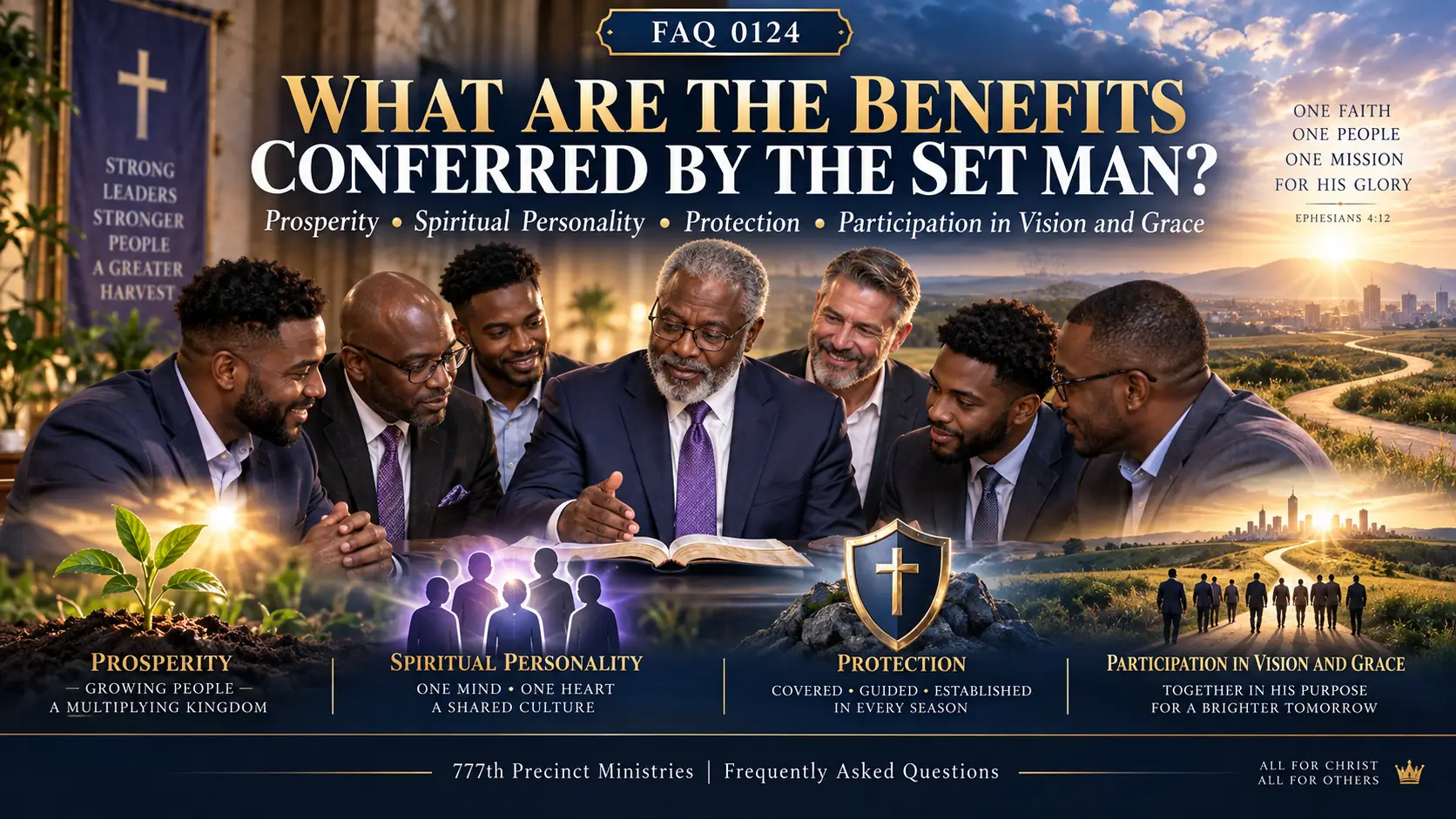
FAQ 0124
WHAT ARE THE BENEFITS CONFERRED BY THE SET MAN?
Prosperity • Spiritual Personality • Protection • Participation in Vision and Grace
Within the set-man framework, God may use a faithful lead servant to bring measurable benefit to a local house. The benefit does not originate in the personality of the leader as though he were the source; it originates in God and is carried through calling, character, teaching, protection, vision and shared grace.
1. Introduction
The previous FAQ considered the qualifications of a set man. This FAQ turns from qualification to effect: what benefits may a God-appointed set man bring to the local church and to the people who participate in the vision?
The supplied framework identifies four primary benefits: prosperity, personality, protection, and participation in vision, grace and anointing. Each of these ideas is supported by biblical examples, but each also needs careful definition so that the set man is never treated as the source of blessing, the owner of people, or a substitute for Christ and the Holy Spirit.
| QUESTION |
| What are the benefits conferred by the set man? |
| SHORT ANSWER |
| A faithful set man may become a channel through whom God brings four significant benefits to a local church: fruitfulness and flourishing; a recognisable spiritual culture or grace-expression; protective oversight; and participation in a shared vision, burden and ministry grace. These benefits are received from God through faithful leadership and healthy covenant relationships. They must never be interpreted as guaranteed material wealth, personality cloning, mystical immunity, or ownership of another believer’s anointing. |
2. The Set Man Is a Vessel, Not the Source
1 Corinthians 3:5-7 (BSB)
What then is Apollos? And what is Paul? They are servants through whom you believed, as the Lord has assigned to each his role. I planted the seed and Apollos watered it, but God made it grow. So neither he who plants nor he who waters is anything, but only God, who makes things grow.
This is the first safeguard. Paul refuses to make the minister the source of growth. Leaders plant and water; God gives increase.
Therefore, when we speak about benefits ‘conferred by the set man,’ we mean benefits that God may mediate through a faithful leader. The glory belongs to God, and the people remain Christ’s possession.
3. Benefit One: Prosperity
The source teaches that the set man brings prosperity to the local church. In biblical language, prosperity should not be reduced to money. It includes fruitfulness, order, increase, effectiveness, development, peace, provision and the strengthening of people for God’s purposes.
A faithful leader can help create an environment in which people and ministries flourish because he carries wisdom, order, discipline, vision and grace.
4. Potiphar Prospered Because of Joseph
Genesis 39:2-5 (BSB)
And the LORD was with Joseph, and he became a successful man, serving in the household of his Egyptian master. When his master saw that the LORD was with him and made him prosper in all he did, Joseph found favor in his sight and became his personal attendant. Potiphar put him in charge of his household and entrusted him with everything he owned. From the time that he put Joseph in charge of his household and all he owned, the LORD blessed the Egyptian’s household on account of Joseph.
Joseph carried the presence, wisdom and favour of God into Potiphar’s household. The result was not merely private blessing for Joseph; the environment around him benefited.
This illustrates how a God-formed leader can affect the spiritual and practical health of an entire house.
5. Laban Prospered Because of Jacob
Genesis 30:27-30 (BSB)
But Laban said to him, ‘If I have found favor in your sight, please stay. I have learned by divination that the LORD has blessed me because of you.’ Then Laban added, ‘Name your wages, and I will pay them.’ Jacob replied, ‘You know how I have served you and how your livestock have thrived under my care. For you had very little before I came, but now your wealth has increased many times over. The LORD has blessed you wherever I have been.’
Jacob’s presence and labour produced increase in Laban’s house. Again, the biblical emphasis is not magical association with a person; it is the fruit of God’s favour operating through faithful stewardship.
6. Lot Benefited Through Association With Abraham
Genesis 13:5-6 (BSB)
Now Lot, who was traveling with Abram, also had flocks and herds and tents. But the land was unable to support them while they stayed together, for their possessions were so great that they could not dwell together.
Lot prospered while journeying with Abraham, and the narrative shows that association with a person carrying God’s promise can expose others to an environment of blessing.
Yet Lot’s later history also teaches an important boundary: proximity to a blessed leader cannot replace personal discernment and obedience. A person must eventually carry his own decisions before God.
7. David’s Distressed Men Became Mighty Men
1 Samuel 22:2 (BSB)
And all those who were in distress or debt or discontented gathered around David, and he became their commander. About four hundred men were with him.
1 Chronicles 11:10 (BSB)
Now these were the chiefs of David’s mighty men, who, together with all Israel, strengthened his kingship according to the word of the LORD concerning Israel.
David did not merely gather already accomplished leaders. Distressed, indebted and discontented men came to him, and over time many became mighty men.
One of the clearest benefits of healthy set-man leadership is transformation: weak people become stronger, immature people mature, and passive people become responsible contributors.
8. Prosperity Must Be Defined Biblically
Biblical prosperity in the life of a local church may include:
- growth in Christlike character;
- sound doctrine and spiritual stability;
- healthy marriages and families;
- wise stewardship of finances and resources;
- development of leaders and ministry gifts;
- mission, generosity and care for the needy;
- order, peace and responsible administration;
- fruitful evangelism and discipleship; and
- the ability to complete God-given assignments.
Material provision may be part of God’s blessing, but Scripture does not promise that association with a set man will make every person financially wealthy.
9. Benefit Two: Spiritual Personality
The supplied framework uses the word ‘personality’ to describe the way the dominant grace of the set man influences the culture of the local church.
For example, an evangelistically graced leader often cultivates evangelistic people. An apostolically graced leader may develop a pioneering, equipping and sending culture.
This should not mean that everyone becomes a copy of the leader’s natural personality. It is better understood as a shared spiritual culture, value system, mindset and ministry emphasis.
10. Jonathan Was Knit to David
1 Samuel 18:1 (BSB)
After David had finished speaking with Saul, the souls of Jonathan and David were knit together, and Jonathan loved him as himself.
Jonathan’s relationship with David became deeply covenantal. The source uses this to illustrate how love and relational proximity can create openness to another person’s mindset, values and courage.
Healthy impartation does not erase identity. Jonathan remained Jonathan. He did not become a duplicate of David. The goal is shared Kingdom values, not personality imitation.
11. Nehemiah’s Mindset Influenced His Servants
Nehemiah 5:16 (BSB)
Instead, I devoted myself to the construction of the wall, and all my servants were gathered there for the work. We did not acquire any land.
Nehemiah’s personal devotion to the assignment shaped the people around him. A leader who works, sacrifices and models integrity can cultivate the same spirit in those who serve alongside him.
12. Paul’s Mindset Was Seen in Timothy and Titus
Philippians 2:20 (BSB)
I have nobody else like him who will genuinely care for your needs.
2 Corinthians 8:16 (BSB)
But thanks be to God, who put into the heart of Titus the same devotion I have for you.
Paul recognised in Timothy and Titus a kindred concern for the churches. The resemblance was not superficial. It was a shared burden, shared values and shared devotion to people.
This is one of the strongest expressions of spiritual personality: the grace in a leader becomes reproducible in sons and daughters who voluntarily embrace the same Christ-centred values.
13. Imitation Is Limited by Christ
1 Corinthians 11:1 (BSB)
You are to imitate me, just as I imitate Christ.
This verse places a clear boundary around all spiritual imitation. Paul does not call believers to imitate him absolutely. He says, in effect, ‘Follow me where I follow Christ.’
The set man’s mindset is beneficial only to the degree that it reflects Christ, Scripture, integrity, love, faith and Kingdom purpose.
14. Unity Is Not Uniformity
1 Corinthians 1:10 (BSB)
I appeal to you, brothers, in the name of our Lord Jesus Christ, that all of you agree together, so that there may be no divisions among you and that you may be united in mind and conviction.
A healthy local church can share vision and values without demanding sameness in personality, gifting or opinion on every secondary matter.
The Holy Spirit distributes different gifts within one body. The set man should therefore cultivate unity of purpose while preserving legitimate diversity.
15. Benefit Three: Protection
The source identifies protection as another benefit. Biblical leadership protects primarily through vigilance, sound doctrine, prayer, correction, boundaries and the willingness to confront threats to the flock.
16. Samuel’s Leadership Protected Israel
1 Samuel 7:13 (BSB)
So the Philistines were subdued, and they stopped invading the territory of Israel. And the hand of the LORD was against the Philistines all the days of Samuel.
Samuel’s faithful leadership coincided with a season in which Israel experienced protection from repeated Philistine aggression. The ultimate protector was the Lord, but Samuel’s obedience, intercession and leadership formed part of the environment through which God protected the nation.
17. Paul’s Presence Guarded the Ephesian Church
Acts 20:28-30 (BSB)
Keep watch over yourselves and the entire flock of which the Holy Spirit has made you overseers. Be shepherds of the church of God, which He purchased with His own blood. I know that after my departure, savage wolves will come in among you and will not spare the flock. Even from your own number, men will rise up and distort the truth to draw away disciples after them.
Paul’s warning shows that mature apostolic oversight can restrain destructive teaching and predatory leadership.
Protection is therefore not merely mystical. It includes discernment, doctrinal clarity, courageous correction and elders who watch over the spiritual welfare of people.
18. Protection Does Not Mean Immunity
A faithful set man cannot guarantee that no believer will ever suffer, be attacked, make a wrong choice or experience hardship.
Biblical protection means that the house has mature watchmen who recognise danger, teach truth, warn the vulnerable, confront wolves and establish wise boundaries.
People must still exercise personal responsibility. No leader can replace a believer’s own obedience, discernment or relationship with God.
19. Protection Must Never Become Control
The language of protection can become unhealthy when it is used to isolate people, forbid legitimate relationships, threaten those who leave, or demand unquestioning obedience.
1 Peter 5:2-3 (BSB)
Be shepherds of God’s flock that is among you, watching over them not out of compulsion, but because it is God’s will; not out of greed, but out of eagerness; not lording it over those entrusted to you, but being examples to the flock.
A shepherd protects the flock; he does not imprison it. Healthy covering strengthens maturity rather than creating dependency.
20. Benefit Four: Participation in Vision, Grace and Anointing
The fourth benefit is corporate participation. God may place a burden, grace and vision upon a lead servant and then bring others alongside so that the assignment becomes shared.
This does not mean that the leader owns the Holy Spirit or that other believers have no grace of their own. It means that people may participate together in a specific God-given assignment.
21. Moses and the Seventy Elders
Numbers 11:16-17 (BSB)
Then the LORD said to Moses, ‘Bring Me seventy of the elders of Israel whom you know to be elders and officers of the people. Bring them to the Tent of Meeting and have them stand there with you. Then I will come down and speak with you there, and I will take some of the Spirit that is on you and put that Spirit on them. They will help you bear the burden of the people, so that you do not have to bear it by yourself.’
The seventy elders participated in the burden Moses had been carrying. God extended the Spirit-enabled capacity needed for shared leadership.
The central principle is corporate burden-bearing. Leadership grace was not meant to terminate in Moses; it was extended so that others could help carry the people.
22. Shared Grace Does Not Mean Borrowed Ownership
The source describes the elders as functioning in Moses’ anointing. This can be useful language if it means they shared the same leadership burden and assignment.
It should not mean that Moses owned their relationship with God. In the New Testament, the Holy Spirit Himself appoints overseers, distributes gifts and works in every believer.
Acts 20:28 (BSB)
Keep watch over yourselves and the entire flock of which the Holy Spirit has made you overseers.
Elders may function within the vision and leadership grace of a house while still remaining directly accountable to Christ and empowered by the Holy Spirit.
23. Paul Saw the Vision; the Team Carried It
Acts 16:9-10 (BSB)
During the night, Paul had a vision of a man of Macedonia standing and pleading with him, ‘Come over to Macedonia and help us.’ As soon as Paul had seen the vision, we prepared to leave for Macedonia, concluding that God had called us to preach the gospel to them.
Paul received the vision, but Luke deliberately shifts from ‘he’ to ‘we.’ The direction became corporate.
This is a healthy picture of set-man leadership: the leader receives or articulates direction, the team discerns it, and together they take responsibility for obedience.
24. Participation in Vision Is Not Blind Compliance
The team in Acts did not merely surrender their conscience to Paul. The text says ‘we concluded’ that God had called them. Corporate vision is strongest when people personally become persuaded that the direction is from God.
Healthy alignment therefore includes:
- understanding the vision;
- testing it against Scripture;
- praying into it;
- recognising one’s own place in it;
- receiving appropriate sending and accountability; and
- serving from conviction rather than fear.
25. What About Elders Ministering Outside the Local House?
The supplied framework warns against elders bypassing the set man and independently ministering elsewhere. The underlying concern is legitimate: leaders who carry delegated responsibility should not operate carelessly, create competing loyalties or represent the local house without communication.
However, this should be framed as covenantal order rather than personal ownership. An elder ultimately belongs to Christ, not to the set man.
A healthy practice is that ministry outside the house occurs with communication, blessing and appropriate sending, especially where the elder represents the local church or carries responsibilities that may be affected.
26. How People Receive These Benefits
- Recognise the grace God has genuinely placed in the house.
- Receive sound teaching with a teachable heart.
- Participate in the vision rather than remain a spectator.
- Serve faithfully and develop your own gifts.
- Allow biblical correction to produce maturity.
- Honour leadership without idolising the leader.
- Remain personally rooted in Scripture and prayer.
- Build healthy covenant relationships with fellow believers.
- Carry responsibility rather than depending permanently on the set man.
- Measure everything by Christ and the Word.
27. Signs the Benefits Are Operating Healthily
- people become more Christlike rather than more leader-dependent;
- sons and daughters grow into responsibility;
- the church becomes fruitful and generous;
- vision becomes corporate rather than private;
- elders mature in discernment and leadership;
- sound doctrine protects the house from error;
- different gifts flourish within a common mission;
- financial and moral accountability increase; and
- the leader can release people without fear of losing control.
28. Warning Signs of an Unhealthy Set-Man Culture
- prosperity is reduced to guaranteed money for those who align with the leader;
- members are expected to copy the leader’s personality or preferences;
- protection is used as a threat that people will be harmed if they leave;
- the set man claims ownership of other people’s anointing or calling;
- elders are not allowed to question decisions;
- outside ministry requires personal permission even when no legitimate house responsibility is involved;
- the leader becomes the centre of loyalty instead of Christ; and
- people become less capable of hearing God and exercising mature responsibility for themselves.
29. The Four Benefits at a Glance
| BENEFIT | BIBLICAL PICTURE | HEALTHY EXPRESSION |
|---|---|---|
| Prosperity | Joseph, Jacob, David’s men | Fruitfulness, development, provision and maturity |
| Spiritual Personality | David/Jonathan; Paul/Timothy/Titus | Shared values, grace-expression and Christ-centred culture |
| Protection | Samuel; Paul at Ephesus | Sound doctrine, vigilance, correction and shepherding |
| Participation in Vision/Grace | Moses and the 70; Paul and team | Shared burden, mission, delegated responsibility and corporate ownership |
30. The Greatest Benefit Is Maturity in Christ
All four benefits must finally serve one greater purpose: the formation of Christ in the people.
Ephesians 4:11-13 (BSB)
And it was He who gave some to be apostles, some to be prophets, some to be evangelists, and some to be pastors and teachers, to equip the saints for works of ministry and to build up the body of Christ, until we all reach unity in the faith and in the knowledge of the Son of God, as we mature to the full measure of the stature of Christ.
The measure of a set man’s success is therefore not how indispensable he becomes, but how effectively the people mature, serve, discern, reproduce and carry the Kingdom purpose of God.
31. 777th Precinct Ministries – Position Statement
777th Precinct Ministries affirms that a God-appointed set man may become a significant channel of benefit to a local church. Within this framework, we identify four principal benefits: prosperity, spiritual personality, protection, and participation in vision, grace and anointing.
We understand prosperity as holistic Kingdom fruitfulness rather than guaranteed material wealth. We understand spiritual personality as the healthy reproduction of Christ-centred values and grace-expression rather than personality cloning. We understand protection as vigilant shepherding rather than control. We understand participation in vision and anointing as shared burden, mission and grace under the Holy Spirit rather than ownership of another person’s calling.
The set man is a steward and vessel, not the source. Christ remains the Head of the Church, the Holy Spirit remains the giver of gifts and grace, and every leader remains accountable to Scripture and mature covenant relationships.
32. Conclusion
A faithful set man can bring extraordinary benefit to a house. He can help people flourish, establish a recognisable spiritual culture, guard the flock from destructive influences, and gather people around a shared God-given vision.
Joseph’s presence benefited Potiphar. Jacob’s labour increased Laban’s house. David’s distressed men became mighty. Paul’s heart was reproduced in Timothy and Titus. Samuel protected Israel through faithful leadership. Moses shared his burden with seventy elders, and Paul’s Macedonian vision became the mission of an entire team.
Yet every one of these benefits must point beyond the leader to God. Healthy set-man leadership does not produce personality worship; it produces mature people who know Christ, carry responsibility and participate freely in His Kingdom purpose.
The set man is a vessel. God is the source. The people belong to Christ.
Grace to you.
Scripture quotations are from the Berean Standard Bible (BSB), public domain.
OTHER PUBLICATIONS BY THIS AUTHOR CAN BE FOUND AT: