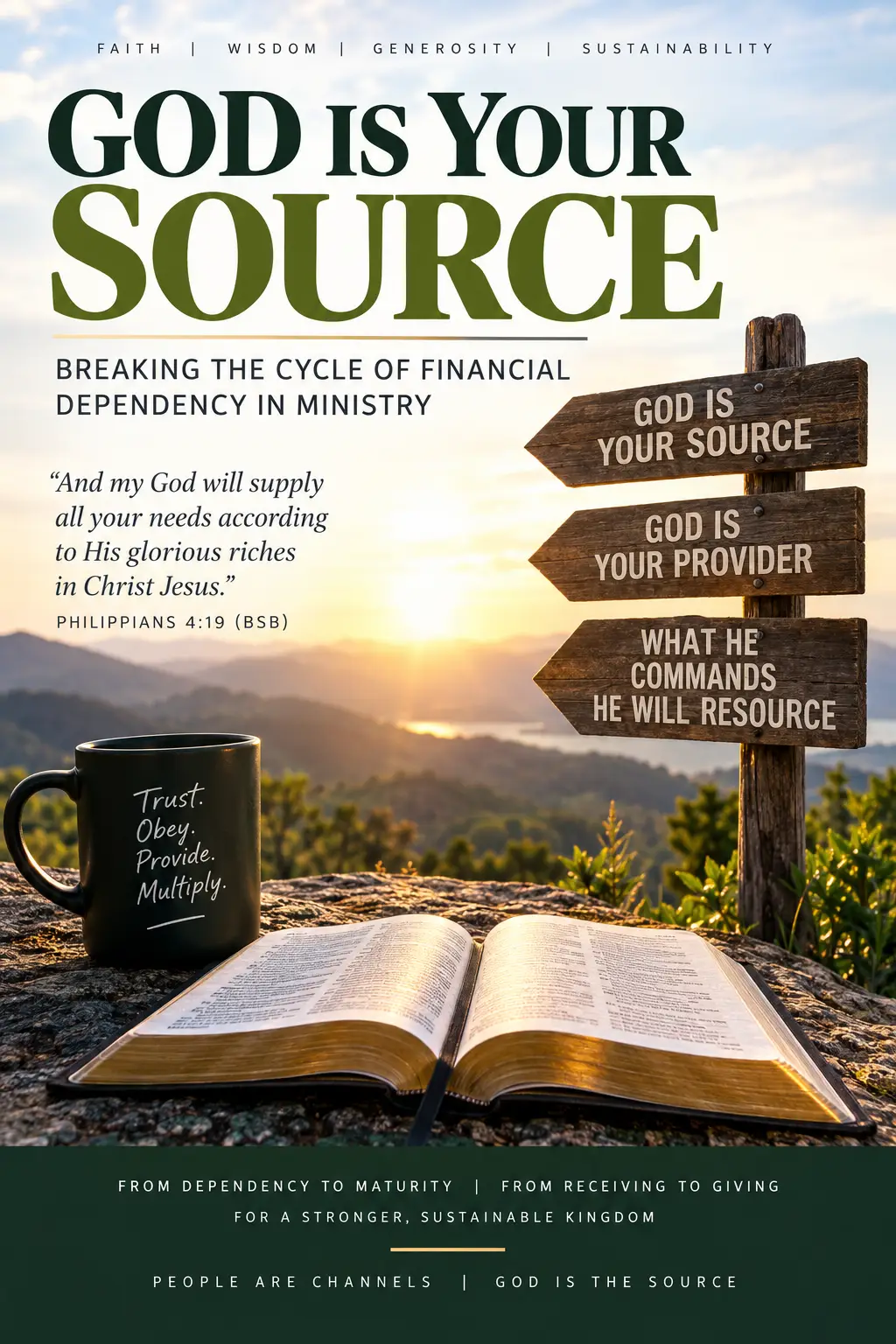
Breaking the Cycle of Financial Dependency in the Ministry
One of the challenges increasingly encountered in Christian relationships is the constant appeal for financial assistance.
Pastors, ministers, churches, ministries, families, and individuals may face genuine financial difficulties. Poverty is real. Economic hardship is real. Unexpected emergencies are real. Scripture repeatedly commands believers to be compassionate, generous, and willing to help those genuinely in need.
However, there is an important difference between receiving help in a season of need and developing a culture of financial dependency in which other people continually become our first point of reference whenever we require money.
A Kingdom mindset must begin somewhere else:
God is our Source.
God is our Provider.
What God genuinely commands, He is able to resource.
People may become channels through which God provides, but people must never replace God as our source.
1. GOD IS YOUR SOURCE
Our first confidence must always be in God.
Philippians 4:19 BSB
And my God will supply all your needs according to His glorious riches in Christ Jesus.
Paul did not say that another pastor, another ministry, another country, another church, or another wealthy believer would supply all our needs.
He said: “My God will supply.”
God may certainly use another person. He may use employment. He may use a business. He may use a church. He may use a friend. He may use an unexpected opportunity. But those are channels. God remains the Source.
When we begin looking continually toward people rather than toward God, there is a danger that our faith slowly moves from divine provision to human dependency.
Psalm 23:1 BSB
The LORD is my shepherd; I shall not want.
David understood that his security was connected to his Shepherd. The sheep’s confidence is not in another sheep. It is in the shepherd. Likewise, our confidence must ultimately rest in God.
2. GOD IS YOUR PROVIDER
Jesus taught His disciples not to live consumed by anxiety about material provision.
Matthew 6:31–33 BSB
Therefore do not worry, saying, “What shall we eat?” or “What shall we drink?” or “What shall we wear?” For the Gentiles strive after all these things, and your heavenly Father knows that you need them. But seek first the kingdom of God and His righteousness, and all these things will be added unto you.
Notice the order: seek first the Kingdom, then trust God concerning provision.
This does not mean that believers should become passive or irresponsible. Trusting God does not mean refusing to work, refusing to plan, refusing to budget, or refusing to exercise wisdom. Faith and responsibility work together.
God provides, but He frequently places resources, opportunities, abilities, relationships, work, creativity, and wisdom into our hands. We must learn to recognise those things as part of His provision.
3. WHAT GOD COMMANDS, HE IS ABLE TO RESOURCE
There is an important principle in Kingdom ministry: if God gives the assignment, God is capable of sustaining the assignment.
This does not mean that every ministry will have unlimited finances. Neither does it mean that there will never be times of sacrifice. But it does mean that we should be cautious about continually placing pressure upon people to finance something we claim God commanded us to do.
2 Corinthians 9:8 BSB
And God is able to make all grace abound to you, so that in all things, at all times, having all that you need, you will abound in every good work.
If God has genuinely commissioned something, we should first go back to the One who commissioned it. Before asking, “Who can give me money?” perhaps we should ask, “Father, how have You intended to resource this assignment?”
The answer may be different from what we expect. God may provide money, but He may also provide an opportunity, employment, land, equipment, skills, partners, favour, or an idea. He may show us that the project should be smaller. Or He may even reveal that what we are trying to do was our idea rather than His instruction. That discernment is important.
4. PEOPLE ARE CHANNELS — THEY ARE NOT THE SOURCE
One of the greatest mistakes we can make is confusing God’s channel with God’s source.
Suppose God uses someone to bless you financially. Thank that person. Honour that person. Be grateful. But do not begin treating that person as your permanent financial supply.
Yesterday’s provision does not necessarily mean that the person God used yesterday is responsible for tomorrow’s provision. God may choose another channel entirely.
If we continually return to the same people asking for money, we may unintentionally begin putting pressure upon relationships that God never intended to carry that burden.
Faith says: “God provided through this person.”
Dependency says: “This person must continue providing for me.”
Those are very different attitudes.
5. BIBLICAL SUPPORT FOR MINISTRY IS RIGHT
It is equally important that we do not swing to the opposite extreme. The Bible clearly teaches that genuine ministry may be financially supported.
1 Timothy 5:18 BSB
For the Scripture says, “Do not muzzle an ox while it is treading out the grain,” and, “The worker is worthy of his wages.”
Jesus and His disciples also received support from people who willingly assisted their ministry. Paul gratefully acknowledged believers who partnered financially with him. Therefore, there is nothing wrong with supporting pastors, missionaries, ministries, or believers in genuine need.
The problem begins when support becomes entitlement.
2 Corinthians 9:7 BSB
Each one should give what he has decided in his heart to give, not out of regret or compulsion. For God loves a cheerful giver.
Giving that must continually be extracted through guilt, emotional pressure, repeated requests, exaggerated emergencies, manipulation, or spiritual intimidation is moving away from the biblical pattern. A person should be free to hear God concerning their giving.
6. FINANCIAL SUPPORT SHOULD NOT CREATE UNHEALTHY DEPENDENCY
There are moments when believers must help each other. A widow may genuinely need assistance. Someone may lose employment. A family may experience a disaster. A ministry may face an extraordinary need. Scripture teaches us to care for one another.
But healthy support should ideally help a person move toward greater stability rather than create permanent dependency.
1 Thessalonians 4:11–12 BSB
Make it your ambition to lead a quiet life, to mind your own business, and to work with your own hands, just as we instructed you, so that you will behave properly toward outsiders, without being dependent on anyone.
There is dignity in responsibility. There is dignity in work. There is dignity in learning to steward what God has placed in our hands.
This principle is especially important for ministry leaders. Pastors should not continually teach their people to look outward for rescue. They should teach people how to trust God, work faithfully, steward resources, develop skills, build sustainable livelihoods, and become capable of helping others.
7. THE KINGDOM SHOULD PRODUCE CONTRIBUTORS, NOT PERMANENT CONSUMERS
Discipleship should move people toward maturity. A mature disciple should increasingly ask, “What can I contribute?” rather than always asking, “What can someone give me?”
Acts 20:35 BSB
In everything, I showed you that by this kind of hard work we must help the weak, remembering the words of the Lord Jesus Himself: “It is more blessed to give than to receive.”
The purpose of receiving help should eventually be that we become capable of helping someone else.
- From receiving to standing.
- From standing to producing.
- From producing to giving.
- From giving to empowering others.
This is Kingdom multiplication.
8. THERE IS A DIFFERENCE BETWEEN BEING UNABLE TO WORK AND UNWILLING TO WORK
Compassion must always be accompanied by discernment. Some people genuinely cannot provide for themselves. They should be cared for with compassion. Others may simply have developed a pattern of depending upon people because asking has become easier than taking responsibility.
2 Thessalonians 3:10 BSB
If anyone is unwilling to work, he shall not eat.
Notice that Scripture does not say “unable.” It says “unwilling.” There is a significant difference.
The elderly, disabled, sick, widowed, orphaned, displaced, unemployed, and people facing genuine crises may require compassionate assistance. But where someone is capable of working, planning, producing, or developing income, continually financing irresponsibility may actually prevent maturity.
Sometimes the most loving response is not another donation. Sometimes it is helping someone develop a sustainable solution.
9. NOT EVERY NEED IS YOUR ASSIGNMENT
Believers must understand another important truth: you are not personally responsible for every need that comes before you.
There will always be needs. You cannot finance every ministry. You cannot support every pastor. You cannot rescue every family. You cannot respond positively to every request. Therefore, giving must remain under the leadership of the Holy Spirit.
Before giving, ask:
- Has God assigned this need to me?
- Am I giving from faith or guilt?
- Will my giving genuinely help, or will it deepen dependency?
- Is there accountability?
- Is the need legitimate?
- Is the person stewarding what they already have responsibly?
Sometimes God will say, “Give.” Sometimes He may say, “Give generously.” Sometimes He may say, “Help them create a sustainable solution.” And sometimes He may simply say, “No.” A Spirit-led “no” is not disobedience.
10. PASTORS MUST MODEL FAITH RATHER THAN FINANCIAL DEPENDENCY.
Ministry leaders carry an additional responsibility. Pastors teach not only through sermons but through patterns.
If leaders continually communicate, “Someone overseas must help us,” “Someone must send us money,” or “Someone must rescue our ministry,” they may unintentionally train entire congregations into dependency.
What happens if the external donor disappears? Does the ministry collapse? Or has the church learned to trust God, steward resources, work together, give sacrificially, develop enterprises, and use what God has already placed within the community?
Healthy apostolic ministry should strengthen indigenous capacity. It should produce mature sons and daughters who recognise that God lives among them and has placed gifts, abilities, resources, creativity, wisdom, and opportunity within them.
11. PAUL RECEIVED SUPPORT — BUT HE ALSO WORKED
Paul presents a powerful balance. He gratefully received financial partnership from churches such as the Philippians. But he was also willing to work.
Acts 18:3 BSB
And because he was of the same trade, he stayed with them and worked, for they were tentmakers by trade.
He did not see work as beneath his apostolic calling. This is an important lesson. Sometimes the provision for ministry may come through employment or business rather than donations.
A pastor who works is not necessarily demonstrating a lack of faith. He may actually be demonstrating responsibility. Paul’s identity was not diminished because he worked with his hands. His work helped support his mission.
12. ASK GOD FOR STRATEGY, NOT ONLY FOR MONEY
Often we pray, “Lord, send me money.” Perhaps we should sometimes pray, “Lord, show me Your strategy.”
Deuteronomy 8:18 BSB
But remember that it is the LORD your God who gives you the power to gain wealth, in order to confirm His covenant that He swore to your fathers, as it is this day.
God may answer a financial need by giving us wisdom. Ask Him:
- What do I already have?
- What skill can I develop?
- What can I produce?
- What can I sell?
- What service can I offer?
- What opportunity am I overlooking?
- Who can I partner with rather than merely ask for money?
- What expenditure can I eliminate?
- What resource is already present in my community?
God’s answer may already be around us.
13. PARTNERSHIP IS HEALTHIER THAN DEPENDENCY
Kingdom Partnership says, “God has joined us together for this assignment.” Dependency says, “You have more than I have, therefore you must support me.”
Partnership includes relationship, accountability, shared vision, mutual honour, clear purpose, responsibility, and measurable fruit. Healthy partnership should never be based primarily upon guilt.
Neither geography nor economic difference automatically creates financial obligation. We belong to one Body, and we should love and support each other, but every believer must still learn to hear God concerning stewardship.
14. GENEROSITY MUST NEVER BECOME MANIPULATION
Scripture strongly promotes generosity. We should remain generous people. We should help the poor. We should support genuine Kingdom work. We should care for brothers and sisters facing legitimate hardship.
But generosity must remain generosity. It stops being generosity when giving is extracted through guilt, pressure, fear, spiritual manipulation, constant emotional appeals, entitlement, or repeated demands.
The giver must remain free. And the receiver must remain grateful.
15. A HEALTHY KINGDOM MINDSET
A mature financial mindset can therefore be summarised as follows:
- God is my Source.
- God is my Provider.
- People are channels, not my source.
- What God commands, He is able to resource.
- I will work with what God has placed in my hands.
- I will manage resources faithfully.
- I will receive help gratefully when necessary.
- I will not develop entitlement toward those who help me.
- I will give generously as God leads me.
- I will not allow guilt or manipulation to determine my giving.
- I will seek sustainability rather than permanent dependency.
- I will trust God for wisdom as well as money.
CONCLUSION
There is nothing wrong with asking for help. There is nothing wrong with supporting genuine ministries. There is nothing wrong with believers assisting one another during difficult seasons. The Body of Christ should be characterised by extraordinary generosity.
But generosity must produce strength rather than dependency.
Our goal should never be to create generations of believers continually looking toward another person, church, organisation, country, or donor for survival.
Our goal should be to produce mature believers who can say:
God is my Source.
God is my Provider.
I will obey what He has told me to do.
I will faithfully steward what He has placed in my hands.
And I trust that what God genuinely commands, He is fully able to resource.
People may help us. People may partner with us. People may bless us. People may sow into what God has called us to do. But ultimately, our eyes must remain upon God and not upon man.
Psalm 121:1–2 BSB
I lift up my eyes to the hills. From where does my help come? My help comes from the LORD, the Maker of heaven and earth.
That is where Kingdom provision begins.
God is the Source. God is the Provider. And faithful obedience remains our responsibility.
OTHER PUBLICATIONS BY THIS AUTHOR CAN BE FOUND AT: