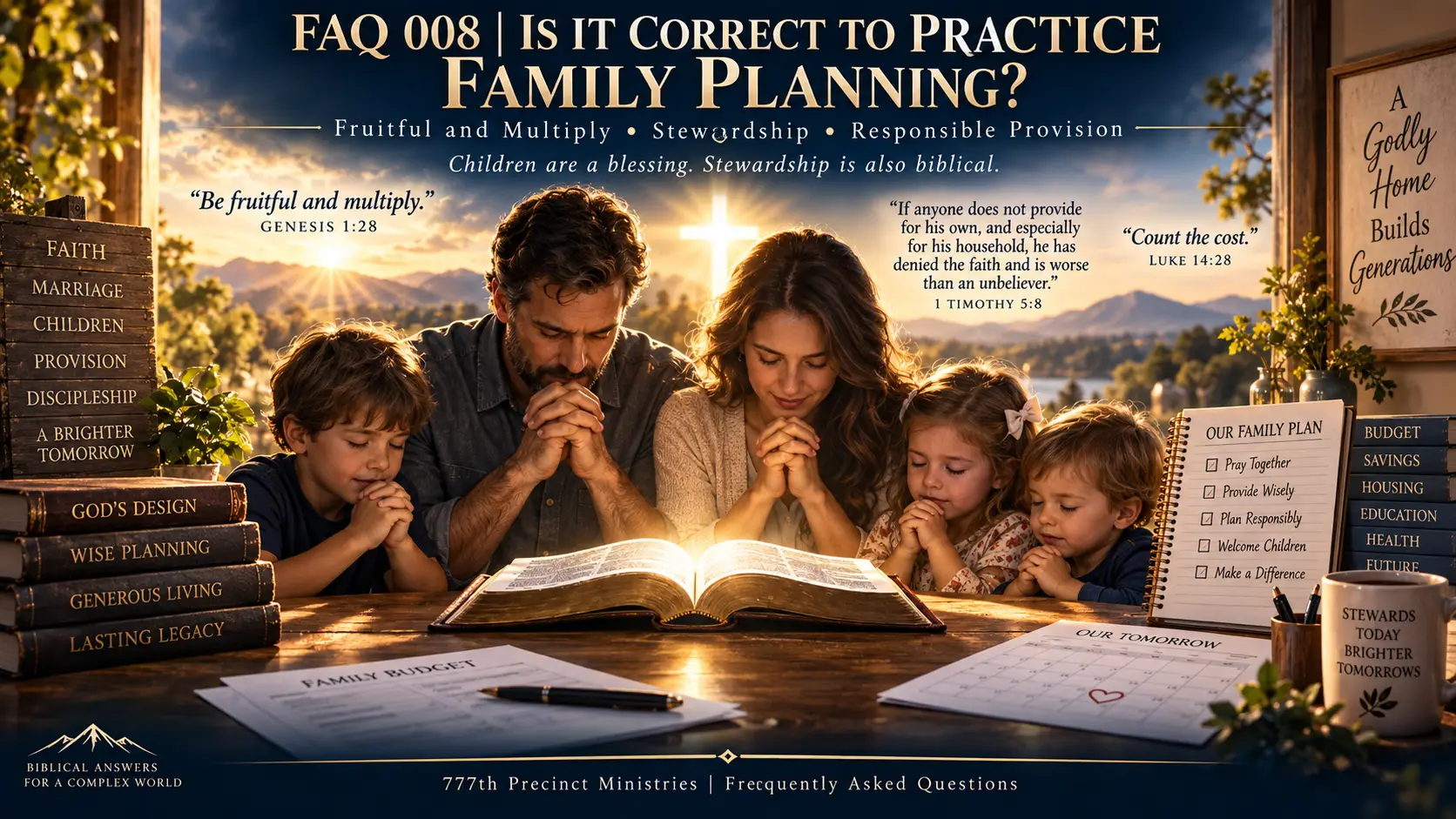
FAQ 008
IS IT CORRECT TO PRACTICE FAMILY PLANNING?
Fruitfulness • Stewardship • Responsible Provision
Genesis 1:28 presents fruitfulness and multiplication as part of God’s good creation mandate. Scripture also commands parents to provide, nurture, disciple and wisely steward the household entrusted to them. Responsible family planning can honour both truths when it is prayerful, mutual, life-honouring and governed by biblical stewardship rather than fear, selfishness or contempt for children.
QUESTIONIs it correct to practice family planning and disregard Genesis 1, where the Word of God states that we must be fruitful and multiply, especially if one has many children and does not have the resources to take care of them?SHORT ANSWERYes, responsible family planning can be biblically permissible, but Genesis 1:28 should not be disregarded.
| Children are a blessing from God, and fruitfulness is part of His good design. At the same time, Scripture requires parents to provide for their household, nurture their children, act prudently, and count the cost of responsibilities. The Bible does not command every married couple to have the maximum possible number of children. A husband and wife may prayerfully plan or space children according to health, provision, calling and responsible stewardship, provided their motives and methods honour God, respect life and remain open to His lordship. |
1. Introduction
The question of family planning is sometimes framed as a conflict between faith and responsibility: if God said, “Be fruitful and multiply,” does any attempt to plan the size or spacing of a family amount to disobedience? Scripture presents a more complete picture.
The Bible celebrates children as a blessing and treats fruitfulness as good. It also places serious responsibilities on parents: to provide, nurture, teach, protect and manage the household faithfully. Biblical stewardship therefore asks not only, “Can we have another child?” but also, “How will we faithfully care for the children God has already entrusted to us?”
2. Genesis 1:28 Must Be Honoured, Not Ignored
Genesis 1:28 (BSB)
God blessed them and said to them, “Be fruitful and multiply, and fill the earth and subdue it; rule over the fish of the sea and the birds of the air and every creature that crawls upon the earth.”
God’s words to Adam and Eve are both blessing and commission. Human fruitfulness is not presented as something shameful or undesirable. Marriage, children, generations and the filling of the earth belong to God’s good creation design.
For this reason, a Christian approach to family planning should never arise from contempt for children or from the belief that children are merely an inconvenience. The biblical starting point is gratitude: life and children are gifts from God.
3. Children Are a Blessing From the Lord
Psalm 127:3-5 (BSB)
Children are indeed a heritage from the LORD, and the fruit of the womb is His reward. Like arrows in the hand of a warrior, so are children born in one’s youth. Blessed is the man whose quiver is full of them.
Scripture speaks positively about children. They are a heritage and a reward, not a curse. Responsible planning must therefore be distinguished from a rejection of children. A couple may limit or space pregnancies while still deeply valuing children and remaining thankful for the family God has given them.
4. “Be Fruitful and Multiply” Is Not a Command to Maximise Births at Any Cost
Genesis 1:28 is a creation mandate given to humanity. It establishes fruitfulness as part of God’s design, but Scripture does not state that every individual married couple must produce the greatest number of children biologically possible.
The New Testament recognises that some believers will remain unmarried and therefore will not fulfil fruitfulness through biological children. Paul even speaks positively of singleness for those who are graced for it. This demonstrates that the creation mandate cannot be interpreted as an individual command requiring every believer to reproduce physically.
1 Corinthians 7:7-8 (BSB)
I wish that all men were as I am. But each man has his own gift from God; one has this gift, another has that. Now to the unmarried and widows I say this: It is good for them to remain unmarried, as I am.
Physical fruitfulness is therefore one expression of God’s purpose, but Kingdom fruitfulness also includes discipleship, good works, spiritual children, service and multiplication of the life of Christ in others.
5. Scripture Requires Parents to Provide for Their Household
1 Timothy 5:8 (BSB)
If anyone does not provide for his own, and especially his own household, he has denied the faith and is worse than an unbeliever.
This is a strong statement. Provision is not optional Christian behaviour. Parents carry a responsibility to care for the people God has entrusted to them. Provision includes more than money: food, shelter, safety, healthcare, education, emotional presence, spiritual formation and responsible guidance are all part of stewardship.
Therefore a couple who already struggles to meet the legitimate needs of their children is not necessarily acting faithlessly by considering whether another pregnancy should be delayed or avoided. Prayerful family planning may be one way of taking the duty of provision seriously.
6. Parents Must Also Nurture and Disciple Their Children
Ephesians 6:4 (BSB)
Fathers, do not provoke your children to wrath; instead, bring them up in the discipline and instruction of the Lord.
Biblical parenting is not completed by giving birth. Children must be raised. They need instruction, discipline, love, time, protection, example and spiritual formation. The question is therefore not merely how many children can be born, but how faithfully each child can be shepherded.
Deuteronomy 6:6-7 (BSB)
These words I am commanding you today are to be upon your hearts. And you shall teach them diligently to your children and speak of them when you sit at home and when you walk along the road, when you lie down and when you get up.
Parenthood requires intentional investment. Responsible family planning may help parents preserve the time, strength and resources needed to disciple the children already in their care.
7. Biblical Wisdom Includes Planning
Proverbs 21:5 (BSB)
The plans of the diligent bring plenty, as surely as haste leads to poverty.
Planning is not the opposite of faith. Scripture repeatedly commends prudence, diligence, preparation and wise management. Faith does not require avoidable disorder.
Luke 14:28 (BSB)
Which of you, wishing to build a tower, does not first sit down and count the cost to see if he has the resources to complete it?
Jesus used the principle of counting the cost to teach about discipleship. The wider wisdom principle is clear: responsible people consider the demands of what they undertake. Applying that principle to family stewardship is legitimate, provided children are never reduced to financial calculations alone.
8. Prudence Is Not Unbelief
Proverbs 22:3 (BSB)
The prudent see danger and take cover, but the simple keep going and suffer the consequences.
A couple may face genuine health, financial, emotional, housing or caregiving pressures. Recognising those pressures is not automatically fear or unbelief. Prudence sees reality and responds wisely. The key question is whether the decision is being governed by God, truth and stewardship rather than panic or materialism.
9. Family Planning Should Be a Mutual Marital Decision
1 Corinthians 7:3-4 (BSB)
The husband should fulfill his marital duty to his wife, and likewise the wife to her husband. The wife does not have authority over her own body, but the husband. Likewise the husband does not have authority over his own body, but the wife.
Paul presents marriage in terms of mutual responsibility rather than unilateral control. Decisions concerning intimacy, pregnancy spacing and family size should therefore not be imposed by one spouse on the other. Husband and wife should pray, communicate honestly and seek unity.
Family planning becomes unhealthy when it is used coercively, secretly or selfishly. Healthy stewardship is covenantal and mutual.
10. Motive Matters
Two couples may make the same practical decision for very different spiritual reasons. Scripture continually addresses the heart. Family planning may arise from wise stewardship, or it may arise from fear, vanity, greed, convenience or a refusal to receive children under any circumstances.
Helpful questions include:
- Are we seeking God together, or merely avoiding inconvenience?
- Are we grateful for children, or have we begun to view them as obstacles to our lifestyle?
- Are health, provision and existing caregiving responsibilities legitimate factors in this decision?
- Are we making the decision in faith and peace, or primarily from fear?
- Are husband and wife in genuine agreement?
- Are we willing for God to redirect our plans?
11. Stewardship Is Not the Same as Materialism
It would be equally unbiblical to say, “We will only welcome a child when every financial condition is perfect.” Few families ever reach perfect certainty. Scripture calls believers to trust God, live generously and avoid anxiety.
Matthew 6:31-33 (BSB)
Therefore do not worry, saying, “What shall we eat?” or “What shall we drink?” or “What shall we wear?” For the Gentiles strive after all these things, and your heavenly Father knows that you need them. But seek first the kingdom of God and His righteousness, and all these things will be added unto you.
The biblical balance is neither reckless presumption nor anxious control. We trust God as Provider while also obeying His commands concerning work, provision, wisdom and stewardship.
12. Existing Children Must Never Be Made to Feel Like a Mistake
Where a family already has many children and resources are strained, the children themselves must never be treated as the problem. Every child already present is to be loved, protected and valued. The stewardship question concerns future decisions, not the worth of existing sons and daughters.
If a household is under severe pressure, the church and wider covenant community should also ask how they can practically support vulnerable families rather than merely criticising them.
Galatians 6:2 (BSB)
Carry one another’s burdens, and in this way you will fulfill the law of Christ.
13. Does Family Planning Show a Lack of Faith?
Not necessarily. Scripture does not equate planning with unbelief. Noah prepared the ark. Joseph stored grain for famine. Proverbs praises foresight. Paul made travel plans while still submitting them to God. Faith plans with an open hand: “If the Lord wills.”
James 4:15 (BSB)
Instead, you ought to say, “If the Lord is willing, we will live and do this or that.”
Christian family planning should therefore be submitted planning, not autonomous control. Couples may make wise decisions while acknowledging that God remains Lord over life and circumstances.
14. The Bible Does Not Prescribe a Specific Number of Children
Scripture nowhere gives a universal number that defines a faithful Christian family. Some families are large; some are small; some couples experience infertility; some remain childless; some adopt or foster; some carry extensive responsibilities toward relatives or spiritual children.
The measure of faithfulness is therefore not a numerical quota but obedience to God in the stewardship actually entrusted to each household.
15. What About Methods of Family Planning?
The Bible was written before modern contraceptive methods and does not name them individually. Christians therefore have to reason from biblical principles: the sanctity of life, marital faithfulness, mutuality, stewardship, conscience and the difference between preventing conception and intentionally ending an established pregnancy.
A Christian couple should understand what a proposed method does, consider relevant health implications, pray together and act with a clear conscience before God. Where a method raises medical or ethical uncertainty, wise professional medical advice and mature pastoral counsel can help the couple make an informed decision.
This FAQ does not prescribe one medical method for every couple. Its purpose is to establish the biblical framework within which the decision should be made.
16. Family Planning Must Remain Life-Honouring
Psalm 139:13-14 (BSB)
For You formed my inmost being; You knit me together in my mother’s womb. I praise You, for I am fearfully and wonderfully made. Marvelous are Your works, and I know this very well.
Christian stewardship must honour the sacredness of human life. Decisions about preventing pregnancy should therefore be ethically distinguished from the intentional destruction of developing human life. This is one reason couples should understand the method they choose rather than acting casually or ignorantly.
17. The Example of Onan Should Not Be Misused
Genesis 38:8-10 is sometimes presented as a universal prohibition of all birth control. The immediate context, however, concerns Onan’s refusal to fulfil his levirate obligation to provide offspring for his deceased brother while exploiting the marital relationship for himself.
The passage certainly condemns Onan’s rebellion and selfishness, but it does not provide a complete biblical doctrine of modern family-planning methods. Ethical conclusions should therefore be drawn from the whole counsel of Scripture, not from an isolated use of this account.
18. Fruitfulness Is Larger Than Biology Alone
John 15:8 (BSB)
This is to My Father’s glory, that you bear much fruit, proving yourselves to be My disciples.
In the New Covenant, believers are called to fruitfulness that includes character, discipleship, good works, Kingdom multiplication and spiritual reproduction. Biological children are a precious expression of fruitfulness, but they are not the only biblical measure of a fruitful life.
A couple who prayerfully limits the size of their biological family may still live profoundly fruitful lives by raising their children well, discipling others, serving the poor, building the Kingdom and multiplying spiritual life.
19. A Biblical Balance
Children are a heritageEach child is valuable and worthy of welcome, love and care.Provide for your householdParents have a serious responsibility to care for those entrusted to them.Mutual marital responsibilityNeither spouse should control the other coercively.God is LordPlans remain subject to God’s will and providence.
| BIBLICAL TRUTH | WHAT IT MEANS | PRACTICAL IMPLICATION | ||||||
|---|---|---|---|---|---|---|---|---|
| Be fruitful and multiply | Children and generations belong to God’s good design. | |||||||
| Do not despise children or treat fertility as an evil. | ||||||||
| Existing children must never be treated as mistakes or burdens. | ||||||||
| Resources, health and caregiving capacity may legitimately affect timing and spacing. | ||||||||
| Count the cost | Wise people consider responsibilities before undertaking them. | Planning can be faithful stewardship rather than unbelief. | ||||||
| Family-planning decisions should be prayerful and mutual. | ||||||||
| Plan responsibly, but hold plans with an open hand. |
20. When Family Planning May Be a Wise Stewardship Decision
Family planning may be a responsible choice when, for example:
- the mother’s health or recovery requires careful spacing of pregnancies;
- the family is already under severe financial or caregiving pressure;
- existing children require significant medical, developmental or pastoral attention;
- the couple needs time to establish stability in housing, employment or family life;
- there are serious circumstances that make an immediate additional pregnancy unwise;
- husband and wife have prayerfully reached a shared conviction concerning the size or spacing of their family.
None of these automatically dictates a particular decision. They are stewardship factors to bring before God rather than reasons to condemn another family whose circumstances and calling differ.
21. When Family Planning May Reveal an Unhealthy Heart
The same subject requires self-examination. Family planning may become spiritually unhealthy when it is driven by:
- contempt for children or hostility toward God’s design for family;
- a determination to preserve luxury, status or personal freedom at any cost;
- fear that refuses to trust God even when the couple has reasonable capacity to parent;
- one spouse coercing the other;
- deception or secret decisions within the marriage;
- methods or choices that violate a well-informed biblical conscience concerning human life.
The issue is not simply the existence of a plan, but whether the plan itself is submitted to Christ.
22. A Practical Process for Christian Couples
- Pray together and submit the question to the Lord.
- Study the relevant Scriptures rather than relying only on culture or family pressure.
- Evaluate the health and wellbeing of the mother and the needs of the children already entrusted to you.
- Consider provision realistically: income, housing, education, healthcare, time and emotional capacity.
- Discuss motives honestly. Distinguish stewardship from fear, selfishness or materialism.
- Seek mutual agreement rather than coercion.
- Understand the medical method being considered and seek competent advice where necessary.
- Keep the decision open to God’s direction and revisit it as circumstances change.
23. Should the Church Dictate Family Size?
The church should teach biblical principles and help believers develop mature consciences, but Scripture does not authorise leaders to impose a universal family size on every married couple. The household belongs under Christ, and husband and wife must carry their stewardship before Him.
Romans 14:12 (BSB)
So then, each of us will give an account of himself to God.
Where Scripture has not given a numerical rule, the church should be cautious about creating one. Pastoral counsel can guide, but it should not replace the couple’s prayerful responsibility before God.
24. 777th Precinct Ministries – Position Statement
777th Precinct Ministries affirms Genesis 1:28 and the biblical goodness of fruitfulness, marriage, children and generational blessing. We reject the idea that children are merely inconveniences to be eliminated from one’s plans.
We also affirm the biblical responsibility of parents to provide, nurture, disciple and wisely administer the household God has entrusted to them. Scripture does not require every married couple to pursue the maximum biologically possible number of children, nor does it prescribe a universal family size.
We therefore regard prayerful, mutual and life-honouring family planning as a matter of Christian stewardship and conscience when it is exercised under the lordship of Christ, informed by Scripture, and motivated by responsible care rather than fear, selfishness or contempt for children.
Fruitfulness and stewardship are not enemies. Biblical wisdom holds them together.
25. Conclusion
Genesis 1:28 should never be disregarded. God’s call to fruitfulness reveals that life, children and generations are good gifts within His creation purpose. But the same Bible that celebrates children also commands parents to provide, nurture, teach, plan wisely and manage their households faithfully.
For a family that already has many children and genuinely lacks the resources or capacity to care responsibly for more, prayerful family planning can be an expression of stewardship rather than rebellion. The couple should seek God together, examine their motives, honour life, act in mutual agreement and remain open to His direction.
The biblical question is therefore not simply, “How many children must we have?” It is, “How can we faithfully steward the family, life, resources and calling that God has entrusted to us?”
Grace to you.
Scripture quotations are from the Berean Standard Bible (BSB), public domain.
OTHER PUBLICATIONS BY THIS AUTHOR CAN BE FOUND AT: