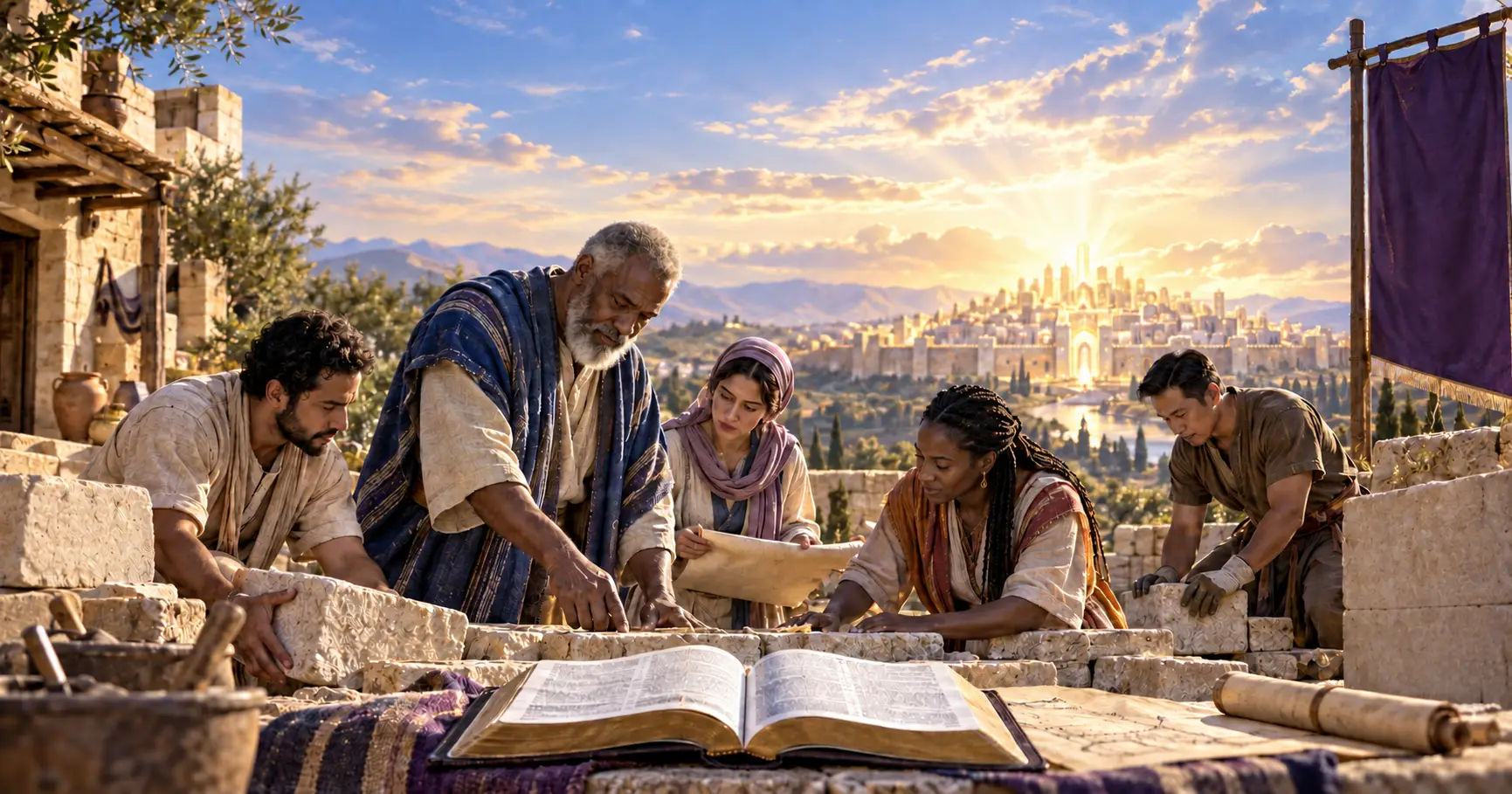
Revelation 21:7
“The one who overcomes will inherit all things, and I will be his God, and he will be My son.” BSB
All Scripture quotations are from the Berean Standard Bible.
The Kingdom Must Become Visible on Earth
Jesus taught us to pray:
Matthew 6:10 BSB
(10) Your kingdom come, Your will be done, on earth as it is in heaven.
This prayer calls the church to more than an expectation of heaven in the future. It calls us to administer the order, nature and purpose of God in the earth now, while we continue to look forward to the fullness of His kingdom.
Kingdom administration is the faithful stewardship of what God entrusts to us. It includes people, relationships, doctrine, resources, responsibilities and systems. Its purpose is not to make our own names great. Its purpose is to make Christ visible and to establish households that can carry His nature and assignment from one generation to another.
Revelation 21 presents the holy city as a bride prepared for her husband and as the dwelling place of God among His people. Within that picture we see family, care, government and inheritance. God wipes away tears, calls a people His own and promises an inheritance to the one who overcomes. The city is therefore not merely a collection of individuals. It is an ordered people who live under the rule of God.
This generational dimension of administration is best described as a Kingdom dynasty. We are not called to build monuments to personal achievement. We are called to form people who can continue faithfully in Christ after our own role has changed.
Administration Begins with a Household
Divine government is relational before it is institutional. God reveals Himself as Father, gathers a household and brings His people into mature sonship. Spiritual sonship describes covenant identity, maturity, responsibility and inheritance. It applies to both men and women in Christ; it is not a statement about gender. A spiritual son knows that he or she belongs to the Father, receives His nature and accepts responsibility for His purpose.
An orphaned mindset asks what it can receive while remaining detached from responsibility. A son builds, serves, protects covenant relationships and takes ownership of the Father’s purpose. This does not mean that a son becomes controlled by another person. Healthy spiritual fathering connects sons to the heavenly Father and equips them to hear, obey and represent Christ for themselves.
The household also changes how we understand care. Scripture clearly commands the church to care for the poor, widows, orphans, the elderly and those in distress. Yet this care should not be left to the pastor or a small welfare department. In a Kingdom household, believers bear one another’s burdens and take practical responsibility for their neighbours. The aim is loving support that restores dignity, belonging, maturity and participation rather than permanent dependence.
Inheritance Belongs to Overcomers
Revelation 21:7 BSB
(7) The one who overcomes will inherit all things, and I will be his God, and he will be My son.
Revelation 21:7 joins sonship, overcoming and inheritance. The letters to the seven churches make the same connection. God’s people must overcome lost love, compromise, spiritual deadness, controlling influences and lukewarmness. Inheritance is therefore more than receiving a position. It is receiving the capacity to represent the Father’s rule with faithfulness.
Salvation brings us before the throne in worship, but maturity also trains us to share in Christ’s rule.
Revelation 3:21 BSB
(21) To the one who overcomes, I will grant the right to sit with Me on My throne, just as I overcame and sat down with My Father on His throne.
Revelation 3:21 promises the overcomer a place with Christ on His throne. Kingdom administration prepares sons to carry responsibility without using authority for personal power.
Legacy and Kingdom Dynasty
A legacy can be a good testimony. It may preserve the memory of faithful work, wisdom or sacrifice. Memory alone, however, cannot carry an assignment into the next generation. A Kingdom dynasty requires living people who have been formed to continue what God initiated.
| Legacy | Kingdom Dynasty |
|---|---|
| Asks what will remain after me | Asks what will continue through us |
| Preserves what a founder accomplished | Reproduces what God placed within a household |
| Often becomes visible after a leader departs | Is received through shared labour in the present |
| May rest in buildings, programmes, documents or reputation | Lives in formed people, covenant culture and ordered relationships |
| Can become static when people only remember the past | Multiplies when sons raise sons who carry Christ forward |
The central distinction is simple. A legacy preserves what a father accomplished. A dynasty reproduces what the father carries from God.
Inheritance Through Shared Labour
In a natural estate, an inheritance is usually transferred after death. In an apostolic household, inheritance begins while father and son are still labouring together. The son learns the doctrine, nature, values and assignment of the household by participating in the work. As the son matures and begins to build a household, the father continues to support, counsel and labour with the son. This is co-regency.
Co-regency must never become control. A spiritual father does not own a son’s calling, and a son does not exist to preserve a father’s personal status. Both belong to Christ and remain accountable to Him. A mature father releases responsibility without withdrawing love, wisdom or prayer. A mature son honours the grace received while accepting responsibility for the assignment.
Ministry functions may change with age, health or capacity, but there is no retirement from listening to God, blessing the next generation, praying, imparting wisdom and strengthening those who now carry greater operational responsibility. The form of the labour may change while the covenant remains.
Abraham Built a Household That Could Carry the Assignment
Genesis 14:14 BSB
“And when Abram heard that his relative had been captured, he mobilized the 318 trained men born in his household, and they set out in pursuit as far as Dan.” BSB
Abram’s 318 trained men were not casual spectators around a successful leader. They were formed within his household, trusted with responsibility and able to act with him when the household faced a crisis. The measure of Abram’s building was not only what he possessed. It was what had become reproducible in people.
Paul later identifies those who have faith as sons of Abraham and those who belong to Christ as Abraham’s seed and heirs according to the promise.
Galatians 3:7 BSB
(7) Understand, then, that those who have faith are sons of Abraham.
Galatians 3:29 BSB
(29) And if you belong to Christ, then you are Abraham’s seed and heirs according to the promise.
Abraham’s dynasty was therefore larger than biological descent. God established a lineage of faith that would carry covenant purpose across generations.
David Received a House and a Kingdom
2 Samuel 7:16 BSB
“Your house and kingdom will endure forever before Me, and your throne will be established forever.”
God’s promise to David joins household, kingdom and throne. The movement is from a house to government and from one generation to transgenerational authority. David’s later sons were measured by whether they walked in his covenantal ways. Jehoshaphat, Hezekiah and Josiah lived generations later, yet Scripture could still describe David as their father because they returned to the God-centred pattern associated with his house.
David also learned that zeal cannot replace divine order. When the ark was first transported on a cart, the method was wrong even though the desire appeared sincere. Later the ark was carried according to God’s instruction through consecrated people, shared participation, sacrifice and worship. Dynasty is preserved through a culture of obedience, not through occasional spiritual events.
Paul and Timothy Show Reproducible Ministry
2 Timothy 2:2 BSB
“And the things that you have heard me say among many witnesses, entrust these to faithful men who will be qualified to teach others as well.”
This verse contains four generations of transmission: Paul, Timothy, faithful people and those whom they would teach. Paul did not ask Timothy merely to preserve notes about his ministry. Timothy had carefully followed Paul’s teaching, conduct, purpose, faith, patience, love and perseverance.
2 Timothy 3:10 BSB
(10) You, however, have observed my teaching, my conduct, my purpose, my faith, my patience, my love, my perseverance,
He could therefore represent the same apostolic intention in another place without becoming a copy of Paul’s personality.
A true dynasty is visible when the word, nature and mission of Christ can be entrusted to faithful people who are able to teach and form others.
How Kingdom Dynasties Are Built
Developed Through Spiritual Fathers
A dynasty begins when a pioneer receives a God-given vision, establishes a path and embodies a pattern that can be reproduced. The primary work of a father is to feed God’s people with the word, model obedience and connect sons to the heavenly Father. Fathering is doctrinal and covenantal before it is sentimental. Personal affection is valuable, but it cannot replace truth, formation and responsibility.
Formed Through Covenant Culture
Acts 2:42 BSB
“They devoted themselves to the apostles’ teaching and to the fellowship, to the breaking of bread and to prayer.”
Doctrine, fellowship, breaking of bread and prayer formed the daily culture of the first church. These were not occasional events added to a programme. They were repeated practices that shaped the people. A dynasty becomes stable when Kingdom truth and behaviour become the household’s learned way of life.
Led by the Holy Spirit
Romans 8:14 BSB
“For all who are led by the Spirit of God are sons of God.” BSB
A spiritual household cannot be sustained by human organisation alone. Plans and structures are necessary, but they must serve what the Spirit is saying. David’s experience with the ark demonstrates that sincerity and energy cannot substitute for divine order. Kingdom dynasties grow as fathers and sons remain yoked to the Spirit and willing to correct their methods.
Nurtured by Servant Sons
Dynasty requires people who serve the vision faithfully. Joseph served in Potiphar’s house, in prison and eventually in Pharaoh’s administration. Service developed his capacity to govern. Biblical servanthood is not slavery, manipulation or the loss of identity. It is the willing use of one’s grace and strength for the good of the household and the advancement of God’s purpose.
United in Shared Life and Purpose
Acts 2:44 BSB
(44) All the believers were together and had everything in common.
Acts 2:44 says that the believers were together and had all things in common. A Kingdom household gathers around a shared Christ, shared doctrine, shared values and shared purpose. This unity is not uniformity. Sons may differ in personality, culture, age, race and gifting, yet they carry the same covenant mind and advance the same divine assignment.
Ordered Through Strategic Administration
Vision needs structure. David organised Levites, priests, musicians and gatekeepers around the ark. In the same way, a household needs clear functions, accountable stewardship and wise deployment. A dynasty is not a crowd held together by enthusiasm. It is an ordered body in which every member knows where and how to serve. When someone is absent, a real function is missing.
Rooted in Righteousness
Proverbs 12:7
“The wicked are overthrown and perish, but the house of the righteous will stand.” BSB
The enduring treasure of a Kingdom dynasty is not money, property or prominence. It is righteousness expressed through character, truth, covenant faithfulness and reverence for God. Material resources can support an assignment, but they cannot preserve it when the household loses its moral centre. Righteousness makes the house trustworthy because everyone understands that the assignment belongs to God and must be handled as sacred.
Established by Wisdom
Proverbs 24:3–4
“By wisdom a house is built and by understanding it is established; through knowledge its rooms are filled with every precious and beautiful treasure.” BSB
Wisdom turns vision into architecture. It discerns what must be built, where people should function, which boundaries protect the household and how truth will be preserved. Good administration does not compete with spiritual life. It gives spiritual purpose a trustworthy form through which people can grow and serve.
Proved by Generational Reproduction
Proverbs 17:6
“Grandchildren are the crown of the aged, and the glory of a son is his father.” BSB
The evidence of successful fathering is not the number of people who gather around a father. It is the appearance of sons who can raise sons. Books, buildings and programmes may be useful, but they are not the final measure. The crowning joy of a spiritual father is to see Christ reproduced in a second and third generation that can carry responsibility faithfully.
Outward Succession Is Not Always a Dynasty
Judges 10:3–5 records that Jair judged Israel for twenty-two years and had thirty sons who rode thirty donkeys and controlled thirty towns. The picture suggests influence, prosperity and visible succession. Yet the next verse states that Israel again did evil in the sight of the Lord and served other gods.
Judges 10:6 BSB
(6) And again the Israelites did evil in the sight of the LORD. They served the Baals, the Ashtoreths, the gods of Aram, Sidon, and Moab, and the gods of the Ammonites and Philistines. Thus they forsook the LORD and did not serve Him.
Scripture does not give us every detail of Jair’s household, so we should not claim more than the text says. It does show that family prominence, territorial influence and numerical strength did not guarantee covenant faithfulness in the next season. Biological descendants are not by themselves a spiritual dynasty. A Kingdom dynasty exists where people carry the nature, truth and assignment of God.
Protecting What God Builds
A God-established dynasty is protected by the Lord’s faithfulness, but every generation must choose to remain aligned with Him. Sons can remove themselves from active participation through disobedience, rivalry, dishonour, dishonest stewardship or unrighteous conduct. Gehazi, Achan, Absalom, Adonijah, and Ananias and Sapphira each show how character failure can separate a person from a God-given purpose.
A household protects its continuity when it does the following
- Keeps Christ, rather than a founder’s personality, at the centre
- Preserves sound doctrine and teaches each generation why it matters
- Practises fellowship, the breaking of bread and prayer as a way of life
- Maintains righteousness, accountability and honest financial stewardship
- Refuses rivalry, personal ambition and competition between brothers and sisters
- Honours fathers without making them idols and releases sons without abandoning them
- Allows every generation to encounter God and obey the Spirit personally
Protection is therefore not the policing of loyalty to a human leader. It is the patient work of keeping the household aligned with Christ, Scripture, righteousness and covenant responsibility.
Christ Is the Inheritance
1 Corinthians 11:1 BSB
“You are to imitate me, just as I imitate Christ.” BSB
The goal of spiritual reproduction is not to duplicate a father’s accent, mannerisms, preferences or personality. A father can say “imitate me” only to the extent that he is imitating Christ. The inheritance is Christ Himself: His nature, His truth, His righteousness and His mission expressed through a particular household.
No spiritual father owns the sons whom God entrusts to him. Like Abraham placing Isaac before God, fathers must release sons to the Lord and trust the heavenly Father to direct their future. A father succeeds when sons can hear God, walk in righteousness, serve the body, carry responsibility and reproduce the life of Christ in others.
Questions for Personal and Household Evaluation
- Am I building something that depends on my presence, or am I forming people who can carry Christ and the assignment faithfully?
- Is our ministry sustained mainly by events, or have doctrine, fellowship, breaking of bread and prayer become our culture?
- Are the people I father becoming more dependent on me, or more securely connected to the heavenly Father?
- Are sons receiving inheritance through meaningful shared labour now, or are they waiting for a future handover?
- Do our structures give every person a clear function, appropriate accountability and room to mature?
- Is righteousness the true treasure of our household, especially in relationships, authority and finances?
- Can I identify sons who are already raising sons and reproducing Christ beyond my direct reach?
Conclusion
A legacy may tell the story of a faithful life. A Kingdom dynasty ensures that the life of Christ continues through a faithful people. The goal is not to make our ministries permanent or to preserve our personal names. The goal is to administer heaven on earth by forming households that can carry God’s nature, order and purpose from generation to generation.
A house becomes a people. The people become an ordered household. The ordered household becomes capable of carrying the assignment into another generation. This is how fathers and sons become faithful administrators of heaven on earth. This is how we build dynasties rather than monuments.
OTHER PUBLICATIONS BY THIS AUTHOR CAN BE FOUND AT: