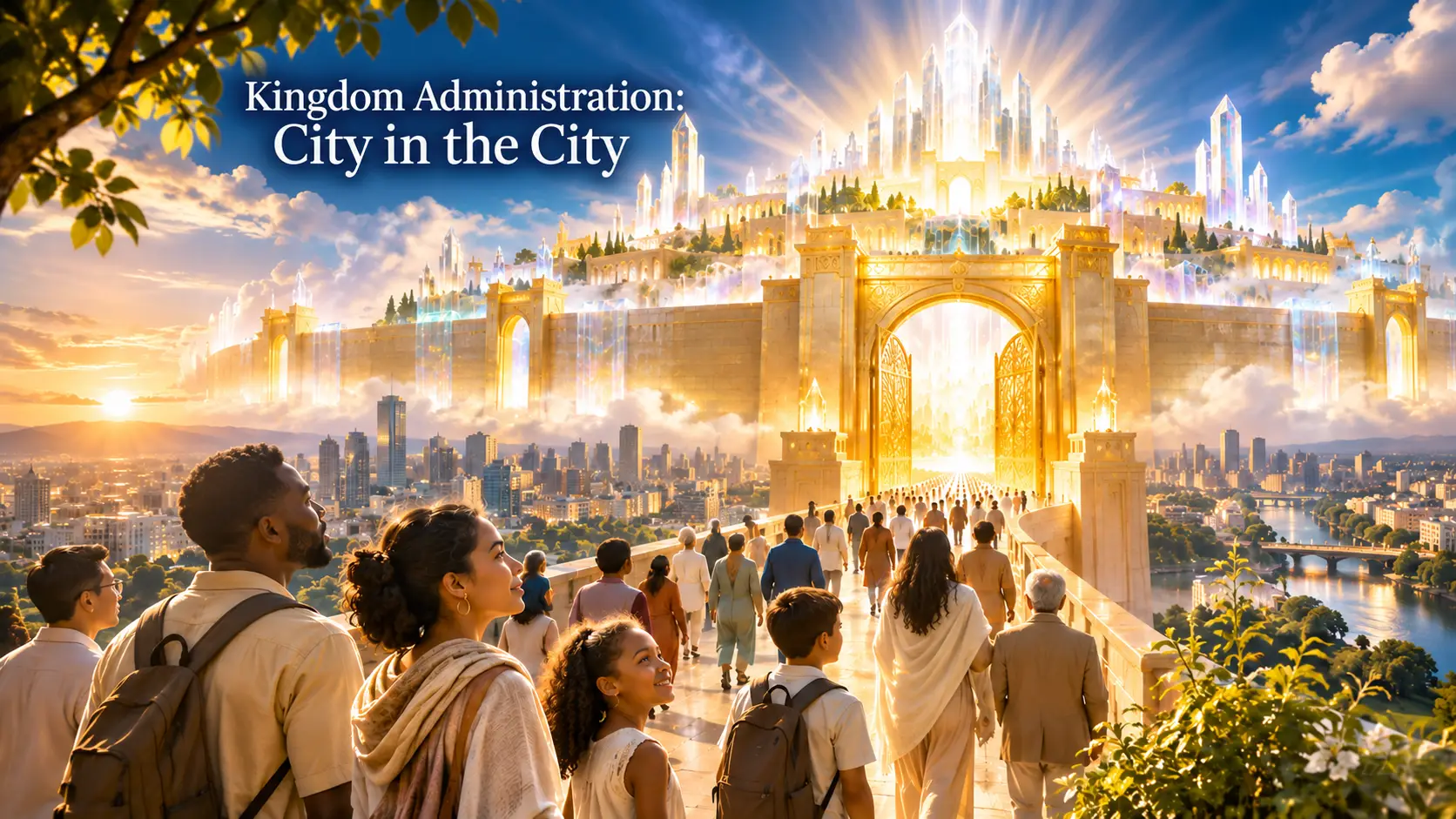
A biblical teaching by Herman Bouwer
Subtitle: How the people of God can become a visible community of Christ’s order, character, maturity, and light within the city where He has placed them.
Key Scripture: Revelation 21:1–3 (BSB)
Revelation gives John a vision of the holy city, the New Jerusalem, coming down from God. The vision reaches its fulfilment in the new creation, when God dwells with His people. The city is described as a bride, and its defining reality is the presence of God and the Lamb. This is more than an image of buildings: it is a picture of a people brought into covenant life with God.
The Church does not replace that future hope or claim to have arrived at its fullness. Yet the people of Christ are called now to bear witness to the life of the coming Kingdom. In that sense, the Church is to be a “city in the city”—a community within earthly society whose shared life makes the character of Jesus visible. Revelation 21:1–27 gives us a rich picture of the qualities that should shape this witness.
1. Governmental Authority: Life Ordered Under Christ
John sees twelve foundations bearing the names of the apostles of the Lamb (Revelation 21:14). The number and the foundations evoke the ordered, covenant people of God. The Church’s authority is therefore not self-created. It rests on the apostolic witness to Jesus Christ, the Lamb, and serves His purposes.
Biblical government begins with the reign of Christ. Isaiah 9:6–7 speaks of the government resting on the promised Son, while Colossians 1:13 describes believers as transferred into the kingdom of God’s beloved Son. This authority is expressed through righteousness, peace, justice, truth, and loving service—not control or personal status. A household shaped by Christ seeks His order in its relationships; a congregation shaped by Christ equips people to serve; and the Church’s public witness commends what is just and life-giving (Isaiah 32:16–18).
2. Integrity: One Standard in Every Place
The city is measured as a perfect square, with its dimensions equal (Revelation 21:15–16). The text gives the city a striking symmetry. As an application of this image, we can consider the integrity of a life in which confession, thought, speech, and conduct belong together.
James 1:22 calls believers to be doers of the word, not hearers only. Proverbs 11:1 commends honest measures, and Jesus teaches His disciples to speak plainly and truthfully (Matthew 5:37). Integrity is tested in ordinary decisions: keeping commitments, telling the truth when it costs us, treating people fairly, and accepting the same standard we ask of others. The Church’s teaching gains credibility when its shared practice reflects the Gospel it proclaims.
3. Maturity: A People Growing into Christ
John records the measurement of the city’s wall (Revelation 21:17). The outline applies this picture to the Church’s corporate maturity. Ephesians 4:11–16 gives a clear foundation for that application: Christ gives ministry gifts to equip the saints, build up His body, and bring believers toward unity and maturity in Him.
Maturity is not merely the accumulation of information or the appearance of strength. It is growth into Christ, the Head—learning truth, exercising discernment, serving with our gifts, and remaining steady when confronted by misleading teaching (Ephesians 4:14–16; Hebrews 5:14). A mature community makes room for every member to contribute while remaining accountable to Christ and to the truth of Scripture.
4. Transparency: A Life That Can Be Examined
The city’s materials are described as pure gold, like clear glass, and its gates are made of pearl (Revelation 21:18, 21). The imagery communicates splendour and purity. As a spiritual application, it invites the Church to live without a hidden double standard, allowing the character of Christ to be seen in its life together.
Transparency does not mean carelessness with people’s privacy. It means refusing deception, welcoming truthful correction, and bringing our lives under the searching light of God’s Word. Psalm 139:23–24 models a readiness for God to examine the heart; Galatians 2:20 points to a life in which Christ is being formed and expressed. When a church can acknowledge wrong, pursue holiness, and make meaningful changes, its witness becomes more trustworthy.
5. Precious Stones: Different Lives Built Together
The foundations of the city are adorned with many kinds of precious stones (Revelation 21:19). The variety suggests beauty that is not uniform. Scripture describes believers as living stones being built into a spiritual house and as members with different gifts in one body (1 Peter 2:4–5; Romans 12:4–8; 1 Corinthians 12:18).
Kingdom administration recognises the grace and contribution God gives to each person, then helps each one take a faithful place in the Body of Christ. Unity does not erase difference; it orders our differences toward a shared purpose. The Church is also called a royal priesthood (1 Peter 2:9), a people whose worship and service point beyond themselves to the wisdom of God and the good of the nations.
6. From Natural Sight to Spiritual Understanding
John sees no temple in the city, because the Lord God Almighty and the Lamb are its temple; the glory of God gives it light (Revelation 21:22–23). The vision centres the people’s life on God’s immediate presence. It does not teach contempt for creation or ordinary human responsibilities. Rather, it reveals that every part of life finds its meaning and direction in God.
Paul writes of the Spirit who enables believers to understand what God has given (1 Corinthians 2:12–16), and he asks that the eyes of the heart be enlightened (Ephesians 1:17–18). Spiritual understanding reshapes how we see our homes, work, neighbourhoods, and public life. We learn to weigh circumstances by the wisdom of Christ and to let God’s Word illuminate the path ahead (Psalm 119:130).
7. The Glory of the Nations: Christ’s Light for Public Life
Revelation pictures the nations walking by the city’s light and bringing their glory and honour into it (Revelation 21:24–26). The imagery presents a hope in which the nations are not erased. Their honour is brought into the light of God. Isaiah 60:1–3 also portrays the nations drawn toward the light of the Lord, while Ephesians 3:10 speaks of God’s wisdom being made known through the Church.
This vision encourages the Church to engage society with humility and courage. The skills, creativity, learning, and resources present among peoples can be directed toward what is good, truthful, and just. Believers serve their neighbours and contribute to the common good while bearing witness to Christ, whose light exposes evil and gives hope.
Practising the “City in the City” Calling
This calling takes shape in daily life. Families can set aside regular time to read Scripture together and remember Christ’s work, including through communion in keeping with their church’s practice. Congregations can ask whether their relationships, leadership, teaching, and care reflect the integrity and maturity described in Scripture. Individual believers can identify one concrete way to serve their neighbours, strengthen a relationship, or use a God-given gift for the good of others.
For Reflection
- Where is Christ’s order bringing greater truth, justice, or peace into my daily relationships?
- Do my words and actions reflect the same convictions?
- What gift or responsibility can I use to strengthen my local church and neighbourhood?
- How can our congregation make the character of Jesus more visible in the life of our city?
Conclusion
The New Jerusalem is the Bible’s vision of God dwelling fully with His redeemed people. It gives the Church a horizon of hope and a pattern for faithful witness today. As a people formed under Christ’s authority, marked by integrity, growing toward maturity, open to truth, joined in diverse gifts, guided by spiritual understanding, and serving among the nations, the Church can become a visible sign of the Kingdom in the place where God has set it.
Continue reading: Kingdom Radiance: Becoming the Visible Expression of Christ and Hope for Our Nations.
Scripture references in this article follow the Berean Standard Bible (BSB).
OTHER PUBLICATIONS BY THIS AUTHOR CAN BE FOUND AT: