BREAKING FREE FROM ORPHANITY INTO SONSHIP
INTRODUCTION
Poverty is often viewed purely through an economic lens—lack of money, resources, or opportunity. Yet Scripture reveals a deeper reality: poverty frequently begins as a mindset before it manifests as a condition.
At the root of this mindset is what can be described as an orphan spirit—a way of thinking and living that is disconnected from the Father’s provision, identity, and covenant.
Until the orphan mindset is confronted and replaced with sonship, poverty—whether spiritual, emotional, or financial—will continue to reproduce itself not only in the life of a believer but in that of every individual maintaining such a mindset.
POVERTY BEGINS IN THE MIND
Proverbs clearly establish the connection between thinking and reality:
Proverbs 23:7 (NKJV)
(7) For as he thinks in his heart, so is he. “Eat and drink!” he says to you, But his heart is not with you.
This scripture also warns us not to envy the lifestyles of those who have become rich by being stingy and miserly, and not to gain their favour by fawning over them. Their “friendship” is phony—they will just use you for their own gain. This behaviour is what feeds their orphanity.
We need to understand that a person who sees themselves as lacking, abandoned, or unsupported will live out that belief—even when provision is available.
Romans 12:2 (NKJV)
(2) And do not be conformed to this world, but be transformed by the renewing of your mind, that you may prove what is that good and acceptable and perfect will of God.
Paul warned Christians: “Don’t copy the behaviour and customs of this world” that are usually selfish and often corrupting. Wise Christians decide that much worldly behaviour is off-limits for them. Our refusal to conform to this world’s values, however, must go even deeper than just behaviour and customs; it must be firmly planted in our mind: “Let God transform you into a new person by changing the way you think.”
Remember It is possible to avoid most worldly customs and still be proud, covetous, selfish, stubborn, and arrogant. Only when the Holy Spirit renews, re-educates, and redirects our mind are we truly transformed.
Romans 8:5 NKJV
(5) For those who live according to the flesh set their minds on the things of the flesh, but those who live according to the Spirit, the things of the Spirit.
Transformation is not external first—it is internal. Poverty cannot be broken externally if it is still rooted internally. It is very much an issue of the heart.
THE ROOT: ORPHANITY VS SONSHIP
Jesus came to restore our relationship with the Father:
John 14:18 (NKJV)
(18) I will not leave you orphans; I will come to you.
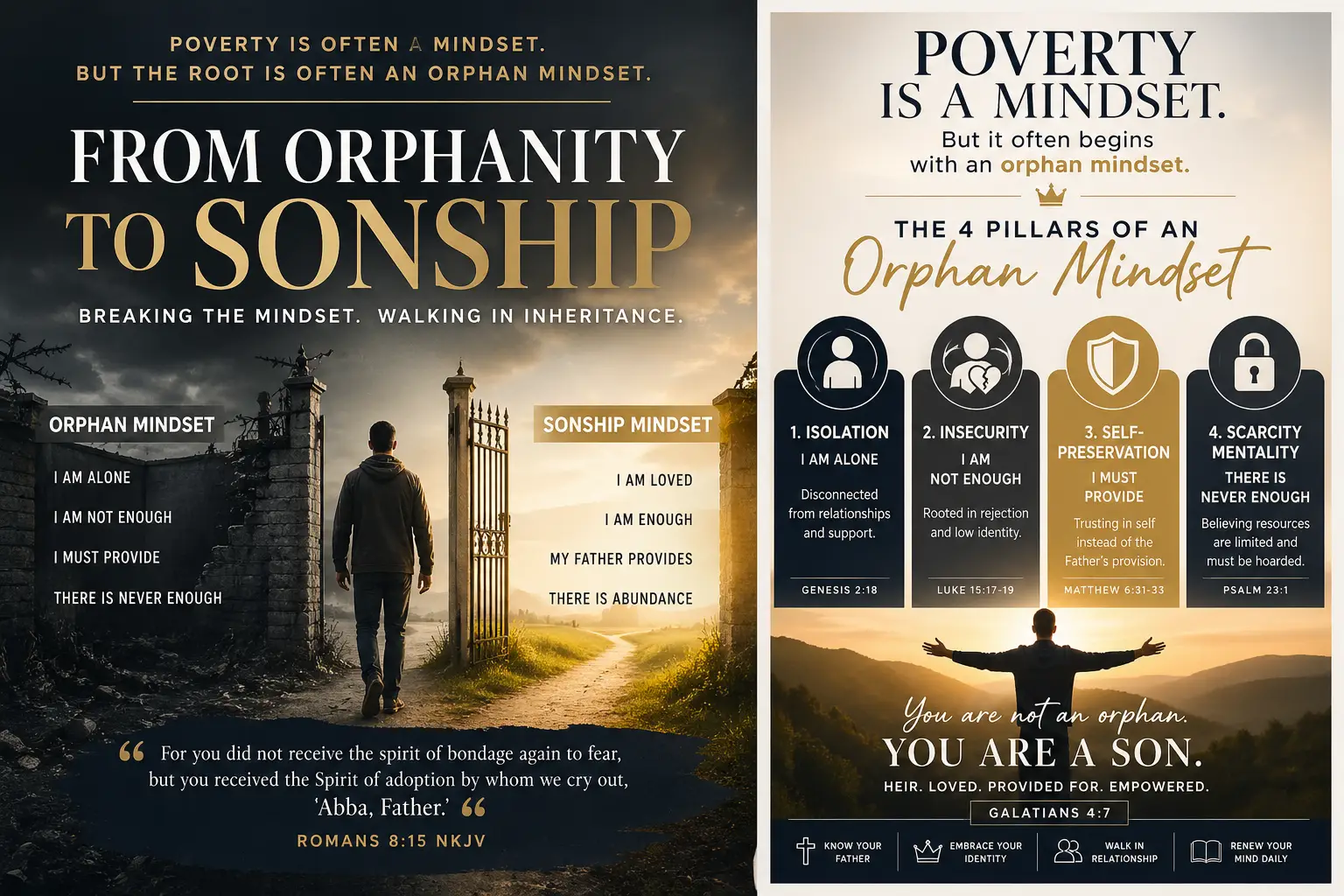
This statement is profound—because it reveals that orphanity is a spiritual condition, not just a natural disposition. The truth of the matter is that you can have a lot of money and still function with an orphan mindset.
An orphan mindset says:
- I am alone
- I must fend for myself
- No one is responsible for me
- Resources are scarce
But a sonship mindset declares:
Romans 8:15–17 (NKJV)
(15) For you did not receive the spirit of bondage again to fear, but you received the Spirit of adoption by whom we cry out, “Abba, Father.”
(16) The Spirit Himself bears witness with our spirit that we are children of God,
(17) and if children, then heirs—heirs of God and joint heirs with Christ, if indeed we suffer with Him, that we may also be glorified together.
Paul uses adoption to illustrate the believer’s new relationship with God. In Roman culture, the adopted person lost all rights in his old family and gained all the rights of a legitimate child in his new family. He became a full heir to his new father’s estate.
Likewise, when a person becomes a Christian, he or she gains all the privileges and responsibilities of a child in God’s family. One of these outstanding privileges is being led by the Spirit of God. We may not always feel as though we belong to God, but the Holy Spirit is our witness. His inward presence reminds us of who we are and encourages us with God’s love.
We are no longer like “fearful slaves”; instead, we are the Master’s children. What a privilege! Because we are God’s children, we share in great treasures as co-heirs. God has already given us his best gifts: his Son, his Holy Spirit, forgiveness, and eternal life; and he encourages us to ask him for whatever we need.
As a result you can see how sonship establishes identity, inheritance, and security—three things that the orphan mindset lacks.
THE FOUR PILLARS OF AN ORPHAN MINDSET
To dismantle poverty at its root, we must understand the structure that sustains it. The orphan mindset is built on four pillars:
- Isolation
- Insecurity
- Self-preservation
- Lack or Scarcity Mentality
Lets take a moment and break this down in more detail for a deeper understanding of these pillars.
-
Isolation (I Am Alone)
The orphan believes they must survive independently. This leads to disconnection from relationships, accountability, and covering.
Genesis 2:18 (NKJV)
(18) And the LORD God said, “It is not good that man should be alone; I will make him a helper comparable to him.”
God’s creative work was not complete until he made woman. He could have made her from the dust of the ground, as he made man. God chose, however, to make her from the man’s flesh and bone. In so doing, he illustrated for us that in marriage man and woman symbolically are united into one. This is a mystical union of the couple’s hearts and lives. Throughout the Bible, God treats this special partnership seriously. The goal in marriage should be more than friendship; it should be oneness.
Isolation removes the flow of wisdom, provision, and support that comes through divine relationships.
Ecclesiastes 4:9–10 (NKJV)
(9) Two are better than one, Because they have a good reward for their labor.
(10) For if they fall, one will lift up his companion. But woe to him who is alone when he falls, For he has no one to help him up.
Cooperating with others has advantages. Life is designed for companionship, not isolation, for intimacy, not loneliness. Some people prefer isolation, thinking they cannot trust anyone. We are not here on earth to serve ourselves, however, but to serve God and others. Don’t isolate yourself and try to go it alone. Seek companions; and be a team member. That is one of the reasons why it is important to be actively involved as part of a Household.
Isolation sustains poverty because it cuts off access to the collective strength within the Body of Christ.
-
Insecurity (I Am Not Enough)
The orphan mindset is rooted in rejection and low and poor self-identity and self-image. It constantly strives but never feels sufficient.
Luke 15:17–19 (NKJV) (The prodigal son)
(17) “But when he came to himself, he said, ‘How many of my father’s hired servants have bread enough and to spare, and I perish with hunger!
(18) I will arise and go to my father, and will say to him, “Father, I have sinned against heaven and before you,
(19) and I am no longer worthy to be called your son. Make me like one of your hired servants.” ‘
The younger son, like many who are rebellious and immature, wanted to be free to live as he pleased, and he had to hit bottom before he came to his senses. It often takes great sorrow and tragedy to cause people to look to the only One who can help them—Jesus. Are you trying to live life your own way, selfishly pushing aside any responsibility or commitment that gets in your way? Stop and look before you hit bottom. You will save yourself and your family much grief.
Even when returning home, the prodigal son still thought like an orphan.
Insecurity leads to:
- Fear of failure
- Fear of loss
- Settling for less than God’s provision
But sonship restores our identity:
2 Corinthians 5:17 (NKJV)
(17) Therefore, if anyone is in Christ, he is a new creation; old things have passed away; behold, all things have become new.
Christians are brand-new people on the inside. The Holy Spirit gives them new life, and they are not the same anymore. We are not reformed, rehabilitated, or re-educated—we are re-created (new creations), living in vital union with Christ. At conversion we do not merely turn over a new leaf; we begin a new life under a new Master.
Colossians 2:6-7 NKJV
(6) As you therefore have received Christ Jesus the Lord, so walk in Him,
(7) rooted and built up in Him and established in the faith, as you have been taught, abounding in it with thanksgiving.
While this newness is true individually, Paul is saying much more. Not only are believers changed from within, but a whole new order of creative energy began with Christ. There is a new covenant, a new perspective, a new body, a new church. All of creation is being renewed. So take notice. This is not a superficial change that will be quickly superseded by another novelty. This is an entirely new order of all creation under Christ’s authority. It requires a new way of looking at all people and all of creation. Does your life reflect this new perspective?
-
Self-Preservation (I Must Provide for Myself)
The orphan trusts in personal effort above divine provision. This results in striving, fear-driven decisions, and often greed or scarcity thinking.
Matthew 6:31–32 (NKJV)
“Therefore do not worry, saying, ‘What shall we eat?’ or ‘What shall we drink?’… For your heavenly Father knows that you need all these things.”
Self-preservation produces anxiety and toil, instead of trust.
Contrast this with Kingdom priority:
Matthew 6:33 (NKJV)
(33) But seek first the kingdom of God and His righteousness, and all these things shall be added to you.
To “seek the Kingdom of God above all else” means to put God first in your life, to fill your thoughts with his desires, to take his character for your pattern, and to serve and obey him in everything. What is really important to you? People, objects, goals, and other desires all compete for priority. Any of these can quickly become most important to you if you don’t actively choose to give God first place in every area of your life.
Living your life from a place of an orphan mentality will keep you from walking in the fullness of what God has for you.
-
Scarcity Mentality (There Is Never Enough)
The orphan believes resources are limited and must be hoarded.
This mindset leads to:
- Fear of giving
- Competition instead of collaboration
- Jealousy and comparison
Yet Scripture reveals God as an abundant Father:
Psalm 23:1 (NKJV)
“The Lord is my shepherd; I shall not want.”
Remember that sheep are completely dependent on the shepherd for provision, guidance, and protection. ARE YOU SUCH A SHEEP?
2 Corinthians 9:8 (NKJV)
(8) And God is able to make all grace abound toward you, that you, always having all sufficiency in all things, may have an abundance for every good work.
The orphan will hesitate to give generously to God because they worry about having enough money left over to meet their own needs. Paul assured the Corinthians that God was able to meet their needs. The person who gives only a little will receive only a little in return. Don’t let a lack of faith keep you from giving cheerfully and generously.
Remember that scarcity thinking blocks generosity—and generosity is a key to Kingdom increase.
BREAKING THE POVERTY-ORPHAN CYCLE
The solution is not merely financial—it is relational and transformational.
- Restore Relationship with the Father
You cannot walk in provision if you do not know the Provider.
- Embrace Sonship Identity
You are not a survivor—you are an heir.
- Align with Covenant Relationships
Provision often flows through people God connects you to.
- Renew the Mind Daily
Replace orphan thinking with Kingdom truth through saturating yourself and your mind with the Word of God.
CONCLUSION
Poverty is not just about lack—it is about disconnection.
An orphan mindset produces limitation, but a sonship mindset unlocks inheritance.
God’s desire is not merely to supply your needs—but to restore your identity.
Galatians 4:7 (NKJV)
(7) Therefore you are no longer a slave but a son, and if a son, then an heir of God through Christ.