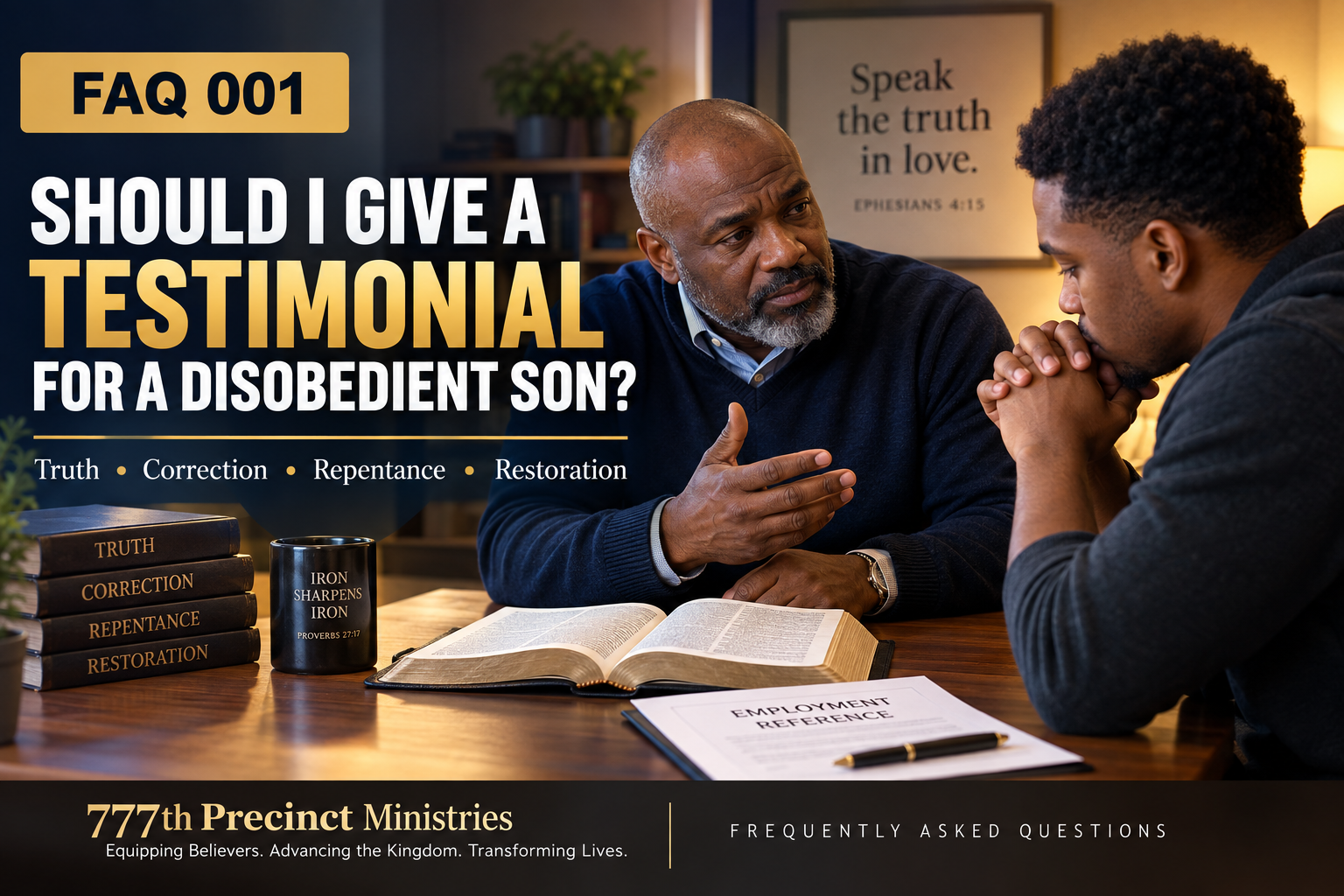
SHOULD A SPIRITUAL FATHER GIVE A WORK TESTIMONIAL FOR A DISOBEDIENT SON?
A spiritual father must never use a testimonial to control a son, but neither should he give an endorsement that is untrue. Biblical fathering requires truth spoken in love, correction aimed at restoration, and grace that never compromises integrity.
1. Introduction
A difficult situation can arise when a spiritual son or daughter approaches a spiritual father asking for a testimonial, character reference or recommendation for employment while there are unresolved matters of disobedience, poor character, broken relationship or resistance to correction.
What should the father do?
Should he refuse the testimonial because of the unresolved behaviour? Should he give it because the son needs employment? Would refusing it become punishment or manipulation? Would giving it compromise the father’s integrity?
The answer requires more than simply asking whether the son has been obedient to the father. We must ask whether the father can truthfully and responsibly testify concerning the person’s character, conduct and suitability for the particular responsibility.
Biblical fathering must always operate under the authority of Christ and Scripture. A spiritual father is a steward of a relationship; he is not the owner of another person’s life.
| QUESTION |
| As a spiritual father, am I supposed to give a testimonial or work referral for a son who is walking in disobedience? |
| SHORT ANSWER |
| A spiritual father should never give a false or misleading testimonial. If unresolved disobedience involves dishonesty, irresponsibility, rebellion, lack of integrity or behaviour that is directly relevant to the employment being sought, the father cannot honestly give an unqualified positive recommendation. However, a testimonial must also never be used as a weapon of control or punishment. A spiritual father should not obstruct someone’s employment merely because that person disagrees with him, leaves a ministry, questions a decision, or does not follow a personal preference that cannot clearly be established from Scripture. Where genuine sin or destructive behaviour is present, the goal of the father must be correction, repentance, restoration and maturity. Where possible, he may provide a truthful factual reference while declining to endorse qualities he cannot honestly affirm. The governing principle is therefore: Truth without control. Grace without compromise. Correction with restoration as its goal. |
2. Spiritual Immaturity Can Affect Discernment
Disobedience is sometimes connected to spiritual immaturity. A person may genuinely believe that he or she is acting correctly while lacking the maturity necessary to discern what is happening internally.
Hebrews 5:12–14 (BSB)
12 Although by this time you ought to be teachers, you need someone to reteach you the basic principles of God’s word. You need milk, not solid food!
13 For everyone who lives on milk is still an infant, inexperienced in the message of righteousness.
14 But solid food is for the mature, who by constant use have trained their senses to distinguish good from evil.
Spiritual maturity develops discernment. The immature believer may react primarily from emotion, personal preference, offence, independence or limited understanding. The mature believer increasingly learns to distinguish between what feels right and what actually agrees with God’s Word.
This is one of the functions of biblical fathering. The father does not merely condemn immaturity; he helps the son mature. Correction should therefore become an opportunity for development rather than rejection.
2 Timothy 3:16 (BSB)
16 All Scripture is God-breathed and is useful for instruction, for conviction, for correction, and for training in righteousness.
Notice that Scripture does not merely expose what is wrong. It also corrects and trains. The purpose of correction is restoration into righteousness.
3. We Must First Define Disobedience Correctly
Before refusing a testimonial because a son is “disobedient,” the spiritual father must ask an important question:
| A KEY QUESTION |
| Disobedient to whom—and concerning what? |
There is a major difference between disobedience to God and clear biblical truth; persistent dishonesty or immoral behaviour; refusal to accept legitimate correction; irresponsibility or broken commitments—and merely disagreeing with the spiritual father, choosing a different method, leaving a particular ministry, following a different calling, asking legitimate questions, or refusing something that is merely the father’s personal preference.
A spiritual father must never assume that disagreement with him automatically equals rebellion against God.
Healthy spiritual fathering directs sons toward Christ, not permanent dependence upon the father. A father must therefore examine his own heart before judging the son’s.
The question is not: “Has this person obeyed me?” The deeper question is: “Is there demonstrable behaviour contrary to Scripture, truth, integrity and mature Christian character?”
This distinction protects biblical fathering from becoming controlling or manipulative.
4. Truth Must Govern Every Testimonial
A testimonial is fundamentally a statement of witness. When someone asks us to recommend them, they are asking us to place our credibility behind what we say about them. Therefore, the first responsibility of the father is truthfulness.
Proverbs 12:22 (BSB)
22 Lying lips are detestable to the LORD, but those who deal faithfully are His delight.
Grace never requires dishonesty. Love never requires exaggeration. Spiritual fathering never requires a father to tell an employer that someone is trustworthy, reliable, responsible or of proven character when the father knows this is not true.
A testimonial should therefore distinguish between what the father actually knows and what he cannot honestly affirm. For example, a father may be able truthfully to say that someone has certain skills, has served in a particular ministry, has completed certain responsibilities, or has demonstrated particular strengths while still being unable to provide an unrestricted character endorsement.
There is nothing unloving about telling the truth.
5. Lack of Understanding Can Produce Wrong Behaviour
Another contributor to disobedience can be a lack of understanding.
Psalm 119:130 (BSB)
130 The unfolding of Your words gives light; it informs the simple.
God’s Word brings light into areas where our understanding has been darkened. This is why spiritual sons and daughters must remain teachable.
Proverbs 3:5–7 (BSB)
5 Trust in the LORD with all your heart, and lean not on your own understanding;
6 in all your ways acknowledge Him, and He will make your paths straight.
7 Be not wise in your own eyes; fear the LORD and turn away from evil.
One of the dangers of immaturity is becoming convinced that one’s own perception is always correct. The answer is not blind submission to another human being. The answer is submission to God, His Word and the work of the Holy Spirit, accompanied by humility toward mature counsel.
Understanding requires an active response.
Luke 11:9 (BSB)
9 So I tell you: Ask, and it will be given to you; seek, and you will find; knock, and the door will be opened to you.
The words ask, seek and knock reveal movement. Maturity is not passive. A son who desires understanding must be willing to seek truth, hear correction, examine his own heart and respond when God gives light.
6. A Hardened Heart Produces Dull Hearing
Repeated resistance to truth can eventually affect our capacity to hear.
Hebrews 5:11 (BSB)
11 We have much to say about this, but it is hard to explain, because you are dull of hearing.
Jesus similarly warned of hearts that had become insensitive.
Matthew 13:15 (BSB)
15 For this people’s heart has grown callous; they hardly hear with their ears, and they have closed their eyes. Otherwise they might see with their eyes, hear with their ears, understand with their hearts, and turn, and I would heal them.
The problem is deeper than the physical ear. When the heart becomes hardened, correction is increasingly interpreted as attack, counsel as interference, accountability as control, and instruction as something to resist.
But the response of a spiritual father should not be retaliation. The father must continue to speak truth with meekness and a desire for restoration.
7. Correction Must Be Given in Gentleness
2 Timothy 2:25–26 (BSB)
25 He must gently reprove those who oppose him, in the hope that God may grant them repentance leading to a knowledge of the truth.
26 Then they will come to their senses and escape the snare of the devil, who has taken them captive to his will.
Notice the spirit in which correction takes place: gently.
Biblical correction is not humiliation. It is not revenge. It is not withholding opportunities to force compliance. The goal is repentance, knowledge of truth and restoration.
A spiritual father who discovers disobedience should therefore ask: “How can I help this son see, understand, repent, mature and be restored?” rather than: “How can I make this son suffer until he obeys me?” That distinction is vital.
8. Humility Opens the Door to Grace
Many unresolved relational problems eventually come down to the condition of the heart.
James 4:6 (BSB)
6 But He gives us more grace. This is why it says: “God opposes the proud, but gives grace to the humble.”
1 Peter 5:5–6 (BSB)
5 Young men, in the same way, submit yourselves to your elders. And all of you, clothe yourselves with humility toward one another, because, “God opposes the proud, but gives grace to the humble.”
6 Humble yourselves, therefore, under God’s mighty hand, so that in due time He may exalt you.
Notice that Peter does not place humility only upon the younger person. He says: “All of you, clothe yourselves with humility toward one another.” This means humility is required from both father and son.
The son must be humble enough to receive correction. The father must be humble enough to recognise that he could also misunderstand a situation. A healthy father–son relationship does not operate through domination but through truth, honour, humility and mutual submission to God.
9. A Crisis Can Become an Opportunity for Restoration
When a son approaches a spiritual father during a crisis—such as unemployment, financial difficulty or the need for a work reference—the vulnerability of the situation may create an opportunity for meaningful conversation. But that vulnerability must never be exploited.
The father should not say, in effect: “Obey me and then I will help you.” Instead, the situation can become an opportunity to ask: “What is happening in your life?” “Are there matters we need to resolve?” “Is there something God has been addressing that you have resisted?” “How can we move toward truth, reconciliation and restoration?”
The father’s heart must remain redemptive.
Psalm 91:15 (BSB)
15 When he calls out to Me, I will answer him; I will be with him in trouble. I will deliver him and honor him.
God responds redemptively to those who call upon Him. The spiritual father should reflect the same redemptive heart.
10. Direct Answer: Should I Give the Testimonial?
A. If You Can Truthfully Recommend Him—Do So
A son does not need to be spiritually perfect before receiving a work recommendation. Every believer is still growing. If the father genuinely knows the person to be capable, dependable and suitable for the work concerned, an area of spiritual immaturity does not automatically require the father to refuse assistance.
B. If You Cannot Honestly Recommend His Character—Do Not Pretend That You Can
Where unresolved behaviour directly involves qualities relevant to employment—such as dishonesty, theft, unreliability, serious irresponsibility, deception or persistent breach of trust—the father must not give a glowing testimonial that conceals what he knows. That would compromise truth.
C. A Factual Reference May Sometimes Be Appropriate
There is a difference between a reference and a recommendation. The father may sometimes truthfully confirm facts such as how long he has known the person, positions in which the person has served, responsibilities undertaken, skills personally observed, and strengths he can honestly affirm. He need not make claims beyond what he actually knows.
D. Do Not Use Employment as Leverage for Spiritual Submission
A spiritual father should never threaten a person’s livelihood in order to force submission. Statements such as, “Until you submit to me, I will make sure nobody employs you,” would represent an abuse of spiritual authority. A son’s employment belongs to the sphere of his stewardship before God and should not become a bargaining tool in a ministry relationship.
E. Distinguish Sin from Disagreement
If the so-called “disobedience” simply means that the son has disagreed with the father, chosen another congregation, pursued another ministry direction or declined a non-biblical instruction, that alone is insufficient grounds for damaging his employment prospects. The father must distinguish between biblical correction and personal control.
F. Where Genuine Repentance Is Required, Encourage Restoration
If serious sin or destructive behaviour exists, the father should lovingly address it. Repentance should produce fruit. Change in conduct can restore confidence and eventually make it possible for the father to recommend the person wholeheartedly again.
11. Repentance Should Produce Observable Fruit
Repentance is more than saying, “I am sorry.” Biblical repentance involves a change of mind that begins producing a changed direction.
The spiritual father should therefore not demand perfection, but he may reasonably look for fruit such as humility, teachability, honesty, responsibility, restored communication and willingness to make wrong things right.
Grace gives a person opportunity to change. Grace does not require us to pretend that change has already occurred when it has not. This is especially important when another person or organisation will rely upon our recommendation.
A father should therefore never knowingly transfer an unresolved serious problem into another environment by giving a false endorsement. That would not serve the son, the employer or the Kingdom.
12. The Father’s Responsibility Is Restoration, Not Punishment
The spiritual father’s role is not merely to identify disobedience. A father builds. A father corrects. A father teaches. A father restores. A father helps the son mature. A father ultimately desires to see the son released into responsibility and fruitfulness.
Correction that permanently keeps sons dependent upon the father has misunderstood fathering. The goal is maturity.
Healthy sons should eventually become capable of hearing God, understanding Scripture, making responsible decisions, carrying responsibility and reproducing spiritual maturity in others.
The greatest success of a spiritual father is therefore not producing sons who cannot function without him. It is producing mature sons who can faithfully walk with God.
13. Safeguards for Spiritual Fathers
Before refusing or providing a testimonial, the spiritual father should examine several questions:
- Am I telling the truth?
- Is the behaviour I am concerned about genuinely sinful or simply disagreement with me?
- Is the matter relevant to the job for which I am being asked to provide a reference?
- Am I acting from love and integrity, or from offence and a desire to punish?
- Have I spoken directly to the son about my concerns?
- Have I given him a genuine opportunity to respond, repent or clarify the situation?
- Can I provide a limited factual reference without making claims I cannot honestly support?
- Would what I say about him be something I would also be willing to say directly to him?
- Am I helping him mature, or am I attempting to control him?
- Does my response reflect the character of Christ?
These questions protect both father and son.
14. Foundational Conclusion
A spiritual father is not automatically required to give a positive testimonial simply because someone identifies as his spiritual son. Neither is the father justified in automatically refusing assistance because the son has disappointed him.
The testimony must be governed by truth. Where a son’s conduct involves serious, unresolved matters of integrity that directly prevent the father from honestly recommending him, the father should not provide a false endorsement.
Where repentance and genuine change occur, the father should gladly recognise that restoration and, where appropriate, support the son in moving forward. But where the issue is merely disagreement, personal preference or the father’s desire to maintain control, withholding a testimonial can become an abuse of spiritual authority.
| A MORE ACCURATE KINGDOM POSITION |
| No false testimony. No manipulation. No control. Speak truth, pursue restoration, recognise repentance and extend grace. |
15. 777th Precinct Ministries – Position Statement
| POSITION STATEMENT |
| 777th Precinct Ministries believes that spiritual fathering exists to nurture maturity, character, wisdom, obedience to Christ and eventual release into purpose. Spiritual fathers are stewards of relationships and must never use their influence to control the employment, livelihood, calling or personal decisions of spiritual sons and daughters.
Where a father is asked to provide a testimonial or employment recommendation, that reference must be truthful and limited to matters the father can honestly affirm. Serious unresolved issues of integrity may prevent an unrestricted positive recommendation, but correction must always seek repentance and restoration rather than punishment. Where genuine repentance and change occur, restoration should be welcomed. Where disagreement is not contrary to Scripture, it should not be labelled rebellion merely because the son has chosen differently from the father. The purpose of spiritual fathering is not to possess sons, but to help form mature sons and daughters who know God, hear Him, obey His Word, carry His nature and fulfil His purpose. |
16. Final Summary
A son seeking a testimonial may indeed be experiencing a moment in which deeper matters of character, maturity and relationship need to be addressed. The spiritual father should not ignore those matters. But he must handle them in the spirit of Christ.
Truth may sometimes require the father to say: “I cannot honestly give the recommendation you are asking me to give at this time.”
Grace may sometimes allow him to say: “I can truthfully confirm these things about you, although I cannot affirm everything being requested.”
Restoration may eventually allow him to say: “I have seen genuine change in your life, and I am now able to recommend you with confidence.”
That is biblical fathering. It holds truth and grace together. It corrects without controlling. It confronts without condemning. It recognises repentance. It celebrates restoration. And ultimately, it seeks to see every son and daughter mature into the image and purpose of Christ.
Grace to you.
Scripture quotations are from the Berean Standard Bible (BSB), public domain.
OTHER PUBLICATIONS BY THIS AUTHOR CAN BE FOUND AT: