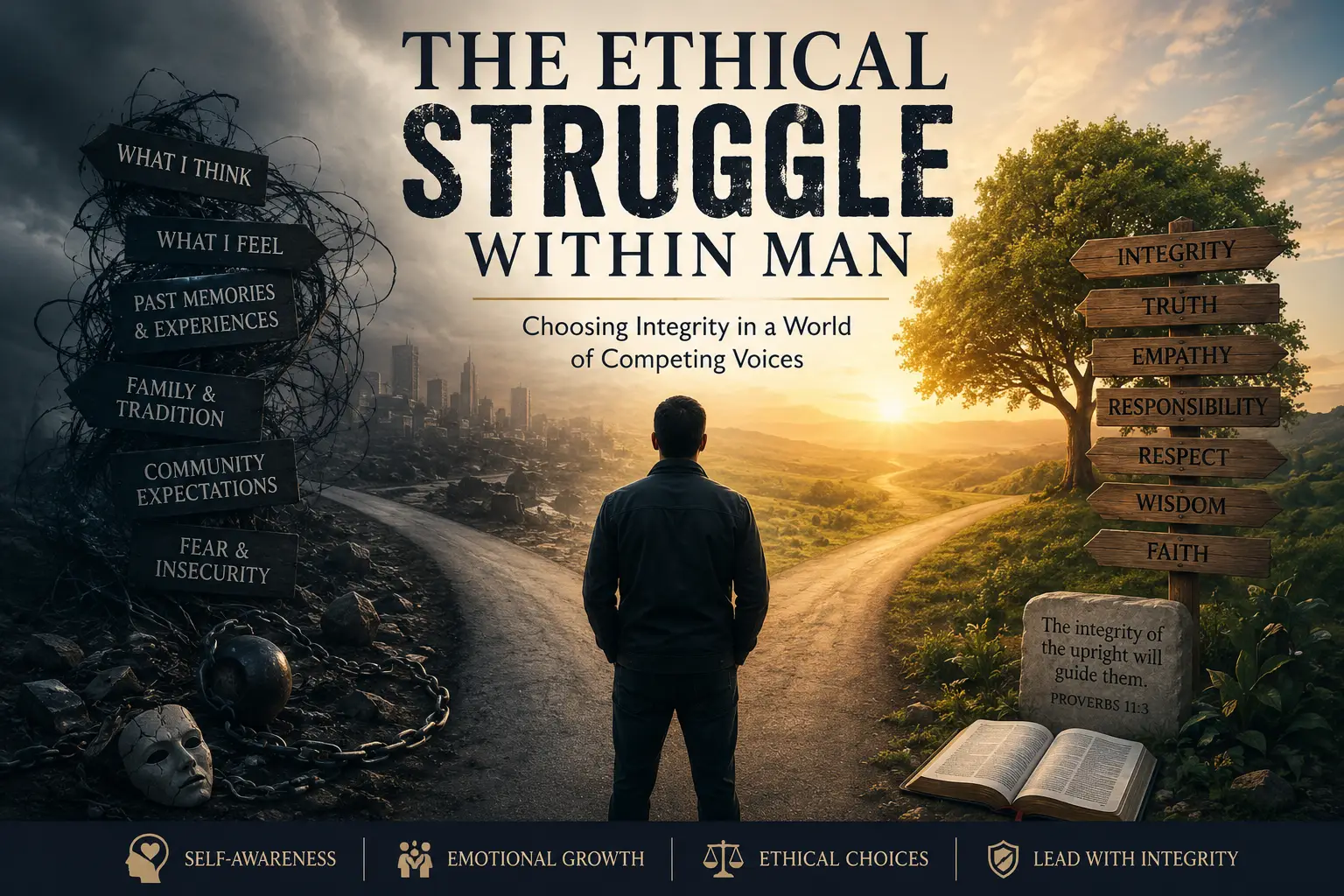
THE ETHICAL INTEGRITY STRUGGLE WITHIN MAN
Every person carries an inner struggle. We wrestle with what we think, what we feel, what we do, what society expects from us, what family and tradition have taught us, and what our memories and past experiences have shaped within us. Yet, in the middle of all these inward battles, we are still expected to function normally in society.
The challenge is that what is “normal” for one person may not be normal for another. This often leads to differences of opinion, misunderstandings, conflict, and even broken relationships.
Scripture reminds us that the battle inside man is real:
Romans 7:19 NKJV
(19) For the good that I will to do, I do not do; but the evil I will not to do, that I practice.
THE EXPECTATION OF INTEGRITY
We often expect educated, qualified, and respected people to be pillars of society. We assume that a person with degrees, status, registration,

or influence will naturally make ethical decisions. However, education does not automatically produce integrity.
Every person is still human. Every person has a personal story, private wounds, past experiences, and inner battles that have shaped their path. Many strive to outshine others and reach the highest levels of success, but the question remains:
Can our integrity sustain us throughout the journey?
Integrity means adhering to moral and ethical principles. It is honesty, soundness of character, and consistency in doing what is right—even when no one is watching.
Proverbs 11:3 NKJV
(3) The integrity of the upright will guide them, But the perversity of the unfaithful will destroy them.
Honesty is not only about being truthful with others. It also means being truthful with yourself.
THE BROKEN IMAGE OF FATHERHOOD

Many ethical struggles are rooted deeper than behaviour. They come from broken identity. Man often stems from a broken image of fatherhood, which produces what can be called an orphan mentality.
An orphan can be defined as a person existing in the absence of one or both parents. This absence may be physical, emotional, spiritual, or relational. Time spent with both parents is important for creating bonds, security, emotional strength, and healthy relationships in adulthood.
When this foundation is absent or damaged, an orphan mentality can develop. This mentality can shape a person’s value system, emotional outlook, relationships, and even their integrity.
John 14:18 NKJV
(18) I will not leave you orphans; I will come to you.
God’s desire is not for people to live as orphans, but as sons and daughters who know they are loved, accepted, corrected, and secure in Him.
SIGNS OF AN ORPHAN MENTALITY
An orphan mentality often causes a person to live in survival mode. Such a person may constantly feel the need to provide for themselves, protect themselves, hoard resources, fight for recognition, and seek position.
This mindset often produces excessive independence and self-reliance. The person struggles to trust others, submit to healthy authority, or do what is right when it appears to threaten their security.
An orphan mentality may show itself in the following ways:
- Living for praise, approval, and acceptance from people.
- Striving to impress others.
- Comparing oneself with others and feeling not good enough.
- Seeking counterfeit affections to hide insecurity.
- Competing with others because of jealousy.
- Exposing or accusing others to look better.
- Distrusting authority.
- Resisting correction.
- Becoming easily offended.
- Fighting for personal advantage.
- Allowing the past to control the present and future.
Such people often “live yesterday tomorrow.” Their past continues to guide, cloud, and control how they see themselves and how they respond to others.
Isaiah 43:18-19 NKJV
(18) “Do not remember the former things, Nor consider the things of old.
(19) Behold, I will do a new thing, Now it shall spring forth; Shall you not know it? I will even make a road in the wilderness And rivers in the desert.
FROM ORPHANHOOD TO WHOLENESS

Once an orphan mentality is recognized, it can be confronted and healed. A person must take stock of what they think, what they feel, what they do, what they believe, what they fear, and how past experiences have shaped their decisions.
Healing begins when we stop living yesterday tomorrow.
Romans 12:2 NKJV
(2) And do not be conformed to this world, but be transformed by the renewing of your mind, that you may prove what is that good and acceptable and perfect will of God.
The renewing of the mind is essential. A person cannot live ethically if their inner world remains unhealed, unexamined, and uncontrolled.
DEVELOPING EMOTIONAL INTELLIGENCE
One of the keys to ethical growth is emotional intelligence. This is the ability to be aware of your emotions, control them, express them properly, and understand the emotions of others.
A person with emotional intelligence becomes self-aware. They recognize their strengths, weaknesses, values, and moral compass. They understand how their emotions affect the people around them.
Proverbs 16:32 NKJV
(32) He who is slow to anger is better than the mighty, And he who rules his spirit than he who takes a city.
Emotional intelligence includes empathy—the ability to put yourself in another person’s shoes and see from their perspective.
Matthew 7:12 NKJV
(12) Therefore, whatever you want men to do to you, do also to them, for this is the Law and the Prophets.
Empathy helps us treat others with respect, resolve conflict wisely, and give praise where it is due.
BECOMING A LEADER OF INTEGRITY
Becoming a leader with integrity is possible when a person chooses wholeness, honesty, and ethical consistency.
A leader of integrity keeps their word. They are timeous in their actions. They make fair decisions. They take time to analyse options before speaking. They listen with empathy and avoid becoming judgmental.
A leader of integrity gives credit where it is due, regardless of who the person is. They communicate honestly and ensure that their dealings are transparent and above suspicion.
Proverbs 11:1 NKJV
(1) Dishonest scales are an abomination to the LORD, But a just weight is His delight.
Integrity must be practised unrelentingly. It is not a public image, but a private conviction. It is not only what we do when people are watching, but who we are when no one sees.
CONCLUSION
The ethical struggle within man is real. It is shaped by thoughts, emotions, upbringing, community expectations, family traditions, memories, wounds, and personal experiences. Yet none of these things need to define our future.
Through self-awareness, renewed thinking, emotional maturity, healing from orphanhood, and submission to God’s truth, a person can grow into integrity.
The goal is not merely to appear ethical, but to become whole.
Matthew 5:16 NKJV
(16) Let your light so shine before men, that they may see your good works and glorify your Father in heaven.
Integrity is the fruit of a life being restored from the inside out.
OTHER PUBLICATIONS BY THIS AUTHOR CAN BE FOUND AT: