
The Vinedresser’s Touch: How God Prunes Us for Greater Fruitfulness
Why Do We Need Pruning as a Christian?
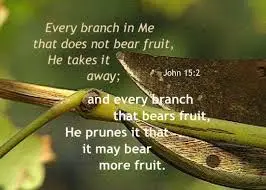
John 15:1–3 (NKJV)
“I am the true vine, and My Father is the vinedresser.
Every branch in Me that does not bear fruit He takes away; and every branch that bears fruit He prunes, that it may bear more fruit.
You are already clean because of the word which I have spoken to you.”
Jesus’ words in John 15 introduce us to one of the most searching and uncomfortable truths of the Christian walk: fruitfulness is inseparable from pruning. To be connected to Christ is not merely to live—it is to be worked on, cut back, cleansed, and shaped by the Father’s hand.
The Nature of the Vine and the Necessity of Pruning
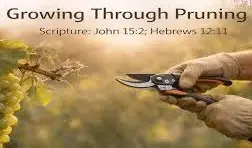
There are two remarkable characteristics of the vine.
First, there is no other plant from which juice can be so richly and abundantly distilled. The vine is designed for fruitfulness.
Second, there is no plant that so quickly turns its energy into excessive wood rather than fruit. Left unattended, the vine becomes wild, overgrown, and unproductive.
Merciless Pruning is the demand
For this reason, the vine requires merciless pruning.
Unlike some fruit trees that can bear reasonably well with minimal intervention, the vine cannot. No matter how healthy the soil, how deep the roots, or how sufficient the watering, pruning is non-negotiable if the vine is to fulfil its purpose.
So, it is with the Christian life.
You may be deeply rooted in Christ. You may be faithful, disciplined, knowledgeable, and active in ministry. Yet even then, pruning remains essential if your life is to bear lasting and increasing fruit.
Pruning Is the Father’s Work on Fruitful Branches
Jesus makes a profound statement:
“Every branch that bears fruit He prunes, that it may bear more fruit.”
Pruning is not punishment.
Pruning is not rejection.
Pruning is not a sign of failure.
Pruning is the Father’s intentional work on fruitful believers.
If a branch bears no fruit, it is removed. But if it bears fruit, it is cleansed—not to diminish its productivity, but to multiply it. This reveals something deeply comforting and deeply challenging: the more fruitful a believer becomes, the more pruning is required.
What Pruning Really Is—and What It Is Not
Pruning is not primarily about removing external hindrances. It is not merely the cutting away of weeds, thorns, or outward distractions. Rather, pruning deals with what comes from within.
In the vine, pruning involves cutting away the long, healthy shoots produced by the previous season’s growth. These shoots are not diseased. They are not sinful. They are the very proof of the vine’s vigour.
And yet—they must go.
Why? Because they consume too much sap. If left intact, they divert life away from fruit-bearing and into excessive growth. The sap must be conserved and directed exclusively toward producing grapes.
In viticulture, branches that may stretch eight or ten feet long are cut back to mere inches—just enough to bear fruit. Only when everything unnecessary is removed can full, rich, concentrated fruit be expected.
Pruning Beyond Sin: The Cutting Away of Self
This is where the truth becomes deeply personal.
Pruning in John 15 is not limited to the removal of sin. While sin must certainly be dealt with, Jesus is addressing something more subtle and often more painful: the pruning of self.
This includes our religious activity, our methods, our strengths, and even our successes.
In serving God, we naturally employ our gifts—wisdom, eloquence, leadership, influence, zeal. These gifts are not evil. They are often God-given. Yet after every season of fruitfulness, the Father brings us to the end of ourselves so that we do not begin to trust in the branch instead of the Vine.
What once produced fruit can, if left untouched, begin to replace dependence on Christ.
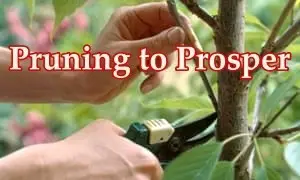
The Goal of Pruning: Total Devotion and Deeper Union
God’s pruning removes everything inconsistent with complete devotion to Christ. The cutting away of self reduces the surface area upon which our own strength operates, allowing the Holy Spirit to work with greater intensity and focus.
Less of self.
Living your Life from a Culture of Brokenness
More of Christ.
Greater fruit.
This is what Scripture calls the circumcision of the heart (Romans 2:29).

This is the reality of being crucified with Christ (Galatians 2:20).
Pruning brings us into a deeper participation in the cross—not as a doctrine only, but as a lived experience where our life is continually surrendered so that His life may be fully expressed through us.
The Word as the Pruning Knife
Jesus concludes with these words:
“You are already clean because of the word which I have spoken to you.”
The Father prunes primarily through His Word. The Word exposes motives, corrects direction, limits excess, and re-centers our lives on Christ alone. When received humbly, it does not destroy us—it purifies us.
Final Reflection
If you find yourself in a season of cutting back—less visibility, fewer activities, reduced influence, or the stripping away of familiar strengths—do not assume something is wrong.
You may simply be in the hands of a skilled Vinedresser.

Pruning is proof that the Father sees fruit in you—and desires even more.