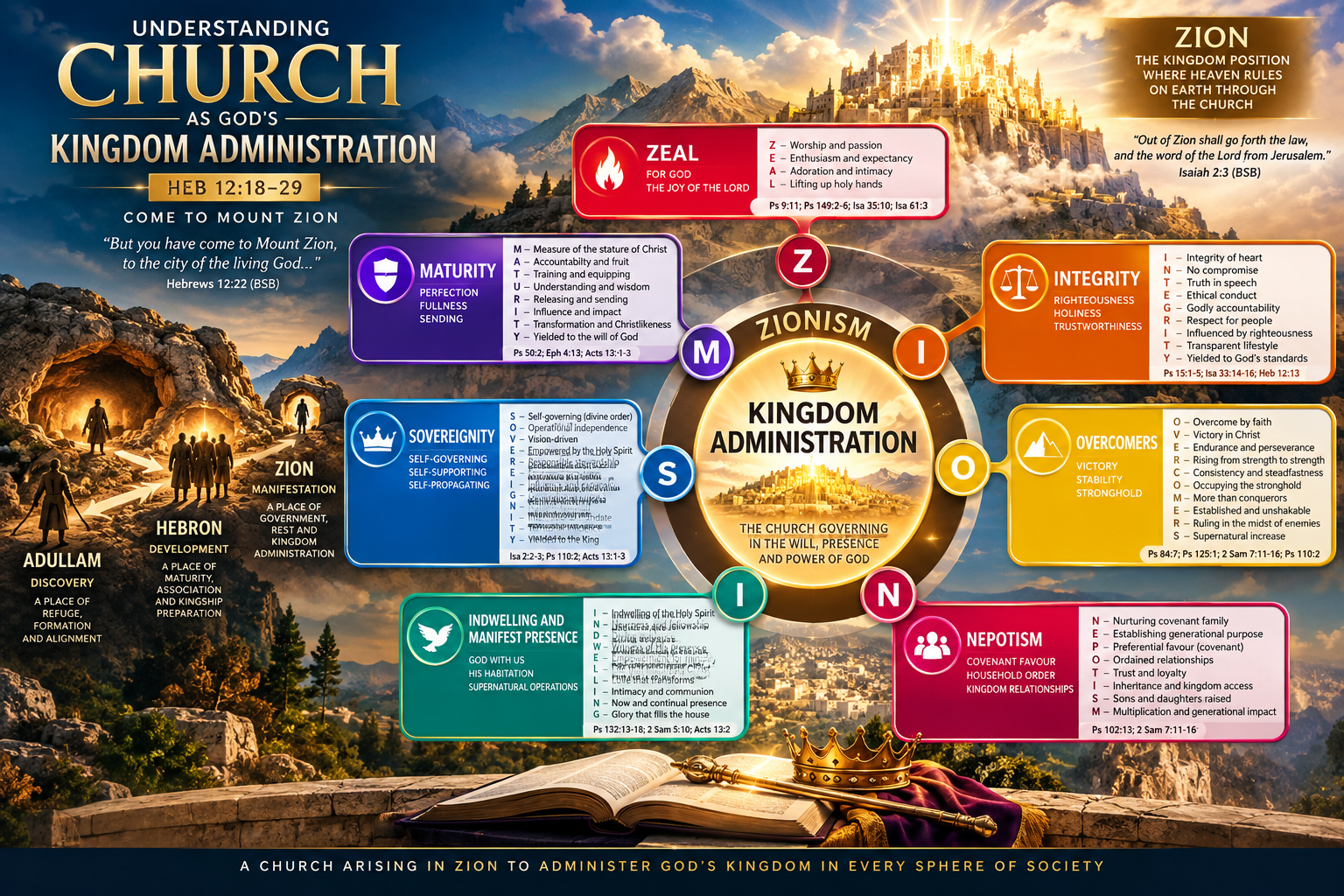
Hebrews 12:18–24 | Acts 13:1–3
The Church is more than a congregation gathered around religious activity. It is the Body of Christ, the household of God, the temple of the Holy Spirit and a royal priesthood through whom the wisdom, nature and government of God are demonstrated. Kingdom administration begins with submission to the King. The Church does not invent its mandate; it receives the word, order, authority and purpose of Christ and expresses His will in the earth under His headship.
From Sinai to Zion
“Instead, you have come to Mount Zion, to the city of the living God, the heavenly Jerusalem…” — Hebrews 12:22 (BSB)
Hebrews 12 does not merely describe a future destination. The writer says, “you have come.” Zion therefore speaks of a present covenantal and spiritual reality entered through Christ. It includes access to God, heavenly citizenship, the congregation of the firstborn, the new covenant and Jesus the Mediator.
Zion should not be treated as another name for Jesus Himself. Rather, Jesus is the Mediator, King, centre and access point of the Zion reality. There is no biblical Zion position apart from Christ. Hebrews 12 concludes with the declaration that we are receiving an unshakable Kingdom. Zion therefore becomes a powerful picture of the Church functioning in mature, stable, heavenly Kingdom order.
The Journey of Sons: Adullam → Hebron → Zion
David’s journey gives us a useful prophetic picture of the development of sons and Kingdom communities. It is not a rigid formula, but it reveals recognizable stages of formation, covenantal joining and mature governmental function.
Adullam is the place of formation. David gathered men who were distressed, indebted and discontented, and under his leadership they were shaped into mighty men. Adullam speaks of refuge, discipleship, testing, character formation and alignment.
Hebron is the place of covenant and recognition. David was acknowledged by Judah and later by all Israel. Hebron speaks of covenant relationships, fathering, sonship, joining, trust and corporate identity.
Zion is the place of mature Kingdom administration. David captured the stronghold, established his throne, brought the ark into the city and ruled from there. Zion is where covenant sons become a governmental, worshipping, representative and sending people.
Many believers understand Adullam formation and Hebron covenant, but the journey becomes incomplete when covenant becomes an inward-looking destination. Hebron must mature into Zion. Relationship is not abandoned at Zion; relationship becomes the foundation from which the purposes of God are administered.
The Zion Position — ZIONISM
The mnemonic ZIONISM is used here only as a teaching aid for the biblical characteristics of a Zion-positioned church. It is not a reference to modern political Zionism.
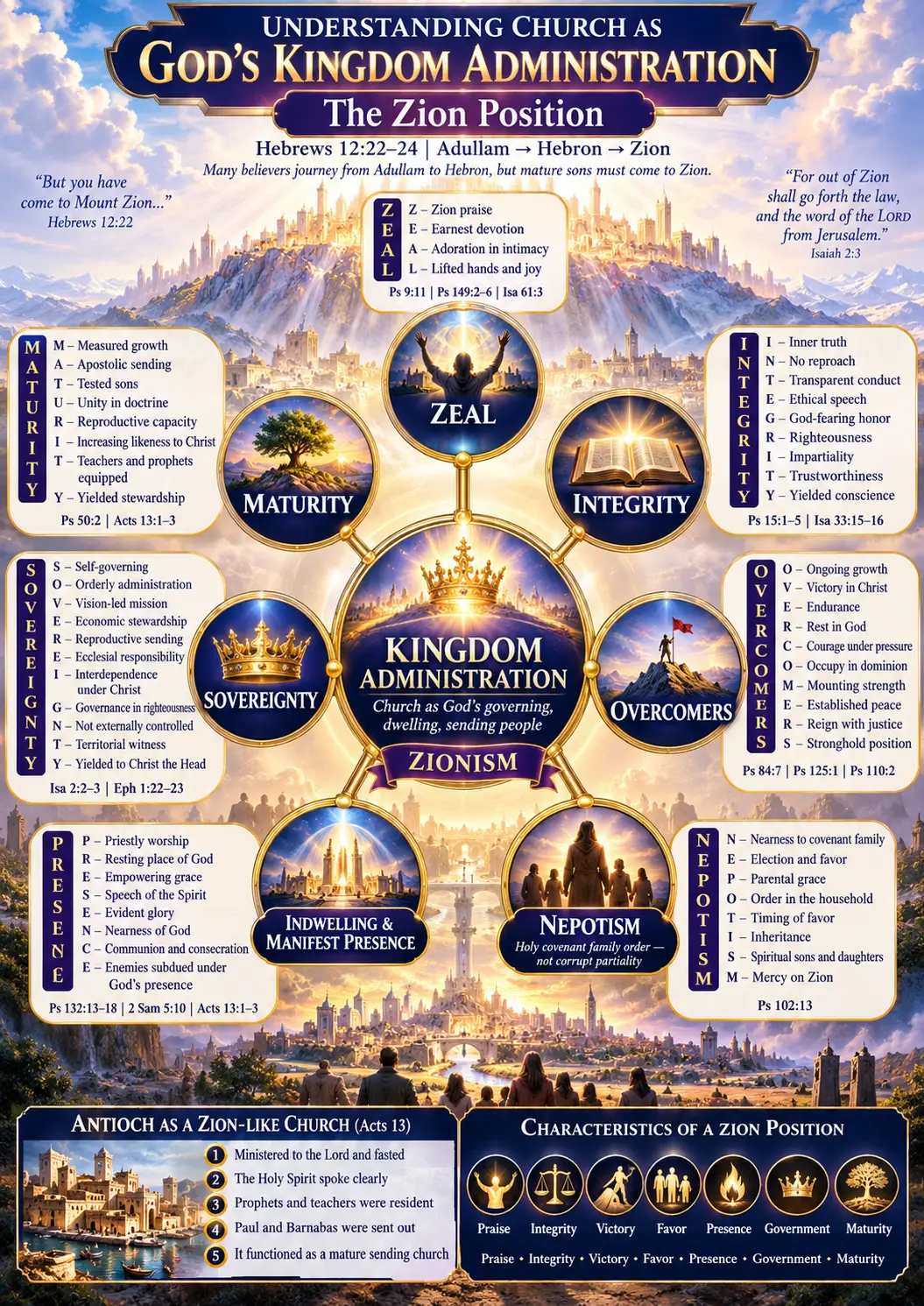
Z — ZEAL FOR GOD / JOY OF THE LORD
“Sing praises to the LORD, who dwells in Zion; proclaim His deeds among the nations.” — Psalm 9:11 (BSB)
Zion is marked by joyful, God-centred devotion. This zeal is deeper than emotional excitement. It is sustained by intimacy, revelation and delight in the King. Antioch demonstrates this principle: while the leaders were worshiping the Lord and fasting, the Holy Spirit spoke and commissioned Barnabas and Saul.
ZEAL
Z — Zest for God: holy passion that delights in God Himself.
E — Earnest worship: worship, prayer, fasting and thanksgiving.
A — Affection set above: the heart and mind oriented toward Christ.
L — Love that labours: zeal becoming obedience, service and perseverance.
I — INTEGRITY
“O LORD, who may abide in Your tent? Who may dwell on Your holy mountain? He who walks with integrity and practices righteousness, who speaks the truth from his heart.” — Psalm 15:1–2 (BSB)
Zion authority is inseparable from Zion character. The Church cannot credibly proclaim the righteousness of the Kingdom while normalising manipulation, dishonesty, sexual immorality, financial opacity, slander, injustice or double standards. Integrity means wholeness: private and public life agree.
INTEGRITY
I — Identity in Christ
N — No duplicity
T — Truth in the heart
E — Equity and justice
G — Governed appetites
R — Reliability
I — Impartiality
T — Transparency
Y — Yieldedness
O — OVERCOMERS
The Zion position is an overcoming position. Scripture reveals at least three dimensions of this victory.
1. Increase in quality
“They go from strength to strength, until each appears before God in Zion.” — Psalm 84:7 (BSB)
Mature churches do not merely increase numerically; they increase in Christlikeness, competence, discernment, ministry function, fathering capacity and representational accuracy.
2. Stability and rest
“Those who trust in the LORD are like Mount Zion. It cannot be moved; it abides forever.” — Psalm 125:1 (BSB)
Rest is not the absence of warfare. It is the condition in which a believer or house is no longer governed by fear, reaction and instability.
3. Stronghold and governmental authority
“Nevertheless, David captured the fortress of Zion (that is, the City of David).” — 2 Samuel 5:7 (BSB)
From Zion the rule of the King is expressed even in the presence of enemies. Kingdom authority is not domination; it is righteous rule, judgment, justice and servant leadership under Christ.
OVERCOMERS
O — Obedient
V — Vigilant
E — Enduring
R — Renewed
C — Christ-centred
O — Ordered
M — Maturing
E — Established
R — Ruling servants
S — Steadfast in testimony
N — NEPOTISM: COVENANT HOUSEHOLD ORDER, NOT CARNAL FAVOURITISM
“You will rise up and have compassion on Zion, for it is time to show her favor—the appointed time has come.” — Psalm 102:13 (BSB)
The word nepotism normally describes improper favour shown to relatives. Scripture rejects partiality, injustice and corrupt favouritism. Within this mnemonic, however, the term is used in a deliberately qualified sense to point to covenant household order, spiritual family, generational continuity and favour flowing through legitimate relationship.
Biblical father-son relationships are never permission for partiality. They are environments for formation, inheritance, accountability, trust, responsibility and multiplication.
NEPOTISM
N — Nurturing covenant family
E — Establishing generational purpose
P — Parental grace
O — Ordered relationships
T — Trust and loyalty
I — Inheritance and Kingdom access
S — Sons and daughters raised
M — Multiplication and generational impact
I — INDWELLING AND MANIFEST PRESENCE
“For the LORD has chosen Zion; He has desired it for His home: ‘This is My resting place forever and ever; here I will dwell, for I have desired this home.’” — Psalm 132:13–14 (BSB)
Zion is associated with the dwelling presence of God. We must distinguish the indwelling presence of the Holy Spirit in every believer from the manifest presence of God experienced when He makes His nature, voice, power and glory evident among His people.
At Antioch the Holy Spirit spoke with clarity. Zion churches do not merely discuss God; they cultivate an environment in which His presence, word and direction govern the house.
INDWELLING / MANIFEST PRESENCE
I — Indwelling Spirit
N — Nearness of God
D — Dwelling place prepared
W — Worship-centred culture
E — Empowering grace
L — Listening to the Spirit
L — Life-giving communion
I — Intimacy with God
N — New-covenant consciousness
G — Glory revealed
S — SOVEREIGNTY
Within a Zion position, the local church grows toward responsible Kingdom function: self-governing under Christ, self-supporting through faithful stewardship and self-propagating through reproduction and sending. This is never independence from the Body of Christ. It is mature responsibility under the sovereignty of God.
“For out of Zion shall go forth the law, and the word of the LORD from Jerusalem.” — Isaiah 2:3 (BSB)
SOVEREIGNTY
S — Self-governing under Christ
O — Orderly administration
V — Vision-led mission
E — Economic stewardship
R — Reproductive sending
E — Ecclesial responsibility
I — Interdependence in the Body
G — Governance in righteousness
N — Not externally controlled
T — Territorial witness
Y — Yielded to Christ the Head
M — MATURITY
“From Zion, perfect in beauty, God shines forth.” — Psalm 50:2
Zion speaks of maturity, completeness and functional fullness. A mature church is not simply an old church, a large church or a wealthy church. Maturity is measured by Christ being formed in a people and by their capacity to carry responsibility, reproduce sons, equip saints and release ministry.
MATURITY
M — Measure of Christ
A — Accountability and fruit
T — Training and equipping
U — Understanding and wisdom
R — Releasing and sending
I — Influence and impact
T — Transformation and Christlikeness
Y — Yielded stewardship
Antioch: A New Testament Picture of Zion Characteristics
Acts 13 does not call Antioch “Zion,” but the church there demonstrates several characteristics associated with a Zion position. It ministered to the Lord, fasted, heard the Holy Spirit clearly, possessed resident prophets and teachers and released Barnabas and Saul into apostolic mission.
Antioch was therefore not a ministry-consuming church but a ministry-producing and ministry-sending church. Its internal maturity became external mission.
Why Some Believers Remain at Hebron
Hebron is indispensable because covenant, sonship and relationship matter. Yet covenant can become a ceiling when relationship is treated as the final objective rather than preparation for corporate responsibility. A house may enjoy fellowship and strong relational bonds yet fail to govern, equip, send and represent Christ beyond itself.
The movement from Hebron to Zion requires mature sons who can carry responsibility without losing relationship; exercise authority without becoming controlling; honour fathers without becoming dependent; receive inheritance without entitlement; and move from being continually served to becoming servants, builders, fathers and senders.
Church as God’s Kingdom Administration
The Zion position reveals the Church as a people gathered around the presence and government of God. The goal is not institutional power, political control or religious prominence. It is an accurate corporate representation of the King.
A Zion-positioned church is therefore marked by zeal, integrity, overcoming life, covenant household order, the indwelling and manifest presence of God, responsible Kingdom government and maturity.
The journey of sons is not complete when they merely find refuge at Adullam or belonging at Hebron. Formation must become covenant, and covenant must mature into Kingdom responsibility. Mature sons come to Zion—not to build personal empires, but to administer the purposes of the King from a place of worship, righteousness, presence, rest and mature sonship.
“Therefore, since we are receiving an unshakable kingdom, let us be thankful and so worship God acceptably with reverence and awe.” — Hebrews 12:28 (BSB)
Herman Bouwer
From the Desk of Herman