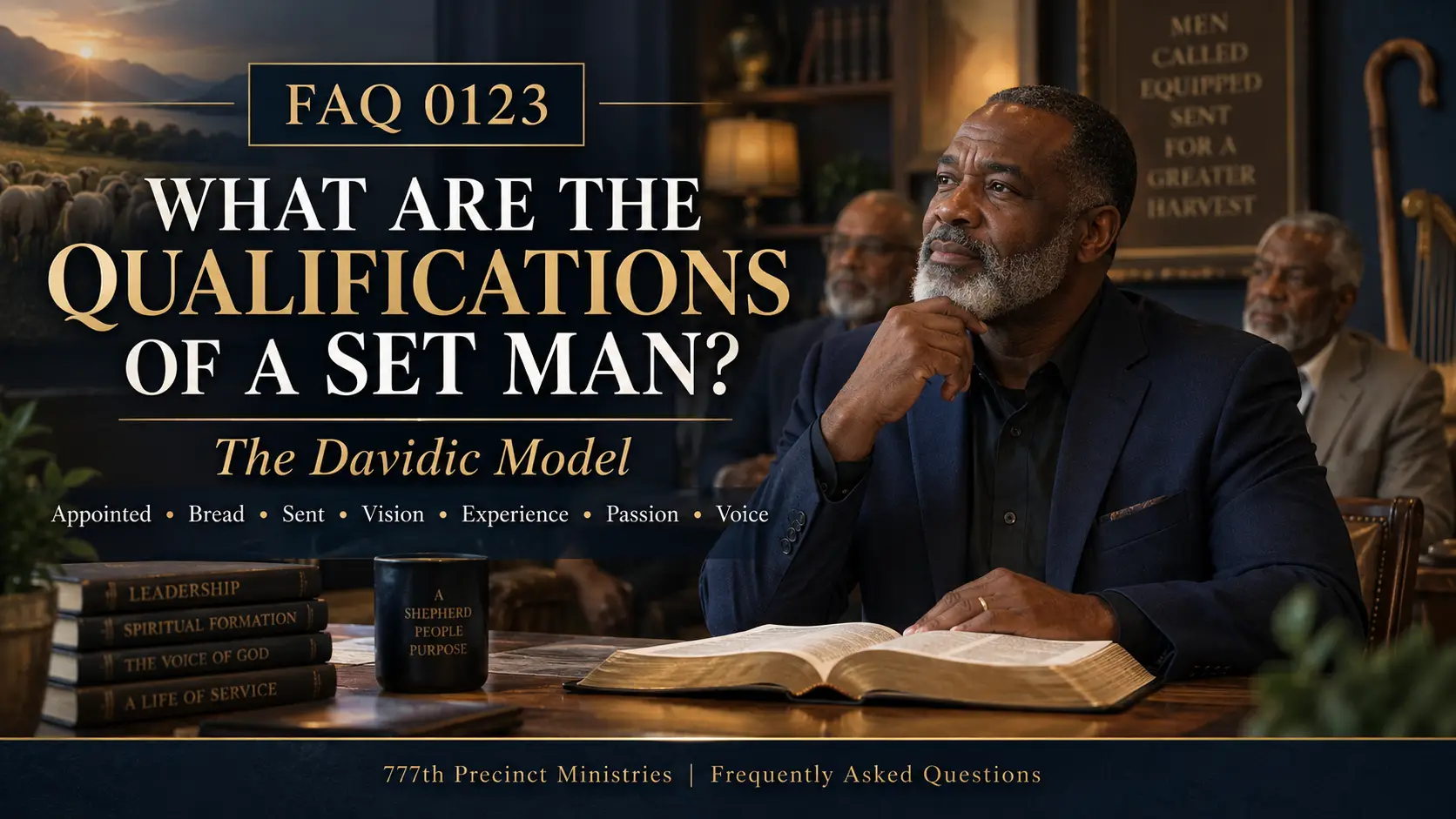
FAQ 0123
WHAT ARE THE QUALIFICATIONS OF A SET MAN IN THE DAVIDIC MODEL?
God-Appointed • Familiar • Bread • Sent • Vision • Experienced • Passionate • Voice
The Davidic model describes the set man not merely as the person occupying the leading position, but as a leader whose call, formation, vision, message, character and spiritual discernment demonstrate that God has genuinely entrusted him with responsibility for a people and a purpose.
1. Introduction
Within the Davidic leadership framework, a ‘set man’ is the recognised lead servant through whom vision, direction and responsibility are carried in a particular house, ministry or sphere. The term is a ministry-framework expression rather than a formal New Testament office-title. Its value lies in the biblical principles it gathers together: divine calling, proven formation, spiritual nourishment, mission, vision, maturity, passion for God and discernment of His voice.
The supplied teaching identifies eight qualifications. David is the primary model, while Solomon, Moses, Joseph, Jeremiah, Gideon, John, Paul, Nehemiah, Hezekiah and Josiah are used as supporting examples.
These qualities should never be used to make a leader appear infallible or beyond accountability. Davidic leadership is healthiest when clear leadership operates under the supreme Headship of Christ, within Scripture, and alongside mature elders who can confirm, test and strengthen what the leader carries.
| QUESTION |
| What are the qualifications of a set man as seen in the Davidic model? |
| SHORT ANSWER |
| In the Davidic model, a set man should be genuinely appointed by God, emerge as a recognised brother among the people, carry and feed the house with the Word of God, be sent with divine purpose, originate and steward God-given vision, possess proven experience rather than novice enthusiasm, burn with passion for God, and demonstrate a mature ability to discern His voice. These qualifications must be joined to biblical character, humility, servant leadership and accountability. |
2. Qualification One: God-Appointed – ‘The Set Man’
| 1 Samuel 16:12-13 (BSB)
So Jesse sent for him. He was ruddy, with beautiful eyes and a handsome appearance. And the LORD said, ‘Rise and anoint him, for he is the one.’ Then Samuel took the horn of oil and anointed him in the presence of his brothers, and the Spirit of the LORD rushed upon David from that day forward. |
The first qualification is calling. David did not appoint himself. Samuel did not choose David because he looked strategically useful. God identified him.
A set man therefore cannot be produced merely by ambition, organisational politics, family succession or personal charisma. There should be credible evidence of divine calling.
Evidence of a genuine call may include:
- a sustained inner conviction rather than a passing desire for status;
- confirmation through Scripture and the Holy Spirit;
- recognition by mature leaders and the people being served;
- fruit that corresponds with the calling;
- grace to carry responsibility over time; and
- a willingness to obey even when the calling is costly.
Solomon, Jeremiah and Paul reinforce the same principle: God chooses and appoints servants for specific purposes. Leadership is therefore first a stewardship received from God, not a possession claimed by man.
3. Calling Must Be Distinguished From Ambition
| Hebrews 5:4 (BSB)
No one takes this honor upon himself; he must be called by God, just as Aaron was. |
The desire to lead is not automatically wrong, but ambition must be purified. The set man is not someone who simply wants the highest seat. He is someone willing to accept the burden, responsibility, sacrifice and accountability that accompany leadership.
A self-appointed leader usually needs the position to validate himself. A God-appointed leader can remain secure even while hidden, tested or misunderstood because his identity is rooted in God rather than office.
4. Qualification Two: Chosen From Among His Brothers – ‘The Familiar Man’
| 1 Samuel 16:13 (BSB)
Then Samuel took the horn of oil and anointed him in the presence of his brothers, and the Spirit of the LORD rushed upon David from that day forward. |
David was raised from among his own brothers. The teaching calls this the ‘familiar man’: a leader whose life has been visible, whose character has been observed and who is not merely an impressive stranger imported because of reputation.
Deuteronomy 17:15 required Israel’s king to be chosen from among his brothers. In applying that principle to church leadership, the emphasis should be relational recognition rather than ethnic or geographic restriction.
A local house benefits when its lead elder is known rather than merely famous. People should have opportunity to observe his doctrine, lifestyle, humility, family relationships, service and response to difficulty.
5. Familiarity Does Not Mean Leadership Can Never Come From Outside
The ‘familiar man’ principle should not be turned into an absolute rule that God can never send an outsider. Scripture contains many sent leaders who entered new regions. Barnabas was sent to Antioch, Paul was sent to the Gentiles, and prophets were frequently sent beyond their home environments.
The deeper principle is that authority should become relationally recognisable. A sent leader must eventually become known by character and fruit, not remain a distant title.
6. Qualification Three: Revelation of the Proceeding Word – ‘The Bread Man’
The source connects David with Bethlehem, the ‘house of bread,’ and uses bread as a picture of Christ and the Word. The set man is therefore expected to nourish the house with living biblical truth.
| John 6:35 (BSB)
Jesus answered, ‘I am the bread of life. Whoever comes to Me will never hunger, and whoever believes in Me will never thirst.’ |
| Matthew 4:4 (BSB)
But Jesus answered, ‘It is written: Man shall not live on bread alone, but on every word that comes from the mouth of God.’ |
The phrase ‘proceeding word’ does not mean a leader invents new revelation equal to Scripture. It means he is able to bring the written Word into the present condition of the people with clarity, relevance and spiritual understanding.
A true bread man does more than deliver sermons. He feeds people so that they mature.
7. What Does It Mean to Feed the House?
- teach Scripture accurately and in context;
- bring Christ rather than merely clever concepts;
- discern what the people need in a particular season;
- connect doctrine to practical obedience;
- equip believers to study and apply Scripture for themselves;
- correct error without creating dependency on the preacher; and
- provide both foundational truth and mature instruction.
Joseph’s provision for his household illustrates the same stewardship principle: leadership carries responsibility to ensure that the house receives nourishment appropriate to its need.
8. Qualification Four: The Sent Man
| Psalm 78:70-72 (BSB)
He chose David His servant and took him from the sheepfolds; from tending the ewes He brought him to be shepherd of His people Jacob, of Israel His inheritance. So David shepherded them with integrity of heart and guided them with skillful hands. |
Calling and sending belong together. A person may feel called, but the set man must also carry a sense of assignment: sent to a particular people, place, work or season.
The source traces this pattern through David, Moses, Gideon, John, Joseph and Jeremiah. God does not merely give leaders identity; He gives them mission.
The sent man therefore asks not only, ‘Who am I?’ but, ‘What have I been sent to accomplish, for whom, and in what season?’
9. Sending Produces Responsibility, Not Celebrity
Being sent is not a claim to importance. It creates accountability. The messenger is responsible to the One who sent him.
| John 20:21 (BSB)
Again Jesus said to them, ‘Peace be with you. As the Father has sent Me, so also I am sending you.’ |
A sent man is therefore measured by faithfulness to the assignment, not by size of platform, public recognition or institutional power.
10. Qualification Five: Progenitor and Custodian of Vision – ‘The Vision Man’
David carried the desire to build a house for God. Joseph carried a dream. Nehemiah carried a burden to rebuild Jerusalem. Hezekiah and Josiah initiated restoration of the house of the Lord. The source uses these examples to show that a set man carries originating vision.
| 2 Samuel 7:2 (BSB)
The king said to Nathan the prophet, ‘Here I am, living in a house of cedar, while the ark of God remains in a tent.’ |
| Nehemiah 2:12 (BSB)
I set out at night with a few men. I did not tell anyone what my God had laid on my heart to do for Jerusalem. |
Vision is more than a slogan. It is a God-shaped burden concerning what should be built, restored, corrected, planted or released.
11. The Vision Man Must Remain Teachable
David’s desire to build the temple was genuine, but God did not allow him personally to complete it. Solomon would build. This is a crucial safeguard: even a true vision from God may require correction concerning timing, method or who will finish the work.
The set man is therefore a custodian of vision, not the owner of God’s purpose. He must be able to receive prophetic correction and release the next generation.
12. Vision Must Become Corporate
A vision is not mature merely because the leader sees it. It becomes fruitful when people understand it, embrace their place in it and can carry it beyond the leader’s personality.
- the vision should be explainable;
- it should agree with Scripture;
- it should produce Kingdom fruit rather than personal empire;
- elders should be able to test and confirm it;
- sons and daughters should be equipped to participate; and
- succession should be possible without destroying the work.
13. Qualification Six: A Man of Experience – ‘The Experienced Man’
The source emphasises that the set man is not an instant leader. David faced the lion, the bear, Goliath and Saul before he carried the throne. Moses spent years in Midian. Joseph passed through the pit and prison before national leadership. Paul experienced a period of formation before wider apostolic ministry.
| 1 Timothy 3:6 (BSB)
He must not be a recent convert, or he may become conceited and fall under the same condemnation as the devil. |
Experience forms depth. It teaches a leader how to suffer without quitting, how to succeed without becoming proud, how to wait without forcing doors and how to lead people whose circumstances are complex.
14. What Kind of Experience Matters?
- experience of serving before leading;
- experience of hiddenness and waiting;
- experience of conflict and reconciliation;
- experience of failure, repentance and restoration;
- experience of spiritual warfare without becoming paranoid;
- experience of handling resources faithfully;
- experience of building people rather than merely projects;
- experience of submitting to authority before exercising authority; and
- experience of carrying responsibility over time.
Experience alone does not qualify a leader, but untested gifting can become dangerous when given authority too quickly.
15. Qualification Seven: Passion for God – ‘The Passionate Man’
| 1 Samuel 13:14 (BSB)
But now your kingdom will not endure; the LORD has sought out a man after His own heart and appointed him ruler over His people, because you have not kept the LORD’s command. |
David’s defining passion was God Himself. Paul likewise describes himself as constrained by the love of Christ.
| 2 Corinthians 5:14 (BSB)
For Christ’s love compels us, because we are convinced that One died for all, therefore all died. |
The set man must be driven by more than organisational ambition. Without passion for God, ministry gradually becomes maintenance, branding, reputation or career.
16. Passion Is Tested by Cost
Passion is not merely emotional intensity during worship. It is revealed when obedience costs something.
Paul was willing to suffer in order to finish his assignment. David repeatedly chose God’s honour over personal convenience. A passionate leader values the presence, name and purpose of God more than personal safety, applause or comfort.
17. Qualification Eight: The ‘Voice Man’
| 2 Samuel 5:19 (BSB)
So David inquired of the LORD, ‘Should I go up against the Philistines? Will You deliver them into my hand?’ And the LORD answered David, ‘Go up, for I will surely deliver the Philistines into your hand.’ |
David did not merely repeat yesterday’s strategy. He inquired of the Lord. In a later battle, God’s instruction changed. This demonstrates a leader who remains dependent upon present divine direction rather than assuming that previous success guarantees present guidance.
The source also points to Abraham and Paul as men who received clear divine direction. The set man should therefore cultivate a life of prayer, listening and discernment.
18. Hearing God Does Not Mean Infallibility
The phrase ‘voice man’ must be handled carefully. No leader should claim that his impressions are automatically equal to Scripture or immune from examination.
| 1 Thessalonians 5:20-21 (BSB)
Do not treat prophecies with contempt, but test all things. Hold fast to what is good. |
A mature set man submits what he hears to:
- the written Word of God;
- the character and ways of Christ;
- the witness and wisdom of mature elders;
- the fruit produced by the direction;
- providential circumstances where relevant; and
- humble willingness to admit error when he has misunderstood.
19. The Eight Qualifications at a Glance
| QUALIFICATION | DESCRIPTIVE TITLE | CORE EMPHASIS |
| God-Appointed | The Set Man | Divine calling and recognition |
| Chosen From Among Brothers | The Familiar Man | Relational credibility and known character |
| Proceeding Word | The Bread Man | Feeding the house with Christ-centred truth |
| Sent | The Sent Man | Clear assignment and mission |
| Progenitor of Vision | The Vision Man | God-given burden, direction and stewardship |
| Experienced | The Experienced Man | Proven formation rather than novice leadership |
| Passion for God | The Passionate Man | Love for God that drives ministry |
| Discerns God’s Voice | The Voice Man | Prayerful, tested sensitivity to divine direction |
20. Additional Biblical Qualification: Character
The Davidic model describes call and function, but the New Testament adds an indispensable layer: character qualifications for overseers and elders.
| Titus 1:7-9 (BSB)
As God’s steward, an overseer must be above reproach – not self-willed, not quick-tempered, not given to drunkenness, not violent, not greedy for money. Instead, he must be hospitable, a lover of good, self-controlled, upright, holy, and disciplined. He must hold firmly to the trustworthy message as it was taught, so that he can encourage others by sound doctrine and refute those who oppose it. |
A person may appear visionary, passionate and spiritually gifted, yet still be unqualified to lead if character is corrupt. The Davidic set-man model must therefore be integrated with New Testament elder qualifications.
21. Additional Biblical Qualification: Servant Leadership
| Mark 10:42-45 (BSB)
You know that those regarded as rulers of the Gentiles lord it over them, and their superiors exercise authority over them. But it shall not be this way among you. Instead, whoever wants to become great among you must be your servant, and whoever wants to be first must be the slave of all. For even the Son of Man did not come to be served, but to serve, and to give His life as a ransom for many. |
The set man leads, but he does not dominate. His authority is expressed through responsibility, sacrifice, example, service and the willingness to lay down his life for the people.
22. Additional Biblical Qualification: Accountability
| 1 Peter 5:2-3 (BSB)
Be shepherds of God’s flock that is among you, watching over them not out of compulsion, but because it is God’s will; not out of greed, but out of eagerness; not lording it over those entrusted to you, but being examples to the flock. |
A set man should not function as an isolated monarch. Healthy leadership requires plurality and accountability. Fellow elders are not merely assistants whose purpose is to agree with the leader; they help guard doctrine, character, finances, decisions and the welfare of the flock.
23. The Difference Between a Set Man and a Dictator
A biblical set man:
- receives authority as stewardship rather than ownership;
- welcomes wise counsel;
- can explain decisions from Scripture and vision;
- raises mature leaders rather than permanent dependants;
- does not punish honest questions;
- does not claim exclusive access to God;
- shares responsibility appropriately;
- remains financially and morally accountable; and
- knows that Christ, not himself, is the Head of the Church.
A dictator needs control. A set man needs faithfulness. The difference is not merely structural; it is spiritual and moral.
24. How Is a Genuine Set Man Recognised?
Recognition should arise from a convergence of evidence:
- God’s call is credible and sustained.
- His character is known and proven.
- He carries grace to feed and equip people.
- He has a clear assignment rather than vague ambition.
- A coherent God-centred vision rests upon him.
- He has endured processes that have formed maturity.
- His love for God is stronger than his love for position.
- He demonstrates prayerful discernment rather than impulsive claims.
- Mature elders can confirm both his call and his fruit.
- The people become stronger, more mature and more Christ-centred under his leadership.
25. What a Set Man Is Not
- He is not the owner of the church.
- He is not the mediator between believers and God.
- He is not beyond correction.
- He is not automatically right because he is the set man.
- He is not entitled to unquestioning obedience when he contradicts Scripture.
- He is not the only person who can hear God.
- He is not called to keep sons and daughters dependent upon him.
- He is not free to confuse personal ambition with divine vision.
26. The Davidic Principle of Preparation Before Position
Perhaps the strongest thread running through the model is that God prepares the man before fully releasing the position. David was anointed long before he was enthroned.
The field, the lion, the bear, Goliath, Saul, the cave and the wilderness all formed something in David that the throne itself could not create.
This is a major warning for ministry today: ordination can confer recognition, but it cannot replace formation. A title can be given in a moment; character is formed through seasons.
27. The Ultimate Pattern Is Christ
David is a valuable leadership model, but he is not the final model. Jesus Christ is the perfect Shepherd-King.
| John 10:11 (BSB)
I am the good shepherd. The good shepherd lays down His life for the sheep. |
Every Davidic pattern must therefore be judged by Christ. If an interpretation of set-man authority produces domination, fear, self-exaltation or dependency, it has departed from the Shepherd whose leadership is sacrificial.
28. 777th Precinct Ministries – Position Statement
777th Precinct Ministries recognises the set man as a God-appointed lead servant who carries particular responsibility for vision, direction, teaching and stewardship within a local house or ministry sphere.
Within the Davidic model, we identify eight principal qualifications: he is God-appointed, relationally recognised among his brothers, a carrier of the proceeding Word, a sent man, a progenitor and custodian of vision, a man of proven experience, a man of passion for God, and a man who has cultivated mature sensitivity to God’s voice.
We affirm that these functional qualifications must operate together with the New Testament qualifications of character, sound doctrine, servant leadership, humility and accountability.
We reject any use of the set-man principle that makes a leader an owner, an unquestionable authority, the exclusive voice of God, or a substitute for Christ. The set man leads under Jesus Christ, serves alongside mature elders, equips the saints and prepares sons and daughters to mature and carry Kingdom responsibility.
29. Conclusion
The qualification of a set man is not primarily a title, platform or organisational appointment. It is a convergence of call, character, message, mission, vision, experience, passion and discernment.
David was chosen before he was crowned, formed before he was enthroned, tested before he was trusted, and taught to inquire of God rather than merely rely on his own ability.
The mature set man therefore does not ask, ‘How much authority do I have?’ His deeper question is, ‘How faithfully am I carrying what God has entrusted to me?’
Christ is the Head. The set man is a steward. The vision belongs to God.
Grace to you.
Scripture quotations are from the Berean Standard Bible (BSB), public domain.
OTHER PUBLICATIONS BY THIS AUTHOR CAN BE FOUND AT: