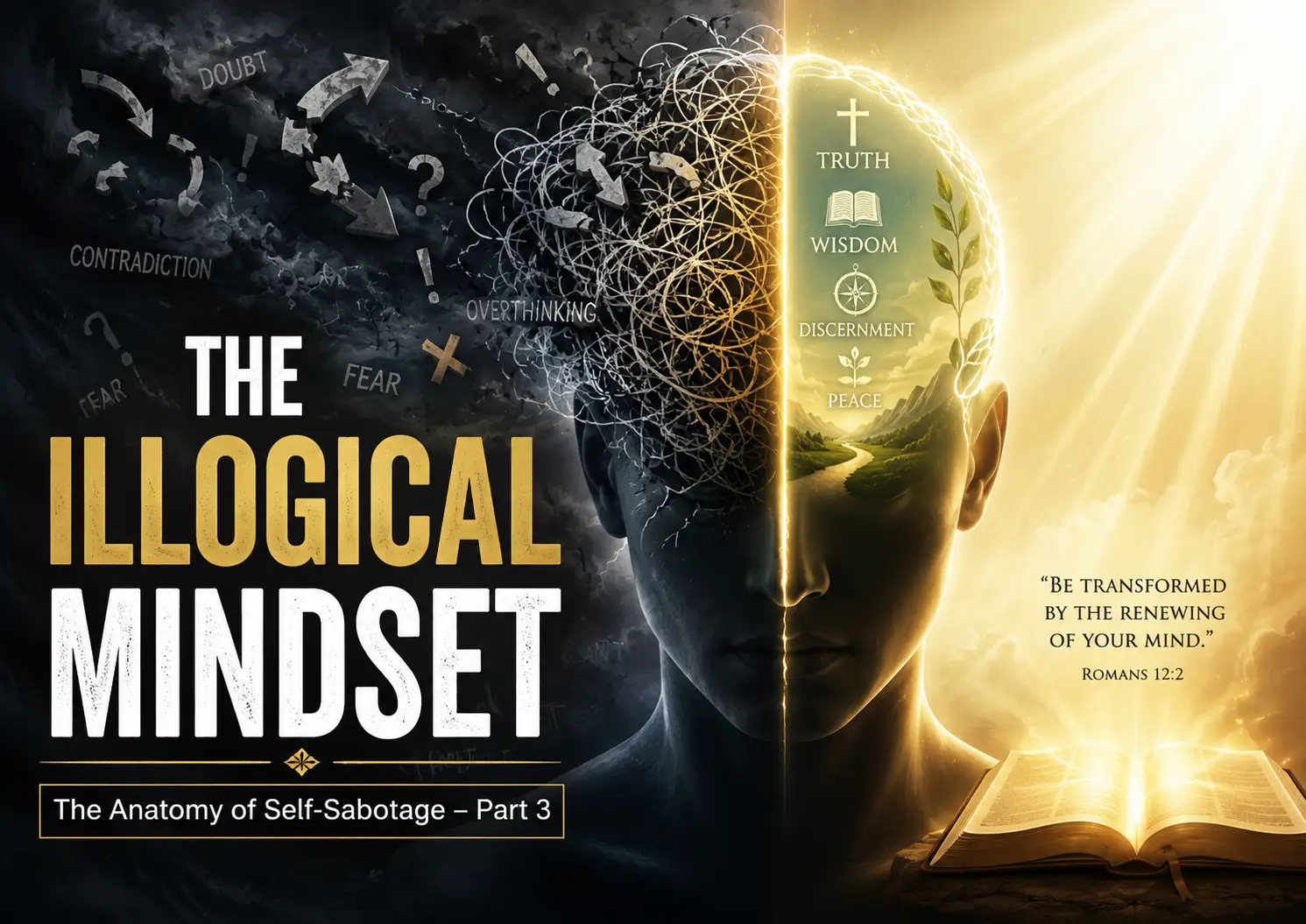
THE ILLOGICAL MINDSET
When the Mind Contradicts Truth, Wisdom, and Obedience
Introduction
One of the most damaging mindsets a believer can carry is the illogical mindset. This is a way of thinking that does not submit to truth, wisdom, sound judgment, or biblical reasoning. It makes conclusions that do not agree with reality. It justifies contradictions. It allows emotions to overrule obedience. It can declare one thing with the mouth while doing the opposite in action.
The illogical mindset is dangerous because it often appears reasonable to the person carrying it. A person may sincerely believe they are making the right decision while ignoring truth, rejecting counsel, contradicting Scripture, and producing unnecessary confusion. This mindset causes believers to make emotional decisions, defend irrational conclusions, accuse others unfairly, and behave inconsistently.
The renewed mind does not ignore feelings, but it does not allow feelings to become the final authority. The renewed mind is governed by truth, wisdom, discernment, and obedience to God.
Romans 12:2 NKJV says:
“And do not be conformed to this world, but be transformed by the renewing of your mind, that you may prove what is that good and acceptable and perfect will of God.”
The illogical mindset must be confronted because it blocks transformation. A mind that refuses truth cannot properly discern the will of God.
WHAT IS THE ILLOGICAL MINDSET?
The illogical mindset is a mindset governed by irrational conclusions, contradictions, emotional reasoning, and inconsistency.
It is a way of thinking that does not follow truth through to its proper conclusion. It may know certain facts, but it does not respond to those facts correctly. It may hear truth, but it interprets truth through fear, pressure, pride, insecurity, or emotion.
This mindset says one thing but does another. It knows what is right but chooses what is convenient. It condemns in others what it excuses in itself. It makes spiritual decisions based on fear, pressure, popularity, or emotion rather than wisdom and obedience.
James 1:8 NKJV says:
“He is a double-minded man, unstable in all his ways.”
Although the illogical mindset is not exactly the same as the double-minded mindset, they are closely related. The illogical mindset creates instability because the person’s thinking is not anchored in truth. When thinking is unstable, decisions become unstable. When decisions become unstable, life becomes unstable.
Biblical Example 1: Israel and the Golden Calf
One of the clearest biblical examples of the illogical mindset is found in Israel’s worship of the golden calf.
God had delivered Israel from Egypt with mighty signs and wonders. He had opened the Red Sea. He had destroyed Pharaoh’s army. He had led them by a pillar of cloud by day and a pillar of fire by night. He had provided manna from heaven. Yet when Moses delayed on the mountain, the people quickly turned to an idol.
Exodus 32:4 NKJV says:
“And he received the gold from their hand, and he fashioned it with an engraving tool, and made a molded calf. Then they said, ‘This is your god, O Israel, that brought you out of the land of Egypt!’”
This was deeply illogical. The golden calf had not delivered them from Egypt. The idol did not confront Pharaoh. The idol did not part the Red Sea. The idol did not provide manna. The idol was only formed after their deliverance had already taken place.
Yet Israel attributed the work of God to something they had made with their own hands.
This is what the illogical mindset does. It replaces truth with an irrational conclusion. It ignores evidence. It forgets testimony. It rewrites history. It gives credit to the wrong source.
Israel’s behavior reveals how quickly people can abandon truth when fear, impatience, and pressure take control of the mind.
Aaron’s Role in the Illogical Mindset
Aaron’s role in this moment is equally sobering. He was a leader. He had seen the works of God. He had stood with Moses before Pharaoh. He knew that the golden calf was not Israel’s deliverer. Yet he participated in producing the idol.
This reveals another danger of the illogical mindset: it can cause leaders to cooperate with error in order to satisfy the pressure of people.
Aaron knew better, but he did not act better. He allowed the emotional demand of the people to influence his leadership decision. Instead of correcting irrational thinking, he accommodated it.
A leader with sound judgment must not allow the fear of people to override obedience to God.
Proverbs 29:25 NKJV says:
“The fear of man brings a snare, But whoever trusts in the LORD shall be safe.”
The illogical mindset is often strengthened by the fear of man. When people are afraid of rejection, criticism, or confrontation, they may make decisions that contradict truth.
Biblical Example 2: Pontius Pilate
Pontius Pilate is another powerful example of the illogical mindset. Pilate examined Jesus and publicly declared that he found no fault in Him.
John 19:4 NKJV says:
“Pilate then went out again, and said to them, ‘Behold, I am bringing Him out to you, that you may know that I find no fault in Him.’”
This statement was clear. Pilate knew Jesus was innocent. He had the authority to release Him. He publicly acknowledged that Jesus was not guilty.
Yet Matthew 27:26 NKJV says:
“Then he released Barabbas to them; and when he had scourged Jesus, he delivered Him to be crucified.”
Pilate declared Jesus innocent but still condemned Him. This is a contradiction of justice, truth, and moral responsibility.
This is the illogical mindset in action. It knows the truth but acts against it. It recognizes innocence but still participates in injustice. It sees what is right but chooses what is politically convenient.
Pilate’s decision was not based on righteousness. It was based on pressure. He wanted to satisfy the crowd. He wanted to protect his position. He chose self-preservation over truth.
The illogical mindset often produces compromise when truth becomes costly.
When Pressure Replaces Principle
Pilate teaches us that it is possible to know the right thing and still do the wrong thing. Many people assume that knowledge alone guarantees obedience, but Scripture shows otherwise. A person may have the facts and still reject righteousness.
When pressure replaces principle, logic collapses. A person may say, “I know this is wrong,” and then still proceed to do it. They may say, “I know God’s Word says this,” but then excuse behavior that directly contradicts Scripture.
This is why the renewed mind must be more than informed. It must be surrendered.
James 4:17 NKJV says:
“Therefore, to him who knows to do good and does not do it, to him it is sin.”
Truth carries responsibility. Once we know what is right, we are accountable to respond correctly.
Biblical Example 3: Jehoshaphat
Jehoshaphat was a king who began well. He strengthened Judah and fortified himself against Israel under Ahab.
2 Chronicles 17:1 NKJV says:
“Then Jehoshaphat his son reigned in his place, and strengthened himself against Israel.”
This was wise. Ahab was a wicked king who had led Israel into deep spiritual corruption. Jehoshaphat understood that he had to protect Judah from ungodly influence.
Yet later, Jehoshaphat formed an alliance with Ahab.
2 Chronicles 18:1 NKJV says:
“Jehoshaphat had riches and honor in abundance; and by marriage he allied himself with Ahab.”
This was a contradiction. He first strengthened himself against Ahab’s kingdom, but later joined himself to Ahab’s house. He recognized the danger, but still entered into relationship with it.
When Ahab asked him to go to war with him, Jehoshaphat responded:
2 Chronicles 18:3 NKJV says:
“So Ahab king of Israel said to Jehoshaphat king of Judah, ‘Will you go with me against Ramoth Gilead?’ And he answered him, ‘I am as you are, and my people as your people; we will be with you in the war.’”
This was not sound judgment. Jehoshaphat blurred the line between covenant obedience and ungodly partnership. He identified himself with someone whose ways were contrary to God.
Afterward, Jehu the seer confronted him.
2 Chronicles 19:2 NKJV says:
“And Jehu the son of Hanani the seer went out to meet him, and said to King Jehoshaphat, ‘Should you help the wicked and love those who hate the LORD? Therefore the wrath of the LORD is upon you.’”
Jehoshaphat’s error reveals how the illogical mindset can cause a person to recognize danger in one season but embrace it in another.
The Contradiction of Ungodly Alliances
Jehoshaphat teaches us that discernment must be consistent. It is not enough to identify danger; we must also avoid joining ourselves to it.
Many believers know that certain relationships, environments, systems, and influences are spiritually unhealthy. They may even speak against them. Yet later they enter into covenant, partnership, or agreement with the very things they once resisted.
This is the contradiction of the illogical mindset.
It says:
- “I know this is dangerous, but I will still get close to it.”
- “I know this person is ungodly, but I will still allow their influence.”
- “I know this system is corrupt, but I will still benefit from it.”
- “I know God has warned me, but I will still proceed.”
Wisdom does not only recognize danger. Wisdom responds properly to danger.
Proverbs 22:3 NKJV says:
“A prudent man foresees evil and hides himself, But the simple pass on and are punished.”
The prudent person does not merely see evil; he takes action. The illogical mindset sees danger and still walks into it.
Characteristics of the Illogical Mindset

-
Emotional Decisions
The illogical mindset makes decisions based on emotional pressure instead of truth. Feelings become the driver. Anger, fear, frustration, excitement, loneliness, or impatience becomes stronger than wisdom.
Emotions are real, but they are not always reliable. A believer must learn to submit emotions to the Word of God.
Proverbs 14:12 NKJV says:
“There is a way that seems right to a man, But its end is the way of death.”
Something can seem right emotionally and still be wrong spiritually. The fact that something feels right does not mean it is right. The renewed mind must ask, “What does God say?” not merely, “How do I feel?”
-
Contradictory Behavior
The illogical mindset produces contradiction between belief and behavior. A person may confess faith but live in fear. They may speak about obedience but resist correction. They may preach forgiveness but hold bitterness. They may demand loyalty but behave disloyally.
This contradiction weakens spiritual credibility.
Titus 1:16 NKJV says:
“They profess to know God, but in works they deny Him, being abominable, disobedient, and disqualified for every good work.”
A person’s confession must be supported by conduct. The renewed mind produces alignment between what we say, what we believe, and how we live.
-
Irrational Accusations
An illogical mindset often accuses others without proper evidence, context, or discernment. It jumps to conclusions. It assumes motives. It interprets correction as rejection. It hears concern as criticism. It turns misunderstanding into offense.
This is dangerous because false conclusions can damage relationships, churches, families, and leadership structures.
Proverbs 18:13 NKJV says:
“He who answers a matter before he hears it, It is folly and shame to him.”
Sound judgment listens before it concludes. Wisdom gathers truth before speaking. The illogical mindset reacts first and reasons later.
-
Lack of Discernment
The illogical mindset lacks discernment because it does not properly separate truth from error, wisdom from foolishness, or emotion from conviction. It may accept what is exciting while rejecting what is sound. It may follow personalities instead of principles. It may admire gifting while ignoring character.
Hebrews 5:14 NKJV says:
“But solid food belongs to those who are of full age, that is, those who by reason of use have their senses exercised to discern both good and evil.”
Discernment must be exercised. It grows through maturity, obedience, correction, and consistent exposure to truth. An immature mind often confuses spiritual excitement with spiritual accuracy.
-
Double Standards
The illogical mindset often applies one standard to others and another standard to itself. It condemns others for behavior it excuses personally. It expects grace but refuses to give grace. It demands accountability but rejects accountability.
Jesus warned against hypocritical judgment.
Matthew 7:3–5 NKJV says:
“And why do you look at the speck in your brother’s eye, but do not consider the plank in your own eye? Or how can you say to your brother, ‘Let me remove the speck from your eye’; and look, a plank is in your own eye? Hypocrite! First remove the plank from your own eye, and then you will see clearly to remove the speck from your brother’s eye.”
The renewed mind begins with self-examination. It does not excuse sin in itself while exposing weakness in others.
How the Illogical Mindset Damages a Believer
It Confuses Decision-Making
When the mind is not governed by truth, decisions become unstable. The person may move from one conclusion to another without spiritual clarity. They may start projects they never finish, enter relationships they should have avoided, leave assignments prematurely, or make major choices based on temporary feelings.
It Damages Relationships
Illogical thinking often produces misunderstanding, suspicion, accusation, and offense. When a person draws wrong conclusions, they respond to people based on what they imagined rather than what is true.
It Weakens Obedience
The illogical mindset finds ways to justify disobedience. It may say, “God understands,” while refusing to obey what God has clearly spoken. It may excuse compromise by appealing to emotion, pressure, or personal circumstances.
It Opens the Door to Deception
When a person does not reason biblically, they become vulnerable to deception. They may believe anything that agrees with their emotions, even when it contradicts Scripture.
Colossians 2:8 NKJV says:
“Beware lest anyone cheat you through philosophy and empty deceit, according to the tradition of men, according to the basic principles of the world, and not according to Christ.”
Biblical reasoning protects the believer from empty arguments, emotional manipulation, and false conclusions.
The Redemptive Cure for the Illogical Mindset
The illogical mindset can be healed. God does not only save the spirit; He renews the mind. He teaches us to think truthfully, reason biblically, judge wisely, and walk consistently.
-
Wisdom
Wisdom is the ability to apply truth correctly. It is not merely knowledge. A person may know Scripture but still make foolish decisions if they do not apply it properly.
James 1:5 NKJV says:
“If any of you lacks wisdom, let him ask of God, who gives to all liberally and without reproach, and it will be given to him.”
The cure begins by admitting, “Lord, I need wisdom.” Pride keeps people trapped in irrational thinking. Humility opens the door to divine wisdom.
-
Sound Judgment
Sound judgment is the ability to weigh matters carefully and make decisions based on truth rather than pressure. It refuses impulsive reactions. It listens. It examines. It tests the matter before reaching a conclusion.
1 Thessalonians 5:21 NKJV says:
“Test all things; hold fast what is good.”
The renewed mind does not accept every thought, feeling, accusation, or opportunity as truth. It tests all things.
The illogical mindset is transformed through the renewing of the mind. This means our thoughts must be re-trained by the Word of God.
Romans 12:2 NKJV says:
“And do not be conformed to this world, but be transformed by the renewing of your mind, that you may prove what is that good and acceptable and perfect will of God.”
A renewed mind does not think according to the patterns of the world. It learns to think according to the will of God.
This requires daily exposure to Scripture, honest self-examination, repentance, and obedience.
-
Godly Counsel
The illogical mindset often isolates itself from correction. It does not want counsel because counsel exposes contradictions. But wise believers welcome counsel.
Proverbs 11:14 NKJV says:
“Where there is no counsel, the people fall; But in the multitude of counselors there is safety.”
Counsel brings safety. It protects us from emotional decisions and blind spots. Godly counsel helps us see what our emotions may be hiding.
However, counsel must be biblical. The goal is not to gather people who agree with our emotions. The goal is to receive truth from those who fear God and walk in wisdom.
-
Biblical Reasoning
Biblical reasoning means learning to think from Scripture, not merely about Scripture. It means allowing God’s Word to shape our conclusions, decisions, values, and responses.
2 Corinthians 10:5 NKJV says:
“Casting down arguments and every high thing that exalts itself against the knowledge of God, bringing every thought into captivity to the obedience of Christ.”
Every thought must be brought under the obedience of Christ. This includes emotional thoughts, fearful thoughts, suspicious thoughts, proud thoughts, and irrational thoughts.
The believer must learn to ask:
Does this thought agree with Scripture?
Is this conclusion based on truth or emotion?
Am I responding in obedience or reacting in fear?
Have I sought wise counsel?
Am I applying the same standard to myself that I apply to others?
This is how biblical reasoning begins to replace irrational thinking.
Signs That the Illogical Mindset Is Being Healed
A person is being delivered from the illogical mindset when:
They pause before reacting.
They seek truth before forming conclusions.
They receive correction without becoming defensive.
They stop making decisions based only on emotions.
They become consistent in speech and action.
They test thoughts against Scripture.
They seek godly counsel before major decisions.
They admit when their thinking has been wrong.
They become more stable, teachable, and discerning.
Healing is not merely thinking more intelligently. Healing is learning to think more truthfully.
Practical Steps to Overcome the Illogical Mindset
Step 1: Identify Contradictions
Ask yourself honestly: “Where am I saying one thing but doing another?” Contradiction must be exposed before it can be corrected.
Step 2: Slow Down Emotional Decisions
Do not make permanent decisions in temporary emotional storms. Pause. Pray. Seek counsel. Wait until your emotions are submitted to truth.
Step 3: Test Your Conclusions
Before accusing, reacting, withdrawing, or deciding, ask: “Do I have the full truth, or am I assuming?”
Step 4: Submit Your Thoughts to Scripture
Do not allow feelings to become doctrine. The Word of God must become the final authority.
Step 5: Welcome Correction
Correction is not rejection. Correction is one of the tools God uses to rescue us from deception.
Proverbs 12:1 NKJV says:
“Whoever loves instruction loves knowledge, But he who hates correction is stupid.”
This is a strong verse, but it reveals the seriousness of rejecting correction. A teachable spirit is essential for a renewed mind.
Conclusion
The illogical mindset is a damaged mindset because it causes the believer to live in contradiction. It makes emotional decisions, forms irrational conclusions, applies double standards, resists discernment, and often knows the truth without obeying it.
Israel gave credit to an idol for what only God had done. Pilate declared Jesus innocent but still condemned Him. Jehoshaphat fortified himself against Ahab yet later allied himself with Ahab. These examples show us how dangerous contradiction can be when the mind is not governed by truth.
But in Christ, the mind can be renewed. The believer is not called to emotional confusion, irrational conclusions, or unstable decision-making. We are called to wisdom, sound judgment, discernment, counsel, and biblical reasoning.
The renewed mind learns to think with truth, judge with righteousness, and walk in obedience.
OTHER PUBLICATIONS BY THIS AUTHOR CAN BE FOUND AT: