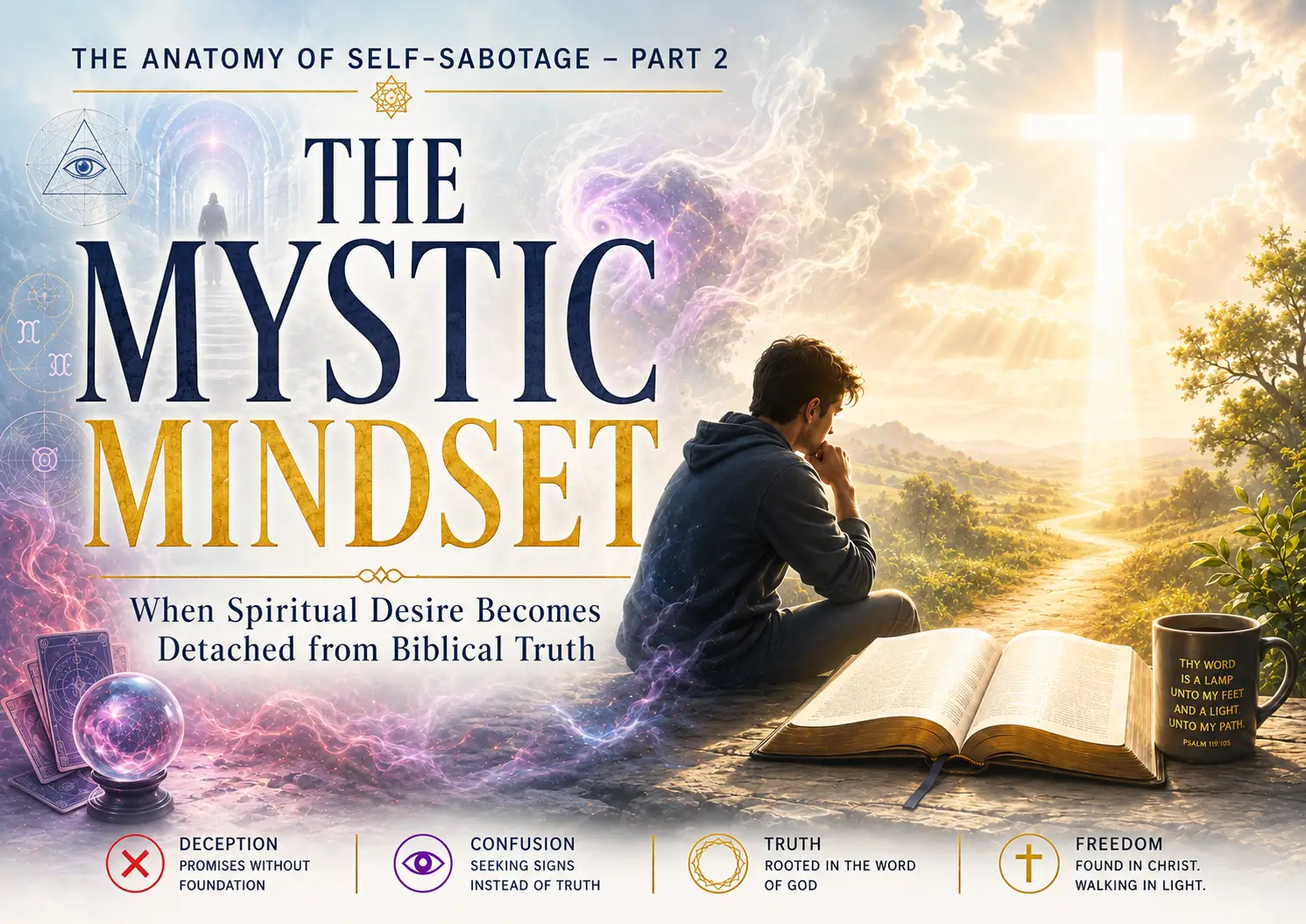
THE MYSTIC MINDSET AND SPIRITUAL SELF-SABOTAGE
When Spiritual Desire Becomes Detached from Biblical Truth
Introduction
Every believer is called to be spiritual, but not every spiritual-looking experience is truly from God. The Christian life is supernatural by nature. We are born again by the Spirit, led by the Spirit, strengthened by the Spirit, and called to worship God in spirit and truth. However, there is a dangerous counterfeit that can enter the life of a believer when spiritual desire becomes detached from biblical truth.
This counterfeit is what we will call the mystic mindset.
The mystic mindset is not the same as true spirituality. True spirituality is Christ-centred, Scripture-governed, Spirit-led, obedient, humble, discerning, and transformational. The mystic mindset, however, is often obsessed with mystical experiences, sensationalism, hidden revelations, signs, wonders, spiritual manifestations, strange practices, and supernatural encounters more than truth, obedience, and conformity to Christ.
This mindset becomes a form of self-sabotage because it causes believers to chase experiences while neglecting maturity. It can make people hunger for power but avoid repentance. It can make people pursue manifestations but resist correction. It can cause believers to look for “deep revelation” while ignoring the simple and clear instruction of Scripture.
The danger is not in being spiritual. The danger is in becoming spiritually curious without being biblically grounded.
What Is the Mystic Mindset?
The mystic mindset is a damaged mindset that becomes overly fascinated with mystical experiences, sensational spiritual activity, hidden knowledge, supernatural manifestations, and spiritual mysteries while failing to remain anchored in Christ, Scripture, sound doctrine, and obedience.
It is a mindset that often says:
- “I had a dream, therefore it must be God.”
- “I felt something, therefore it must be true.”
- “I saw something in the spirit, therefore no one may question it.”
- “I received a revelation, therefore Scripture must now be interpreted around what I experienced.”
- “I need a sign before I obey.”
- “I need a prophetic word before I make a decision.”
This mindset may sound spiritual, but it can become dangerous when personal experiences are treated as equal to, or greater than, the Word of God.
True spirituality submits every dream, vision, prophecy, impression, manifestation, and experience to the authority of Scripture. God does speak, but He will never contradict His written Word. The Holy Spirit will never lead a believer away from Christ, away from truth, away from holiness, or away from obedience.
Spirit and Truth Must Remain Together
Jesus made it clear that true worship is not merely spiritual; it is spiritual and truthful.
John 4:23-24 NKJV
(23) But the hour is coming, and now is, when the true worshipers will worship the Father in spirit and truth; for the Father is seeking such to worship Him.
(24) God is Spirit, and those who worship Him must worship in spirit and truth.”
This is a foundational safeguard. Spirit without truth becomes error. Truth without the Spirit becomes dead religion. God requires both.
The mystic mindset often emphasizes the spiritual realm but neglects truth. It becomes fascinated with angels, demons, dreams, visions, prophecies, symbols, numbers, oils, rituals, and spiritual signs, yet may fail to produce the fruit of Christlike character.
True spirituality always leads us closer to Christ. It produces humility, holiness, love, obedience, wisdom, self-control, and discernment. The mystic mindset often produces confusion, fear, spiritual pride, instability, manipulation, and dependence on experiences.
Biblical Warning Against False Spirituality
The apostle Paul warned the church about people who appeared spiritual but were not properly connected to Christ.
Colossians 2:18-19 NKJV
(18) Let no one cheat you of your reward, taking delight in false humility and worship of angels, intruding into those things which he has not seen, vainly puffed up by his fleshly mind,
(19) and not holding fast to the Head, from whom all the body, nourished and knit together by joints and ligaments, grows with the increase that is from God.
Paul describes people who intrude into spiritual matters, become puffed up by their minds, and lose connection with the Head, who is Christ. This is a perfect picture of the mystic mindset. A person may speak much about the spiritual realm but not remain submitted to Christ. They may appear humble, but inwardly become proud because of what they think they have seen, heard, or experienced.
The greatest test of spirituality is not how much a person claims to see in the spirit. The real test is whether they are holding fast to Christ.
CHARACTERISTICS OF THE MYSTIC MINDSET
Characteristic 1: Fascination with Mysteries
One of the first signs of the mystic mindset is an unhealthy fascination with mysteries. This person is not satisfied with the plain truth of Scripture. They are always looking for hidden meanings, secret codes, special revelations, unusual interpretations, and spiritual messages behind everything.
There is nothing wrong with desiring deeper understanding. Scripture does contain mysteries revealed in Christ. However, when a person becomes obsessed with hidden knowledge more than revealed truth, they become vulnerable to deception.
Deuteronomy 29:29 NKJV
“The secret things belong to the LORD our God, but those things which are revealed belong to us and to our children forever, that we may do all the words of this law.”
This verse gives us an important boundary. There are secret things that belong to God, and there are revealed things that belong to us. The believer must learn to live faithfully by what God has revealed instead of becoming obsessed with what God has not revealed.
Many people sabotage themselves because they keep searching for hidden revelation while disobeying revealed instruction. They want to know mysteries about the future, but they refuse to forgive. They want to understand spiritual secrets, but they neglect prayer, humility, love, and obedience.
God is not impressed by curiosity that avoids obedience.
Characteristic 2: Dependence on Signs and Wonders
The mystic mindset often depends on signs and wonders before it will believe, obey, or move forward. Such a person may constantly ask God for signs, confirmations, prophetic words, dreams, open doors, supernatural signals, or dramatic manifestations before obeying what Scripture has already made clear.
Jesus warned against a generation that demands signs while lacking true repentance.
Matthew 12:39 NKJV
(39) But He answered and said to them, “An evil and adulterous generation seeks after a sign, and no sign will be given to it except the sign of the prophet Jonah.
Signs and wonders are biblical, but they are not meant to replace faith, obedience, and truth. God performed signs through Moses, Elijah, Elisha, Jesus, and the apostles. Yet signs were never meant to become the foundation of faith. Christ is the foundation.
A believer who constantly needs a sign may become unstable. Instead of being led by Scripture and the Holy Spirit, they become dependent on external confirmations. This opens the door to confusion, manipulation, and delay.
John 20:29 NKJV
(29) Jesus said to him, “Thomas, because you have seen Me, you have believed. Blessed are those who have not seen and yet have believed.”
Faith does not always need visible proof. Mature faith obeys God because He is trustworthy.
Characteristic 3: Emotional Frenzy Mistaken for Spirituality
The mystic mindset often confuses emotional intensity with the presence of God. It may assume that loudness, shaking, crying, shouting, falling, excitement, or dramatic behaviour automatically proves spiritual depth.
Emotions are part of our humanity, and God can touch our emotions. We may weep in repentance, rejoice in worship, tremble under conviction, or become deeply moved by the presence of God. However, emotion alone is not the measure of spirituality.
The Holy Spirit does not produce confusion, disorder, manipulation, or loss of self-control.
1 Corinthians 14:33 NKJV
(33) For God is not the author of confusion but of peace, as in all the churches of the saints.
1 Corinthians 14:40 NKJV
(40) Let all things be done decently and in order.
True spiritual activity may be powerful, but it will not contradict the nature of God. The Spirit of God produces order, peace, holiness, reverence, and edification. Emotional frenzy can impress people, but it cannot transform the heart unless truth, repentance, and obedience are present.
A person can cry in a meeting and remain unchanged. A person can fall under emotion and still refuse forgiveness. A person can shout loudly and still live in rebellion. The fruit of the Spirit is a better measure of maturity than the intensity of an emotional moment.
Characteristic 4: Vain Repetitions and Chanting
The mystic mindset may also place confidence in repetitive words, chants, formulas, or ritualistic prayers. Instead of praying from a sincere heart in faith, the person may believe that repeating certain phrases over and over gives them spiritual power.
Jesus warned directly against this.
Matthew 6:7-8 NKJV
(7) And when you pray, do not use vain repetitions as the heathen do. For they think that they will be heard for their many words.
(8) “Therefore do not be like them. For your Father knows the things you have need of before you ask Him.
Prayer is not witchcraft. Prayer is not manipulation. Prayer is not a formula used to force spiritual outcomes. Prayer is communion with the Father through Christ by the Holy Spirit.
The problem is not repetition itself. Jesus prayed more than once in the Garden of Gethsemane, and the Psalms contain repeated phrases of worship. The problem is vain repetition—empty, mechanical, ritualistic repetition that trusts in the method instead of trusting in God.
When prayer becomes a formula, the believer begins to trust the technique more than the Father. That is no longer faith; it becomes spiritual superstition.
Characteristic 5: Fear-Driven Spirituality
The mystic mindset often produces fear-driven spirituality. People become afraid of curses, demons, witchcraft, ancestral powers, evil altars, territorial spirits, objects, dreams, numbers, names, symbols, places, and spiritual attacks. Their spiritual life becomes controlled more by fear of darkness than confidence in Christ.
This does not mean spiritual warfare is not real. The Bible clearly teaches that believers wrestle against spiritual forces. However, biblical spiritual warfare is never meant to make believers demon-conscious more than Christ-conscious.
2 Timothy 1:7 NKJV
(7) For God has not given us a spirit of fear, but of power and of love and of a sound mind.
Fear-driven spirituality does not produce a sound mind. It produces anxiety, suspicion, confusion, and bondage. A believer may begin to interpret every difficulty as an attack, every disagreement as witchcraft, every delay as a curse, and every dream as a demonic message.
Christ has not called His people to live in fear. He has called them to live in victory, authority, wisdom, and peace.
Colossians 2:15 NKJV
(15) Having disarmed principalities and powers, He made a public spectacle of them, triumphing over them in it.
The believer must remember that Jesus did not merely challenge darkness. He triumphed over it.
Characteristic 6: Obsession with Demons and Spiritual Warfare
One of the most common expressions of the mystic mindset is an unhealthy obsession with demons and spiritual warfare. Some believers talk more about demons than Jesus, more about curses than covenant, more about attacks than authority, and more about deliverance than discipleship.
Spiritual warfare is real, but it must remain biblical, Christ-centered, and balanced.
Ephesians 6:10-13 NKJV
(10) Finally, my brethren, be strong in the Lord and in the power of His might.
(11) Put on the whole armor of God, that you may be able to stand against the wiles of the devil.
(12) For we do not wrestle against flesh and blood, but against principalities, against powers, against the rulers of the darkness of this age, against spiritual hosts of wickedness in the heavenly places.
(13) Therefore take up the whole armor of God, that you may be able to withstand in the evil day, and having done all, to stand.
Characteristic 7: Unbiblical Spiritual Practices
Another major characteristic of the mystic mindset is the adoption of unbiblical spiritual practices. This happens when a believer begins to use methods, rituals, objects, symbols, formulas, or spiritual activities that are not rooted in Scripture, not centred on Christ, and not governed by the Holy Spirit.
The danger of the mystic mindset is that it often borrows from different spiritual systems while still using Christian language. A person may speak about Jesus, prayer, prophecy, deliverance, and the Holy Spirit, but at the same time practise things that are closer to superstition, manipulation, divination, witchcraft, or occultism than biblical Christianity.
This is one of the most deceptive areas because many unbiblical practices are presented as “deep spiritual revelation.” They may appear powerful, mysterious, or effective, but effectiveness is not the test of truth. The real question is not, “Did something happen?” The real question is, “Is this practice submitted to Christ and supported by Scripture?”
Not every spiritual manifestation is from God. Not every supernatural experience is holy. Not every spiritual practice that produces a result is biblical.
God Forbids Mixture
Throughout Scripture, God strongly warns His people against mixing true worship with forbidden spiritual practices. Israel was not only commanded to worship the Lord; they were also commanded not to adopt the spiritual practices of the surrounding nations.
Deuteronomy 18:10-12 NKJV
(10) There shall not be found among you anyone who makes his son or his daughter pass through the fire, or one who practices witchcraft, or a soothsayer, or one who interprets omens, or a sorcerer,
(11) or one who conjures spells, or a medium, or a spiritist, or one who calls up the dead.
(12) For all who do these things are an abomination to the LORD, and because of these abominations the LORD your God drives them out from before you.
This passage is important because it shows that God does not accept every form of spirituality. Some spiritual practices are forbidden because they open people to deception, bondage, and demonic influence.
The mystic mindset becomes vulnerable to mixture because it is more interested in spiritual experiences than biblical boundaries. It may say, “But it works,” while ignoring the fact that God has already said, “Do not practise it.”
The believer must understand that power without purity is dangerous. Spiritual activity without biblical truth can become deception.
EXAMPLES OF UNBIBLICAL SPIRITUAL PRACTICES
Unbiblical spiritual practices may take many forms. They are not always obvious at first because they are often wrapped in Christian words or church culture.
Some examples include:
- Using objects as spiritual charms or lucky items.
- Depending on oils, water, cloths, salt, candles, bracelets, pictures, or other objects as if they contain automatic spiritual power.
- Praying ritualistic formulas without faith, repentance, or relationship with God.
- Seeking hidden messages through numbers, dreams, symbols, signs, or repeated coincidences without testing them by Scripture.
- Consulting mediums, fortune-tellers, ancestral spirits, spiritual healers, or diviners.
- Trying to communicate with the dead.
- Using chants, declarations, or repeated phrases as if words themselves have magical power apart from faith in God.
- Building doctrine around personal visions, dreams, prophecies, or supernatural experiences instead of Scripture.
- Treating deliverance practices as more important than discipleship, repentance, holiness, and renewed thinking.
- Using fear-based rituals to “protect” oneself instead of trusting in the finished work of Christ.
These practices may appear spiritual, but they move the believer away from simple devotion to Christ.
The Danger of Spiritual Substitutes
One of the greatest dangers of unbiblical spiritual practices is that they become substitutes for Christ Himself. Instead of trusting in Christ, the believer begins to trust in an object, ritual, prophet, formula, or spiritual system.
- The person may say, “I cannot sleep unless I have this oil.”
- “I am afraid unless I carry this object.”
- “I cannot make a decision unless someone gives me a prophetic word.”
- “I must repeat this phrase a certain number of times for protection.”
- “I must perform this ritual to break the curse.”
This is no longer biblical faith. It becomes spiritual dependency on something other than Christ.
The believer must be careful not to turn biblical symbols into superstitious tools. For example, Scripture does mention anointing with oil, laying on of hands, prayer cloths in a specific apostolic context, baptism, communion, and other spiritual actions. However, none of these are independent sources of power. Their value is found in obedience to God, faith in Christ, and submission to the Holy Spirit.
When the object becomes the focus, Christ is displaced.
CHRIST MUST REMAIN THE CENTRE
The apostle Paul warned believers not to be moved away from the simplicity and purity of devotion to Christ.
2 Corinthians 11:3 NKJV
(3) But I fear, lest somehow, as the serpent deceived Eve by his craftiness, so your minds may be corrupted from the simplicity that is in Christ.
This is a powerful warning. The enemy does not always deceive people by making them openly reject Christ. Sometimes he deceives them by adding spiritual complications that slowly move them away from Christ.
The mystic mindset often makes the Christian life complicated. It adds rituals, formulas, objects, spiritual systems, hidden rules, fear-based practices, and endless spiritual requirements. Instead of resting in Christ, the believer becomes anxious and dependent on methods.
True Christianity is not empty ritual. It is life in Christ.
- Christ is our Saviour.
- Christ is our Deliverer.
- Christ is our Mediator.
- Christ is our Peace.
- Christ is our Protection.
- Christ is our Wisdom.
- Christ is our Victory.
Anything that takes the place of Christ, even if it appears spiritual, becomes dangerous.
THE BIBLICAL EXAMPLE OF EPHESUS
A powerful biblical example of people turning away from unbiblical spiritual practices is found in Acts 19. When the gospel impacted Ephesus, many people who had practised magic and occult arts repented and destroyed their books.
Acts 19:18-20 NKJV
(18) And many who had believed came confessing and telling their deeds.
(19) Also, many of those who had practiced magic brought their books together and burned them in the sight of all. And they counted up the value of them, and it totaled fifty thousand pieces of silver.
(20) So the word of the Lord grew mightily and prevailed.
This passage shows that true revival does not produce deeper involvement in mystical practices. True revival produces repentance, separation, and the supremacy of the Word of God.
The people in Ephesus did not try to Christianise their old practices. They did not keep their magic books and simply add the name of Jesus to them. They renounced them. They destroyed them. They separated themselves from what was unclean.
The result was powerful: “So the word of the Lord grew mightily and prevailed.”
Where unbiblical spiritual practices are removed, the Word of God gains authority again.
WHEN SPIRITUAL CURIOSITY BECOMES A DOORWAY
Spiritual curiosity may appear harmless, but it can become a doorway to deception. Many people do not enter unbiblical practices because they hate God. They enter them because they are curious, desperate, fearful, wounded, or hungry for power.
- Some want quick answers.
- Some want supernatural control.
- Some want protection from fear.
- Some want spiritual experiences.
- Some want to feel important or specially chosen.
- Some want power without process.
This is why discernment is so important. The believer must not open spiritual doors simply because something appears interesting, mysterious, or powerful.
1 John 4:1 NKJV
(1) Beloved, do not believe every spirit, but test the spirits, whether they are of God; because many false prophets have gone out into the world.
Scripture does not tell us to accept every spiritual experience. It commands us to test the spirits. This means every teaching, prophecy, manifestation, dream, practice, and spiritual influence must be examined by the Word of God, the character of Christ, the fruit it produces, and the witness of the Holy Spirit.
A spiritual practice is not safe simply because it uses the name of Jesus. It must be consistent with the nature, doctrine, and authority of Christ.
THE PROBLEM WITH RITUAL WITHOUT RELATIONSHIP
Unbiblical spiritual practices often appeal to people because they seem easier than true relationship with God. A ritual can be performed quickly. An object can be carried. A formula can be repeated. A prophet can be consulted. A ceremony can be done.
- But relationship requires surrender.
- Relationship requires obedience.
- Relationship requires repentance.
- Relationship requires trust.
- Relationship requires transformation.
The mystic mindset often prefers ritual over relationship because ritual gives a person the feeling of control. True relationship with God requires the believer to yield control to the Lord.
God is not looking for people who use spiritual methods to control outcomes. He is looking for sons and daughters who trust Him, obey Him, love Him, and walk with Him.
UNBIBLICAL PRACTICES CREATE BONDAGE
One of the signs that a spiritual practice is unhealthy is that it produces bondage instead of freedom. If a believer becomes afraid to function without a certain object, ritual, person, declaration, or practice, then that thing has become a chain.
Jesus did not come to replace one bondage with another. He came to set people free.
John 8:36 NKJV
(36) Therefore if the Son makes you free, you shall be free indeed.
Freedom in Christ is not carelessness. It is not spiritual laziness. It is not denial of spiritual warfare. Freedom in Christ means the believer is no longer controlled by fear, superstition, manipulation, or dependence on unbiblical systems.
The believer’s confidence is not in a ritual. The believer’s confidence is in Christ.
HOW TO DISCERN WHETHER A PRACTICE IS UNBIBLICAL
A believer can ask several important questions when evaluating any spiritual practice:
- Does this practice clearly honour Jesus Christ?
- Is it supported by Scripture when understood correctly?
- Does it produce holiness, humility, love, obedience, and soundness of mind?
- Does it lead me closer to God or make me dependent on a person, object, formula, or ritual?
- Does it create fear or faith?
- Does it exalt Christ or magnify demons, curses, and darkness?
- Does it align with the fruit of the Spirit?
- Does it require secrecy, manipulation, payment, fear, or control?
- Does it make me more obedient to Scripture or more obsessed with spiritual experiences?
These questions help expose whether a practice is biblical or whether it belongs to the mystic mindset.
THE REDEMPTIVE CURE
The cure for unbiblical spiritual practices is not spiritual dryness. The cure is not to become anti-supernatural. The cure is to return to biblical, Christ-centred, Spirit-led spirituality.
The believer must return to sound doctrine.
Titus 2:1 NKJV
(1) But as for you, speak the things which are proper for sound doctrine:
Sound doctrine protects the believer from spiritual deception. It anchors the heart in truth and prevents spiritual hunger from becoming spiritual error.
The believer must return to Christ-centred worship. Worship must not be built around angels, demons, manifestations, personalities, or mysteries. Worship must exalt the Father through the Son by the Holy Spirit.
The believer must grow in spiritual maturity. Mature believers do not chase every manifestation. They test, discern, examine, and remain grounded.
The believer must develop discernment. Discernment is not suspicion. Discernment is the Spirit-given ability to distinguish between truth and error, holy and unholy, Spirit and flesh, Christ and counterfeit.
The believer must become grounded in Scripture. The Word of God must become the final authority over every experience.
Psalm 119:105 NKJV
(105) Your word is a lamp to my feet And a light to my path.
The Word of God gives light. It keeps the believer from walking in darkness while thinking they are walking in revelation.
CONCLUSION
Unbiblical spiritual practices are dangerous because they often appear spiritual while leading people away from Christ. They can create fear, confusion, dependency, superstition, deception, and bondage. They may promise power, protection, revelation, or breakthrough, but anything that moves a believer away from Christ and Scripture must be rejected.
- The believer does not need spiritual mixture. The believer needs Christ.
- The believer does not need superstition. The believer needs truth.
- The believer does not need fear-based rituals. The believer needs faith-filled obedience.
- The believer does not need mystical dependency. The believer needs spiritual maturity.
The mystic mindset is healed when the believer returns to the simplicity, purity, and authority of Christ. True spirituality is not found in strange practices, hidden rituals, or mystical experiences. True spirituality is found in a life surrendered to Jesus, governed by Scripture, led by the Holy Spirit, and transformed into the image of Christ.
OTHER PUBLICATIONS BY THIS AUTHOR CAN BE FOUND AT: