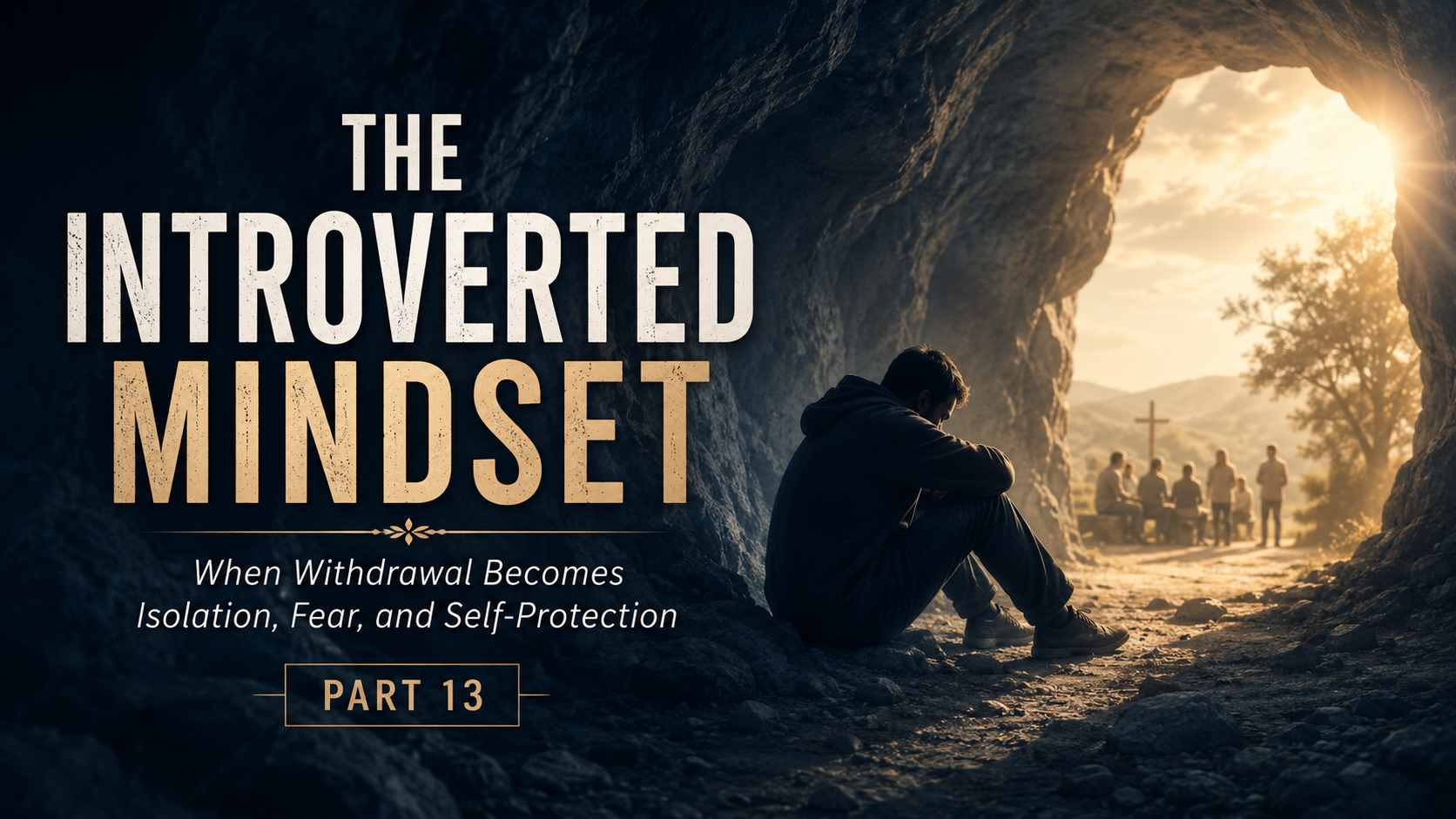
THE ANATOMY OF SELF-SABOTAGE – PART 13
THE INTROVERTED MINDSET — UNHEALTHY FORM – WHEN WITHDRAWAL BECOMES ISOLATION, FEAR, AND SELF-PROTECTION
INTRODUCTION: WHEN QUIETNESS BECOMES A HIDING PLACE
Not every quiet person is wounded, fearful, or spiritually unhealthy. Introversion itself is not sinful. Some people are naturally reflective, reserved, thoughtful, and strengthened by solitude. In fact, Scripture shows that solitude can be holy when it becomes a place of prayer, renewal, and communion with God.
Jesus Himself withdrew from the crowds to pray.
Luke 5:16 NKJV
(16) So He Himself often withdrew into the wilderness and prayed.
However, there is a difference between healthy solitude and unhealthy isolation. Solitude seeks God; isolation avoids people. Solitude renews the soul; isolation imprisons the soul. Solitude strengthens obedience; isolation often protects fear, offense, shame, and emotional pain.
The unhealthy introverted mindset develops when withdrawal becomes a fortress of self-protection. It is when a person begins to hide from accountability, avoid confrontation, suppress emotions, resist fellowship, and disconnect from the very relationships God may use for healing and growth.
This mindset does not always appear rebellious on the outside. Sometimes it looks quiet, peaceful, spiritual, or even mature. But beneath the surface, it may be driven by fear, disappointment, rejection, offense, weariness, insecurity, or a desire to avoid being hurt again.
The danger of unhealthy isolation is that it distorts perception. A person alone with their pain can begin to believe things that are not true. They may think nobody understands them, nobody cares, nobody can be trusted, and nobody is standing with them. This is exactly what happened to Elijah.
CLARIFICATION: INTROVERSION IS NOT SINFUL
It is important to state this clearly: introversion is not sin. Being quiet is not sin. Enjoying time alone is not sin. Needing space to think, process, and recover emotionally is not sin.
God created people with different temperaments, personalities, and emotional rhythms. Some people are energized by crowds, while others are drained by constant social interaction. Some think out loud, while others process deeply and silently. The Kingdom of God needs both.
The issue is not personality. The issue is when withdrawal becomes disobedience, isolation, fear, pride, avoidance, or self-protection.
Unhealthy isolation becomes destructive when it prevents:
- accountability,
- healing,
- confrontation,
- fellowship,
- discipleship,
- vulnerability,
- correction,
- and covenant relationships.
Proverbs 18:1 NKJV
(1) A man who isolates himself seeks his own desire; He rages against all wise judgment.
This verse reveals the danger of isolation. Isolation is not always neutral. Sometimes it becomes self-willed. A person withdraws not because God is calling them aside, but because they no longer want to be corrected, challenged, helped, or confronted.
Healthy solitude says, “Lord, strengthen me so I can obey You.”
Unhealthy isolation says, “I am safer alone, and I do not need anyone.”
DEFINITION OF THE UNHEALTHY INTROVERTED MINDSET
The unhealthy introverted mindset is a damaged pattern of thinking where a person withdraws from people, avoids necessary relationships, suppresses emotions, fears confrontation, and protects themselves through isolation rather than trusting God for healing, fellowship, and accountability.
- It is not simply being reserved. It is hiding.
- It is not simply needing rest. It is disconnecting.
- It is not simply being quiet. It is refusing to speak when truth, transparency, or repentance is required.
- It is not simply avoiding noise. It is avoiding responsibility, vulnerability, and relational growth.
This mindset often says:
- “I am better off alone.”
- “Nobody understands me.”
- “I cannot trust people.”
- “I do not want to explain myself.”
- “I do not want confrontation.”
- “I will just keep everything inside.”
- “I do not need fellowship.”
- “I will serve God privately but avoid people.”
But biblical Christianity was never designed to be lived in isolation. God saves us into a body, a family, a household, and a fellowship of believers.
1 Corinthians 12:27 NKJV
(27) Now you are the body of Christ, and members individually.
A member disconnected from the body becomes vulnerable. No believer can mature fully while permanently separated from fellowship, correction, encouragement, and covenant relationship.
Biblical Example: Elijah — When Isolation Distorted Perception
Elijah was a powerful prophet of God. He confronted Ahab, challenged Baal worship, prayed down fire from heaven, and stood boldly for truth in a corrupt generation. Yet after one threat from Jezebel, Elijah ran into the wilderness and entered a season of deep emotional exhaustion and isolation.
1 Kings 19:3-4 NKJV
(3) And when he saw that, he arose and ran for his life, and went to Beersheba, which belongs to Judah, and left his servant there.
(4) But he himself went a day’s journey into the wilderness, and came and sat down under a broom tree. And he prayed that he might die, and said, “It is enough! Now, LORD, take my life, for I am no better than my fathers!”
Notice the progression. Elijah ran for his life. Then he left his servant behind. Then he went alone into the wilderness. The moment he separated himself from companionship, his thoughts became darker. Isolation gave room for despair to speak louder than truth.
Elijah had just experienced one of the greatest public victories in Scripture on Mount Carmel, yet shortly afterward he wanted to die. This shows us that even strong spiritual people can become vulnerable when they are exhausted, isolated, threatened, and emotionally overwhelmed.
God did not respond to Elijah with condemnation. He first gave him rest and food.
1 Kings 19:5-6 NKJV
(5) Then as he lay and slept under a broom tree, suddenly an angel touched him, and said to him, “Arise and eat.”
(6) Then he looked, and there by his head was a cake baked on coals, and a jar of water. So he ate and drank, and lay down again.
This is important. Sometimes what people call a spiritual failure is also connected to physical exhaustion, emotional depletion, and prolonged pressure. Elijah needed restoration before instruction. God cared for his body before addressing his perspective.
Later, Elijah entered a cave. The cave became a picture of inward withdrawal, hidden fear, and distorted perception.
1 Kings 19:9-10 NKJV
(9) And there he went into a cave, and spent the night in that place; and behold, the word of the LORD came to him, and He said to him, “What are you doing here, Elijah?”
(10) So he said, “I have been very zealous for the LORD God of hosts; for the children of Israel have forsaken Your covenant, torn down Your altars, and killed Your prophets with the sword. I alone am left; and they seek to take my life.”
God later corrected this false perception.
1 Kings 19:18 NKJV
(18) Yet I have reserved seven thousand in Israel, all whose knees have not bowed to Baal, and every mouth that has not kissed him.”
Elijah was not alone. There were seven thousand others who had remained faithful. But isolation had convinced him otherwise.
This is one of the greatest dangers of the unhealthy introverted mindset: it can make a person believe their feelings are facts. It can cause them to interpret life through exhaustion, fear, rejection, disappointment, and loneliness rather than through the truth of God.
THE DANGER OF THE CAVE
The cave can represent many things in a believer’s life.
- It can be the cave of disappointment.
- It can be the cave of fear.
- It can be the cave of offense.
- It can be the cave of emotional shutdown.
- It can be the cave of self-protection.
- It can be the cave of “I am done with people.”
- It can be the cave of silent bitterness.
- It can be the cave of spiritual withdrawal.
God asked Elijah, “What are you doing here?” That question was not because God lacked information. It was a question of confrontation, awakening, and realignment.
God was not only asking Elijah where he was geographically. He was asking where he was spiritually, emotionally, and mentally.
In the same way, the Lord may ask us:
- “What are you doing in this place of isolation?”
- “What are you doing in this cave of fear?”
- “What are you doing hiding from the people I assigned to you?”
- “What are you doing separating yourself from fellowship?”
- “What are you doing protecting pain instead of bringing it into My light?”
God did not intend for Elijah to die in the cave. He still had assignment, purpose, and prophetic responsibility.
CHARACTERISTICS OF THE INTROVERTED MIND
Characteristic 1: Withdrawal
Withdrawal is one of the first signs of the unhealthy introverted mindset. Withdrawal happens when a person begins to pull back emotionally, relationally, spiritually, or physically from people who are meant to walk with them.
There are times when withdrawal is necessary for rest. Jesus withdrew to pray. But unhealthy withdrawal is different. It is not rooted in prayer; it is rooted in avoidance. It does not produce renewed strength; it produces distance, silence, and disconnection.
A person operating in unhealthy withdrawal may stop attending fellowship, avoid difficult conversations, ignore messages, withdraw from leadership, stop serving, or become emotionally unavailable.
They may still appear present physically, but their heart has already left.
Hebrews 10:24-25 NKJV
(24) And let us consider one another in order to stir up love and good works,
(25) not forsaking the assembling of ourselves together, as is the manner of some, but exhorting one another, and so much the more as you see the Day approaching.
The assembling of believers is not merely a religious routine. It is a spiritual protection. God uses fellowship to stir us, strengthen us, encourage us, correct us, and keep our hearts awake.
When a person withdraws from the body, they often become easier targets for discouragement, deception, offense, and temptation.
Even in the beginning, God declared that isolation was not good.
Genesis 2:18 NKJV
(18) And the LORD God said, “It is not good that man should be alone; I will make him a helper comparable to him.”
This statement was made before sin entered the world. That means the need for relationship was not a result of weakness or failure. It was part of God’s design.
Characteristic 2: Isolation
Withdrawal can become isolation when distance becomes a lifestyle. Isolation is more dangerous than temporary retreat because it creates a closed internal world where the person becomes the only voice they listen to.
In isolation, thoughts can become exaggerated. Pain can become magnified. Fear can become prophetic in a person’s imagination. Suspicion can increase. Discouragement can become normal. The person may begin to rehearse conversations that never happened, assume motives that were never expressed, and believe conclusions that were never tested.
This is what happened to Elijah. He concluded, “I alone am left.” His conclusion felt real, but it was not true.
Isolation often makes people interpret absence as rejection, correction as attack, silence as abandonment, and disagreement as betrayal.
Ecclesiastes 4:9-10 NKJV
(9) Two are better than one, Because they have a good reward for their labor.
(10) For if they fall, one will lift up his companion. But woe to him who is alone when he falls, For he has no one to help him up.
The danger of isolation is revealed in the next statement:
Isolation removes the very hands God may use to lift us up.
The isolated person may say, “I do not need anyone.” But Scripture teaches that even the strong need companions. Moses needed Aaron and Hur to hold up his hands in battle.
Exodus 17:12 NKJV
(12) But Moses’ hands became heavy; so they took a stone and put it under him, and he sat on it. And Aaron and Hur supported his hands, one on one side, and the other on the other side; and his hands were steady until the going down of the sun.
Moses was the leader, but he still needed support. His calling did not remove his need for people.
Characteristic 3: Fear of Confrontation
The unhealthy introverted mindset often avoids confrontation. This avoidance may come from fear of rejection, fear of conflict, fear of being misunderstood, fear of emotional pain, or fear of losing relationships.
But avoiding confrontation does not remove problems. It often allows them to grow in silence.
Biblical confrontation is not cruelty. It is truth spoken in love for the purpose of restoration. Jesus did not avoid confrontation when truth, repentance, and spiritual alignment were at stake. Yet His confrontation was never driven by insecurity; it was rooted in love, righteousness, and obedience to the Father.
Ephesians 4:15 NKJV
(15) but, speaking the truth in love, may grow up in all things into Him who is the head—Christ—
Growth requires truth. Love without truth becomes sentimental compromise. Truth without love becomes harshness. But truth spoken in love produces maturity.
A person with an unhealthy introverted mindset may avoid difficult conversations by saying, “I do not want drama.” But sometimes what is called “drama” is actually the necessary process of healing, clarification, repentance, and reconciliation.
Jesus gave a clear process for dealing with offense and relational breakdown.
Matthew 18:15 NKJV
(15) “Moreover if your brother sins against you, go and tell him his fault between you and him alone. If he hears you, you have gained your brother.
This requires courage. It requires humility. It requires obedience. It also requires a willingness to come out of hiding.
Avoiding confrontation can lead to buried offense. Buried offense does not die; it grows roots.
Characteristic 4: Emotional Suppression
Another characteristic of the unhealthy introverted mindset is emotional suppression. This happens when a person refuses to express pain, fear, disappointment, confusion, or need. Instead of bringing emotions into the light, they bury them.
Suppression is not the same as self-control. Self-control submits emotions to the Spirit of God. Suppression hides emotions in darkness and pretends they do not exist.
Many believers confuse silence with maturity. But silence is only mature when it is governed by wisdom. Silence becomes dangerous when it is used to avoid honesty, repentance, confession, or healing.
David was a man after God’s own heart, yet he did not suppress his emotions before God. The Psalms are filled with honest prayers, tears, questions, fears, repentance, and worship.
Psalms 62:8 NKJV
(8) Trust in Him at all times, you people; Pour out your heart before Him; God is a refuge for us. Selah
God does not ask us to pretend. He invites us to pour out our hearts before Him.
Emotional suppression may look strong, but it often produces inner heaviness, resentment, distance, anxiety, and spiritual dullness. What is not brought into the light cannot be healed properly.
James 5:16 NKJV
(16) Confess your trespasses to one another, and pray for one another, that you may be healed. The effective, fervent prayer of a righteous man avails much.
There is a healing that comes through honest confession, prayer, and trusted spiritual relationships. Not every person deserves access to your inner life, but every believer needs safe, godly, accountable relationships where truth can be spoken and burdens can be shared.
THE SPIRITUAL DANGER OF SELF-PROTECTION
Self-protection often feels safe, but it can become a prison. When people have been hurt, rejected, betrayed, or misunderstood, they may build walls around their hearts. These walls are designed to keep pain out, but they also keep love, correction, fellowship, and healing out.
The unhealthy introverted mindset says, “I will never allow anyone close enough to hurt me again.”
But the way of Christ is not emotional hardness. The way of Christ is healing, wisdom, discernment, and love.
Proverbs 4:23 NKJV
(23) Keep your heart with all diligence, For out of it spring the issues of life.
Guarding the heart does not mean hardening the heart. Guarding means protecting the heart from corruption while keeping it open to God, truth, love, and righteous relationships.
Self-protection becomes unhealthy when it replaces trust in God. A person may avoid fellowship not because God told them to step away, but because fear told them to hide.
BIBLICAL BALANCE: SOLITUDE WITH GOD, FELLOWSHIP WITH PEOPLE
Jesus modelled the perfect balance. He withdrew to pray, but He did not isolate Himself from assignment, disciples, fellowship, or people in need.
He spent time alone with the Father, then returned to serve people. His solitude strengthened His mission; it did not cancel it.
That is the difference between holy solitude and unhealthy isolation.
Holy solitude produces obedience. Unhealthy isolation produces avoidance.
Holy solitude refreshes love. Unhealthy isolation hardens the heart.
Holy solitude deepens fellowship with God. Unhealthy isolation cuts off fellowship with people.
Holy solitude brings clarity. Unhealthy isolation distorts perception.
Holy solitude prepares us for purpose. Unhealthy isolation pulls us away from purpose.
REDEMPTIVE CURE FOR AN INTROVERTED MIND:
-
FELLOWSHIP
The first redemptive cure for the unhealthy introverted mindset is fellowship.
Fellowship is more than attending a meeting. It is shared spiritual life. It is walking with other believers in truth, love, prayer, encouragement, correction, and mutual responsibility.
Acts 2:42 NKJV
(42) And they continued steadfastly in the apostles’ doctrine and fellowship, in the breaking of bread, and in prayers.
The early church did not only gather around teaching. They continued in fellowship. Doctrine and fellowship belonged together. Truth was not meant to be received in isolation, but lived in community.
Fellowship helps break the lie that says, “I am alone.” It reminds the believer that they are part of a body, a family, and a spiritual household.
1 John 1:7 NKJV
(7) But if we walk in the light as He is in the light, we have fellowship with one another, and the blood of Jesus Christ His Son cleanses us from all sin.
Walking in the light creates fellowship. Isolation often grows in darkness, secrecy, fear, and silence. Fellowship grows where there is light, honesty, humility, and love.
-
ACCOUNTABILITY
Accountability is another cure for unhealthy isolation. Accountability is not control. It is a loving structure that helps believers remain aligned with truth, wisdom, and spiritual responsibility.
A person who refuses accountability is often protecting something. It may be pain, pride, fear, sin, offense, or independence. But true accountability is a gift from God.
Proverbs 27:17 NKJV
(17) As iron sharpens iron, So a man sharpens the countenance of his friend.
Iron cannot sharpen iron from a distance. Sharpening requires contact. It may create friction, but the result is greater usefulness.
Accountability helps expose blind spots. Elijah needed God to confront his distorted perception. He thought he was alone, but he was not. He thought his assignment was finished, but it was not. He thought death was the answer, but God still had purpose for him.
Accountability reminds us that our feelings must be tested by truth.
-
COMMUNITY
God’s answer to isolation is not merely more information. It is community. Believers are not called to live as disconnected individuals but as members of one body.
Romans 12:4-5 NKJV
(4) For as we have many members in one body, but all the members do not have the same function,
(5) so we, being many, are one body in Christ, and individually members of one another.
Community is where gifts are developed, love is tested, humility is formed, and spiritual maturity is cultivated.
- A believer cannot properly practice patience alone.
- A believer cannot properly practice forgiveness alone.
- A believer cannot properly practice submission alone.
- A believer cannot properly practice bearing burdens alone.
- A believer cannot properly practice reconciliation alone.
Many virtues require relationship in order to mature.
Galatians 6:2 NKJV
(2) Bear one another’s burdens, and so fulfill the law of Christ.
The isolated believer carries alone what God intended to be carried in fellowship. Community does not mean everyone knows everything about your life. It means you are rightly connected to people who can pray, strengthen, encourage, confront, and walk with you.
-
TRANSPARENCY
Transparency is the willingness to walk in truth without hiding behind masks, silence, religious language, or emotional walls. It does not mean exposing your heart carelessly to everyone. It means refusing to live in deception, secrecy, or false appearance.
- Transparency says, “I need prayer.”
- Transparency says, “I am struggling.”
- Transparency says, “I was hurt.”
- Transparency says, “I need counsel.”
- Transparency says, “I was wrong.”
- Transparency says, “I need help coming out of this cave.”
David practiced transparency before God. He did not pretend to be strong when he was overwhelmed.
Psalms 142:2-3 NKJV
(2) I pour out my complaint before Him; I declare before Him my trouble.
(3) When my spirit was overwhelmed within me, Then You knew my path. In the way in which I walk They have secretly set a snare for me.
Transparency opens the door to healing because it brings hidden things into the light. The enemy works powerfully through secrecy, shame, and silence. God works powerfully through truth, humility, confession, and grace.
COMING OUT OF THE CAVE
God did not leave Elijah in the cave. He called him out, corrected his perception, restored his assignment, and connected his future to others.
One of the most significant instructions God gave Elijah was connected to Elisha.
1 Kings 19:16 NKJV
(16) Also you shall anoint Jehu the son of Nimshi as king over Israel. And Elisha the son of Shaphat of Abel Meholah you shall anoint as prophet in your place.
God’s answer to Elijah’s isolation included relationship, succession, and generational connection. Elijah was not meant to finish alone. Elisha would walk with him, serve him, learn from him, and continue the prophetic assignment.
This is powerful. The isolated prophet needed a son. The lonely servant of God needed connection. The man who said, “I alone am left,” had to discover that God still had people, purpose, and partnership prepared for him.
Coming out of the cave does not always happen instantly. For some, it begins with one honest conversation. For others, it begins with returning to fellowship, asking for prayer, reconnecting with spiritual leadership, or allowing trusted people back into their life.
The first step is simple but powerful: stop agreeing with the lie that you are safer in isolation than you are in obedience.
Practical Signs That Isolation Is Becoming Unhealthy
Isolation may be becoming unhealthy when:
- you avoid people who can help you,
- you ignore correction,
- you stop attending fellowship,
- you refuse to explain what is happening in your heart,
- you assume nobody cares,
- you suppress emotions until they become bitterness,
- you avoid confrontation even when truth is needed,
- you reject accountability,
- you feel spiritually numb,
- you believe you are the only one who understands,
- you use silence as punishment,
- you call fear “discernment,”
- and you confuse self-protection with wisdom.
The solution is not to become loud, extroverted, or socially active in a superficial way. The solution is to become whole, connected, honest, accountable, and obedient.
God is not trying to change your personality. He is renewing your mind.
RENEWING THE INTROVERTED MIND
The renewed mind understands that quietness can be a strength, but isolation can become a stronghold. The renewed mind values solitude with God, but also honors fellowship with the body of Christ.
Romans 12:2 NKJV
(2) And do not be conformed to this world, but be transformed by the renewing of your mind, that you may prove what is that good and acceptable and perfect will of God.
The goal is not behaviour modification alone. The goal is transformation. God wants to renew the inner patterns of thought that cause people to hide, withdraw, suppress, and isolate.
The renewed mind says:
- “I can be quiet without being disconnected.”
- “I can rest without running away.”
- “I can be private without being secretive.”
- “I can guard my heart without hardening my heart.”
- “I can face confrontation with humility and courage.”
“I can walk in fellowship without losing my identity.” - “I can be known, loved, corrected, and healed.”
- “I do not have to live in the cave.”
CONCLUSION: FROM ISOLATION TO CHRISTLIKE CONNECTION
The unhealthy introverted mindset is not healed by forcing a person to become someone they are not. It is healed by bringing fear, pain, withdrawal, and self-protection under the Lordship of Christ.
Elijah’s story teaches us that even strong servants of God can become tired, afraid, isolated, and distorted in their thinking. But it also teaches us that God meets His servants in mercy, restores their perspective, and calls them back into purpose.
The cave is not your calling. Isolation is not your inheritance. Fear is not your shepherd. Self-protection is not your savior.
Christ is your Shepherd, your Healer, your Refuge, and your Lord.
Philippians 2:5 NKJV
(5) Let this mind be in you which was also in Christ Jesus,
- A renewed mind does not hide from truth.
- A renewed mind does not reject fellowship.
- A renewed mind does not suppress pain until it becomes poison.
- A renewed mind does not confuse isolation with safety.
- A renewed mind thinks according to truth, responds according to wisdom, walks in humility, lives in discernment, and manifests Christ.
The call of God is not merely, “Come out of sin.” Sometimes it is also, “Come out of the cave.”
- Come out of fear.
- Come out of emotional hiding.
- Come out of silent suffering.
- Come out of false conclusions.
- Come out of isolation.
- Come back to fellowship, accountability, community, transparency, and purpose.
God still has people assigned to your life. God still has purpose beyond your pain. God still has grace for your restoration.
REFLECTION QUESTIONS
- Am I withdrawing because I need healthy rest, or because I am avoiding people, truth, or responsibility?
- Have I allowed disappointment, fear, or offense to push me into isolation?
- Who are the godly people God has placed in my life for fellowship, accountability, and encouragement?
- What conversation have I been avoiding that may be necessary for healing or alignment?
- What step can I take this week to come out of the cave and reconnect in a healthy way?
CALL TO ACTION
This week, take one practical step toward healthy connection. Reach out to a trusted believer, spiritual leader, mentor, or mature friend. Ask for prayer. Share honestly. Return to fellowship. Allow God to use community as part of your healing.
You were not created to walk alone. You are part of the body of Christ, and there is grace for you to come out of the cave and walk again in truth, healing, and purpose.
OTHER PUBLICATIONS BY THIS AUTHOR CAN BE FOUND AT: