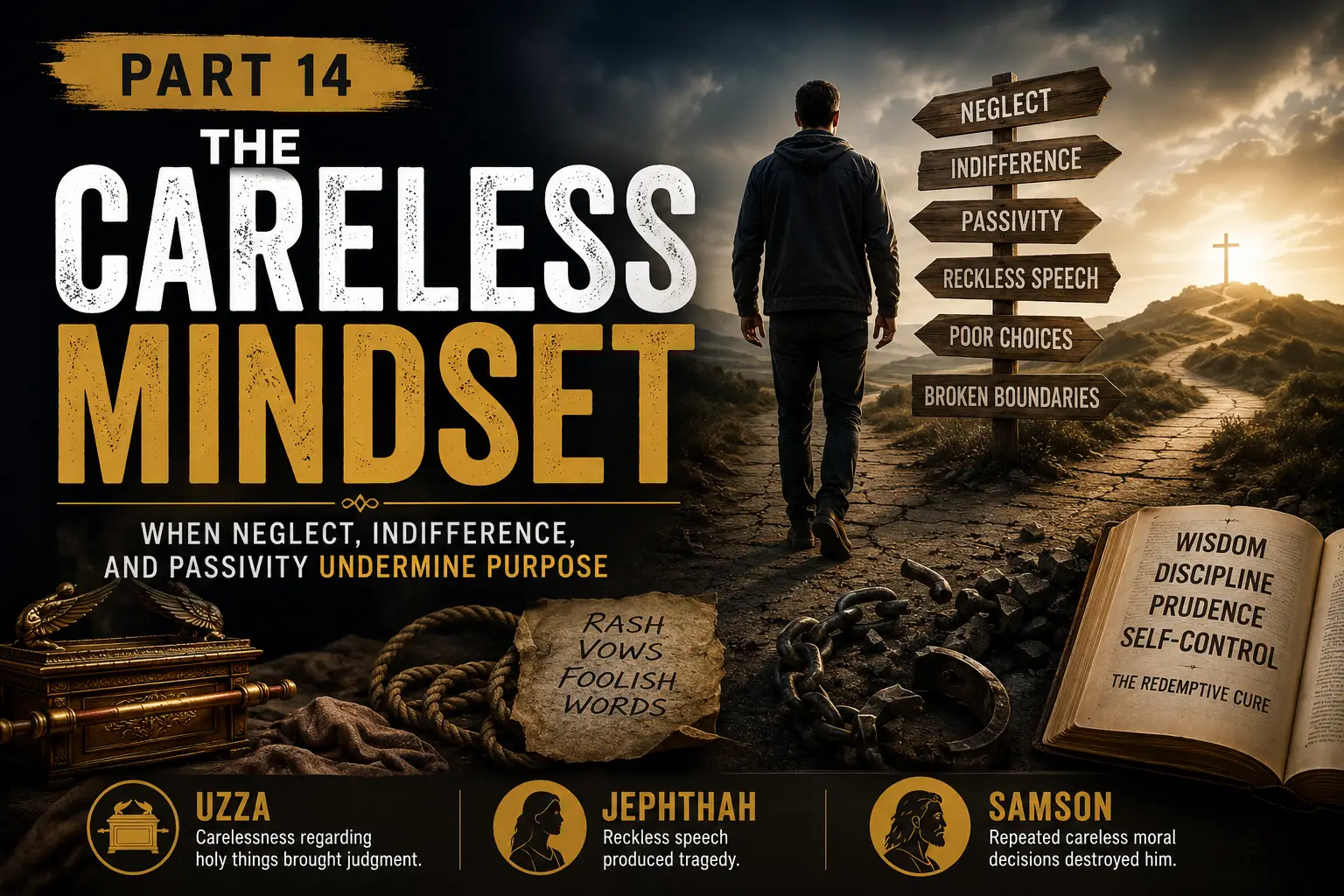
WHEN NEGLECT, INDIFFERENCE, AND PASSIVITY UNDERMINE PURPOSE
INTRODUCTION: WHEN CARELESSNESS BECOMES A SPIRITUAL DANGER
Carelessness may appear harmless at first. It can look like a small delay, an unguarded word, a neglected responsibility, an ignored warning, or a repeated refusal to take life seriously. Yet in Scripture, carelessness is never treated as something insignificant. When a person becomes careless with holy things, relationships, words, assignments, boundaries, or obedience, the result can be destructive.
The careless mindset is not merely about making mistakes. Everyone makes mistakes. It is a mindset that lives without wisdom, restraint, caution, and responsibility. It is a way of thinking that says, “It does not matter,” when God says it does. It is a heart posture that treats serious things lightly and assumes there will be no consequences.
A careless person often does not intend to destroy anything. Uzza probably did not intend dishonour when he touched the ark. Jephthah may not have intended tragedy when he made his vow. Samson may not have intended to lose his strength, sight, and freedom. Yet intention does not cancel consequence. Carelessness can open doors that wisdom would have kept closed.
The Bible repeatedly calls believers to sobriety, diligence, watchfulness, self-control, and wisdom.
Proverbs 22:3 NKJV
(3) A prudent man foresees evil and hides himself, But the simple pass on and are punished.
The careless mindset does the opposite. It ignores danger, dismisses instruction, violates boundaries, and moves forward without spiritual caution.
This article exposes the careless mindset and shows how neglect, indifference, and passivity can undermine purpose. It also reveals the redemptive cure: wisdom, discipline, prudence, and self-control.
DEFINITION OF THE CARELESS MINDSET
The careless mindset is a mindset lacking wisdom, restraint, caution, and responsibility.
It is the inward attitude that fails to weigh consequences, ignores divine instruction, neglects preparation, and treats sacred matters casually. It does not always look rebellious on the surface, but it often produces the same kind of damage as rebellion because it refuses to live carefully before God.
Ephesians 5:15 NKJV
(15) See then that you walk circumspectly, not as fools but as wise,
To walk “circumspectly” means to walk carefully, accurately, and intentionally. The believer is not called to drift through life. We are called to walk with spiritual awareness. The careless mindset refuses this careful walk and chooses a casual, unguarded approach to life.
Carelessness may show up in many ways:
- It may appear as spiritual laziness.
- It may appear as emotional impulsiveness.
- It may appear as poor stewardship.
- It may appear as reckless speech.
- It may appear as wrong relationships.
- It may appear as repeated boundary violations.
- It may appear as a lack of preparation.
- It may appear as indifference toward correction.
The careless mindset is dangerous because it often convinces a person that they are still safe while they are already drifting.
Hebrews 2:1 NKJV
(1) Therefore we must give the more earnest heed to the things we have heard, lest we drift away.
Drifting does not require intentional rebellion. It only requires neglect.
Biblical Example 1: Uzza — Carelessness with Holy Things
Uzza and the Ark of God
One of the clearest biblical examples of carelessness is Uzza. David desired to bring the ark of God back to Jerusalem. The desire was good, but the method was careless. The ark represented the presence, holiness, covenant, glory, and government of God among His people. It was never meant to be handled casually.
1 Chronicles 13:9 NKJV
(9) And when they came to Chidon’s threshing floor, Uzza put out his hand to hold the ark, for the oxen stumbled.
At first glance, Uzza’s action may appear sincere. The oxen stumbled, and he reached out to stabilize the ark. Yet the issue was not merely the moment of touching the ark. The deeper issue was the careless handling of what God had already given instructions about.
The ark was not supposed to be transported on a cart like the Philistines had done. It was supposed to be carried by the Levites according to God’s order.
Numbers 4:15 NKJV
(15) And when Aaron and his sons have finished covering the sanctuary and all the furnishings of the sanctuary, when the camp is set to go, then the sons of Kohath shall come to carry them; but they shall not touch any holy thing, lest they die. “These are the things in the tabernacle of meeting which the sons of Kohath are to carry.
Uzza’s death was not simply about an accidental reflex. It revealed a larger problem: holy things were being handled without holy order.
The Lesson from Uzza
Uzza teaches us that good intentions do not excuse careless obedience. David’s desire to bring the ark back was right, but the process was wrong. When divine instruction is ignored, sincerity is not enough.
Carelessness with holy things can include:
- Treating worship as entertainment.
- Treating ministry as performance.
- Treating leadership as personal status.
- Treating communion casually.
- Treating the Word of God as optional.
- Treating spiritual authority without reverence.
- Treating the presence of God as common.
The careless mindset assumes, “God understands my heart.” Yes, God sees the heart, but He also requires obedience. A sincere heart must still be submitted to divine order.
After the judgment concerning Uzza, David later corrected the process. He recognized that the ark had not been handled according to God’s prescribed order.
1 Chronicles 15:13 NKJV
(13) For because you did not do it the first time, the LORD our God broke out against us, because we did not consult Him about the proper order.”
That phrase is powerful: proper order. Carelessness often enters where proper order is ignored.
Biblical Example 2: Jephthah — Reckless Speech Producing Tragedy
Jephthah’s Rash Vow
Jephthah was a mighty man of valour who became a judge in Israel. God used him to deliver Israel from the Ammonites. However, Jephthah also reveals the danger of reckless speech.
Before going into battle, Jephthah made a vow to the Lord.
Judges 11:30 NKJV
(30) And Jephthah made a vow to the LORD, and said, “If You will indeed deliver the people of Ammon into my hands,
His vow was rash, emotional, and unnecessary. He promised that whatever came out of the doors of his house to meet him on his return would be offered to the Lord.
The tragedy was that his daughter came out to meet him.
Whether one interprets the outcome as literal sacrifice or lifelong consecration, the story remains deeply tragic. Jephthah’s careless speech created sorrow that could have been avoided.
Ecclesiastes 5:2 NKJV
(2) Do not be rash with your mouth, And let not your heart utter anything hastily before God. For God is in heaven, and you on earth; Therefore let your words be few.
Jephthah’s story teaches us that words have weight. A careless mouth can create painful consequences. Not every spiritual-sounding statement is wise. Not every vow is pleasing to God. Not every emotional promise is born from faith.
The Lesson from Jephthah
Jephthah shows us that zeal without wisdom can become destructive. He wanted victory, but he spoke without restraint. His mouth moved faster than his discernment.
Careless speech can manifest as:
- Making promises without counting the cost.
- Speaking emotionally in moments of pressure.
- Making vows to appear spiritual.
- Releasing words in anger and regretting them later.
- Committing to things God never required.
- Using spiritual language to cover insecurity.
Proverbs 18:21 NKJV
(21) Death and life are in the power of the tongue, And those who love it will eat its fruit.
The careless mindset does not respect the power of words. It says things quickly, reacts emotionally, and later tries to escape the consequences. But spiritual maturity requires restraint.
James 1:19 NKJV
(19) So then, my beloved brethren, let every man be swift to hear, slow to speak, slow to wrath;
Carelessness is often quick to speak and slow to discern. Wisdom reverses that order.
Biblical Example 3: Samson — Repeated Careless Decisions Destroying Destiny
Samson’s Pattern of Carelessness
Samson was called from birth. His life carried prophetic purpose before he was even born. The angel of the Lord announced his birth, and he was separated as a Nazirite unto God. His strength was not merely physical; it was connected to covenant consecration.
Yet Samson repeatedly made careless moral decisions. He played with temptation, ignored boundaries, pursued wrong relationships, and treated his consecration lightly.
Judges 14 shows Samson desiring a Philistine woman, even though this relationship was spiritually dangerous. Judges 16 shows him with Delilah, who repeatedly pressed him to reveal the secret of his strength. Samson saw the warning signs, but he remained in the place of danger.
Judges 16:20 NKJV
(20) And she said, “The Philistines are upon you, Samson!” So he awoke from his sleep, and said, “I will go out as before, at other times, and shake myself free!” But he did not know that the LORD had departed from him.
That is one of the most sobering statements in Scripture. Samson had become so careless that he lost spiritual sensitivity. He assumed he could rise as before, but the grace he had treated casually was no longer operating in the same way.
The Lesson from Samson
Samson’s downfall did not happen in one moment. It was the result of repeated careless decisions.
- He was careless with his calling.
- He was careless with his relationships.
- He was careless with his appetites.
- He was careless with his boundaries.
- He was careless with his secret.
- He was careless with the anointing.
Many people do not fall because they are weak in one moment. They fall because they have been careless for a long time. Samson teaches us that repeated boundary violations eventually weaken spiritual strength.
1 Corinthians 10:12 NKJV
(12) Therefore let him who thinks he stands take heed lest he fall.
The careless mindset says, “I can handle it.” Wisdom says, “I must take heed.”
Samson’s life is a warning that calling does not replace character. Anointing does not cancel accountability. Strength does not excuse carelessness. A person can be gifted and still be undisciplined. A person can be called and still be careless. A person can have purpose and still sabotage it through repeated neglect.
CHARACTERISTICS OF THE CARELESS MINDSET
-
Lack of Restraint
A careless mindset lacks restraint. It does not know when to stop, pause, wait, listen, or submit. It reacts before it reflects. It speaks before it discerns. It acts before it prays.
Proverbs 25:28 NKJV
(28) Whoever has no rule over his own spirit Is like a city broken down, without walls.
A person without restraint is spiritually exposed. Like a city without walls, they are vulnerable to invasion. Their emotions, desires, appetites, and impulses become entry points for destruction.
Lack of restraint shows up when a person cannot control anger, spending, speech, eating, sexual desire, curiosity, or reactions. They may constantly say, “I could not help myself.” But self-control is part of the fruit of the Spirit.
Galatians 5:23 NKJV includes “self-control” as evidence of Spirit-formed maturity.
Galatians 5:23 NKJV
(23) gentleness, self-control. Against such there is no law.
Samson lacked restraint. His desires repeatedly overruled his consecration. He followed what pleased him in the moment, even when it endangered his assignment.
A lack of restraint is dangerous because it turns desire into direction. Whatever the person feels becomes what they follow. This is not spiritual maturity. It is emotional government.
The redemptive opposite of restraintlessness is Spirit-led discipline. A mature believer learns to bring desires under the authority of Christ.
-
Reckless Speech
The careless mindset is often revealed through reckless speech. Words are released without prayer, wisdom, timing, or consideration.
Reckless speech wounds people, breaks trust, creates confusion, damages relationships, and opens doors to unnecessary conflict. Some people call it honesty, but biblical honesty is not the same as uncontrolled speech. Truth must be spoken in love, with wisdom and timing.
Proverbs 12:18 NKJV
(18) There is one who speaks like the piercings of a sword, But the tongue of the wise promotes health.
Jephthah is a sobering example of reckless speech. His vow sounded spiritual, but it was careless. He spoke in the pressure of battle without considering the consequence of his words.
Careless speech may include:
- Speaking in anger.
- Making emotional promises.
- Revealing confidential matters.
- Making foolish vows.
- Speaking before understanding the facts.
Proverbs 18:13 NKJV
(13) He who answers a matter before he hears it, It is folly and shame to him.
The careless mindset speaks quickly because it wants release. The wise person speaks carefully because they value truth, people, and consequence.
A believer must learn to ask: Is this true? Is this necessary? Is this the right time? Is this the right spirit? Will this build or destroy? Am I speaking from wisdom or from reaction?
-
Wrong Associations
Carelessness is often seen in the way a person chooses relationships. The careless mindset ignores the influence of association. It assumes that it can remain spiritually strong while staying emotionally tied to people, places, and environments that weaken obedience.
1 Corinthians 15:33 NKJV
(33) Do not be deceived: “Evil company corrupts good habits.”
Samson repeatedly formed dangerous associations. His connection with Delilah became the doorway to his downfall. Delilah did not strengthen his consecration; she attacked it. Yet Samson remained.
Wrong associations are not always obvious at first. Some relationships are enjoyable, attractive, familiar, or emotionally comforting, but they slowly weaken conviction. They normalize compromise. They make disobedience feel acceptable. They mock discipline. They pull the believer away from accountability.
Proverbs 13:20 NKJV
(20) He who walks with wise men will be wise, But the companion of fools will be destroyed.
This means association is formative. Who you walk with shapes what you become.
The careless mindset says, “They do not affect me.” Wisdom says, “Every consistent association carries influence.”
Wrong associations can include:
- People who weaken your obedience.
- People who mock your convictions.
- People who feed your bitterness.
- People who encourage secrecy.
- People who normalize compromise.
- People who dishonor your spiritual boundaries.
- People who pull you away from your assignment.
Jesus ate with sinners, but He did not become governed by sinners. He reached people without surrendering His consecration. The believer must learn the difference between ministering to people and being influenced by them.
The careless mindset does not respect boundaries. It crosses lines emotionally, morally, spiritually, relationally, financially, and ministerially. It often says, “It is not that serious,” but boundaries exist to protect purpose.
Samson violated boundaries repeatedly. His Nazirite consecration required separation, but he kept moving toward what weakened that separation. Each boundary violation made the next one easier.
Proverbs 4:23 NKJV
(23) Keep your heart with all diligence, For out of it spring the issues of life.
The word “keep” means to guard. A guarded heart is not a hard heart. It is a protected heart. Boundaries are not signs of fear; they are signs of wisdom.
Boundary violations may include:
- Sharing private information with unsafe people.
- Entering emotional attachments that are not pure.
- Ignoring accountability.
- Overcommitting beyond capacity.
- Allowing constant access to your life without discernment.
- Remaining in tempting environments.
- Handling holy responsibilities without preparation.
- Touching what God has not assigned you to touch.
Uzza crossed a holy boundary when he touched the ark. Again, the issue was not only physical contact; it was the casual handling of divine order.
Boundaries protect what God has entrusted to you. A careless person sees boundaries as restrictions. A wise person sees boundaries as protection.
-
Sloppiness
Sloppiness is another expression of the careless mindset. It is the refusal to do things with diligence, excellence, attention, and responsibility.
Sloppiness may appear in spiritual life, work, ministry, relationships, finances, communication, and time management. It says, “This is good enough,” even when excellence is required.
Proverbs 18:9 NKJV
(9) He who is slothful in his work Is a brother to him who is a great destroyer.
That is a powerful statement. Scripture connects slothfulness with destruction. Neglect may not look violent, but it can destroy slowly.
Sloppiness can show up as:
- Unprepared ministry.
- Poor stewardship.
- Late responses.
- Broken promises.
- Disorganized leadership.
- Neglected prayer.
- Careless handling of money.
- Inconsistent follow-through.
- Avoiding responsibility.
- Leaving others to clean up what you failed to manage.
The careless mindset often wants the reward of purpose without the responsibility of preparation. But kingdom assignments require diligence.
Colossians 3:23 NKJV
(23) And whatever you do, do it heartily, as to the Lord and not to men,
A believer should not be careless simply because people are not watching. God is watching. Our work, service, speech, and stewardship must be done before Him.
THE HIDDEN ROOTS OF THE CARELESS MINDSET
Carelessness is not always caused by ignorance. Sometimes it is rooted in deeper issues of the heart.

-
Familiarity
When people become too familiar with holy things, they may stop treating them with reverence. The ark was among the people, but that did not make it common. Ministry, worship, Scripture, prayer, communion, and fellowship must never become casual simply because they are familiar.
-
Passivity
Some people are careless because they avoid responsibility. They do not want to decide, confront, prepare, correct, or lead. Passivity becomes a hidden form of neglect.
-
Pride
Carelessness can be rooted in pride. A person may assume, “Nothing will happen to me.” Samson seemed to believe he could keep playing with danger and still remain strong.
-
Emotionalism
Jephthah’s vow shows how emotional pressure can produce careless words. When emotions govern the mouth, wisdom is often silenced.
-
Lack of Fear of the Lord
The fear of the Lord produces careful living. Proverbs 9:10 NKJV says, “The fear of the LORD is the beginning of wisdom.” Where reverence is absent, carelessness grows.
THE REDEMPTIVE CURE FOR THE CARELESS MINDSET
The careless mindset can be healed and transformed. God does not expose carelessness to shame us; He exposes it to restore us. The cure involves wisdom, discipline, prudence, and self-control.
-
Wisdom: Learning to See Life from God’s Perspective

Wisdom is the first cure for carelessness. Wisdom teaches us to value what God values, avoid what God forbids, and discern what produces life.
James 1:5 NKJV
(5) If any of you lacks wisdom, let him ask of God, who gives to all liberally and without reproach, and it will be given to him.
Wisdom is not merely intelligence. A person can be intelligent and still careless. Biblical wisdom is the ability to apply God’s truth accurately in real life.
Wisdom teaches us to ask:
- What does God say about this?
- What are the possible consequences?
- Is this decision aligned with my calling?
- Is this relationship strengthening or weakening obedience?
- Am I acting from faith or impulse?
- Have I sought counsel?
- Am I ignoring warning signs?
David learned wisdom after Uzza’s death. He corrected the process and brought the ark according to proper order. Wisdom is willing to admit, “We did not do this correctly,” and then make the necessary adjustment.
A careless person repeats mistakes. A wise person learns from correction.
-
Discipline: Training the Life to Obey Purpose
Discipline is the second cure for carelessness. Discipline brings structure to desire, order to assignment, and consistency to obedience.
1 Timothy 4:7 NKJV
(7) But reject profane and old wives’ fables, and exercise yourself toward godliness.
The word “exercise” speaks of training. Godliness does not mature through desire alone. It requires practice, repetition, correction, and consistency.

Discipline includes:
- A disciplined prayer life.
- A disciplined thought life.
- A disciplined mouth.
- A disciplined schedule.
- Disciplined finances.
- Disciplined relationships.
- Disciplined ministry preparation.
- Disciplined obedience.
Samson had strength, but he lacked discipline. His strength made him powerful, but his lack of discipline made him vulnerable. Many gifted people fall not because they lack ability, but because they lack discipline.
Discipline is not legalism. Discipline is love under structure. It is the believer saying, “My purpose is too important for me to live carelessly.”
-
Prudence: Foreseeing Danger and Responding Wisely
Prudence is the ability to see danger before it destroys. It is spiritual caution, not fear. Prudence does not live in suspicion, but it refuses to live blindly.
Proverbs 22:3 NKJV
(3) A prudent man foresees evil and hides himself, But the simple pass on and are punished.
The careless person sees danger and keeps walking. The prudent person sees danger and adjusts.
Prudence asks:
- Where is this leading?
- What fruit is this producing?
- What pattern is forming?
- What boundary is being tested?
- What warning am I ignoring?
- What has God already said?
Prudence would have helped Jephthah pause before speaking. Prudence would have helped Samson leave Delilah before destruction came. Prudence would have helped David transport the ark according to divine order from the beginning.
Prudence is not weakness. It is wisdom in motion.
-
Self-Control: Bringing the Flesh Under the Government of the Spirit
Self-control is essential for overcoming the careless mindset. Without self-control, a person becomes ruled by impulses, appetites, emotions, and reactions.
2 Timothy 1:7 NKJV
(7) For God has not given us a spirit of fear, but of power and of love and of a sound mind.
A sound mind is not chaotic, reckless, or uncontrolled. It is governed by the Spirit and aligned with truth.
Self-control helps the believer:
- Stop before speaking.
- Leave before falling.
- Wait before deciding.
- Pray before reacting.
- Think before committing.
- Submit before resisting correction.
- Close doors before temptation becomes bondage.
Self-control is not produced by willpower alone. It is the fruit of walking with the Holy Spirit.
Galatians 5:16 NKJV
(16) I say then: Walk in the Spirit, and you shall not fulfill the lust of the flesh.
The careless mindset is healed as the believer learns to live under the government of the Spirit rather than the impulses of the flesh.
PRACTICAL STEPS TO OVERCOME THE CARELESS MINDSET
-
Take Responsibility for What God Has Entrusted to You
Carelessness often survives because people blame circumstances. But transformation begins when we accept responsibility.
Ask yourself:
- What have I neglected?
- Where have I been passive?
- What responsibility have I avoided?
- What warning has God been giving me?
- What area of my life needs order?
-
Repent for Treating Serious Things Lightly
Repentance is not condemnation. It is returning to God’s mind. If you have treated holy things, relationships, words, finances, calling, or obedience casually, bring it before the Lord.
Ask Him to restore reverence.
-
Rebuild Boundaries
Identify the areas where boundaries have been broken. Then rebuild them with wisdom.
This may involve ending unhealthy conversations, limiting access, restoring accountability, changing environments, or refusing repeated temptation.
-
Submit to Godly Counsel
Careless people often resist counsel because counsel slows them down. But wisdom welcomes correction.
Proverbs 11:14 NKJV
(14) Where there is no counsel, the people fall; But in the multitude of counselors there is safety.
-
Practice Daily Watchfulness
Watchfulness is a kingdom discipline. Jesus warned His disciples to watch and pray.
Matthew 26:41 NKJV
(41) Watch and pray, lest you enter into temptation. The spirit indeed is willing, but the flesh is weak.”
Carelessness weakens when watchfulness grows.
A WORD TO LEADERS: CARELESSNESS IN LEADERSHIP IS COSTLY
Carelessness is especially dangerous in leadership. When leaders are careless, others are affected. David’s mishandling of the ark did not affect only him. Jephthah’s rash vow affected his household. Samson’s moral carelessness affected his nation and assignment.
Leaders must be careful with:
- Doctrine
- Words
- People
- Money
- Authority
- Correction
- Boundaries
- Holy things.
The careless leader may unintentionally wound the very people they are called to protect. Leadership requires sobriety.
1 Peter 5:2 NKJV
(2) Shepherd the flock of God which is among you, serving as overseers, not by compulsion but willingly, not for dishonest gain but eagerly;
Shepherding requires care. A careless shepherd leaves sheep exposed.
THE CARELESS MINDSET VERSUS THE CAREFUL WALK
The careless mindset says:
- It does not matter.
- I can handle it.
- I will fix it later.
- Nobody will know.
- This is not serious.
- God understands.
- I do not need counsel.
- I have done this before.
But the careful walk says:
- I will honor God’s order.
- I will guard my heart.
- I will weigh my words.
- I will avoid temptation.
- I will seek wisdom.
- I will submit to correction.
- I will protect my assignment.
- I will walk circumspectly.
Ephesians 5:15 NKJV
(15) See then that you walk circumspectly, not as fools but as wise,
This is the call of God to every believer who desires to walk in maturity.
CONCLUSION: DO NOT LET CARELESSNESS STEAL PURPOSE
The careless mindset is dangerous because it often looks small before it becomes destructive. A careless word, a careless relationship, a careless compromise, a careless delay, a careless boundary violation, or a careless attitude toward holy things can open the door to painful consequences.
Uzza warns us not to handle holy things casually.
Jephthah warns us not to speak recklessly.
Samson warns us not to play with temptation and assume strength will always remain.
The redemptive path is clear: wisdom, discipline, prudence, and self-control. God is calling His people to careful living, not fearful living. He is calling us to reverence, not religious anxiety. He is calling us to responsibility, not passivity. He is calling us to maturity, not impulsiveness.
The purpose of God upon your life is too valuable to be handled carelessly.
- Do not drift.
- Do not delay.
- Do not ignore warning signs.
- Do not treat holy things as common.
- Do not let your mouth move faster than your wisdom.
- Do not allow wrong associations to weaken your consecration.
- Do not violate boundaries that were meant to protect your destiny.
Walk carefully. Walk wisely. Walk under the government of the Holy Spirit.
FINAL CHALLENGE
Ask the Holy Spirit to reveal any area where carelessness has entered your life. Is it in your speech? Your relationships? Your spiritual disciplines? Your finances? Your assignment? Your boundaries? Your attitude toward holy things?
Then respond with repentance and obedience.
God does not merely want you gifted. He wants you faithful.
He does not merely want you active. He wants you accurate.
He does not merely want you moving. He wants you walking circumspectly.
Your purpose deserves careful stewardship.
OTHER PUBLICATIONS BY THIS AUTHOR CAN BE FOUND AT: