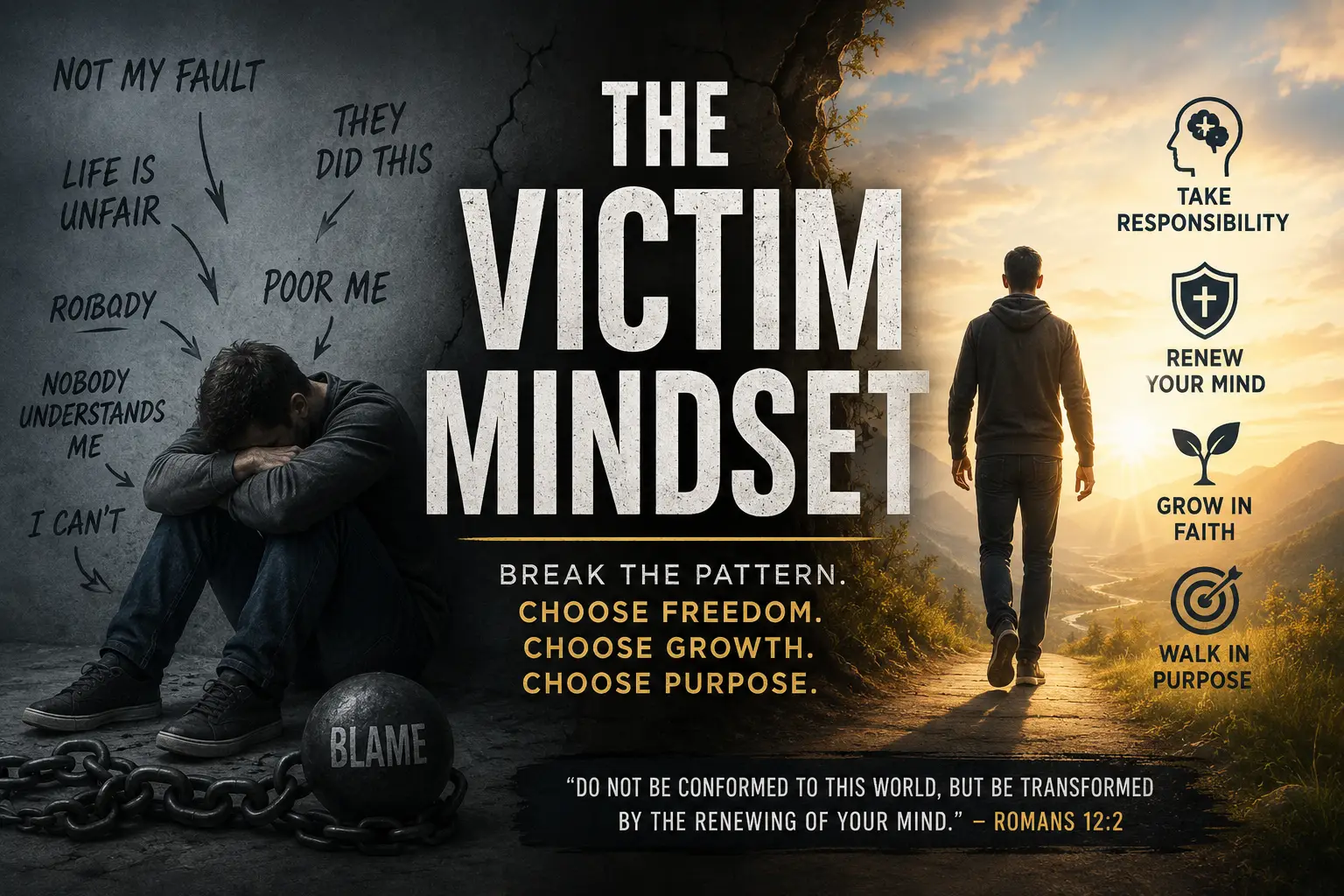
INTRODUCTION TO THE VICTIM MINDSET

The victim mindset is one of the most subtle yet destructive strongholds that can take root in the human heart. It is a way of thinking that consistently sees oneself as powerless, mistreated, disadvantaged, or unfairly targeted while shifting responsibility for personal choices, attitudes, and actions onto others.
Although genuine injustice, pain, and hardship are realities that many people experience, the victim mindset goes beyond suffering and becomes an identity. Instead of seeking healing, growth, and restoration, it remains trapped in blame, self-pity, resentment, and excuses. Over time, it convinces a person that they are unable to change their circumstances because someone else is always responsible for their condition.
Scripture reveals that from the Garden of Eden onward, humanity has struggled with the temptation to avoid responsibility. When confronted by God after eating the forbidden fruit, Adam immediately shifted the blame to Eve and ultimately to God Himself, saying:
Genesis 3:12 NKJV
(12) Then the man said, “The woman whom You gave to be with me, she gave me of the tree, and I ate.”
Rather than acknowledging his own choice, Adam adopted the posture of a victim. This mindset has echoed throughout history, preventing many from embracing personal accountability and spiritual maturity.
The victim mindset is dangerous because it hinders growth, damages relationships, resists correction, and prevents individuals from walking in the freedom and responsibility that Christ provides. While victims focus on what has happened to them, disciples focus on what God can do through them.
The Kingdom of God calls believers not to live as victims of circumstances, people, or the past, but as overcomers through Christ. Through repentance, renewed thinking, and personal responsibility, believers can break free from the chains of victimhood and step into the maturity, authority, and purpose that God has prepared for them.
DEFINITION OF THE VICTIM MINDSET
The victim mindset is a pattern of thinking in which a person consistently sees themselves as the victim of circumstances, people, systems, or events while refusing to take responsibility for their own decisions, actions, attitudes, and responses.
While genuine victims do exist and people can experience real injustice, abuse, rejection, betrayal, or hardship, a victim mindset develops when a person becomes permanently trapped in the identity of being a victim rather than moving toward healing, responsibility, and transformation.
The victim mindset says:
- “It’s not my fault.”
- “Someone else is responsible for my condition.”
- “I cannot change because of what happened to me.”
- “Others owe me.”
- “Life has treated me unfairly.”
Instead of seeking solutions, the victim mindset continually seeks someone to blame.
This mindset often appears humble on the surface but is actually a subtle form of pride because it refuses to acknowledge personal responsibility and rejects God’s power to transform circumstances.
This mindset is rampant in South Africa where we see the constant victim mindset demonstrated with regards to the Apartheids Era.
As a result, no responsibility is taken for the persons own actions and conduct and behaviour.
THE ORIGIN OF THE VICTIM MINDSET
The victim mindset first appeared immediately after the Fall of man.
Adam’s Response
Genesis 3:12 (NKJV)
“Then the man said, ‘The woman whom You gave to be with me, she gave me of the tree, and I ate.'”
Notice Adam’s response. God did not ask Adam who was responsible. God asked Adam what he had done.
Instead of accepting responsibility, Adam shifted blame.
His response reveals three levels of blame:
- He Blamed Eve: “The woman gave me the fruit.”
- He Blamed God: “The woman whom You gave me.”
Adam subtly suggested that God was partly responsible.
- He Minimized His Own Choice: “I ate” appears almost as an afterthought.
The victim mindset always seeks an external explanation while minimizing personal responsibility.
CHARACTERISTICS OF THE VICTIM MINDSET
- Excuse-Making
Victims always have explanations for failure.
Examples:
- “I never had the opportunities others had.”
- “My family held me back.”
- “My pastor failed me.”
- “My church wounded me.”
- “My boss is against me.”
While these may contain elements of truth, they become dangerous when they are used to justify perpetual stagnation.
Proverbs 28:13 (NKJV)
“He who covers his sins will not prosper, But whoever confesses and forsakes them will have mercy.”
- Blame-Shifting
The victim mindset continually transfers responsibility.
Adam blamed Eve. Eve blamed the serpent. Saul blamed the people. Aaron blamed the people. Nobody accepted responsibility.
Exodus 32:24 (NKJV)
“And I said to them, ‘Whoever has any gold, let them break it off.’ So they gave it to me, and I cast it into the fire, and this calf came out.”
Aaron’s explanation is one of the greatest examples of blame-shifting in Scripture.
He acted as if the golden calf simply appeared by itself. Victim-thinking always minimizes personal accountability.
- Self-Pity
Self-pity is often the emotional fuel of the victim mindset. The victim focuses more on what happened to them than on what God is doing in them.
Self-pity produces:
- discouragement
- hopelessness
- passivity
- emotional paralysis
- Entitlement
Victims often feel that others owe them.
They believe:
- God owes them.
- Leaders owe them.
- Family owes them.
- Society owes them.
This mentality creates resentment whenever expectations are not fulfilled.
- Passivity
Victims wait for someone else to solve their problems. They become spectators rather than participants.
Instead of asking: “What can I do?”
they ask: “Why is nobody helping me?”
- Constant Offense
Victims are easily offended because they interpret everything through the lens of personal injustice.
- Every correction becomes an attack.
- Every disagreement becomes rejection.
- Every challenge becomes persecution.
BIBLICAL CASE STUDIES
Israel in the Wilderness
The nation repeatedly adopted victim-thinking.
Numbers 14:2 (NKJV)
“And all the children of Israel complained against Moses and Aaron…”
Despite miraculous deliverance, they continually focused on:
- hardships
- discomfort
- inconvenience
rather than God’s faithfulness. Victim-thinking caused an entire generation of Israelites to die in the wilderness.
King Saul
Saul continually blamed others for his failures.
1 Samuel 15:21 (NKJV)
(21) But the people took of the plunder, sheep and oxen, the best of the things which should have been utterly destroyed, to sacrifice to the LORD your God in Gilgal.”
Instead of accepting responsibility for disobeying God, Saul blamed the people for taking of the plunder instead of taking responsibility. Victim-thinking ultimately cost King Saul the kingdom.
Cain
Genesis 4:13 (NKJV)
“And Cain said to the LORD, ‘My punishment is greater than I can bear!'”
Instead of repenting for murder, Cain focused on his own suffering. Victim-thinking often mourns consequences more than it mourns the sin.
The Elder Brother
Luke 15 reveals another victim mentality. Though the Elder Brother remained in the father’s house, he saw himself as being neglected and mistreated.
Luke 15:29 (NKJV)
(29) So he answered and said to his father, ‘Lo, these many years I have been serving you; I never transgressed your commandment at any time; and yet you never gave me a young goat, that I might make merry with my friends.
The Elder Brother viewed himself as a victim despite possessing access to everything the father had. Victim-thinking blinds people to their blessings.
THE CONSEQUENCES OF A VICTIM MINDSET
- Loss of Personal Growth
Growth begins where excuses end. A victim remains stuck because he believes change is someone else’s responsibility.
- Broken Relationships
Victims eventually exhaust relationships because they continually assign blame. People become weary of carrying responsibility for someone else’s life.
- Loss of Influence
Leaders cannot lead effectively if they refuse responsibility. Great leaders take ownership. Victims seek scapegoats.
- Spiritual Immaturity
A victim mentality prevents discipleship because correction is always viewed as criticism. Such people struggle to receive instruction.
- Wilderness Cycles
Victim-thinking traps people in repetitive cycles. Israel wandered for forty years because they refused to take responsibility for entering the Promised Land by faith.
THE MIND OF CHRIST: THE OPPOSITE OF VICTIMHOOD
Jesus experienced:
- rejection
- betrayal
- injustice
- false accusation
- abandonment
- torture
- crucifixion
Yet He never embraced a victim identity.
Isaiah 53:7 (NKJV)
“He was oppressed and He was afflicted, Yet He opened not His mouth.”
Jesus suffered injustice without becoming defined by it. He chose obedience rather than self-pity. The Cross demonstrates that circumstances do not determine identity.
HOW DO WE OVERCOME A VICTIM MINDSET
- Repentance
Acknowledge blame-shifting and self-pity. Repent for refusing responsibility.
- Taking of Ownership
Ask:
- What choices did I make?
- What can I learn?
- What must I change?
Taking Ownership is the beginning of freedom from the victim mindset.
- Take Responsibility
Galatians 6:5 (NKJV)
“For each one shall bear his own load.”
Maturity accepts responsibility.
- Renew the Mind
Stop rehearsing: “What happened to me.”
Start asking: “What is God teaching me?”
- Embrace Sonship
Victims see themselves as powerless. Sons see themselves as responsible stewards.
Victims ask: “Who is to blame?”
Sons ask: “What is my assignment?”
IN CONCLUSION
The victim mindset keeps people trapped in yesterday’s wounds. The Kingdom mindset takes responsibility for today’s decisions and tomorrow’s possibilities.
The victim says: “I am the product of my circumstances.”
The disciple says: “I am being transformed by Christ.”
Freedom begins the moment blame ends and responsibility begins.
Romans 8:37 (NKJV)
“Yet in all these things we are more than conquerors through Him who loved us.”
OTHER PUBLICATIONS BY THIS AUTHOR CAN BE FOUND AT: