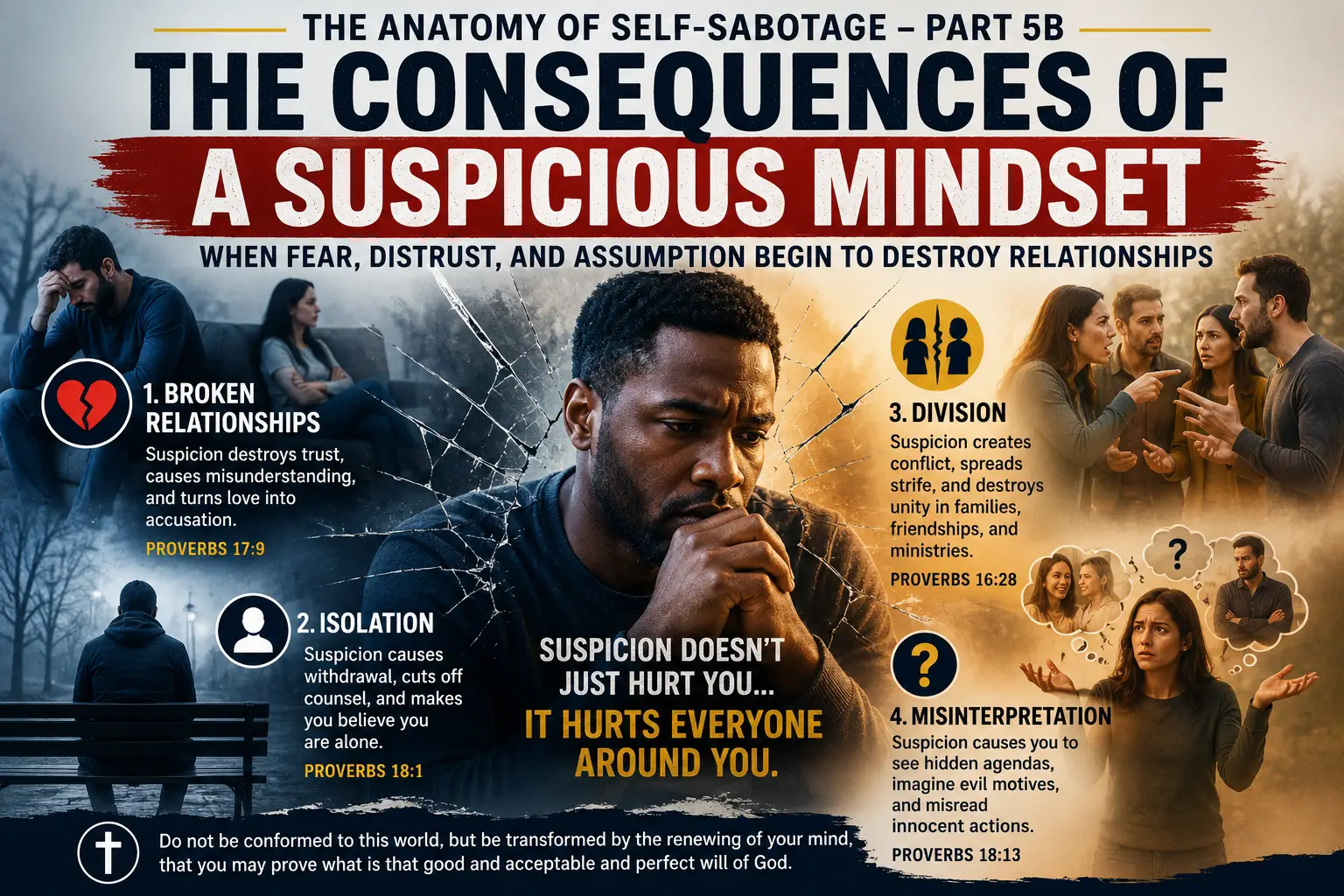
THE ANATOMY OF SELF-SABOTAGE – PART 5B
THE CONSEQUENCES OF A SUSPICIOUS MINDSET
When Fear, Distrust, and Assumption Begin to Destroy Relationships
A suspicious mindset does not remain hidden in the heart. Eventually, it produces visible consequences in relationships, families, ministries, leadership, friendships, and even the believer’s walk with God. Suspicion may begin as a private thought, but if it is not confronted by truth, it becomes a pattern of interpretation. That pattern then begins to shape behaviour.
A suspicious person does not merely struggle with thoughts. They begin to act on those thoughts. They withdraw. They accuse. They misread people. They defend themselves unnecessarily. They reject help. They resist correction. They create distance from others. They turn possible allies into perceived enemies.
This is why the suspicious mindset is so dangerous. It does not only affect the person who carries it. It affects everyone connected to that person.
THE FOLLOWING ARE FOUR MAJOR CONSEQUENCES OF A SUSPICIOUS MINDSET.
-
Broken Relationships
One of the first and most painful consequences of a suspicious mindset is broken relationships. Suspicion weakens the trust that relationships need in order to grow. Where there is constant suspicion, people begin to feel judged, accused, watched, or misunderstood.
Healthy relationships are built on love, truth, trust, honour, forgiveness, and communication. Suspicion attacks all of these. It replaces trust with fear. It replaces communication with assumption. It replaces honour with accusation. It replaces love with self-protection.
The book of Proverbs teaches that strife often begins when people repeat matters, expose faults, or assume wrongly about others.
Proverbs 17:9 NKJV
(9) He who covers a transgression seeks love, But he who repeats a matter separates friends.
Suspicion often repeats matters in the mind before it repeats them with the mouth. A suspicious person keeps rehearsing what they think someone meant, what they think someone did, or what they think someone is planning. Eventually, the matter is spoken out, and when suspicion is spoken without truth, relationships are damaged.
A powerful biblical example is Saul’s relationship with David.
David had served Saul faithfully. He played the harp when Saul was troubled. He fought Goliath when others were afraid. He served the nation and honoured Saul’s authority. Yet Saul became suspicious when the women praised David’s victories.
1 Samuel 18:7–9 NKJV
(7) So the women sang as they danced, and said: “Saul has slain his thousands, And David his ten thousands.”
(8) Then Saul was very angry, and the saying displeased him; and he said, “They have ascribed to David ten thousands, and to me they have ascribed only thousands. Now what more can he have but the kingdom?”
(9) So Saul eyed David from that day forward.
The phrase “Saul eyed David from that day forward” reveals how suspicion can change the way a person sees someone. David had not betrayed Saul. David had not attacked Saul. David had not tried to take the throne by force. Yet Saul’s insecurity caused him to interpret David as a threat.
Suspicion broke what could have been a powerful relationship. Saul could have received David as a loyal servant and future blessing to Israel. Instead, he treated him as a rival.
This is what suspicion does. It destroys relationships that God may have intended for strength, support, covering, mentorship, friendship, or kingdom purpose.
A suspicious mindset often causes people to wound those who were sent to help them. It causes leaders to attack loyal servants. It causes friends to mistrust genuine friends. It causes spouses to question innocent actions. It causes believers to reject correction from those who love them.
Broken relationships are often not caused by what actually happened, but by what suspicion imagined happened.
-
Isolation
Another consequence of a suspicious mindset is isolation. When a person becomes suspicious, they often begin to withdraw from others. They may believe they are protecting themselves, but in reality they may be cutting themselves off from the very relationships God wants to use for healing, wisdom, encouragement, and correction.
Isolation can feel safe to a wounded heart, but it is often dangerous. When a person isolates, they lose the benefit of godly counsel and balanced perspective. Their thoughts become louder because no one is close enough to challenge them. Their fears become stronger because no one is present to comfort them. Their assumptions become more convincing because no one is allowed to clarify the truth.
Scripture warns us about the danger of unhealthy isolation.
Proverbs 18:1 NKJV
(1) A man who isolates himself seeks his own desire; He rages against all wise judgment.
This verse is very important. It shows that isolation can become self-willed. A person may withdraw not because God has called them into prayerful solitude, but because they no longer want their thoughts, motives, attitudes, or conclusions to be challenged.
There is a difference between godly solitude and unhealthy isolation.
Godly solitude draws a person nearer to God and strengthens them to return to people with love, wisdom, and peace.
Unhealthy isolation pulls a person away from people because of fear, offense, suspicion, pride, rejection, or bitterness.
Elijah experienced a moment of deep isolation after his confrontation with the prophets of Baal. After Jezebel threatened his life, he fled into the wilderness and began to believe that he was alone.
1 Kings 19:10 NKJV
(10) So he said, “I have been very zealous for the LORD God of hosts; for the children of Israel have forsaken Your covenant, torn down Your altars, and killed Your prophets with the sword. I alone am left; and they seek to take my life.”
Elijah said, “I alone am left.” That statement shows how fear and pressure can affect perception. Elijah was a true prophet, but in that moment his conclusion was not fully accurate. God later revealed that Elijah was not alone.
1 Kings 19:18 NKJV
(18) Yet I have reserved seven thousand in Israel, all whose knees have not bowed to Baal, and every mouth that has not kissed him.”
This teaches us an important lesson: isolation can distort reality. When a person is wounded, afraid, or suspicious, they may begin to believe, “No one understands me,” “Everyone is against me,” “I am the only one standing,” or “I cannot trust anybody.” But those conclusions may not be true.
Suspicion uses isolation to confirm itself. The more isolated a person becomes, the more suspicious they may become. The more suspicious they become, the more isolated they become. This cycle must be broken by truth, healing, humility, and restored fellowship.
The New Testament also warns believers not to forsake fellowship.
Hebrews 10:24–25 NKJV
(24) And let us consider one another in order to stir up love and good works,
(25) not forsaking the assembling of ourselves together, as is the manner of some, but exhorting one another, and so much the more as you see the Day approaching.
A suspicious person may be physically present in fellowship but emotionally absent. They may attend gatherings, but their heart remains guarded. They may listen to teaching, but they hear through suspicion. They may sit among believers, but inwardly they have already withdrawn.
This kind of inner isolation is dangerous because it prevents love from reaching the wounded areas of the heart.
God heals people not only in private prayer, but also through healthy relationships, wise counsel, faithful fellowship, and loving correction.
-
Division
Suspicion also produces division. When suspicion enters a family, church, leadership team, marriage, friendship, workplace, or community, it begins to separate people from one another. It creates sides. It spreads questions. It plants doubt. It causes people to question motives before truth is established.
Division often begins when suspicion is shared with others. A person may say, “I am just concerned,” but if the concern is based on assumption rather than truth, it can become a seed of division.
Scripture strongly warns against division among God’s people.
1 Corinthians 1:10 NKJV
(10) Now I plead with you, brethren, by the name of our Lord Jesus Christ, that you all speak the same thing, and that there be no divisions among you, but that you be perfectly joined together in the same mind and in the same judgment.
God desires His people to walk in truth, unity, love, and spiritual maturity. Suspicion works against this by creating unnecessary separation. It makes people question one another. It makes people form conclusions without proper communication. It creates an atmosphere where people are no longer sure whether they are safe with one another.
One biblical example of suspicion producing division is found in the account of Hanun and David’s servants.
David intended to show kindness to Hanun after the death of Hanun’s father. However, Hanun’s advisers interpreted David’s kindness as a hidden military agenda.
2 Samuel 10:2–3 NKJV
(2) Then David said, “I will show kindness to Hanun the son of Nahash, as his father showed kindness to me.” So David sent by the hand of his servants to comfort him concerning his father. And David’s servants came into the land of the people of Ammon.
(3) And the princes of the people of Ammon said to Hanun their lord, “Do you think that David really honors your father because he has sent comforters to you? Has David not rather sent his servants to you to search the city, to spy it out, and to overthrow it?”
David sent comforters, but suspicion called them spies. David sent kindness, but suspicion interpreted it as a threat. David intended honour, but suspicion saw conspiracy.
The result was shame, conflict, and war. A relationship that could have been strengthened through kindness was destroyed through suspicion.
This is how division often begins. Someone’s motive is misread. Their words are twisted. Their actions are interpreted through fear. Then the suspicious interpretation is shared with others, and soon people who should have been at peace become divided.
Suspicion is especially dangerous in spiritual communities because it can disguise itself as discernment. A person may say, “The Lord showed me something,” when in reality they are speaking from fear, jealousy, offense, or rejection. True discernment does not produce unnecessary division. True discernment is governed by truth, love, humility, wisdom, and the fear of the Lord.
James warns that envy and self-seeking produce confusion and evil works.
James 3:14–16 NKJV
(14) But if you have bitter envy and self-seeking in your hearts, do not boast and lie against the truth.
(15) This wisdom does not descend from above, but is earthly, sensual, demonic.
(16) For where envy and self-seeking exist, confusion and every evil thing are there.
Where suspicion is rooted in envy, insecurity, or self-seeking, confusion will follow. People become uncertain. Trust breaks down. Peace is disturbed. Relationships become strained. The atmosphere becomes heavy.
God does not bless unnecessary division. He calls His people to be peacemakers.
Matthew 5:9 NKJV
(9) Blessed are the peacemakers, For they shall be called sons of God.
A person who is being healed from suspicion must learn to become a peacemaker rather than a divider. This does not mean ignoring real problems. It means refusing to create conflict from assumptions, fear, and unverified conclusions.
-
Misinterpretation
Misinterpretation is one of the most common consequences of a suspicious mindset. Suspicion causes people to interpret words, actions, silence, kindness, correction, and even blessing through a distorted lens.
A suspicious mindset does not ask, “What did they really mean?” It assumes, “I know what they meant.”
It does not ask, “Could there be another explanation?” It assumes, “My fear is the truth.”
This is dangerous because a person can respond to something that never actually happened. They may become angry over an imagined motive. They may withdraw because of a misunderstood silence. They may accuse someone because of a conclusion that was never tested.
Scripture teaches that it is foolish to answer a matter before hearing it properly.
Proverbs 18:13 NKJV
(13) He who answers a matter before he hears it, It is folly and shame to him.
Suspicion answers before it hears. It judges before it understands. It reacts before it verifies. This is why misinterpretation becomes so destructive.
Hanun misinterpreted David’s kindness as espionage. Saul misinterpreted David’s success as rebellion. Joseph’s brothers misinterpreted Joseph’s dreams as arrogance and threat, while God was revealing purpose.
Joseph’s brothers became hostile toward him because of jealousy, insecurity, and misinterpretation.
Genesis 37:4 NKJV
(4) But when his brothers saw that their father loved him more than all his brothers, they hated him and could not speak peaceably to him.
Genesis 37:11 NKJV
(11) And his brothers envied him, but his father kept the matter in mind.
Joseph’s brothers could not speak peaceably to him because their hearts had already interpreted him through envy. They saw favour as a threat. They saw destiny as arrogance. They saw a brother as an enemy.
This is what suspicion does. It changes the meaning of what people say and do.

- Correction becomes rejection.
- Silence becomes hatred.
- Kindness becomes manipulation.
- Success becomes pride.
- Delay becomes dishonour.
- Advice becomes control.
- Questions become attacks.
- Help becomes interference.
Misinterpretation causes unnecessary pain because people begin to fight meanings that were never intended. Instead of seeking clarity, they respond to assumption.
This is why communication is so important. Many relationships could be saved if people would ask honest questions before forming final conclusions.
Jesus gave a clear principle for dealing with relational offenses.
Matthew 18:15 NKJV
(15) “Moreover if your brother sins against you, go and tell him his fault between you and him alone. If he hears you, you have gained your brother.
This verse shows the importance of direct communication. Jesus did not say, “Assume the worst.” He did not say, “Speak to everyone else first.” He said to go to the person. The goal is not accusation. The goal is restoration: “you have gained your brother.”
A suspicious mindset avoids this kind of healthy communication. It often speaks about the person instead of speaking to the person. It builds a case internally instead of seeking truth relationally.
Misinterpretation is healed when we slow down, listen carefully, ask questions, seek truth, and submit our emotions to the Holy Spirit.
CONCLUSION: SUSPICION DESTROYS WHAT LOVE WAS MEANT TO BUILD
The suspicious mindset has serious consequences. It breaks relationships. It produces isolation. It creates division. It causes

misinterpretation. It causes people to live in fear of enemies they may not actually have.
Suspicion is not the same as discernment. Discernment is guided by truth. Suspicion is driven by fear. Discernment protects. Suspicion accuses. Discernment seeks clarity. Suspicion assumes guilt. Discernment works with wisdom. Suspicion works with insecurity.
The believer must allow the Holy Spirit to heal the wounds that feed suspicion. Where there has been rejection, God can restore identity. Where there has been betrayal, God can restore trust. Where there has been fear, God can perfect love. Where there has been misinterpretation, God can teach wisdom and communication.
The way out of suspicion is not foolish trust, but healed perception. God does not call us to be naïve. He calls us to be wise, loving, discerning, humble, and truthful.
1 Corinthians 13:4–7 NKJV
(4) Love suffers long and is kind; love does not envy; love does not parade itself, is not puffed up;
(5) does not behave rudely, does not seek its own, is not provoked, thinks no evil;
(6) does not rejoice in iniquity, but rejoices in the truth;
(7) bears all things, believes all things, hopes all things, endures all things.
Love “thinks no evil.” This does not mean love ignores truth or tolerates sin. It means love does not live by evil assumptions. Love does not quickly assign wicked motives without evidence. Love seeks truth, believes rightly, hopes redemptively, and endures faithfully.
A suspicious mindset damages relationships, but a renewed mind can rebuild them.
When fear is replaced by love, distrust by truth, isolation by fellowship, division by peace, and misinterpretation by communication, the believer becomes free to see people more clearly and love them more purely.
OTHER PUBLICATIONS BY THIS AUTHOR CAN BE FOUND AT: