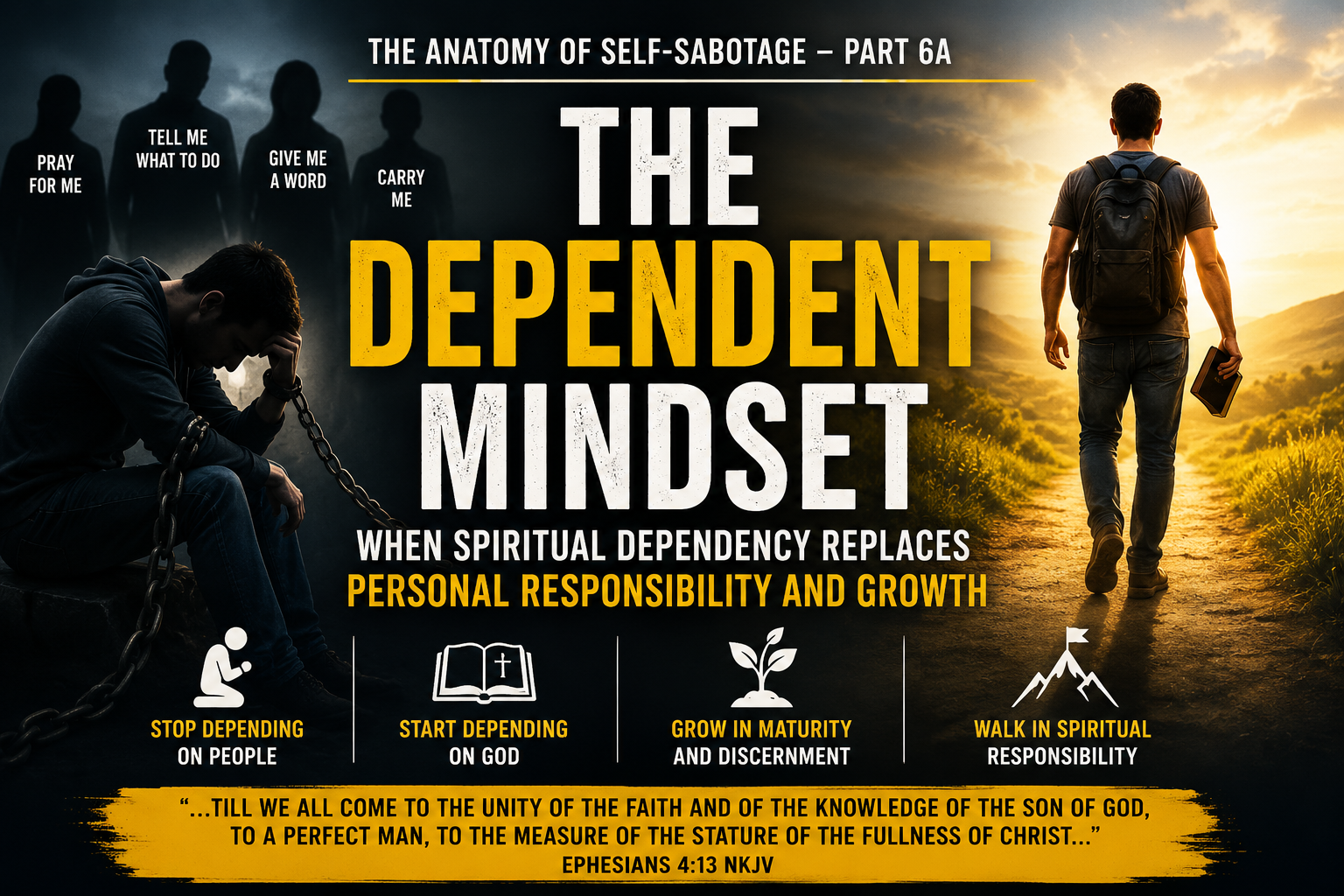
THE ANATOMY OF SELF-SABOTAGE – PART 6A
THE DEPENDENT MINDSET – PART 6A – FROM DEPENDENCY TO MATURITY
INTRODUCTION
One of the most subtle forms of self-sabotage in the life of a believer is the dependent mindset. This is not the healthy dependence every believer must have on God. Scripture teaches that we are completely dependent on the Lord for life, grace, strength, wisdom, direction, and salvation. Jesus Himself said:
John 15:5 NKJV
(5) “I am the vine, you are the branches. He who abides in Me, and I in him, bears much fruit; for without Me you can do nothing.
Healthy dependence on God produces humility, obedience, maturity, and fruitfulness. However, the dependent mindset addressed in this article is different. It is a damaged mindset that refuses spiritual responsibility, avoids personal growth, and places the burden of one’s spiritual life on someone else.
This mindset says, “I cannot hear God unless someone else hears for me.”
It says, “I cannot pray unless someone stronger prays for me.”
It says, “I cannot make decisions unless someone gives me a word.”
It says, “I cannot grow unless I am constantly carried.”
The dependent mindset is dangerous because it keeps believers in a permanent state of spiritual infancy. It creates people who love inspiration but resist discipline; people who want covering but reject responsibility; people who desire prophetic words but neglect personal devotion; people who want access to spiritual leaders but do not develop their own walk with God.
The Christian life was never designed to produce permanent spiritual babies. God’s purpose is sonship, maturity, responsibility, and fruitful representation. The apostle Paul writes:
1 Corinthians 13:11 NKJV
(11) When I was a child, I spoke as a child, I understood as a child, I thought as a child; but when I became a man, I put away childish things.
The dependent mindset must be confronted because it can appear spiritual while actually resisting maturity.
This is a most dangerous form of self-sabotage in the life of a believer as it is not always open rebellion, pride, or obvious sin. Sometimes it appears as helplessness. It hides behind the language of need, weakness, humility, or spiritual hunger, but underneath it is an unwillingness to grow into personal responsibility before God.
This is the dependent mindset.
The dependent mindset is a damaged way of thinking that keeps a believer permanently reliant on other people for spiritual direction, strength, confirmation, encouragement, prayer, and decision-making. Instead of growing in personal devotion, discernment, maturity, and obedience, the person remains spiritually passive. They always need someone else to hear God for them, pray for them, motivate them, correct them, and carry them.
There is nothing wrong with needing help. The body of Christ is designed for mutual support, encouragement, instruction, and accountability. However, there is a difference between receiving help and refusing to grow. There is a difference between being shepherded and becoming spiritually helpless. God gives leaders, pastors, teachers, prophets, and spiritual fathers to equip the saints, not to replace their personal walk with Him.
Ephesians 4:11-13 NKJV
(11) And He Himself gave some to be apostles, some prophets, some evangelists, and some pastors and teachers,
(12) for the equipping of the saints for the work of ministry, for the edifying of the body of Christ,
(13) till we all come to the unity of the faith and of the knowledge of the Son of God, to a perfect man, to the measure of the stature of the fullness of Christ;
The purpose of ministry leadership is not to create dependency. It is to produce maturity.
DEFINITION OF THE DEPENDENT MINDSET
The dependent mindset is a mindset incapable of spiritual responsibility and personal growth.
It is a condition where a person constantly leans on other people for spiritual direction, emotional strength, prayer, confirmation, motivation, and discipline, while neglecting their own personal relationship with God.
This mindset is not the same as receiving counsel, submitting to leadership, asking for prayer, or walking in fellowship with other believers. Those are biblical and necessary. Scripture says:
Proverbs 11:14 NKJV
(14) Where there is no counsel, the people fall; But in the multitude of counselors there is safety.
However, counsel must never replace conviction. Prayer support must never replace personal prayer. Leadership must never replace personal obedience. Prophetic ministry must never replace direct relationship with God. Fellowship must never replace personal responsibility.
The dependent mindset wants the benefits of maturity without the process of maturity. It wants others to carry the burden of obedience, discernment, discipline, and devotion.
HEALTHY DEPENDENCE VERSUS UNHEALTHY DEPENDENCE
It is important to make a clear distinction between healthy biblical dependence and unhealthy spiritual dependency.
- Healthy dependence says, “I need God.” Unhealthy dependence says, “I cannot walk with God unless another person carries me.”
- Healthy dependence says, “I value spiritual leadership.” Unhealthy dependence says, “I cannot make any decision without a leader deciding for me.”
- Healthy dependence says, “Pray with me.” Unhealthy dependence says, “Pray for me while I remain prayerless.”
- Healthy dependence says, “Teach me to grow.” Unhealthy dependence says, “Keep feeding me, but do not require growth from me.”
- Healthy dependence produces humility. Unhealthy dependence produces passivity.
- Healthy dependence produces teachability. Unhealthy dependence produces helplessness.
- Healthy dependence builds maturity. Unhealthy dependence delays maturity.
The apostle Paul shows us that the goal of ministry is not to keep people dependent on leaders forever, but to bring them into maturity:
Colossians 1:28 NKJV
(28) Him we preach, warning every man and teaching every man in all wisdom, that we may present every man perfect in Christ Jesus.
The word “perfect” in this context speaks of maturity, completeness, and full development. The goal of ministry is not permanent spiritual dependence, but mature representation of Christ.
Biblical Example 1: Israel After Moses Left
One of the clearest biblical pictures of the dependent mindset is seen in Israel after Moses went up Mount Sinai. Moses had been their visible leader, deliverer, intercessor, and guide. Through Moses, God confronted Pharaoh, brought plagues upon Egypt, opened the Red Sea, provided direction in the wilderness, and spoke His commandments to the nation.
But when Moses was absent for a period of time, the people collapsed spiritually.
“Now when the people saw that Moses delayed coming down from the mountain, the people gathered together to Aaron, and said to him, ‘Come, make us gods that shall go before
It is the condition of a believer who remains immature because they have transferred their personal responsibility onto someone else. Instead of developing a direct relationship with God, they live from the spiritual strength of others.
This person may love God sincerely, attend church faithfully, and respect spiritual leadership deeply, but they struggle to stand when visible leadership is absent. Their faith rises and falls depending on who is around them. They are strong when someone is watching, but weak when they must walk alone. They depend on external voices more than inward conviction.
A dependent believer may say:
- “Pastor, pray for me,” but they do not pray personally.
- “I need a word,” but they do not study Scripture.
- “I need confirmation,” but they do not develop discernment.
- “I need encouragement,” but they do not strengthen themselves in the Lord.
- “I need someone to tell me what to do,” but they do not take responsibility for obedience.
This mindset delays maturity because it keeps the believer in a state of spiritual childhood.
Hebrews 5:12-14 NKJV
(12) For though by this time you ought to be teachers, you need someone to teach you again the first principles of the oracles of God; and you have come to need milk and not solid food.
(13) For everyone who partakes only of milk is unskilled in the word of righteousness, for he is a babe.
(14) But solid food belongs to those who are of full age, that is, those who by reason of use have their senses exercised to discern both good and evil.
God expects growth. There is a time for milk, but there must also be a progression toward maturity.
Biblical Example 2: The Book of Judges: When People Keep Falling Without Spiritual Maturity
The Book of Judges gives us one of the clearest biblical pictures of the dependent mindset operating across generations. Israel repeatedly depended on strong leaders to rescue them, correct them, guide them, and restore them. Yet whenever that leader died, the people returned to sin, idolatry, compromise, and rebellion.
This reveals a tragic spiritual pattern: the people experienced deliverance, but they did not develop lasting maturity. They celebrated rescue, but they did not cultivate responsibility. They benefited from the courage and obedience of the judges, but they did not personally embrace covenant faithfulness to God.
The repeated cycle in Judges is simple but dangerous: Israel sinned, God allowed oppression, the people cried out, God raised up a deliverer, the land had rest, the judge died, and the people returned to corruption again. This was not merely a leadership problem. It was a mindset problem.
The people were dependent on the judge but not deeply devoted to the Lord.
Judges 2:7 NKJV
“So the people served the LORD all the days of Joshua, and all the days of the elders who outlived Joshua, who had seen all the great works of the LORD which He had done for Israel.”
At first, Israel served the Lord while Joshua and the elders were alive. This shows the power of righteous leadership and generational example. However, the next verses reveal a serious weakness. Once that generation passed away, the people quickly lost spiritual direction.
Judges 2:10-11 NKJV
(10) When all that generation had been gathered to their fathers, another generation arose after them who did not know the LORD nor the work which He had done for Israel.
(11) Then the children of Israel did evil in the sight of the LORD, and served the Baals;
This is the danger of a dependent mindset. It can live near spiritual greatness without becoming spiritually grounded. It can witness the works of God without developing personal conviction. It can honour leaders outwardly without internalising truth inwardly.
Israel had memories of deliverance, but not maturity. They had history, but not heart transformation. They had leaders, but they lacked personal covenant responsibility.
The Repeated Cycle of Dependence
The Book of Judges repeatedly shows Israel falling into the same pattern. They would drift from God, suffer under oppression, cry out for help, and then God would raise up a judge to deliver them. But instead of allowing deliverance to become a turning point into maturity, they often returned to the same sins once the judge was gone.
Judges 2:16-19 NKJV
(16) Nevertheless, the LORD raised up judges who delivered them out of the hand of those who plundered them.
(17) Yet they would not listen to their judges, but they played the harlot with other gods, and bowed down to them. They turned quickly from the way in which their fathers walked, in obeying the commandments of the LORD; they did not do so.
(18) And when the LORD raised up judges for them, the LORD was with the judge and delivered them out of the hand of their enemies all the days of the judge; for the LORD was moved to pity by their groaning because of those who oppressed them and harassed them.
(19) And it came to pass, when the judge was dead, that they reverted and behaved more corruptly than their fathers, by following other gods, to serve them and bow down to them. They did not cease from their own doings nor from their stubborn way.
This passage exposes the heart of the dependent mindset. Israel could experience relief while the judge was alive, but they did not develop the inner discipline to remain faithful when the judge was gone. Their obedience was too dependent on external leadership and not rooted deeply enough in personal devotion to God.
They needed a deliverer, but they also needed transformation. They needed rescue, but they also needed renewal. They needed judges, but they also needed covenant maturity.
DEPENDENCE ON LEADERS WITHOUT PERSONAL CONVICTION
A dependent mindset often attaches itself to strong personalities. It follows when the leader is present, but it weakens when the leader is absent. It behaves correctly under supervision but collapses when left alone. This kind of spirituality is not stable because it is based more on external influence than internal conviction.
This is what happened in the Book of Judges. The people were influenced by the judges, but they were not transformed into a people who could walk faithfully with God without constant intervention.
Deborah arose in a time of national weakness. Gideon arose when Israel was hiding from Midian. Jephthah arose during conflict and oppression. Samson arose during Philistine domination. Each judge was used by God in a particular season, but Israel as a nation repeatedly failed to become a mature covenant people.
The issue was not that God failed to send help. The issue was that the people failed to grow.
This is a powerful warning to believers today. God may send leaders, teachers, pastors, prophets, fathers, mentors, and counsellors into our lives, but we must not use their strength as an excuse to remain spiritually underdeveloped. Leaders can guide us, but they cannot obey God for us. They can teach us, but they cannot build our prayer life for us. They can correct us, but they cannot repent on our behalf. They can encourage us, but they cannot carry our entire walk with God.
“Everyone Did What Was Right in His Own Eyes”
The Book of Judges ends with one of the most sobering statements in Scripture.
Judges 21:25 NKJV
(25) In those days there was no king in Israel; everyone did what was right in his own eyes.
This statement reveals what happens when people lack both righteous leadership and internal spiritual government. Without spiritual maturity, people become unstable. They move according to personal opinion, emotion, appetite, culture, pressure, and convenience.
The dependent mindset may appear submissive while a leader is present, but without personal transformation, it can quickly become lawless when structure is removed. This is why true discipleship must go deeper than attendance, excitement, personality attachment, or public agreement. True discipleship forms Christ within the believer.
Paul said:
Galatians 4:19 NKJV
(19) My little children, for whom I labor in birth again until Christ is formed in you,
The goal of leadership is not to create lifelong dependency. The goal is to see Christ formed in people so they can walk with God personally, responsibly, and faithfully.
LESSONS FROM THE BOOK OF JUDGES
The Book of Judges teaches us that repeated rescue does not automatically produce maturity. A person can be delivered from crisis many times and still remain spiritually undeveloped if they never take responsibility for their walk with God.
It also teaches us that strong leadership can bring temporary order, but only inner transformation can produce lasting faithfulness. Israel’s problem was not the absence of God’s mercy. God repeatedly raised deliverers. Their problem was the absence of sustained covenant obedience.
The dependent mindset wants God to keep sending someone to fix the consequences of immaturity. But the renewed mind asks, “Lord, what must change in me so I stop repeating the same cycle?”
The Book of Judges therefore confronts us with an important question: Are we only faithful when someone is watching, leading, motivating, or rescuing us? Or have we developed a personal devotion to God that remains steady even when no visible leader is present?
APPLICATION FOR THE BELIEVER TODAY

Many believers still repeat the pattern of Judges. They run to church during crisis but neglect devotion when life becomes comfortable. They ask for prayer but do not build a prayer life. They seek prophetic direction but do not study Scripture. They want deliverance from consequences but resist the discipline that prevents repeated bondage.
This is not maturity. It is dependency.
God’s desire is not merely to rescue us repeatedly from the same cycles. His desire is to mature us until we walk in truth, wisdom, obedience, and spiritual responsibility. The dependent believer keeps needing another judge. The mature believer learns to walk under the government of God.
The redemptive lesson from Judges is clear: God may use leaders to deliver us, but He wants truth to be established within us. He may send help in seasons of weakness, but He also calls us to grow into strength. He may raise voices around us, but He also desires to form His voice within us through Scripture, prayer, obedience, and the Holy Spirit.
The cure for the dependent mindset is not independence from God-ordained leadership. It is personal maturity under God. It is learning to stand before the Lord with conviction, devotion, discipline, and obedience.
A believer must never become so dependent on a leader that they cannot remain faithful to God when that leader is absent. True maturity is revealed when our obedience is no longer dependent on constant external pressure, but flows from an inward relationship with the Lord.
CHARACTERISTICS OF THE DEPENDENT MINDSET
The dependent mindset is often difficult to recognise because it can appear humble, submissive, teachable, or honouring of leadership. However, beneath the surface, it avoids personal responsibility and spiritual growth. It does not want to carry the weight of maturity. It prefers to be carried, rescued, reminded, confirmed, and constantly encouraged by others.
God does not call believers to live independently from the Body of Christ, but He does call every believer to grow into maturity, discernment, obedience, prayer, and responsibility. The church is a family, but it is not a place where believers remain spiritual infants forever. True discipleship should produce sons and daughters who can walk with God personally, not people who collapse whenever visible leadership is absent.
-
DEPENDENCE ON PERSONALITIES
One of the clearest marks of the dependent mindset is an unhealthy dependence on personalities. This happens when a believer attaches their spiritual stability to a person rather than to Christ. Their faith rises or falls based on the presence, approval, attention, or encouragement of a leader.
This kind of believer may say, “I can only receive from this pastor,” “I only trust this prophet,” “I cannot move unless my spiritual father speaks,” or “If this leader is not there, I cannot function.” While honouring spiritual leadership is biblical, replacing personal relationship with God with dependence on a human personality is dangerous.
Paul confronted this problem in the Corinthian church.
1 Corinthians 3:4-7 NKJV
(4) For when one says, “I am of Paul,” and another, “I am of Apollos,” are you not carnal?
(5) Who then is Paul, and who is Apollos, but ministers through whom you believed, as the Lord gave to each one?
(6) I planted, Apollos watered, but God gave the increase.
(7) So then neither he who plants is anything, nor he who waters, but God who gives the increase.
The Corinthian believers were dividing themselves around personalities. Some identified with Paul, others with Apollos. Paul corrected them by reminding them that leaders are servants through whom God works, but God alone gives the increase.
A dependent mindset turns leaders into spiritual crutches. It admires the vessel more than the God who uses the vessel. It becomes attached to the personality, the voice, the style, the charisma, the platform, or the anointing, but fails to develop a personal foundation in Christ.
Spiritual leaders are gifts from God, but they are not God. They are given to equip the saints, not to replace the believer’s own relationship with the Lord.
Ephesians 4:11-13 NKJV
(11) And He Himself gave some to be apostles, some prophets, some evangelists, and some pastors and teachers,
(12) for the equipping of the saints for the work of ministry, for the edifying of the body of Christ,
(13) till we all come to the unity of the faith and of the knowledge of the Son of God, to a perfect man, to the measure of the stature of the fullness of Christ;
The purpose of ministry gifts is not to create dependence. Their purpose is to equip, strengthen, mature, and develop believers until Christ is formed in them. A healthy leader does not want people permanently dependent on his or her personality. A healthy leader wants people rooted in Christ, grounded in truth, and able to walk in obedience.
When believers depend on personalities, they become unstable. If the leader falls, they fall. If the leader leaves, they leave. If the leader does not notice them, they feel rejected. If the leader corrects them, they become offended. Their spiritual life becomes attached to human presence instead of divine conviction.
The cure is not dishonour toward leadership. The cure is proper alignment. Honour leaders, receive from leaders, learn from leaders, but build your life on Christ.
1 Corinthians 11:1 NKJV
(1) Imitate me, just as I also imitate Christ.
Paul did not say, “Follow me instead of Christ.” He said, “Imitate me as I imitate Christ.” The true goal of leadership is always to point people beyond the servant to the Lord Himself.
-
NO PERSONAL PRAYER LIFE
Another major characteristic of the dependent mindset is the absence of a personal prayer life. This believer may constantly ask others to

pray but does not develop the discipline of prayer personally. They want prayer covering, prayer support, prayer meetings, and prophetic intercession, but they do not build their own altar before God.
There is nothing wrong with asking others to pray. Scripture encourages believers to pray for one another. The problem begins when a person always asks for prayer but never learns to pray. This reveals dependence without devotion.
Jesus taught His disciples that prayer should be personal, sincere, and direct before the Father.
Matthew 6:6 NKJV
(6) But you, when you pray, go into your room, and when you have shut your door, pray to your Father who is in the secret place; and your Father who sees in secret will reward you openly.
Jesus did not say, “When others pray for you.” He said, “When you pray.” This means every believer has a personal responsibility to seek the Father. Prayer is not only a church activity. It is not only something leaders do for members. Prayer is the breath of a believer’s relationship with God.
A person with no personal prayer life becomes spiritually weak because they are always receiving second-hand strength. They live off the prayers, discernment, instruction, and obedience of others. They may enjoy powerful services, anointed meetings, and strong spiritual environments, but when they are alone, they have no inner altar.
This is dangerous because real spiritual strength is often developed in private before it is expressed in public. Jesus Himself modelled a life of prayer.
Luke 5:16 NKJV
(16) So He Himself often withdrew into the wilderness and prayed.
If Jesus withdrew to pray, then no believer is too mature, too busy, too gifted, or too important to pray. Prayer is not a religious performance. It is communion with God. It is where the heart is strengthened, motives are purified, burdens are surrendered, and obedience is renewed.
The dependent mindset avoids personal prayer because prayer requires discipline, honesty, and responsibility. In prayer, excuses are exposed. In prayer, God deals with the heart. In prayer, the believer cannot hide behind the pastor, the prophet, the leader, the group, or the atmosphere.
A believer who never prays personally will always need someone else to carry what they refuse to cultivate. They may ask for breakthrough, but not build intimacy. They may ask for direction, but not seek God. They may ask for deliverance, but not surrender. They may ask for peace, but not cast their cares upon the Lord.
Philippians 4:6-7 NKJV
(6) Be anxious for nothing, but in everything by prayer and supplication, with thanksgiving, let your requests be made known to God;
(7) and the peace of God, which surpasses all understanding, will guard your hearts and minds through Christ Jesus.
The instruction is clear: let your requests be made known to God. The dependent believer must move from only saying, “Pray for me,” to also saying, “I will seek the Lord.” Mature believers can receive prayer from others, but they also know how to stand before God personally.
-
ADDICTION TO PROPHETIC WORDS
The dependent mindset often develops an addiction to prophetic words. This happens when a believer constantly seeks a word from someone else but neglects Scripture, wisdom, obedience, and personal discernment.
Prophetic ministry is biblical. God uses prophecy to edify, exhort, and comfort the church. However, prophecy was never intended to replace Scripture, obedience, counsel, character, or a personal relationship with God.
1 Corinthians 14:3 NKJV
(3) But he who prophesies speaks edification and exhortation and comfort to men.
Prophecy is meant to strengthen, encourage, and comfort. It is not meant to become a spiritual addiction. Some believers move from meeting to meeting, prophet to prophet, platform to platform, always looking for a new word. They are constantly seeking confirmation, but rarely walking in obedience to what God has already said.
This becomes dangerous when a person values prophetic excitement more than biblical truth. They may chase words about destiny, elevation, wealth, marriage, open doors, and promotion, but ignore Scriptures about holiness, forgiveness, discipline, humility, correction, and obedience.
The dependent mindset says, “I need a word before I can move.” Maturity says, “I will obey what God has already revealed.”
Psalm 119:105 NKJV
(105) Your word is a lamp to my feet And a light to my path.
The primary light for the believer is the Word of God. Prophecy must never become a substitute for Scripture. Any prophetic word must be tested, weighed, and submitted to the truth of God’s Word.
1 Thessalonians 5:19-21 NKJV
(19) Do not quench the Spirit.
(20) Do not despise prophecies.
(21) Test all things; hold fast what is good.
This passage gives balance. We must not despise prophecy, but we must also test all things. The dependent mindset does not want to test; it wants to consume. It wants another emotional moment, another declaration, another confirmation, another external voice. But maturity does not swallow everything blindly. Maturity discerns.
An addiction to prophetic words can also become a way of avoiding responsibility. A person may keep asking for a word because they do not want to make a disciplined decision. They may want God to speak through someone else because they have neglected their own secret place. They may want confirmation because they fear obedience. They may seek another prophecy because they have not obeyed the last instruction.
Prophecy should never make a believer passive. True prophetic ministry should awaken faith, obedience, responsibility, and alignment with God’s will. It should not produce spiritual spectators who wait for the next word but never take the next step.
The believer must learn to treasure Scripture, cultivate discernment, and obey the revealed will of God.
2 Timothy 3:16-17 NKJV
(16) All Scripture is given by inspiration of God, and is profitable for doctrine, for reproof, for correction, for instruction in righteousness,
(17) that the man of God may be complete, thoroughly equipped for every good work.
-
SPIRITUAL LAZINESS

Spiritual laziness is one of the most dangerous characteristics of the dependent mindset because it disguises itself as weakness, tiredness, busyness, or the need for help. It is the condition where a believer desires spiritual benefits without spiritual discipline. They want growth without devotion, victory without obedience, discernment without study, and maturity without sacrifice.
The spiritually lazy believer often wants others to carry what God has called them to cultivate. They may depend on the pastor to feed them, the prophet to guide them, the intercessor to pray for them, the worship team to stir them, and the church environment to keep them alive spiritually. But outside of those external supports, they do very little to build their own walk with God.
Spiritual laziness does not mean a person has no desire for God at all. Many spiritually lazy believers genuinely want breakthrough, blessing, direction, and peace. The problem is that they do not want the discipline required to grow. They want the results of maturity without the process of maturity.
The writer of Hebrews addressed believers who should have been mature but had remained spiritually undeveloped.
Hebrews 5:12-14 NKJV
(12) For though by this time you ought to be teachers, you need someone to teach you again the first principles of the oracles of God; and you have come to need milk and not solid food.
(13) For everyone who partakes only of milk is unskilled in the word of righteousness, for he is a babe.
(14) But solid food belongs to those who are of full age, that is, those who by reason of use have their senses exercised to discern both good and evil.
This passage reveals that maturity does not happen automatically with time. A person can be in church for years and still remain spiritually immature if they do not exercise themselves in truth. The problem was not that these believers lacked access to teaching. The problem was that they did not grow into responsibility.
Spiritual laziness causes a believer to remain on “milk” when they should be handling “solid food.” They continue needing the basics repeated because they have not practised what they already know. They hear sermons but do not apply them. They receive counsel but do not obey it. They are convicted but do not change. They are exposed to truth but do not exercise themselves in righteousness.
The dependent mindset says, “Someone must keep feeding me.” Maturity says, “I must learn to feed on the Word of God personally.”
Jesus said:
Matthew 4:4 NKJV
(4) But He answered and said, “It is written, ‘MAN SHALL NOT LIVE BY BREAD ALONE, BUT BY EVERY WORD THAT PROCEEDS FROM THE MOUTH OF GOD.’
A believer cannot live spiritually on occasional encouragement, Sunday sermons, forwarded devotionals, or emergency prayers alone. Just as the body needs regular nourishment, the spirit must be strengthened through the Word, prayer, obedience, worship, fellowship, and discipline.
Spiritual laziness also produces dullness. The heart becomes slow to respond to truth. The conscience becomes less sensitive. The believer becomes easily distracted, easily offended, easily discouraged, and easily led astray. When there is no discipline, there is no depth. When there is no depth, there is no stability.
Paul instructed Timothy to exercise himself toward godliness.
1 Timothy 4:7-8 NKJV
(7) But reject profane and old wives’ fables, and exercise yourself toward godliness.
(8) For bodily exercise profits a little, but godliness is profitable for all things, having promise of the life that now is and of that which is to come.
The word “exercise” shows that godliness requires intentional effort. Spiritual growth does not come by accident. It is cultivated through repeated obedience, disciplined devotion, and a willing heart. Just as physical strength is developed through consistent exercise, spiritual strength is developed through consistent practice.
The spiritually lazy believer often wants others to do the exercising for them. They want the benefits of someone else’s prayer life, someone else’s discipline, someone else’s study, someone else’s consecration, and someone else’s obedience. But no one can develop spiritual maturity on behalf of another person.
Others can encourage you, but they cannot seek God for you.
Others can teach you, but they cannot obey for you.
Others can pray with you, but they cannot build your secret place for you.
Others can counsel you, but they cannot renew your mind for you.
Spiritual laziness is also revealed when a believer only becomes serious during crisis. When trouble comes, they pray intensely, attend faithfully, seek counsel urgently, and ask for help repeatedly. But when the crisis passes, they return to neglect. This pattern keeps them trapped in cycles of emergency spirituality.
The Book of Judges reveals this pattern repeatedly. Israel cried out to God when they were oppressed, but after deliverance came, they often returned to compromise. They wanted relief from suffering but did not sustain covenant faithfulness.
Judges 2:18-19 NKJV
(18) And when the LORD raised up judges for them, the LORD was with the judge and delivered them out of the hand of their enemies all the days of the judge; for the LORD was moved to pity by their groaning because of those who oppressed them and harassed them.
(19) And it came to pass, when the judge was dead, that they reverted and behaved more corruptly than their fathers, by following other gods, to serve them and bow down to them. They did not cease from their own doings nor from their stubborn way.
This is the fruit of spiritual laziness. The people cried out when they needed rescue, but they did not develop lasting obedience. They wanted deliverance from oppression but not transformation of heart.
Many believers today live in the same pattern. They pray when they are desperate but neglect prayer when they are comfortable. They seek God when doors close but forget Him when doors open. They attend church faithfully during crisis but become casual when life stabilises. They want God’s intervention but resist God’s discipline.
Spiritual laziness also causes believers to depend excessively on spiritual atmospheres. They only feel strong in a powerful service. They only feel encouraged when worship is emotional. They only feel spiritual when others are passionate around them. But when they are alone, they have no personal fire.
This is why Paul told Timothy:
2 Timothy 1:6 NKJV
(6) Then the young man who told him said, “As I happened by chance to be on Mount Gilboa, there was Saul, leaning on his spear; and indeed the chariots and horsemen followed hard after him.
Paul did not tell Timothy to wait for someone else to stir him. He told him to stir up the gift of God within him. There are moments when every believer must take responsibility for the fire of God in their own life.
The spiritually lazy believer waits to be stirred. The mature believer learns to stir up what God has placed within.
Spiritual laziness must be confronted because it weakens discernment, delays maturity, and keeps believers dependent on external motivation. It produces people who know what to do but do not do it. They know they should pray, but they do not pray. They know they should forgive, but they delay. They know they should study the Word, but they neglect it. They know they should obey, but they postpone obedience.
James warns against hearing without doing.
James 1:22-25 NKJV
(22) But be doers of the word, and not hearers only, deceiving yourselves.
(23) For if anyone is a hearer of the word and not a doer, he is like a man observing his natural face in a mirror;
(24) for he observes himself, goes away, and immediately forgets what kind of man he was.
(25) But he who looks into the perfect law of liberty and continues in it, and is not a forgetful hearer but a doer of the work, this one will be blessed in what he does.
Spiritual laziness deceives a person into thinking that hearing is the same as growing. But growth comes when the Word is applied. A sermon heard but not obeyed does not produce maturity. A Scripture quoted but not practised does not transform the heart. A prophetic word received but not stewarded does not bear fruit.
The cure for spiritual laziness is not condemnation. It is repentance, discipline, and renewed devotion. The believer must take ownership of their walk with God and begin to practise spiritual responsibility daily.
This includes setting time aside for prayer, reading and meditating on Scripture, obeying what God has already revealed, gathering with the saints, receiving correction, serving faithfully, and cultivating a lifestyle of worship and surrender.
Romans 12:11 NKJV
(11) not lagging in diligence, fervent in spirit, serving the Lord;
This verse gives a clear picture of the opposite of spiritual laziness. The believer must not lag in diligence. The believer must be fervent in spirit. The believer must serve the Lord with commitment, zeal, and faithfulness.
Spiritual maturity requires diligence. It requires consistency when emotions are low. It requires obedience when no one is watching. It requires devotion when there is no applause. It requires faithfulness when there is no immediate reward.
The dependent mindset says, “Carry me.” The renewed mind says, “Lord, strengthen me to walk responsibly before You.”
The believer who overcomes spiritual laziness moves from passive dependence to active devotion. They stop waiting for others to create their spiritual life for them. They begin to build their own altar, strengthen their own faith, exercise their own discernment, and walk with God personally.
Spiritual leaders are a blessing, but they are not a substitute for personal responsibility. The church can equip, encourage, correct, and support, but every believer must choose to grow. No one can be mature on your behalf.
The call of God is clear: rise from passivity, shake off spiritual laziness, and take responsibility for your walk with the Lord.
-
LACK OF INITIATIVE
A lack of initiative is another major characteristic of the dependent mindset. It is the condition where a believer waits for someone else to begin, instruct, remind, motivate, organise, or push them before they take spiritual responsibility. Such a person may know what is right, understand what God requires, and even agree with the truth, but they remain passive until another person moves them.
This lack of initiative is not the same as waiting on the Lord. Biblical waiting is active faith, trust, prayer, obedience, preparation, and sensitivity to God’s timing. A lack of initiative, however, is passive neglect. It uses delay as an excuse for disobedience. It says, “No one told me,” “No one reminded me,” “No one invited me,” “No one followed up with me,” or “No one gave me an opportunity.”
The dependent mindset often waits to be carried into obedience. It wants another person to create movement, provide motivation, and remove all discomfort before it takes action. But maturity does not wait for constant supervision. Maturity recognises responsibility and responds faithfully.
A believer who lacks initiative often becomes spiritually stagnant. They may attend church, listen to sermons, receive counsel, and agree with instruction, but they do not move unless someone personally pushes them. They do not begin praying unless a prayer programme is announced. They do not study Scripture unless a group study is arranged. They do not serve unless someone begs them. They do not reconcile unless someone confronts them. They do not grow because they do not take ownership of their growth.
The Bible repeatedly calls believers to diligence, action, obedience, and faithful stewardship.
Proverbs 10:4 NKJV
(4) He who has a slack hand becomes poor, But the hand of the diligent makes rich.
Although this verse speaks broadly of diligence, the principle applies spiritually as well. A slack hand produces lack, while diligence produces increase. Spiritual poverty often grows where there is no initiative. When a believer is passive with prayer, passive with the Word, passive with obedience, passive with service, and passive with repentance, they should not be surprised when their spiritual life becomes weak.
Initiative is not self-reliance. It is responsible obedience. It is the willingness to respond to God without needing constant external pressure.
Paul told Timothy:
2 Timothy 2:15 NKJV
(15) Be diligent to present yourself approved to God, a worker who does not need to be ashamed, rightly dividing the word of truth.
Paul did not tell Timothy to wait until someone else developed him. He told him to be diligent. Timothy had to take responsibility for his own growth, handling of Scripture, and ministry development. Others could impart, encourage, and instruct, but Timothy had to apply himself.
A lack of initiative keeps believers in a childlike condition. Children often need reminders, supervision, and repeated instructions. But maturity means the believer begins to recognise what must be done and does it before being chased, corrected, or pleaded with.
Paul also wrote:
Galatians 6:4-5 NKJV
(4) But let each one examine his own work, and then he will have rejoicing in himself alone, and not in another.
(5) For each one shall bear his own load.
This does not contradict the biblical instruction to bear one another’s burdens. It simply shows that every believer has a personal load of responsibility that no one else can carry for them. Others may help in times of weakness, but they cannot permanently replace personal responsibility.
A lack of initiative often appears in small but revealing ways. The believer does not ask, “How can I grow?” They wait for someone to notice their stagnation. They do not ask, “Where can I serve?” They wait to be approached. They do not ask, “What has God already instructed me to obey?” They wait for another prophetic word. They do not ask, “Who must I forgive?” They wait until bitterness damages their heart.
This mindset produces spectators rather than disciples. Spectators watch, comment, receive, and evaluate. Disciples follow, learn, obey, serve, and grow. Jesus did not call people merely to observe Him. He called them to follow Him.
Matthew 16:24 NKJV
(24) Then Jesus said to His disciples, “If anyone desires to come after Me, let him deny himself, and take up his cross, and follow Me.
Following Christ requires movement. It requires a decision. It requires self-denial. It requires taking up the cross. No one can do this on behalf of another person. A pastor can preach the cross, but he cannot carry your cross for you. A mentor can explain obedience, but he cannot obey for you. A leader can show the way, but he cannot walk your path for you.
The lack of initiative is also seen in the servant who buried his talent.
Matthew 25:24-30 NKJV
(24) “Then he who had received the one talent came and said, ‘Lord, I knew you to be a hard man, reaping where you have not sown, and gathering where you have not scattered seed.
(25) And I was afraid, and went and hid your talent in the ground. Look, there you have what is yours.’
(26) “But his lord answered and said to him, ‘You wicked and lazy servant, you knew that I reap where I have not sown, and gather where I have not scattered seed.
(27) So you ought to have deposited my money with the bankers, and at my coming I would have received back my own with interest.
(28) So take the talent from him, and give it to him who has ten talents.
(29) ‘For to everyone who has, more will be given, and he will have abundance; but from him who does not have, even what he has will be taken away.
(30) And cast the unprofitable servant into the outer darkness. There will be weeping and gnashing of teeth.’
In the next blog we will look at the MODERN SYMPTOMS OF A DEPENDENT MINDSET.
OTHER PUBLICATIONS BY THIS AUTHOR CAN BE FOUND AT: