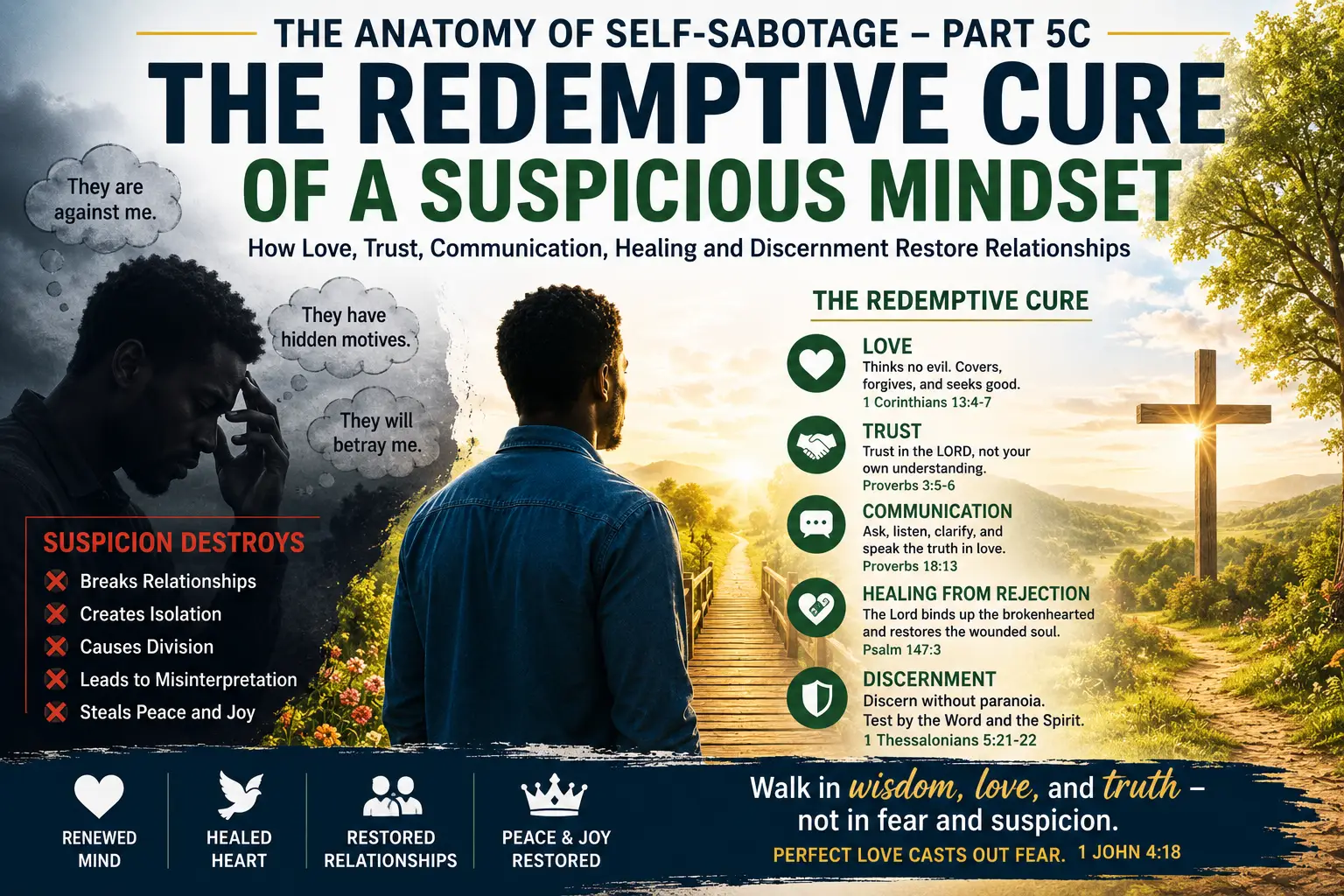
THE ANATOMY OF SELF-SABOTAGE – PART 5C
THE REDEMPTIVE CURE OF A SUSPICIOUS MINDSET
How Love, Trust, Communication, Healing, and Discernment Restore Relationships
The redemptive cure for a suspicious mindset is not healed merely by telling a person, “Stop being suspicious.” Suspicion often has deeper roots. It may come from

betrayal, rejection, disappointment, insecurity, jealousy, fear, trauma, manipulation, or repeated relational wounds. Because of this, the cure must go deeper than behaviour. The heart must be healed. The mind must be renewed. The believer must learn to see people, situations, and relationships through the truth of God’s Word instead of through the lens of fear.
God does not call His people to be naïve. He does not instruct us to ignore real danger, tolerate deception, or trust every person blindly. However, He also does not call us to live in paranoia, accusation, fear, and evil assumptions. There is a holy balance between wisdom and love, discernment and humility, caution and trust, truth and restoration.
The suspicious mindset must be redeemed by the Spirit of God so that the believer can move from fear to love, from mistrust to healthy trust, from assumption to communication, from rejection to healing, and from paranoia to true discernment.
The following are five redemptive cures for a suspicious mindset.
-
LOVE
Love is the first and greatest cure for suspicion because love changes the way we interpret people. Suspicion assumes evil quickly. Love does not. Suspicion expects betrayal. Love seeks truth. Suspicion protects itself by accusing. Love protects relationship by believing, hoping, enduring, and seeking restoration.
The apostle Paul gives us one of the clearest descriptions of love:
1 Corinthians 13:4–7 NKJV
(4) Love suffers long and is kind; love does not envy; love does not parade itself, is not puffed up;
(5) does not behave rudely, does not seek its own, is not provoked, thinks no evil;
(6) does not rejoice in iniquity, but rejoices in the truth;
(7) bears all things, believes all things, hopes all things, endures all things.
The phrase “thinks no evil” is very important when dealing with a suspicious mindset. It does not mean that love ignores truth, tolerates sin, or refuses discernment. Rather, it means love does not live by evil assumptions. Love does not immediately assign wicked motives without evidence. Love does not build accusations on imagination.
A suspicious person may say, “I know what they meant,” when in truth they may only know what fear told them. Love slows the heart down. Love teaches the believer to ask, listen, discern, and respond with grace.
Suspicion is often rooted in fear, but love casts out fear.
1 John 4:18 NKJV
(18) There is no fear in love; but perfect love casts out fear, because fear involves torment. But he who fears has not been made perfect in love.
-
TRUST
Trust is a necessary redemptive cure for the suspicious mindset because suspicion destroys the ability to receive people properly. A suspicious person may desire relationships, but they struggle to trust the sincerity, loyalty, love, correction, or kindness of others. They often expect betrayal before it happens, rejection before it is expressed, and hidden motives before there is evidence.
Trust does not mean foolishness. Trust does not mean ignoring warning signs, overlooking sin, or giving unsafe people unrestricted access to your life. Biblical trust is not naivety. Biblical trust is a healed posture of the heart that refuses to be governed by fear, while still walking in wisdom, truth, and discernment.
The first and highest object of our trust must always be the Lord.
Proverbs 3:5–6 NKJV
(5) Trust in the LORD with all your heart, And lean not on your own understanding;
(6) In all your ways acknowledge Him, And He shall direct your paths.
This Scripture is essential for the suspicious person because suspicion often leans heavily on its “own understanding.” A suspicious mind says, “I know what they meant. I know what they are planning. I know their motive.” But many times those conclusions are not based on truth. They are based on fear, pain, insecurity, rejection, jealousy, or past experiences.
Trusting the Lord means we submit our interpretations to Him. We do not allow fear to become our counsellor. We do not allow wounds to become our prophet. We do not allow suspicion to become our guide. We acknowledge the Lord in the way we see, hear, interpret, respond, and relate.
A suspicious mindset is healed when the believer learns to say, “Lord, I do not want to lean on my fear. I do not want to lean on my past pain. I do not want to lean on my assumptions. Direct my heart in truth.”
Trust Begins with God Before It Extends to People
Many people struggle to trust others because their trust has been broken in the past. They may have been betrayed, rejected, manipulated, abandoned, lied to, or disappointed. Because of this, they may begin to believe that no one is safe and no one can be trusted.
However, the believer’s ability to trust people in a healthy way begins with trusting God. When our hearts are secure in God, we do not need to control every relationship through suspicion. We can trust God to reveal truth, give wisdom, expose deception, heal wounds, and guide our relationships.
Psalm 118:8–9 NKJV
(8) It is better to trust in the LORD Than to put confidence in man.
(9) It is better to trust in the LORD Than to put confidence in princes.
This does not mean we should never trust people. It means people must never become the foundation of our security. God is the foundation. People are human. They can fail, disappoint, misunderstand, or change. But when our trust is anchored in the Lord, we are not destroyed every time people fail us.
A suspicious person often makes people too powerful. They fear what people may do, say, think, or plan. But when trust is restored in God, the heart becomes steadier. The believer learns that even if people misunderstand, reject, betray, or oppose them, God remains faithful.
David gives us a powerful example of this. Saul was suspicious of David and tried to kill him, yet David refused to become governed by suspicion, revenge, and self-protection. David trusted God to judge rightly.
1 Samuel 24:10–12 NKJV
(10) Look, this day your eyes have seen that the LORD delivered you today into my hand in the cave, and someone urged me to kill you. But my eye spared you, and I said, ‘I will not stretch out my hand against my lord, for he is the LORD’s anointed.’
(11) Moreover, my father, see! Yes, see the corner of your robe in my hand! For in that I cut off the corner of your robe, and did not kill you, know and see that there is neither evil nor rebellion in my hand, and I have not sinned against you. Yet you hunt my life to take it.
(12) Let the LORD judge between you and me, and let the LORD avenge me on you. But my hand shall not be against you.
David did not deny the danger. Saul was truly trying to harm him. Yet David did not allow Saul’s suspicion to make him suspicious, bitter, or vengeful. He trusted the Lord with justice. He trusted the Lord with timing. He trusted the Lord with his future.
This is a major key in healing from suspicion: trust God enough not to become like those who wounded you.
Trust Is Not the Same as Blind Access
It is important to understand that trust must be governed by wisdom. Some people should be loved, forgiven, and prayed for, but not immediately given the same level of access they once had. Trust can be restored, but it may need to be rebuilt through repentance, fruit, consistency, humility, and time.
Jesus Himself walked in perfect love, yet He did not entrust Himself carelessly to everyone.
John 2:23–25 NKJV
(23) Now when He was in Jerusalem at the Passover, during the feast, many believed in His name when they saw the signs which He did.
(24) But Jesus did not commit Himself to them, because He knew all men,
(25) and had no need that anyone should testify of man, for He knew what was in man.
This passage gives balance. Jesus was not suspicious, fearful, paranoid, or wounded. Yet He was discerning. He loved people perfectly, but He did not give every person unrestricted access to Himself. He understood what was in man.
Therefore, the cure for suspicion is not reckless trust. The cure is healed trust. Healed trust is able to love without fear, forgive without foolishness, and discern without paranoia.
- A suspicious mindset says, “I trust no one.”
- A naïve mindset says, “I trust everyone.”
- A renewed mind says, “I trust God fully, and I relate to people with love, wisdom, truth, and discernment.”
Trust Must Be Rebuilt Through Truth
Trust grows where truth is honoured. Relationships cannot be healed by pretending that nothing happened. Trust is restored when people speak truthfully, repent sincerely, communicate clearly, and walk consistently.
Paul writes:
Ephesians 4:25 NKJV
(25) Therefore, putting away lying, “LET EACH ONE OF YOU SPEAK TRUTH WITH HIS NEIGHBOR,” for we are members of one another.
Truthfulness is necessary because lies create suspicion. Hidden agendas create suspicion. Manipulation creates suspicion. Inconsistent behaviour creates suspicion. When truth is absent, suspicion increases. But when truth is spoken in love, trust has room to grow again.
A person coming out of suspicion must learn to ask honest questions instead of forming private accusations. They must learn to say:
“Can you help me understand what you meant?”
“I may be interpreting this wrongly.”
“This triggered something in me, but I want to hear your heart.”
“I do not want to assume your motive.”
“Can we speak openly so that mistrust does not grow?”
These kinds of conversations help restore trust because they replace assumption with communication.
Barnabas and Saul: A Biblical Example of Restored Trust
The story of Saul of Tarsus gives us an important example of trust being restored wisely. Saul had persecuted the church. Because of his past, the disciples were afraid of him and did not immediately trust him.
Acts 9:26–28 NKJV
(26) And when Saul had come to Jerusalem, he tried to join the disciples; but they were all afraid of him, and did not believe that he was a disciple.
(27) But Barnabas took him and brought him to the apostles. And he declared to them how he had seen the Lord on the road, and that He had spoken to him, and how he had preached boldly at Damascus in the name of Jesus.
(28) So he was with them at Jerusalem, coming in and going out.
This example is very balanced. The disciples were not wrong to be cautious. Saul had a real history of persecution. However, Barnabas helped them see the evidence of Saul’s transformation. Barnabas did not ask them to trust blindly. He gave testimony of what God had done in Saul’s life and how Saul had already begun to preach boldly in the name of Jesus.
This teaches us that trust can be rebuilt when there is evidence of change. The suspicious mindset often refuses to believe change is possible. But the gospel is built on transformation. God can change people. God can restore relationships. God can redeem histories. God can turn former enemies into brothers.
Barnabas shows us that healed trust makes room for God’s work in people.
Trust Requires Vulnerability
Suspicion avoids vulnerability because it fears being hurt again. But every meaningful relationship requires some level of vulnerability. Without vulnerability, there can be no deep fellowship, accountability, covenant, intimacy, or true friendship.
This does not mean exposing your heart to everyone. It means allowing God to lead you into healthy, trustworthy relationships where your heart can be known, strengthened, corrected, and loved.
Jonathan and David give us a beautiful example of covenant trust.
1 Samuel 18:1–4 NKJV
(1) Now when he had finished speaking to Saul, the soul of Jonathan was knit to the soul of David, and Jonathan loved him as his own soul.
(2) Saul took him that day, and would not let him go home to his father’s house anymore.
(3) Then Jonathan and David made a covenant, because he loved him as his own soul.
(4) And Jonathan took off the robe that was on him and gave it to David, with his armor, even to his sword and his bow and his belt.
Jonathan did not see David as a threat, even though David’s destiny could have been viewed as a threat to Jonathan’s natural claim to the throne. Unlike Saul, Jonathan was not governed by jealousy or suspicion. He trusted David, loved him, and entered covenant with him.
This is powerful because Jonathan and Saul saw the same David differently. Saul saw David through insecurity. Jonathan saw David through love. Saul became suspicious. Jonathan became covenantal. Saul tried to destroy David. Jonathan strengthened him.
The difference was not David. The difference was the condition of the heart looking at David.
Trust Frees the Heart from Constant Self-Protection
A suspicious person lives in constant self-protection. They are always watching, testing, measuring, questioning, and preparing for disappointment. This becomes exhausting. The heart was not designed to live under constant suspicion.
Trust frees the heart from the torment of trying to control everything. It allows the believer to rest in God’s care.
2 Timothy 1:12 NKJV
(12) For this reason I also suffer these things; nevertheless I am not ashamed, for I know whom I have believed and am persuaded that He is able to keep what I have committed to Him until that Day.
Paul’s confidence was not in perfect circumstances or perfect people. His confidence was in the One he believed. This is where trust must be restored. When we know whom we have believed, we can commit our hearts, lives, relationships, and future to Him.
A suspicious mindset says, “I must protect myself from everyone.”
A renewed mind says, “God is my keeper. I will walk in love, wisdom, truth, and discernment, but I will not allow fear to rule my heart.”
Practical Steps to Rebuild Trust
Trust is rebuilt through spiritual and practical obedience. A person coming out of suspicion can begin with these steps:
First, trust God with the pain of past betrayal. Do not deny what happened, but do not allow it to define every future relationship.
Second, stop treating every new person as though they are the person who wounded you. Everyone must not be punished for what someone else did.
Third, ask questions before forming conclusions. Communication weakens suspicion.
Fourth, look for fruit, not fantasy. Do not build trust on words only, but also do not reject people when there is genuine evidence of integrity and change.
Fifth, allow trustworthy people to come close enough to speak into your life. Suspicion is often healed in the presence of safe, truthful, loving relationships.
Sixth, trust God’s ability to reveal truth. You do not need to live in paranoia to be protected. The Holy Spirit is able to lead, warn, correct, and guide.
Trust Restores What Suspicion Destroys
Trust is a redemptive cure because it restores the relational capacity that suspicion damages. Suspicion closes the heart. Trust opens it again under the leadership of God. Suspicion assumes evil. Trust seeks truth. Suspicion isolates. Trust reconnects. Suspicion controls. Trust rests in God.
The believer is not called to reckless trust, but to redeemed trust. We trust God completely. We trust people wisely. We build relationships truthfully. We forgive sincerely. We discern carefully. We communicate honestly.
When trust is restored, the suspicious mindset begins to lose its grip. The heart no longer has to live as though everyone is an enemy. The believer can walk in peace, love, wisdom, and healthy relationship again.
-
COMMUNICATION
Communication is one of the strongest redemptive cures for a suspicious mindset because suspicion grows where communication is absent, unclear, avoided, or replaced by assumption. A suspicious person often does not ask questions; they form conclusions. They do not seek clarity; they interpret motives. They do not open a conversation; they build a case internally.
Suspicion thrives in silence. It feeds on unanswered questions, unresolved offenses, unspoken fears, and imagined motives. When people do not communicate honestly, the suspicious mind begins to fill the gaps with fear. It assumes what was meant. It imagines what was intended. It interprets tone, silence, facial expression, delay, or correction through the lens of distrust.
Many relationships are not destroyed by what actually happened, but by what was never clarified.
This is why healthy communication is necessary for deliverance from suspicion. Communication brings hidden fears into the light. It gives opportunity for truth to replace assumption. It allows people to explain, clarify, repent, forgive, and restore trust.
Suspicion Answers Before It Hears
One of the greatest weaknesses of a suspicious mindset is that it answers before it hears. It responds before it understands. It judges before it listens. It reacts before the full matter is known.
Scripture warns clearly against this.
Proverbs 18:13 NKJV
(13) He who answers a matter before he hears it, It is folly and shame to him.
This verse exposes the danger of premature judgment. A suspicious person may be convinced that they already know what someone meant, but Scripture calls it folly to answer before hearing. When we react without listening, we may end up accusing innocent people, damaging relationships, and bringing shame upon ourselves.
Communication slows the heart down. It teaches us to ask before accusing, listen before judging, and understand before reacting.
- A suspicious mindset says, “I know what you meant.”
- A renewed mind says, “Help me understand what you meant.”
- A suspicious mindset says, “You are against me.”
- A renewed mind says, “Can we talk about what happened?”
- A suspicious mindset says, “I already know your motive.”
- A renewed mind says, “I do not want to assume wrongly.”
This shift is essential. Suspicion closes the door to understanding. Communication opens it.
Communication Must Be Quick to Hear and Slow to Speak
James gives a powerful instruction for all believers, especially those who struggle with suspicion.
James 1:19–20 NKJV
(19) So then, my beloved brethren, let every man be swift to hear, slow to speak, slow to wrath;
(20) for the wrath of man does not produce the righteousness of God.
A suspicious mindset often does the opposite. It is slow to hear, quick to speak, and quick to anger. It rushes to defend, accuse, withdraw, or attack. But the righteousness of God is not produced through emotional reaction.
To be “swift to hear” means we must be willing to listen carefully. Listening is not merely waiting for our turn to speak. Listening means seeking to understand the heart, facts, context, and truth of a matter.
To be “slow to speak” means we must not allow our tongue to run ahead of wisdom. Suspicion often speaks too soon. It says things that wound, accuses without evidence, and declares conclusions that may later prove false.
To be “slow to wrath” means we must not allow anger to govern the conversation. When suspicion and anger join together, communication becomes accusation. The goal is no longer truth; the goal becomes self-defense.
A person being healed from suspicion must learn to pause before responding. They must ask the Holy Spirit to govern their words, tone, timing, and attitude.
Speaking the Truth in Love
Communication is not only about speaking. It is about speaking truth in the right spirit. Some people claim to be “just being honest,” but their honesty is harsh, accusing, careless, or destructive. Biblical communication requires both truth and love.
Ephesians 4:15 NKJV
(15) but, speaking the truth in love, may grow up in all things into Him who is the head—Christ—
- Truth without love can become harsh.
- Love without truth can become shallow.
- But truth spoken in love brings maturity.
A suspicious person must learn to communicate honestly without accusing unfairly. They must be able to say, “This is how I experienced the situation,” without declaring, “This is what you intended,” when they do not yet know the other person’s heart.
There is a big difference between saying:
“You are trying to hurt me.”
And saying:
“When this happened, I felt hurt, and I would like to understand your heart.”
The first statement accuses motive. The second opens a door for clarity.
Healthy communication does not deny pain, but it refuses to turn pain into accusation without truth.
Put Away Lying and Speak Truthfully
Suspicion is also healed when truth becomes the culture of a relationship. Where there are lies, secrecy, manipulation, half-truths, and hidden agendas, suspicion increases. But where truth is spoken clearly and consistently, trust can begin to grow again.
Paul writes:
Ephesians 4:25 NKJV
(25) Therefore, putting away lying, “LET EACH ONE OF YOU SPEAK TRUTH WITH HIS NEIGHBOR,” for we are members of one another.
This verse shows that truthful communication is not optional in the body of Christ. We are members of one another. Lies damage the body. Hidden motives damage the body. Gossip damages the body. Assumption damages the body. Silence, when truth should be spoken, can also damage the body.
Suspicious people must learn to speak truthfully about their fears, wounds, questions, and concerns. Instead of hiding behind withdrawal, coldness, accusation, or indirect comments, they must learn to communicate with humility and honesty.
This may sound like:
- “I realise I may be interpreting this through fear.”
- “I need clarity because I do not want suspicion to grow in my heart.”
- “I was hurt by what happened, but I want to understand before I conclude.”
- “I have struggled with rejection, and this situation triggered that wound.”
- “I want us to walk in truth and peace.”
These kinds of words are redemptive because they invite light into the matter.
A Soft Answer Turns Away Wrath
Communication is not only about the content of our words. It is also about the spirit in which we speak. The same truth can either heal or wound depending on how it is communicated.
Proverbs 15:1 NKJV
(1) A soft answer turns away wrath, But a harsh word stirs up anger.
Suspicion often speaks with a harsh tone because it already feels threatened. A suspicious person may sound defensive, sharp, sarcastic, cold, or accusing. Even when they ask questions, the questions may feel like an interrogation rather than a conversation.
A soft answer does not mean weakness. It means the heart is governed by wisdom, not wrath. It means the goal is peace, not victory. It means the person values restoration more than being right.
When communication is harsh, suspicion increases. People become defensive. Walls go up. Hearts close. But when communication is gentle, honest, and wise, it becomes easier for truth to be received.
The suspicious mindset must be retrained not only in what it thinks, but also in how it speaks.
Jesus Taught Direct Communication
Jesus gave a clear pattern for dealing with offense and relational conflict. He did not teach His disciples to gossip, assume, withdraw, or build secret accusations. He taught direct communication.
Matthew 18:15 NKJV
(15) “Moreover if your brother sins against you, go and tell him his fault between you and him alone. If he hears you, you have gained your

brother.
This verse is powerful because it reveals both the method and the goal.
The method is direct communication: “go and tell him his fault between you and him alone.”
The goal is restoration: “you have gained your brother.”
Suspicion often reverses this. Instead of going to the person, it speaks to others. Instead of seeking restoration, it seeks confirmation of its fears. Instead of gaining the brother, it builds a case against the brother.
Jesus teaches us to address matters directly and privately where possible. This protects dignity, prevents gossip, and gives opportunity for repentance and reconciliation.
When a suspicious person learns to communicate directly, many unnecessary conflicts can be avoided. Direct communication prevents private imagination from becoming public accusation.
Biblical Example: Joseph Communicated With His Brothers
Joseph had every natural reason to mistrust his brothers. They hated him, sold him into slavery, and caused him years of pain. Yet when God brought them back into his life, Joseph did not allow bitterness and suspicion to rule his future. He eventually communicated truth, purpose, and forgiveness.
Genesis 45:4-8 NKJV
(4) And Joseph said to his brothers, “Please come near to me.” So they came near. Then he said: “I am Joseph your brother, whom you sold into Egypt.
(5) But now, do not therefore be grieved or angry with yourselves because you sold me here; for God sent me before you to preserve life.
(6) For these two years the famine has been in the land, and there are still five years in which there will be neither plowing nor harvesting.
(7) And God sent me before you to preserve a posterity for you in the earth, and to save your lives by a great deliverance.
(8) So now it was not you who sent me here, but God; and He has made me a father to Pharaoh, and lord of all his house, and a ruler throughout all the land of Egypt.
-
HEALING FROM REJECTION
Healing from rejection is a vital redemptive cure for a suspicious mindset because suspicion is often rooted in past wounds. Many people are not suspicious because they are naturally difficult; they are suspicious because they have been hurt, rejected, overlooked, abandoned, betrayed, humiliated, or made to feel unwanted.
When rejection is not healed, it becomes a lens. A person no longer sees people as they are; they sees people through what happened to them. The rejected heart often expects to be rejected again. It expects betrayal before betrayal happens. It prepares for abandonment before anyone leaves. It interprets correction as condemnation, silence as distance, delay as dishonour, and disagreement as personal rejection.
This is why suspicion cannot be healed only by correcting behaviour. The wound beneath the behaviour must be brought before God. The person must be healed at the level of identity, belonging, sonship, and love.
A suspicious mindset says, “They will leave me.”

A rejected heart says, “I am not wanted.”
A renewed mind says, “I am accepted in the Beloved, and God’s love defines me.”
Rejection Distorts Perception
Rejection does not only hurt the emotions; it distorts perception. A person who carries rejection may hear words differently from how they were intended. They may see distance where there is only busyness. They may see criticism where there is correction. They may see betrayal where there is misunderstanding. They may see exclusion where there is no intentional harm.
This is why rejection and suspicion often work together. Rejection creates pain, and suspicion tries to protect that pain from happening again. But suspicion is a poor protector. It may keep people at a distance, but it also keeps love, healing, counsel, correction, and fellowship at a distance.
The rejected heart must be healed by the truth that God sees, knows, receives, and values His people.
Psalm 27:10 NKJV
(10) When my father and my mother forsake me, Then the LORD will take care of me.
This verse speaks deeply to the wound of rejection. Even if the closest human relationships fail, God does not abandon His people. The Lord is able to care for the one who feels forsaken, forgotten, or unwanted.
A suspicious person must learn that human rejection does not have the final authority over their identity. What people did may have wounded them, but it does not define them. What people said may have hurt them, but it does not name them. What people withheld may have damaged them, but it does not determine their worth.
God’s love must become louder than the voice of rejection.
Jesus Understands Rejection
One of the greatest comforts for the rejected believer is that Jesus Himself experienced rejection. He was not received by everyone. He was misunderstood, despised, betrayed, abandoned, falsely accused, and crucified.
Isaiah 53:3 NKJV
(3) He is despised and rejected by men, A Man of sorrows and acquainted with grief. And we hid, as it were, our faces from Him; He was despised, and we did not esteem Him.
Jesus understands rejection from the inside. He is not distant from the pain of being unwanted, misunderstood, or falsely judged. He was rejected by men, but He remained secure in the Father. He did not allow rejection to turn Him into a suspicious, bitter, defensive, or hateful person.
This is important. Jesus experienced rejection, but rejection did not control Him. He was wounded, but He did not become suspicious. He was betrayed, but He did not stop loving. He was falsely accused, but He did not answer with paranoia. He suffered, but He entrusted Himself to the Father.
The rejected believer can find healing in Christ because He does not merely sympathise from a distance. He has walked through rejection and overcome it without sin.
John 1:11–12 NKJV
(11) He came to His own, and His own did not receive Him.
(12) But as many as received Him, to them He gave the right to become children of God, to those who believe in His name:
-
DISCERNMENT WITHOUT PARANOIA
Discernment without paranoia is one of the most important redemptive cures for a suspicious mindset. A suspicious person often believes they are being discerning, when in reality they may be interpreting people through fear, rejection, jealousy, insecurity, or past wounds. True discernment is spiritual clarity. Paranoia is fear-driven suspicion.
Discernment is led by the Holy Spirit. Paranoia is led by fear.
Discernment tests what is true. Paranoia assumes what is evil.
Discernment protects without accusing falsely. Paranoia accuses before evidence is established.
Discernment is sober, wise, and peaceful. Paranoia is restless, anxious, and tormented.
The believer is not called to be naïve. Scripture teaches us to be watchful, wise, and spiritually alert. However, we are also not called to live in fear, suspicion, accusation, and emotional torment. God wants His people to discern rightly without becoming paranoid.
Discernment Is Biblical. The Bible does not teach blind trust. It teaches wisdom. Jesus Himself instructed His disciples to be both innocent and discerning.
Matthew 10:16 NKJV
(16) “Behold, I send you out as sheep in the midst of wolves. Therefore be wise as serpents and harmless as doves.
This verse gives the believer a holy balance. We must be “wise as serpents,” meaning we must not be foolish, careless, or unaware of danger. But we must also be “harmless as doves,” meaning we must not become corrupt, cruel, suspicious, manipulative, or accusatory.
A suspicious mindset often takes the first part of the verse and ignores the second. It wants wisdom without harmlessness. It wants caution without love. It wants discernment without humility. But Jesus requires both.
The mature believer must be wise enough to recognise danger, but pure enough not to imagine danger everywhere.
Discernment Tests, Paranoia Assumes
True discernment tests matters before forming conclusions. It does not rush into accusation. It does not build doctrine, decisions, or relationships on imagination. It seeks truth.
John gives an important instruction:
1 John 4:1 NKJV
(1) Beloved, do not believe every spirit, but test the spirits, whether they are of God; because many false prophets have gone out into the world.
This Scripture shows that discernment is necessary. We must test what we hear, what we receive, what is preached, what is prophesied, and what claims to be spiritual. However, testing is not the same as suspecting everyone. Testing is a spiritual process governed by truth. Suspicion is an emotional reaction governed by fear.
Discernment asks, “Does this align with Scripture?” Paranoia asks, “What are they hiding?”
Discernment asks, “What fruit is being produced?” Paranoia asks, “Who are they really trying to deceive?”
Discernment asks, “What is the Holy Spirit revealing?” Paranoia asks, “How can I protect myself from everyone?”
Discernment is careful. Paranoia is suspicious. Discernment examines fruit. Paranoia imagines motives.
Discernment Must Be Trained by the Word.
Discernment is not merely a feeling. It is not suspicion, intuition, fear, or emotional reaction. Biblical discernment is trained by the Word of God and developed through spiritual maturity.
Hebrews 5:14 NKJV
(14) But solid food belongs to those who are of full age, that is, those who by reason of use have their senses exercised to discern both good and evil.
This verse teaches that discernment grows through maturity and exercise. Mature believers have their spiritual senses trained to distinguish between good and evil. They do not rely only on emotion. They do not call fear “discernment.” They do not call suspicion “prophetic insight.” They allow the Word of God, the Spirit of God, and spiritual maturity to train their perception.
A suspicious mindset often says, “I feel something is wrong,” and then treats that feeling as truth. But feelings must be submitted to God. Not every uneasy feeling is a warning from the Holy Spirit. Sometimes it is fear. Sometimes it is trauma. Sometimes it is jealousy. Sometimes it is rejection. Sometimes it is insecurity.
The mature believer does not ignore inner concerns, but neither do they worship them. They test them before God.
Jesus Discerned Without Becoming Paranoid
Jesus is the perfect example of discernment without paranoia. He knew the hearts of men, yet He did not live in fear of people. He loved, served, healed, taught, corrected, confronted, and laid down His life. He was never naïve, but He was also never paranoid.
John 2:23–25 NKJV
(23) Now when He was in Jerusalem at the Passover, during the feast, many believed in His name when they saw the signs which He did.
(24) But Jesus did not commit Himself to them, because He knew all men,
(25) and had no need that anyone should testify of man, for He knew what was in man.
Jesus did not commit Himself carelessly to people because He knew what was in man. This was discernment. Yet He did not become bitter, withdrawn, suspicious, or fearful. He still ministered to people. He still loved people. He still called disciples. He still showed compassion.
This teaches us an important principle: discernment may limit access, but it does not have to destroy love.
- You can love people without giving everyone the same level of access.
- You can forgive people without trusting them blindly.
- You can be kind without being careless.
- You can be wise without being suspicious.
- You can recognise danger without becoming ruled by fear.
Nehemiah: Discernment in the Face of Hidden Agendas
Nehemiah gives us a powerful example of discernment without paranoia. While rebuilding the wall of Jerusalem, he faced opposition from Sanballat, Tobiah, and others. They invited him to meet with them, but Nehemiah discerned that their intention was harmful.
Nehemiah 6:2–4 NKJV
(2) that Sanballat and Geshem sent to me, saying, “Come, let us meet together among the villages in the plain of Ono.” But they thought to do me harm.
(3) So I sent messengers to them, saying, “I am doing a great work, so that I cannot come down. Why should the work cease while I leave it and go down to you?”
(4) But they sent me this message four times, and I answered them in the same manner.
Nehemiah did not need to become emotional, dramatic, or paranoid. He simply discerned the danger and refused the invitation. He did not abandon his assignment to entertain hidden agendas. He did not allow intimidation to distract him.
This is healthy discernment. It recognises danger, remains focused, and responds wisely.
A suspicious mindset may see enemies everywhere and become consumed by them. Nehemiah did not do that. He stayed focused on the work God gave him. Discernment protected the assignment without making the opposition the centre of his life.
Paul: Discernment in Spiritual Matters
Paul also demonstrated discernment when a slave girl followed him and Silas, declaring that they were servants of the Most High God. Her words sounded correct, but the spirit behind them was wrong.
Acts 16:16–18 NKJV
(16) Now it happened, as we went to prayer, that a certain slave girl possessed with a spirit of divination met us, who brought her masters much profit by fortune-telling.
(17) This girl followed Paul and us, and cried out, saying, “These men are the servants of the Most High God, who proclaim to us the way of salvation.”
(18) And this she did for many days. But Paul, greatly annoyed, turned and said to the spirit, “I command you in the name of Jesus Christ to come out of her.” And he came out that very hour.
This example shows that discernment is not only about words. The words spoken by the slave girl sounded accurate, but Paul discerned the spirit behind them. True discernment looks beyond surface appearances and tests the source, fruit, spirit, and purpose of a matter.
However, Paul did not become obsessed with demons or suspicious of every person. He dealt with the matter when discernment was clear. This is the balance believers need. We must be spiritually awake without becoming spiritually paranoid.
The Bereans: Discernment Through Scripture
The Bereans provide another healthy example of discernment. They did not reject Paul’s teaching suspiciously, but they also did not receive it blindly. They searched the Scriptures to confirm whether what they heard was true.
Acts 17:11 NKJV
(11) These were more fair-minded than those in Thessalonica, in that they received the word with all readiness, and searched the Scriptures daily to find out whether these things were so.
This is discernment without paranoia. The Bereans were open, but not gullible. They were teachable, but not careless. They received the word with readiness, but they tested it by Scripture.
- A suspicious person often rejects before examining.
- A gullible person receives without examining.
- A discerning person receives with readiness and tests by Scripture.
This is the balance God wants in His people.
Discernment Must Operate Through Love
Discernment without love can become harsh, critical, and suspicious. Love without discernment can become naïve and easily deceived. The believer needs both.
Paul prayed that love would abound together with knowledge and discernment.
Philippians 1:9–10 NKJV
(9) And this I pray, that your love may abound still more and more in knowledge and all discernment,
(10) that you may approve the things that are excellent, that you may be sincere and without offense till the day of Christ,
This passage is very important. Biblical love is not blind. It grows in knowledge and discernment. But biblical discernment is also not loveless. It operates within the environment of love.
A suspicious mindset often has “discernment” without love. It exposes, accuses, criticises, and separates. But Paul shows us that true discernment helps us approve what is excellent and remain sincere and without offense.
- Discernment should make us more mature, not more suspicious.
- Discernment should make us more truthful, not more accusatory.
- Discernment should make us more loving, not more fearful.
- Discernment should protect purity, not create paranoia.
How to Practise Discernment Without Paranoia
A believer who is being healed from suspicion must learn to practise discernment in a biblical way. We will deal with the above guidelines for discernment of truth in the next and final installment of this series.
CONCLUSION
The redemptive cure for a suspicious mindset is not found in denial, self-protection, or emotional withdrawal, but in allowing God to heal the heart and renew the mind. Suspicion loses its power when love replaces fear, trust in God replaces self-protection, communication replaces assumption, healing replaces rejection, and biblical discernment replaces paranoia. God does not call His people to be naïve, but He does call them to be whole, wise, loving, truthful, and discerning. As the believer submits wounded perceptions to the Word of God and the work of the Holy Spirit, relationships can be restored, trust can be rebuilt, and the heart can learn to see people through truth rather than pain. A healed believer no longer lives expecting betrayal from everyone, but walks in peace, wisdom, love, and discernment under the government of Christ.
OTHER PUBLICATIONS BY THIS AUTHOR
CAN BE FOUND AT: NEW BOOK PUBLISHED