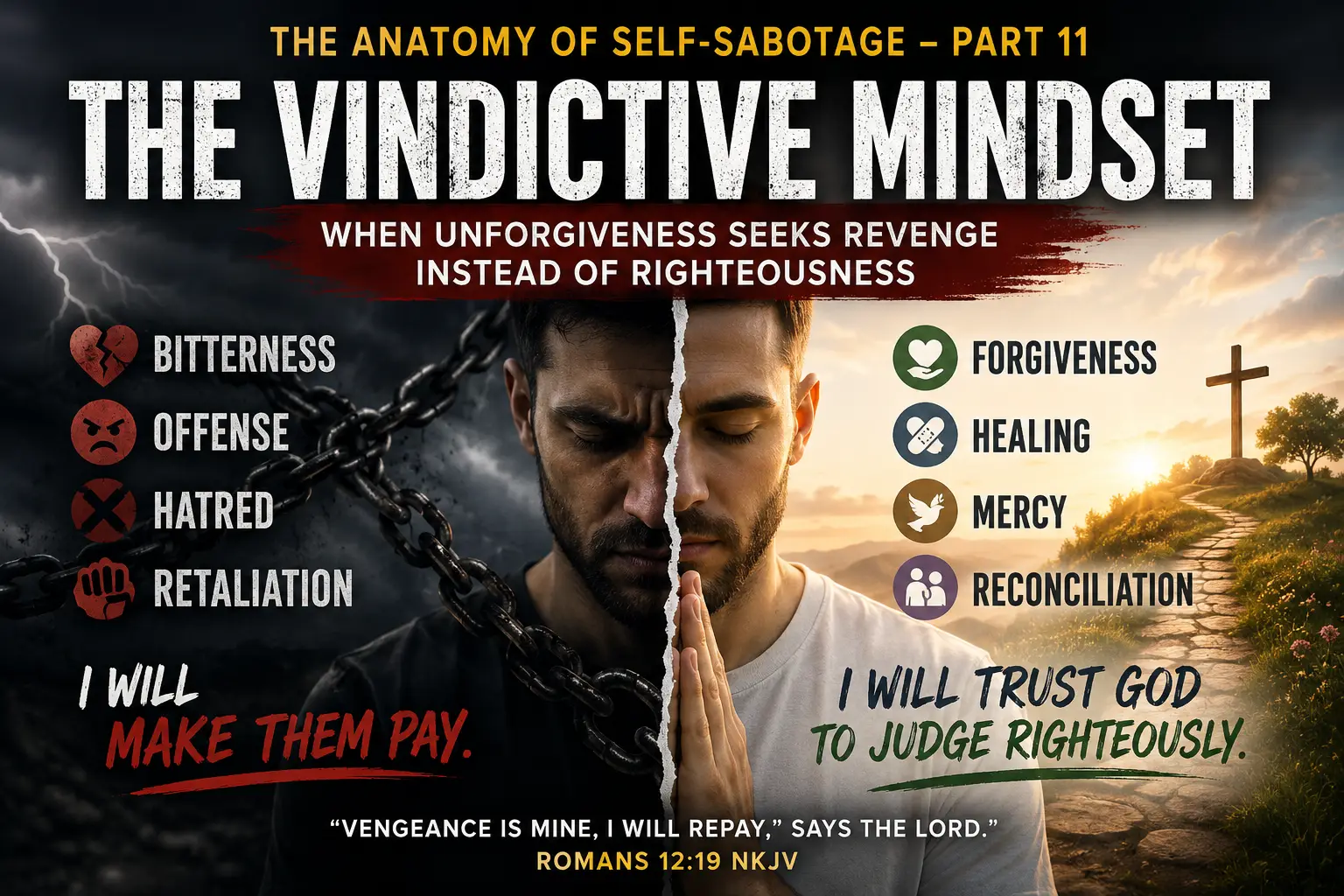
THE VINDICTIVE MINDSET—WHEN UNFORGIVENESS SEEKS REVENGE INSTEAD OF RIGHTEOUSNESS
INTRODUCTION
One of the most destructive mindsets a believer can carry is the vindictive mindset. It is dangerous because it often hides behind the language of justice, fairness, and “standing up for myself,” while the heart is secretly being governed by bitterness, offense, hatred, and revenge.
It does not merely feel pain; it nurses pain. It does not merely recognize injustice; it seeks personal revenge. It does not wait for God’s righteousness; it takes judgment into its own hands.
A vindictive mindset is born when offense is not healed, bitterness is not surrendered, and forgiveness is not embraced. It begins quietly in the heart, but if it is not confronted, it can grow into hatred, retaliation, manipulation, division, and even destruction.
The danger of vindictiveness is that it often feels justified. A person may say, “After what they did to me, I have a right to feel this way.” Pain may be real. Injustice may have happened. The offense may be undeniable. Yet the Kingdom of God does not permit believers to become prisoners of revenge. God calls His people to righteousness, forgiveness, mercy, healing, and reconciliation where possible.
Romans 12:19 NKJV says:
(9) Let love be without hypocrisy. Abhor what is evil. Cling to what is good.
This Scripture does not deny that wrong was done. It simply reminds us that vengeance belongs to God, not to us. When we take revenge into our own hands, we step outside the spirit of Christ and place ourselves in the seat of judgment.
A vindictive mindset is formed when pain is not healed, offense is not surrendered, and forgiveness is refused. Instead of allowing God to deal with the wound, the offended person begins to live with an inner desire to punish, expose, repay, or destroy the person who caused the hurt.
This mindset does not simply damage relationships; it damages the soul. It corrupts discernment, hardens the heart, quenches mercy, and opens the door for bitterness to spread into every area of life. The vindictive person may believe they are protecting themselves, but in reality, they are being imprisoned by the very offense they refuse to release.
The Kingdom of God does not call us to ignore wrongdoing, deny injustice, or pretend that pain is not real. However, the Kingdom does call us to refuse revenge and entrust judgment to God. Righteousness seeks truth, justice, healing, repentance, and restoration where possible. Vindictiveness seeks retaliation.
DEFINITION OF THE VINDICTIVE MINDSET
The vindictive mindset is a mindset driven by revenge, bitterness, and unresolved offense.
It is an inner attitude that refuses to release the offender, refuses to surrender the wound to God, and continually looks for ways to make the other person suffer. It may not always appear as physical revenge. Sometimes vindictiveness expresses itself through silence, withdrawal, slander, sabotage, manipulation, passive aggression, public embarrassment, or secretly rejoicing when another person falls.
At its core, the vindictive mindset says:
“I will make them pay.”
This mindset is dangerous because it replaces God’s justice with personal vengeance. It removes mercy from the heart and allows bitterness to become a governing force. Instead of being led by the Holy Spirit, the person becomes led by pain, anger, and the memory of what was done to them.
It is the inner condition of a person who has been wounded but has not allowed God to heal the wound. Instead of processing pain through forgiveness, prayer, truth, and godly counsel, the person allows the offense to become a weapon.
Vindictiveness says:
“I will make them pay.”
“I will not rest until they suffer.”
“I will forgive only after they feel what I felt.”
“I will treat them according to the pain they caused me.”
This mindset is contrary to the Spirit of Christ. Jesus was deeply wronged, falsely accused, betrayed, mocked, beaten, and crucified, yet He did not respond with revenge.
Ephesians 4:31-32 NKJV
(31) Let all bitterness, wrath, anger, clamor, and evil speaking be put away from you, with all malice.
(32) And be kind to one another, tenderhearted, forgiving one another, even as God in Christ forgave you.
The vindictive mindset keeps what God commands us to put away. It holds on to bitterness, wrath, anger, evil speaking, and malice. But the renewed mind chooses kindness, tenderness, and forgiveness because it remembers how much God has forgiven us in Christ.
Luke 23:34 NKJV
(34) Then Jesus said, “Father, forgive them, for they do not know what they do.” And they divided His garments and cast lots.
- The vindictive mindset says, “Father, punish them.”
- The mind of Christ says, “Father, forgive them.”
This does not mean evil should be excused. It means revenge must not become the ruler of the heart.
THE DIFFERENCE BETWEEN RIGHTEOUSNESS AND REVENGE
Righteousness and revenge are not the same.
Righteousness is governed by truth, justice, obedience, mercy, and the fear of the Lord. Revenge is governed by pain, anger, bitterness, and personal offense.
Righteousness wants God’s will to be done. Revenge wants personal satisfaction.
Righteousness seeks correction and restoration. Revenge seeks punishment and humiliation.
Righteousness is submitted to God’s timing and process. Revenge takes matters into its own hands.
Romans 12:19 NKJV
(19) Beloved, do not avenge yourselves, but rather give place to wrath; for it is written, “VENGEANCE IS MINE, I WILL REPAY,” says the Lord.
This verse does not say there will never be justice. It says justice belongs to God. When we take vengeance into our own hands, we remove ourselves from the place of trust and step into the place of self-appointed judge.
A vindictive mindset is self-sabotaging because it causes a person to become the very thing they claim to hate. The one who was wounded becomes a wounder. The one who was offended becomes an offender. The one who was wronged begins to justify wrongdoing in the name of revenge.
Biblical Example 1: Absalom – Revenge That Consumed the Heart
Absalom is one of the clearest biblical examples of a vindictive mindset. His story is painful because it began with a real injustice.
In 2 Samuel 13, Amnon violated Tamar, Absalom’s sister. This was a grievous sin and a terrible injustice. Absalom had a legitimate reason to be angry. Tamar had been dishonored, and Amnon deserved judgment.
However, Absalom allowed the injustice to become a seedbed for hatred and revenge.
2 Samuel 13:22 NKJV
(22) And Absalom spoke to his brother Amnon neither good nor bad. For Absalom hated Amnon, because he had forced his sister Tamar.
This verse reveals the silent development of bitterness. Absalom did not immediately act, but hatred was growing inside him. He stopped speaking to Amnon, but internally he was nursing revenge.
Vindictiveness often grows in silence. The person may appear calm outwardly, but inwardly they are rehearsing the offense, feeding anger, and planning retaliation.
Two years later, Absalom arranged for Amnon to be killed.
2 Samuel 13:28 NKJV
(28) Now Absalom had commanded his servants, saying, “Watch now, when Amnon’s heart is merry with wine, and when I say to you, ‘Strike Amnon!’ then kill him. Do not be afraid. Have I not commanded you? Be courageous and valiant.”
Absalom did not merely react emotionally in the moment. His revenge was calculated. He allowed pain to mature into murder.
The lesson from Absalom is sobering: unresolved offense can become a platform for destruction. What begins as pain can become hatred. What begins as hatred can become revenge. What begins as revenge can destroy families, relationships, leadership, and destiny.
Absalom’s vindictive spirit did not stop with Amnon. Later, it developed into rebellion against his father David. This shows that bitterness rarely stays contained. If it is not healed, it spreads.
Hebrews 12:15 NKJV
(15) looking carefully lest anyone fall short of the grace of God; lest any root of bitterness springing up cause trouble, and by this many become defiled;
Biblical Example 2: Joab – When Personal Vengeance Overrules Righteousness
Another powerful biblical example of the vindictive mindset is Joab, the commander of David’s army. Joab was a capable military leader, but he also carried a dangerous spirit of revenge. His strength in battle was often weakened by his inability to submit personal offense to righteousness, order, and the will of God.
The background to Joab’s act of revenge is found in the conflict between the house of Saul and the house of David. During a battle, Abner, the commander of Saul’s army, killed Asahel, Joab’s brother. Asahel had pursued Abner relentlessly, and Abner warned him to turn aside, but Asahel refused.
2 Samuel 2:22–23 NKJV says:
(22) So Abner said again to Asahel, “Turn aside from following me. Why should I strike you to the ground? How then could I face your brother Joab?”
(23) However, he refused to turn aside. Therefore Abner struck him in the stomach with the blunt end of the spear, so that the spear came out of his back; and he fell down there and died on the spot. So it was that as many as came to the place where Asahel fell down and died, stood still.
Although Asahel’s death was painful and personal to Joab, it happened in the context of war. Abner did not secretly murder Asahel out of malice; he warned him before striking him. Yet Joab carried the pain of his brother’s death in his heart and later used an opportunity to avenge him.
In 2 Samuel 3, Abner decided to make peace with David and help bring the kingdom under David’s rule. This was a significant moment in God’s unfolding purpose. Abner had come to David in peace, and David sent him away peacefully.
2 Samuel 3:21 NKJV says:
(21) Then Abner said to David, “I will arise and go, and gather all Israel to my lord the king, that they may make a covenant with you, and that you may reign over all that your heart desires.” So David sent Abner away, and he went in peace.
This was not merely a political agreement. It was part of the movement toward the establishing of David’s kingdom. Abner’s cooperation could have helped bring unity, reduce bloodshed, and move Israel toward divine order.
But Joab could not see beyond his personal wound.
When Joab heard that David had received Abner and allowed him to leave in peace, he became angry. Instead of honouring David’s decision, Joab questioned it. His personal offense made him suspicious of David’s mercy and resistant to the possibility of reconciliation.
2 Samuel 3:24–25 NKJV says:
(24) Then Joab came to the king and said, “What have you done? Look, Abner came to you; why is it that you sent him away, and he has already gone?
(25) Surely you realize that Abner the son of Ner came to deceive you, to know your going out and your coming in, and to know all that you are doing.”
Joab presented his concern as wisdom and caution, but underneath it was unresolved revenge. Vindictive people often disguise bitterness as discernment. They may claim they are protecting others, defending truth, or guarding righteousness, when in reality they are still being governed by an old wound.
Joab then acted deceitfully. Without David’s knowledge, he called Abner back and murdered him.
2 Samuel 3:27 NKJV says:
2 Samuel 3:27 NKJV
(27) Now when Abner had returned to Hebron, Joab took him aside in the gate to speak with him privately, and there stabbed him in the stomach, so that he died for the blood of Asahel his brother.
This verse exposes the vindictive mindset clearly. Joab did not kill Abner for the sake of righteousness. He killed him “for the blood of Asahel his brother.” His action was personal. His motive was revenge. His pain overruled David’s authority, the possibility of peace, and the purposes of God for the nation.
Joab’s revenge was especially serious because Hebron was a city of refuge. It was meant to be a place where matters of bloodshed could be judged properly, not a place where personal vengeance was carried out secretly. Joab took what should have been submitted to righteous order and turned it into an opportunity for retaliation.
David immediately distanced himself from Joab’s actions.
2 Samuel 3:28–30 NKJV says:
(28) Afterward, when David heard it, he said, “My kingdom and I are guiltless before the LORD forever of the blood of Abner the son of Ner.
(29) Let it rest on the head of Joab and on all his father’s house; and let there never fail to be in the house of Joab one who has a discharge or is a leper, who leans on a staff or falls by the sword, or who lacks bread.”
(30) So Joab and Abishai his brother killed Abner, because he had killed their brother Asahel at Gibeon in the battle.
David understood that Joab’s act was not an act of justice. It was bloodguilt. Joab had taken vengeance into his own hands and brought defilement upon himself and his house.
David later mourned Abner publicly and honoured him as a great man.
2 Samuel 3:38 NKJV says:
(38) Then the king said to his servants, “Do you not know that a prince and a great man has fallen this day in Israel?
This statement is important because it shows the difference between David’s heart and Joab’s heart. Joab saw Abner only through the lens of personal offense. David saw him through a broader lens of purpose, leadership, and national destiny.
The vindictive mindset narrows a person’s vision. It reduces people to what they did wrong. It refuses to see repentance, change, value, purpose, or the possibility of restoration. Joab could not see Abner as a man who might now serve the purposes of God in David’s kingdom. He only saw him as the man connected to his brother’s death.
This is one of the great dangers of unresolved offense: it can cause us to fight against what God is trying to reconcile.
Joab’s story teaches us that personal pain must never be allowed to overrule righteousness. Even when the pain is real, revenge is not the answer. The believer is not called to repay evil with evil, but to entrust judgment to God.
Romans 12:17–19 NKJV says:
(17) Repay no one evil for evil. Have regard for good things in the sight of all men.
(18) If it is possible, as much as depends on you, live peaceably with all men.
(19) Beloved, do not avenge yourselves, but rather give place to wrath; for it is written, “VENGEANCE IS MINE, I WILL REPAY,” says the Lord.
Joab failed at this point. He did not give place to the wrath of God. He became the judge, jury, and executioner. In doing so, he revealed that revenge had more authority in his heart than righteousness.
The vindictive mindset is dangerous because it can exist in gifted, strong, and influential people. Joab was not weak. He was not passive. He was not without ability. Yet ability without a healed heart can become destructive. Leadership without mercy can become cruel. Strength without submission to God can become dangerous.
Joab’s example warns us that unresolved offense can make a person useful in battle but unsafe in relationships. It can make a person loyal to a cause but disloyal to righteousness. It can make a person defend the kingdom outwardly while violating the spirit of the kingdom inwardly.
A believer must therefore ask: Am I seeking righteousness, or am I seeking revenge? Am I protecting God’s order, or am I punishing someone because of my own pain? Am I acting from the Spirit of Christ, or from the wound of Asahel in my own heart?
The cure for the Joab spirit is surrender. The wound must be brought before God. The desire to repay must be laid down. The heart must choose righteousness over revenge, mercy over malice, and obedience over personal justice.
Joab’s life reminds us that vengeance may feel powerful for a moment, but it always produces spiritual contamination. Righteousness, however, requires that we trust God enough to let Him judge, heal, restore, and repay according to His perfect wisdom.
CHARACTERISTICS OF A VINDICTIVE MINDSET
A vindictive mindset does not appear suddenly. It usually develops through a process. A person is wounded, the wound is not healed, the offense is not surrendered to God, and the heart begins to harden. What began as pain becomes bitterness. What began as disappointment becomes offense. What began as anger becomes hatred. What began as a desire for justice becomes retaliation.
The vindictive mindset must therefore be identified early, because if it is left unchecked, it can become a destructive stronghold in the heart.
1. Bitterness
Bitterness is one of the first signs of a vindictive mindset. It is unresolved pain that has been allowed to remain in the heart until it becomes poison. Bitterness remembers the offense repeatedly, rehearses what happened, and keeps the wound alive.
A bitter person may still function outwardly, but inwardly they are carrying emotional and spiritual contamination. They may smile, serve, worship, and speak spiritual language, but beneath the surface there is an unresolved wound that continues to influence their thoughts, words, and decisions.
Hebrews 12:15 NKJV says:
(15) looking carefully lest anyone fall short of the grace of God; lest any root of bitterness springing up cause trouble, and by this many become defiled;
-
Offense
Offense is another major characteristic of a vindictive mindset. Offense is more than being hurt by what someone said or did. It is the decision to hold that hurt against the person. It is when pain becomes a prison, and the heart refuses to release the offender before God.
The word “offense” carries the idea of a trap or stumbling block. This means offense does not only wound the heart; it also traps the heart. A person who lives offended may think they are protecting themselves, but in reality, they are being held captive by the very thing that hurt them.
Jesus warned that offenses would come, but He also warned against becoming the source of offense.
Luke 17:1 NKJV says:
(1) Then He said to the disciples, “It is impossible that no offenses should come, but woe to him through whom they do come!
This means that believers must not be naïve. In life, relationships, family, church, ministry, and leadership, offenses will happen. People may misunderstand us. Some may mistreat us. Others may disappoint us. Words may wound us. Actions may betray us. But the presence of offense does not mean we must become offended people.
A vindictive mindset takes offense and allows it to become part of the person’s identity. The person begins to see life through the lens of what happened to them. They interpret conversations through suspicion. They remember every wrong. They assume negative motives. They struggle to rejoice when the offender is blessed. Their heart becomes guarded, defensive, and easily provoked.
This is why offense is so dangerous. It does not remain isolated. It spreads into perception, speech, relationships, decisions, and spiritual discernment. Once offense governs the heart, a person may begin to misread even innocent actions as intentional attacks.
Proverbs 18:19 NKJV says:
(19) A brother offended is harder to win than a strong city, And contentions are like the bars of a castle.
This Scripture shows the power of offense. An offended person can become fortified like a city. Their heart becomes surrounded by walls. They may refuse counsel, reject correction, avoid reconciliation, and defend their bitterness as if it were wisdom. The offense becomes a castle with bars, locking the person inside their own pain.
This is especially dangerous in the Body of Christ, because offense can turn brothers into enemies. People who once walked together, prayed together, served together, and shared fellowship can become divided because offense was never healed. Instead of pursuing peace, the offended heart rehearses accusations. Instead of seeking understanding, it withdraws. Instead of forgiveness, it waits for an opportunity to prove itself right.
Absalom is a sobering example of unresolved offense. After Amnon violated Tamar, Absalom’s anger was connected to a real injustice. Yet instead of allowing the matter to be dealt with righteously, Absalom carried the offense in silence.
2 Samuel 13:22 NKJV says:
(22) And Absalom spoke to his brother Amnon neither good nor bad. For Absalom hated Amnon, because he had forced his sister Tamar.
This verse reveals how offense can hide behind silence. Absalom was not openly attacking Amnon at first, but his silence was not healing. It was hatred growing underground. His offense was not submitted to God; it was being stored for revenge.
Many believers make the same mistake. They stop speaking, stop engaging, stop trusting, and stop walking in love, but they never actually bring the wound to God for healing. They say, “I am fine,” but inwardly they are offended. They say, “I have moved on,” but they still replay the incident. They say, “I have forgiven,” but they secretly hope the person fails.
That is not freedom. That is offense under spiritual disguise.
The danger of offense is that it often feels righteous. The offended person may feel morally superior because they were genuinely wronged. But being wronged does not give us permission to become wrong in response. Pain does not excuse bitterness. Betrayal does not justify hatred. Injustice does not give us the right to take revenge into our own hands.
Jesus gives clear instruction on how to deal with offense among believers.
Matthew 18:15 NKJV says:
(15) “Moreover if your brother sins against you, go and tell him his fault between you and him alone. If he hears you, you have gained your brother.
The goal of confronting offense is not humiliation, revenge, or winning an argument. The goal is gaining the brother. The Kingdom way is not to gossip, slander, withdraw, manipulate, or retaliate. The Kingdom way is truth spoken in a spirit of restoration.
Offense becomes vindictive when the desire for reconciliation is replaced by the desire to punish. Instead of wanting the person restored, the offended heart wants them exposed. Instead of wanting peace, it wants payback. Instead of praying for healing, it prays from anger. Instead of seeking God’s righteousness, it seeks personal satisfaction.
This is why the believer must guard the heart diligently.
Proverbs 4:23 NKJV says:
(23) Keep your heart with all diligence, For out of it spring the issues of life.
The heart is the place where offense must be confronted. If offense is allowed to remain, it becomes the seedbed of bitterness, hatred, suspicion, retaliation, and division. But if the heart is kept before God, offense can become an opportunity for maturity, humility, forgiveness, and deeper dependence on the grace of God.
The mature believer does not deny pain, but also does not enthrone pain. The mature believer acknowledges wrong, but refuses to be governed by wrong. The mature believer may confront sin, but does not surrender the heart to vengeance.
Paul gives this instruction in Colossians 3:13 NKJV:
Colossians 3:13 NKJV
(13) bearing with one another, and forgiving one another, if anyone has a complaint against another; even as Christ forgave you, so you also must do.
This verse does not say that there will never be complaints. It says that when complaints arise, forgiveness must govern the heart. The standard is not how deeply we were wounded, but how greatly Christ has forgiven us.
- A vindictive mindset says, “Because they hurt me, I will hold this against them.”
- A renewed mind says, “Because Christ forgave me, I will not allow offense to rule my heart.”
Offense must therefore be surrendered quickly. The longer it remains, the deeper it roots itself. What is not dealt with in prayer may eventually come out in words, attitudes, accusations, withdrawal, or revenge.
The believer must ask honestly:
- Am I hurt, or am I offended?
- Am I seeking healing, or am I seeking revenge?
- Am I guarding my heart, or am I building walls?
- Am I confronting in love, or punishing through silence?
- Am I allowing Christ to rule my heart, or allowing offense to govern my reactions?
The vindictive mindset cannot survive in a heart that refuses to host offense. When offense is surrendered to God, the heart becomes free to forgive, free to heal, free to love, and free to walk in righteousness.
-
Hatred
Hatred is one of the most dangerous developments of a vindictive mindset. Bitterness begins as unresolved pain. Offense turns that pain into a guarded position. But hatred hardens the heart into hostility. It is no longer only about what happened; it becomes about how the person now sees the offender.
Hatred is deeper than anger. Anger may be a temporary emotional response to wrong, but hatred becomes a settled condition of the heart. It looks at another person with contempt, rejection, and hostility. It does not merely dislike what was done; it begins to despise the person who did it.
This is why hatred is so spiritually dangerous. It removes compassion. It silences mercy. It closes the door to repentance, restoration, and reconciliation. A heart governed by hatred no longer wants the offender to be corrected; it wants them to suffer.
1 John 2:9–11 NKJV says:
(9) He who says he is in the light, and hates his brother, is in darkness until now.
(10) He who loves his brother abides in the light, and there is no cause for stumbling in him.
(11) But he who hates his brother is in darkness and walks in darkness, and does not know where he is going, because the darkness has blinded his eyes.
-
Retaliation
Retaliation is the outward action of the vindictive mindset. Bitterness poisons the heart. Offense traps the heart. Hatred hardens the heart. Retaliation then moves the heart into action against the person who caused the pain.
Retaliation is the desire to repay wrong with wrong. It says, “Because you hurt me, I will hurt you.” It is when a person stops trusting God as Judge and begins to take justice into their own hands. Retaliation may appear strong, but spiritually it is a sign that the heart is no longer being governed by the Spirit of Christ.
Romans 12:17–19 NKJV says:
(17) Repay no one evil for evil. Have regard for good things in the sight of all men.
(18) If it is possible, as much as depends on you, live peaceably with all men.
(19) Beloved, do not avenge yourselves, but rather give place to wrath; for it is written, “VENGEANCE IS MINE, I WILL REPAY,” says the Lord.
This Scripture directly confronts retaliation. The believer is not permitted to repay evil with evil. Even when evil has been done, the response of the believer must be governed by righteousness, not revenge. God does not ignore injustice, but He forbids His people from becoming unjust in their response to injustice.
Retaliation becomes dangerous because it often disguises itself as justice. A person may say, “I am only making things right,” but the motive may not be righteousness. It may be revenge. True righteousness seeks God’s will, truth, order, correction, and restoration. Retaliation seeks personal satisfaction through punishment.
This is why the vindictive mindset must be discerned carefully. Not every confrontation is retaliation. There are times when sin must be addressed, boundaries must be established, correction must be given, and justice must be pursued.
However, the difference lies in the motive and the spirit.
Righteous confrontation seeks restoration. Retaliation seeks revenge.
Righteous confrontation is submitted to God. Retaliation is driven by wounded flesh.
Righteous confrontation is governed by truth and love. Retaliation is governed by anger and personal pain.
Galatians 6:1 NKJV says:
(1) Brethren, if a man is overtaken in any trespass, you who are spiritual restore such a one in a spirit of gentleness, considering yourself lest you also be tempted.
This verse shows the spirit of Kingdom correction. The aim is restoration, and the attitude must be gentleness. A vindictive person may confront, but not with the spirit of restoration. They confront to expose, shame, punish, or destroy. Their goal is not to win the person; it is to wound the person.
Jesus taught a radically different way of responding to evil.
Matthew 5:38–42 NKJV says:
(38) “You have heard that it was said, ‘AN EYE FOR AN EYE AND A TOOTH FOR A TOOTH.’
(39) But I tell you not to resist an evil person. But whoever slaps you on your right cheek, turn the other to him also.
(40) If anyone wants to sue you and take away your tunic, let him have your cloak also.
(41) And whoever compels you to go one mile, go with him two.
(42) Give to him who asks you, and from him who wants to borrow from you do not turn away.
Jesus was not teaching believers to enable abuse, ignore justice, or live without boundaries. He was confronting the spirit of revenge that lives by the principle, “Whatever you did to me, I will do back to you.” In the Kingdom, the believer must not be governed by the law of retaliation but by the law of love, mercy, and righteousness.
Retaliation may take many forms. It is not always physical violence. Sometimes it is emotional, relational, verbal, social, or spiritual.
A person may retaliate through slander, spreading private information, withdrawing affection, refusing communication, humiliating someone publicly, manipulating others against the offender, excluding people from fellowship, or secretly celebrating their failure. Sometimes retaliation is passive and hidden. It appears as silence, distance, coldness, or refusal to help when help is needed.
This is why retaliation must not only be judged by outward action, but also by inward motive. A person can appear calm while still carrying revenge in the heart. They may not strike with the hand, but they strike with words. They may not confront directly, but they poison others through accusation. They may not openly attack, but they withhold mercy.
Proverbs 24:17–18 NKJV says:
(17) Do not rejoice when your enemy falls, And do not let your heart be glad when he stumbles;
(18) Lest the LORD see it, and it displease Him, And He turn away His wrath from him.
This Scripture exposes a hidden form of retaliation: rejoicing when another person suffers. The vindictive mindset does not always need to create the punishment; sometimes it simply celebrates it. But God examines the heart. He sees when the pain of another person gives us satisfaction. He sees when we secretly feel vindicated by someone else’s downfall.
Retaliation also damages discernment. When a person is driven by revenge, they often lose the ability to judge matters soberly. They exaggerate the offense, ignore their own attitudes, and interpret everything through the lens of injury. Their pain becomes the filter through which they make decisions.
This happened with Joab. Abner had killed Joab’s brother Asahel in battle after warning him to turn aside. Later, when Abner came to David in peace, David received him and sent him away peacefully. But Joab could not accept this. His brother’s blood still cried in his heart, and he allowed personal vengeance to overrule righteousness.
2 Samuel 3:27 NKJV says:
(27) Now when Abner had returned to Hebron, Joab took him aside in the gate to speak with him privately, and there stabbed him in the stomach, so that he died for the blood of Asahel his brother.
Joab’s action was retaliation. It was not justice. It was not obedience. It was not submission to David’s authority. It was personal revenge. He used deception, privacy, and violence to settle an old wound.
The tragedy is that Joab’s retaliation interfered with a moment of possible peace and unity in Israel. Abner was helping to bring the kingdom under David’s rule, but Joab could not see beyond his personal pain. Retaliation often causes people to fight against the very reconciliation God may be working to establish.
This is a serious warning. When retaliation rules the heart, a person may destroy relationships, divide families, damage churches, and resist the purposes of God while thinking they are defending justice.
David’s response to Saul gives us the opposite picture. Saul pursued David, threatened his life, and treated him unjustly. Yet when David had an opportunity to kill Saul, he refused to retaliate.
1 Samuel 24:10–12 NKJV says:
(10) Look, this day your eyes have seen that the LORD delivered you today into my hand in the cave, and someone urged me to kill you. But my eye spared you, and I said, ‘I will not stretch out my hand against my lord, for he is the LORD’s anointed.’
(11) Moreover, my father, see! Yes, see the corner of your robe in my hand! For in that I cut off the corner of your robe, and did not kill you, know and see that there is neither evil nor rebellion in my hand, and I have not sinned against you. Yet you hunt my life to take it.
(12) Let the LORD judge between you and me, and let the LORD avenge me on you. But my hand shall not be against you.
David’s words reveal the heart of a man who refused retaliation. He acknowledged Saul’s wrongdoing, but he did not take vengeance into his own hands. He trusted God to judge. He chose restraint over revenge. He chose righteousness over personal opportunity.
This is one of the clearest marks of maturity: the ability to have the power to retaliate, yet refuse to use it because God has not authorized it.
Retaliation is especially dangerous when a person has influence, authority, or access to others. A wounded leader may retaliate through control. A wounded parent may retaliate through harshness. A wounded spouse may retaliate through emotional withdrawal. A wounded friend may retaliate through betrayal. A wounded believer may retaliate through gossip, accusation, or division in the church.
This is why the heart must be healed before pain becomes policy. When people create decisions, systems, boundaries, and judgments out of unresolved revenge, they often punish others who were never responsible for the original wound.
The renewed mind must reject retaliation because it belongs to the old nature.
1 Peter 3:8–9 NKJV says:
(8) Finally, all of you be of one mind, having compassion for one another; love as brothers, be tenderhearted, be courteous;
(9) not returning evil for evil or reviling for reviling, but on the contrary blessing, knowing that you were called to this, that you may inherit a blessing.
The believer is called to bless, not to curse. To show compassion, not cruelty. To be tenderhearted, not hardened. To refuse evil for evil, not to mirror the wrong that was done.
Retaliation turns the offended person into a reflection of the offender. It causes the wounded person to reproduce the very spirit that wounded them. But forgiveness breaks that cycle. Mercy interrupts the pattern. Righteousness refuses to become what it has suffered.
Jesus is the supreme example of refusing retaliation.
1 Peter 2:21–23 NKJV says:
(21) For to this you were called, because Christ also suffered for us, leaving us an example, that you should follow His steps:
(22) “WHO COMMITTED NO SIN, NOR WAS DECEIT FOUND IN HIS MOUTH”;
(23) who, when He was reviled, did not revile in return; when He suffered, He did not threaten, but committed Himself to Him who judges righteously;
Jesus was falsely accused, mocked, beaten, rejected, and crucified. Yet He did not retaliate. He did not revile in return. He did not threaten. He committed Himself to the Father who judges righteously.
This is the pattern for every believer. We do not overcome evil by becoming evil. We do not defeat hatred by carrying hatred. We do not establish righteousness through revenge. We overcome evil by submitting our pain to God and responding in the spirit of Christ.
Romans 12:20–21 NKJV says:
(20) Therefore “IF YOUR ENEMY IS HUNGRY, FEED HIM; IF HE IS THIRSTY, GIVE HIM A DRINK; FOR IN SO DOING YOU WILL HEAP COALS OF FIRE ON HIS HEAD.”
(21) Do not be overcome by evil, but overcome evil with good.
Retaliation means evil has overcome the heart. Kingdom maturity means good overcomes evil. This does not mean every relationship must return to its former closeness. It does not mean boundaries are unnecessary. It does not mean trust is instantly restored. But it does mean the believer refuses to be governed by revenge.
A believer may need to confront, report wrongdoing, establish boundaries, seek counsel, or remove themselves from harmful situations. These actions can be righteous when they are done in obedience to God, with a clean heart, and without hatred. But retaliation is different. Retaliation is not about righteousness; it is about making the other person pay.
- The vindictive mindset says, “I will repay.”
- The renewed mind says, “I will obey God and leave judgment in His hands.”
- The vindictive mindset says, “I want them to hurt as I have hurt.”
- The renewed mind says, “Lord, heal my heart so I do not become what wounded me.”
- The vindictive mindset says, “They do not deserve mercy.”
- The renewed mind says, “I received mercy when I did not deserve it.”

Retaliation must therefore be laid at the feet of Christ. The believer must bring the wound, the anger, the desire for payback, and the memory of injustice into the presence of God. Only there can the heart be cleansed from revenge and restored to righteousness.
The question is not whether the offense was real. The question is who will govern the response.
- Will pain govern the response?
- Will anger govern the response?
- Will revenge govern the response?
- Or will Christ govern the response?
The vindictive mindset is broken when the believer refuses to repay evil with evil and chooses to overcome evil with good. This is not weakness. It is spiritual strength under the government of God. It is the power of a healed heart. It is the evidence of a life that has chosen righteousness over revenge.
OTHER PUBLICATIONS BY THIS AUTHOR CAN BE FOUND AT: