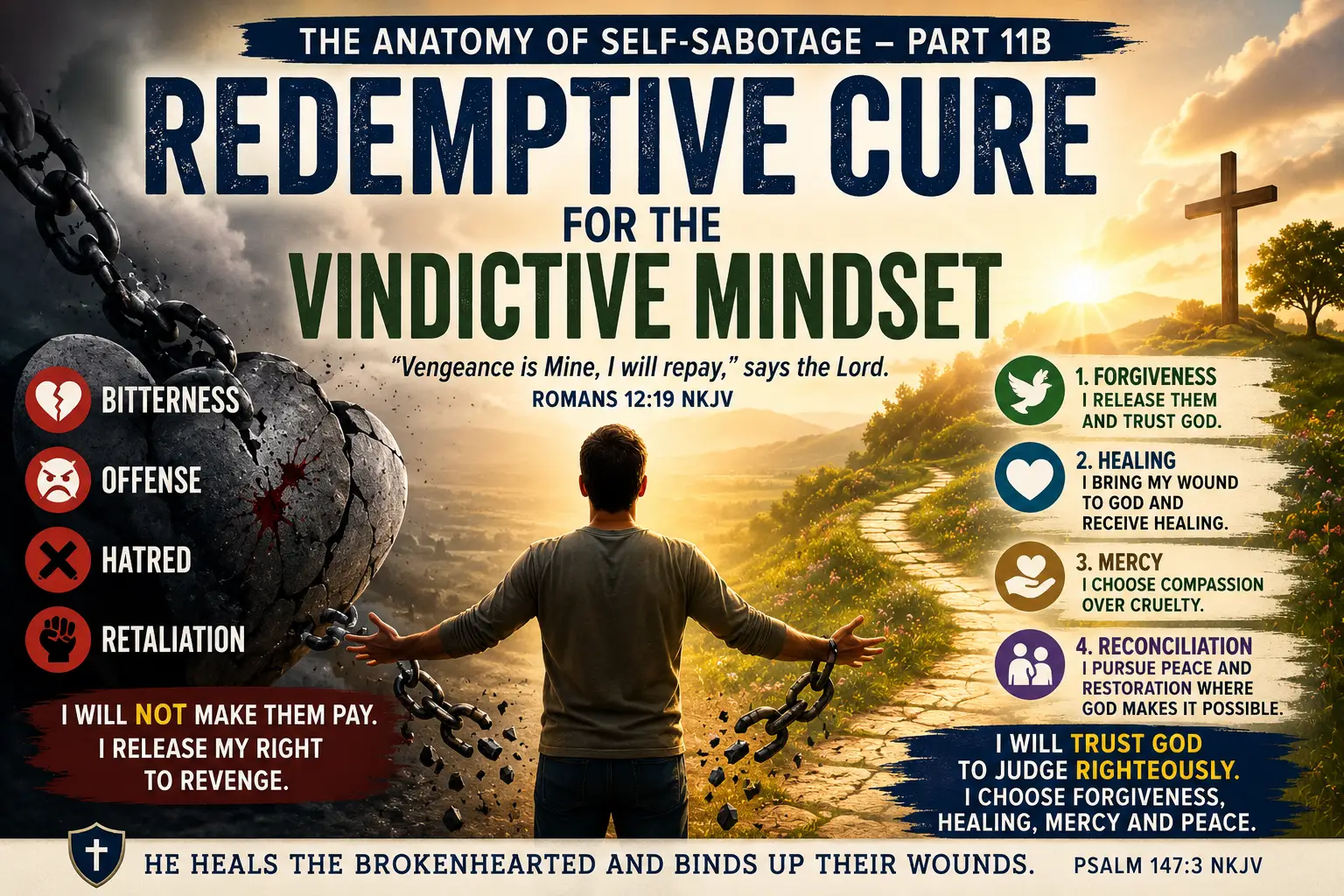
THE ANATOMY OF SELF-SABOTAGE – PART 11B
REDEMPTIVE CURE FOR THE VINDICTIVE MINDSET
INTRODUCTION
The vindictive mindset is not cured by pretending that pain never happened. It is not healed by suppressing anger, denying injustice, or forcing superficial peace. The vindictive mindset is healed when the wounded heart is brought under the government of Christ.
God does not merely want to stop revenge outwardly; He wants to heal the inner place where revenge is being produced. The heart must be cleansed from bitterness, released from offense, delivered from hatred, and restored to righteousness.
The redemptive cure for the vindictive mindset involves forgiveness, healing, mercy, and reconciliation.
Forgiveness
Forgiveness is the first major step in overcoming the vindictive mindset. Without forgiveness, the heart remains chained to the offense. The person may move on physically, but inwardly they remain tied to what happened, who did it, and how deeply it hurt.
Forgiveness does not mean that what happened was right. It does not mean the offender is innocent. It does not mean justice is unnecessary. It does not mean trust is automatically restored. Forgiveness means the believer releases the offender from personal revenge and places the matter into the hands of God.
Romans 12:19 NKJV says:
(19) Beloved, do not avenge yourselves, but rather give place to wrath; for it is written, “VENGEANCE IS MINE, I WILL REPAY,” says the Lord.
This Scripture is essential for breaking the vindictive mindset. God does not say there is no vengeance. He says vengeance belongs to Him. The believer must therefore surrender the right to repay. When we refuse to forgive, we are often trying to keep control over the person who hurt us. But when we forgive, we release the matter to the righteous Judge.
Forgiveness is not weakness. It is obedience. It is not the denial of pain. It is the refusal to allow pain to become lord over the heart.
Ephesians 4:31–32 NKJV says:
(31) Let all bitterness, wrath, anger, clamor, and evil speaking be put away from you, with all malice.
(32) And be kind to one another, tenderhearted, forgiving one another, even as God in Christ forgave you.
The standard of forgiveness is not whether the offender deserves it. The standard is how God in Christ forgave us. Every believer has received mercy they did not earn. Every believer has been forgiven of sins that deserved judgment. Therefore, the forgiven person must become a forgiving person.
A vindictive mindset says, “I will not release them until they suffer.”
A renewed mind says, “Christ released me, therefore I will release them into the hands of God.”
Jesus also taught that forgiveness must be continual and not merely occasional.
Matthew 18:21–22 NKJV says:
(21) Then Peter came to Him and said, “Lord, how often shall my brother sin against me, and I forgive him? Up to seven times?”
(22) Jesus said to him, “I do not say to you, up to seven times, but up to seventy times seven.
Jesus was not teaching a mathematical limit. He was teaching a lifestyle of forgiveness. A believer cannot build a life around revenge and still claim to be governed by the spirit of Christ. Forgiveness must become a pattern of the renewed heart.
This does not mean believers must remain in abusive, unsafe, or destructive relationships without boundaries. Forgiveness and trust are not the same. Forgiveness can be immediate obedience before God, while trust may need to be rebuilt through repentance, accountability, and time. A person can forgive while still setting righteous boundaries.
Forgiveness deals with the debt of revenge. Trust deals with the restoration of relationship.
The vindictive mindset is broken when the believer says, “Lord, I release my right to punish. I surrender this wound to You. Judge righteously. Heal my heart. Keep me from becoming what wounded me.”
Healing
Forgiveness releases the offender, but healing restores the wounded heart. Many believers attempt to forgive without allowing God to heal the pain beneath the offense. As a result, they may say the right words, but the wound remains sensitive, easily provoked, and continually remembered.
The vindictive mindset often grows from unhealed pain. When pain remains untreated, it becomes bitterness. When bitterness remains untreated, it becomes hatred. When hatred remains untreated, it becomes retaliation.
God does not only command forgiveness; He also offers healing.
Psalm 147:3 NKJV says:
(3) He heals the brokenhearted And binds up their wounds.
This verse reveals the tenderness of God. He does not ignore broken hearts. He does not shame wounded people for being wounded. He heals the brokenhearted and binds up their wounds. The believer must therefore bring the wound honestly before God.
Healing begins with truth. The person must be willing to say, “I was hurt.” “I was betrayed.” “I was disappointed.” “I am angry.” “I am struggling to release this.” Healing cannot take place where pain is continually denied.
David often brought his pain honestly before the Lord. He did not hide his distress, but he processed it in the presence of God. This is important because pain that is not processed before God is often projected onto people.
Psalm 34:18 NKJV says:
(18) The LORD is near to those who have a broken heart, And saves such as have a contrite spirit.
God is near to the brokenhearted. The wounded believer does not need to run into revenge; they need to run into the presence of God. Revenge may feel powerful, but it cannot heal. Retaliation may feel satisfying for a moment, but it cannot restore the soul. Only God can heal the place where the wound has entered.
Healing also requires the renewing of the mind. A wounded heart can develop false conclusions: “I can never trust anyone again.” “Everyone will betray me.” “I must protect myself by becoming hard.” “Mercy makes me weak.” “If I forgive, they win.”
These thoughts must be brought under the truth of God’s Word.
Romans 12:2 NKJV says:
(2) And do not be conformed to this world, but be transformed by the renewing of your mind, that you may prove what is that good and acceptable and perfect will of God.
The world often teaches revenge, self-protection, and emotional hardness. Christ teaches forgiveness, healing, wisdom, and righteousness. The renewed mind does not deny the wound, but it refuses to build an identity around the wound.
Healing may also require godly counsel, prayer, confession, and accountability. Some wounds are deep and must be walked through with mature believers who can help the wounded person process pain in truth and grace.
James 5:16 NKJV says:
(16) Confess your trespasses to one another, and pray for one another, that you may be healed. The effective, fervent prayer of a righteous man avails much.
There is healing that flows through honest confession and prayer. A person trapped in vindictiveness should not isolate themselves with their pain. Isolation often strengthens bitterness. Godly fellowship helps expose the wound to light, wisdom, and grace.
Healing does not always erase the memory, but it removes the poison from the memory. A healed person may still remember what happened, but the memory no longer controls them. They can speak about the situation without hatred. They can pray without bitterness. They can move forward without revenge.
The vindictive mindset loses its power when the heart is no longer bleeding from the wound.
Mercy
Mercy is another powerful cure for the vindictive mindset. Vindictiveness wants the offender to suffer. Mercy desires that righteousness, repentance, and restoration become possible.
Mercy does not excuse sin. Mercy does not deny justice. Mercy does not call evil good. Mercy simply refuses to allow the heart to become cruel.
The vindictive mindset says, “They deserve no compassion.” The renewed mind says, “I will not allow their wrongdoing to destroy mercy in me.”
Jesus taught mercy as a mark of the children of God.
Luke 6:35–36 NKJV says:
(35) But love your enemies, do good, and lend, hoping for nothing in return; and your reward will be great, and you will be sons of the Most High. For He is kind to the unthankful and evil.
(36) Therefore be merciful, just as your Father also is merciful.
This is one of the most challenging teachings of Christ. God is kind even to the unthankful and evil. Therefore, His children must reflect His nature. Mercy is not based on the worthiness of the offender; it is based on the nature of the Father.
Mercy protects the heart from becoming what it hates. When a person refuses mercy, they may become harsh, cruel, and judgmental. They may begin to enjoy another person’s pain. They may feel satisfied when the offender falls. But Scripture warns against this.
Proverbs 24:17–18 NKJV says:
(17) Do not rejoice when your enemy falls, And do not let your heart be glad when he stumbles;
(18) Lest the LORD see it, and it displease Him, And He turn away His wrath from him.
This Scripture reveals that God watches not only the actions of the offender, but also the reaction of the offended. He sees when the heart secretly rejoices over another person’s downfall. A vindictive heart celebrates judgment. A merciful heart trembles, because it knows that all people are dependent on the mercy of God.
Mercy also helps us remember our own need for grace. The person who forgets how much they have been forgiven becomes quick to condemn others. Jesus told the parable of the unforgiving servant to expose this danger.
Matthew 18:32–35 NKJV says:
(32) Then his master, after he had called him, said to him, ‘You wicked servant! I forgave you all that debt because you begged me.
(33) Should you not also have had compassion on your fellow servant, just as I had pity on you?’
(34) And his master was angry, and delivered him to the torturers until he should pay all that was due to him.
(35) “So My heavenly Father also will do to you if each of you, from his heart, does not forgive his brother his trespasses.”
The unforgiving servant wanted mercy for himself but judgment for his brother. This is the spirit behind many vindictive attitudes. People want God to be patient with their failures, but they want immediate punishment for those who offended them.
Mercy breaks that hypocrisy. Mercy says, “I too have needed forgiveness. I too have failed. I too have been spared by grace.”
Mercy does not remove consequences where consequences are necessary. A person may still need to face correction, discipline, legal processes, or relational boundaries. But mercy keeps the heart free from cruelty while righteousness is being pursued.
Micah 6:8 NKJV says:
(8) He has shown you, O man, what is good; And what does the LORD require of you But to do justly, To love mercy, And to walk humbly with your God?
This verse holds justice and mercy together. God requires us to do justly, but also to love mercy. The vindictive mindset separates justice from mercy and turns justice into revenge. The renewed mind walks in both righteousness and compassion.
Mercy is therefore not weakness. It is strength under the control of God. It is the power to respond differently. It is the evidence that the heart has been touched by grace.
Reconciliation
Reconciliation is the final redemptive goal where it is possible and righteous. Forgiveness releases the offender. Healing restores the wounded heart. Mercy protects the heart from cruelty. Reconciliation seeks the restoration of relationship where repentance, truth, safety, and righteousness allow it.
It is important to understand that reconciliation is not always possible in every situation.

Romans 12:18 NKJV says:
(18) If it is possible, as much as depends on you, live peaceably with all men.
The words “if it is possible” are important. Reconciliation requires more than one person. Forgiveness can happen in one heart before God, but reconciliation requires truth, repentance, humility, accountability, and mutual willingness to walk in peace.
A believer must pursue peace, but they cannot force another person to repent. They cannot force trust to be restored. They cannot force a broken relationship to become healthy if the other person remains unrepentant, abusive, manipulative, or unsafe.
Still, the heart of the believer must remain open to God’s redemptive purpose. The vindictive mindset wants permanent punishment. The renewed mind desires restoration where God makes it possible.
2 Corinthians 5:18–19 NKJV says:
(18) Now all things are of God, who has reconciled us to Himself through Jesus Christ, and has given us the ministry of reconciliation,
(19) that is, that God was in Christ reconciling the world to Himself, not imputing their trespasses to them, and has committed to us the word of reconciliation.
The gospel itself is a message of reconciliation. God reconciled us to Himself through Christ. Therefore, believers must carry the spirit of reconciliation, not the spirit of revenge.
This does not mean ignoring sin. True reconciliation must be built on truth. False peace avoids confrontation, but Kingdom reconciliation deals honestly with what has happened. Jesus gave a clear process for addressing sin between brothers.
Matthew 18:15 NKJV says:
(15) “Moreover if your brother sins against you, go and tell him his fault between you and him alone. If he hears you, you have gained your brother.
The purpose is not to win an argument. The purpose is to gain the brother. Vindictiveness confronts to shame, expose, punish, or destroy. Righteousness confronts to restore. The spirit of reconciliation does not avoid truth, but it speaks truth with the desire for healing.
Galatians 6:1 NKJV says:
(1) Brethren, if a man is overtaken in any trespass, you who are spiritual restore such a one in a spirit of gentleness, considering yourself lest you also be tempted.
The spiritual person restores with gentleness. The vindictive person exposes with hostility. The difference is not only in the words spoken, but in the spirit behind the words.
Reconciliation may require confession. It may require repentance. It may require apology. It may require forgiveness. It may require restitution. It may require new boundaries. It may require time for trust to be rebuilt. Reconciliation is not pretending the offense never happened; it is allowing God to bring truth, humility, and grace into what was broken.
Joseph is a powerful biblical example of a heart free from vindictiveness. His brothers betrayed him, sold him, and caused him great suffering. Yet when God raised Joseph to a position of authority, he did not use that authority for revenge. He used it to preserve life.
Genesis 50:19–21 NKJV says:
(19) Joseph said to them, “Do not be afraid, for am I in the place of God?
(20) But as for you, you meant evil against me; but God meant it for good, in order to bring it about as it is this day, to save many people alive.
(21) Now therefore, do not be afraid; I will provide for you and your little ones.” And he comforted them and spoke kindly to them.
Joseph did not deny the evil. He said, “You meant evil against me.” But he also saw God’s greater purpose. Because his heart was not governed by revenge, he could become an instrument of preservation, healing, and reconciliation.
This is the opposite of the vindictive mindset. Vindictiveness uses power to punish. A healed heart uses power to serve God’s redemptive purpose.
Reconciliation is one of the greatest signs that revenge has lost its hold on the heart. Even when full relationship is not restored, the believer can still walk free from hatred, pray without bitterness, and desire God’s will above personal revenge.
The goal is not merely to avoid retaliation. The goal is to become a person through whom the peace of Christ can flow.
Matthew 5:9 NKJV says:
(9) Blessed are the peacemakers, For they shall be called sons of God.
Peacemakers are not passive people who avoid difficult issues. They are mature people who carry the nature of the Father into broken places. They do not fuel revenge. They do not spread bitterness. They do not celebrate division. They work with God to bring righteousness, peace, healing, and restoration where possible.
CONCLUSION: CHOOSING RIGHTEOUSNESS OVER REVENGE
The vindictive mindset is one of the most destructive damaged mindsets because it keeps the soul tied to pain. It causes a person to live from the wound instead of from the Spirit. It convinces the heart that revenge will bring relief, but revenge never truly heals. It only deepens the damage.
Absalom shows us how unresolved offense can become hatred and murder. Joab shows us how personal vengeance can overrule righteousness, authority, and the purposes of God. These examples warn us that pain must never be allowed to govern the heart.
The believer is called to a higher way.

Forgiveness releases revenge.
Healing restores the heart.
Mercy protects the soul from cruelty.
Reconciliation seeks restoration where God makes it possible.
- The vindictive mindset says, “I will make them pay.” The renewed mind says, “I will trust God to judge righteously.”
- The vindictive mindset says, “I will hurt them as they hurt me.” The renewed mind says, “I will not become what wounded me.”
- The vindictive mindset says, “They deserve no mercy.” The renewed mind says, “I have received mercy, therefore I will walk in mercy.”
Freedom begins when the believer brings the wound to Christ and allows Him to rule the response. Revenge belongs to the old nature, but forgiveness belongs to the new creation. Hatred belongs to darkness, but mercy belongs to the light. Retaliation belongs to the flesh, but reconciliation belongs to the Kingdom.
The call of God is clear: surrender the offense, release the offender, receive healing, and choose righteousness over revenge.
- The heart that refuses revenge becomes free.
- The heart that forgives becomes whole.
- The heart that shows mercy reflects the Father.
- The heart that seeks peace reveals the nature of Christ.
CONCLUSION: THE CHALLENGE TO CHOOSE RIGHTEOUSNESS OVER REVENGE
The vindictive mindset is one of the most dangerous damaged mindsets because it convinces the wounded heart that revenge will bring relief. It tells the offended person that retaliation will restore dignity, that hatred will protect them from further pain, and that bitterness is justified because of what was done to them. But revenge never heals the heart. It only keeps the wound alive.
Absalom teaches us that unresolved offense can grow quietly until it becomes destructive. His silence toward Amnon was not peace; it was hatred waiting for an opportunity. Joab teaches us that personal vengeance can overrule righteousness, authority, and even the purposes of God. He allowed the blood of Asahel to govern his judgment, and as a result, he acted outside the spirit of righteousness.
These examples warn us that pain must be brought to God before it becomes a weapon in our hands.
The believer is not called to deny injustice, ignore wrongdoing, or pretend that offense never happened. But the believer is called to surrender the right to revenge. God does not ask us to call evil good. He asks us to trust Him as the righteous Judge.
Romans 12:19 NKJV declares:
(19) Beloved, do not avenge yourselves, but rather give place to wrath; for it is written, “VENGEANCE IS MINE, I WILL REPAY,” says the Lord.
This is where freedom begins. The vindictive mindset is broken when we release the offender from our personal courtroom and place the matter into the hands of God. Forgiveness does not mean the offense was acceptable. It means revenge will no longer rule our heart. Healing does not mean the wound was imaginary. It means Christ is greater than the wound.
Mercy does not mean there are no consequences. It means we refuse to become cruel. Reconciliation does not mean trust is instantly restored. It means we remain open to God’s redemptive purpose where truth, repentance, safety, and righteousness make restoration possible.
The challenge is this: will you allow God to heal what you have been tempted to avenge?
- Will you surrender the offense before it becomes bitterness?
- Will you forgive before hatred hardens your heart?
- Will you choose mercy before retaliation controls your actions?
- Will you trust God enough to let Him judge, repay, restore, and heal in His perfect wisdom?
The vindictive mindset says, “I will make them pay.” The renewed mind says, “I will trust God to judge righteously.”
The vindictive mindset says, “I will hurt them as they hurt me.”
The renewed mind says, “I will not become what wounded me.” The vindictive mindset says, “They deserve no mercy.” The renewed mind says, “I have received mercy, therefore I will walk in mercy.”
Every believer must make a decision. Either the wound will govern the heart, or Christ will govern the heart. Either revenge will shape the response, or righteousness will shape the response. Either bitterness will become a prison, or forgiveness will become the doorway to freedom.
Today, bring the wound to Christ. Name the offense honestly before Him. Release the desire to punish. Ask Him to cleanse your heart from bitterness, hatred, and retaliation. Allow Him to heal the place where revenge has been growing. Choose forgiveness. Choose mercy. Choose righteousness. Choose peace.
You may not be able to change what happened, but by the grace of God, you can refuse to let what happened change you into a vindictive person.
- The heart that refuses revenge becomes free.
- The heart that forgives becomes whole.
- The heart that shows mercy reflects the Father.
- The heart that seeks peace reveals the nature of Christ.
The challenge is clear: do not let offense turn you into an instrument of revenge. Let Christ turn your wound into a testimony of healing, mercy, and righteousness.
OTHER PUBLICATIONS BY THIS AUTHOR CAN BE FOUND AT: