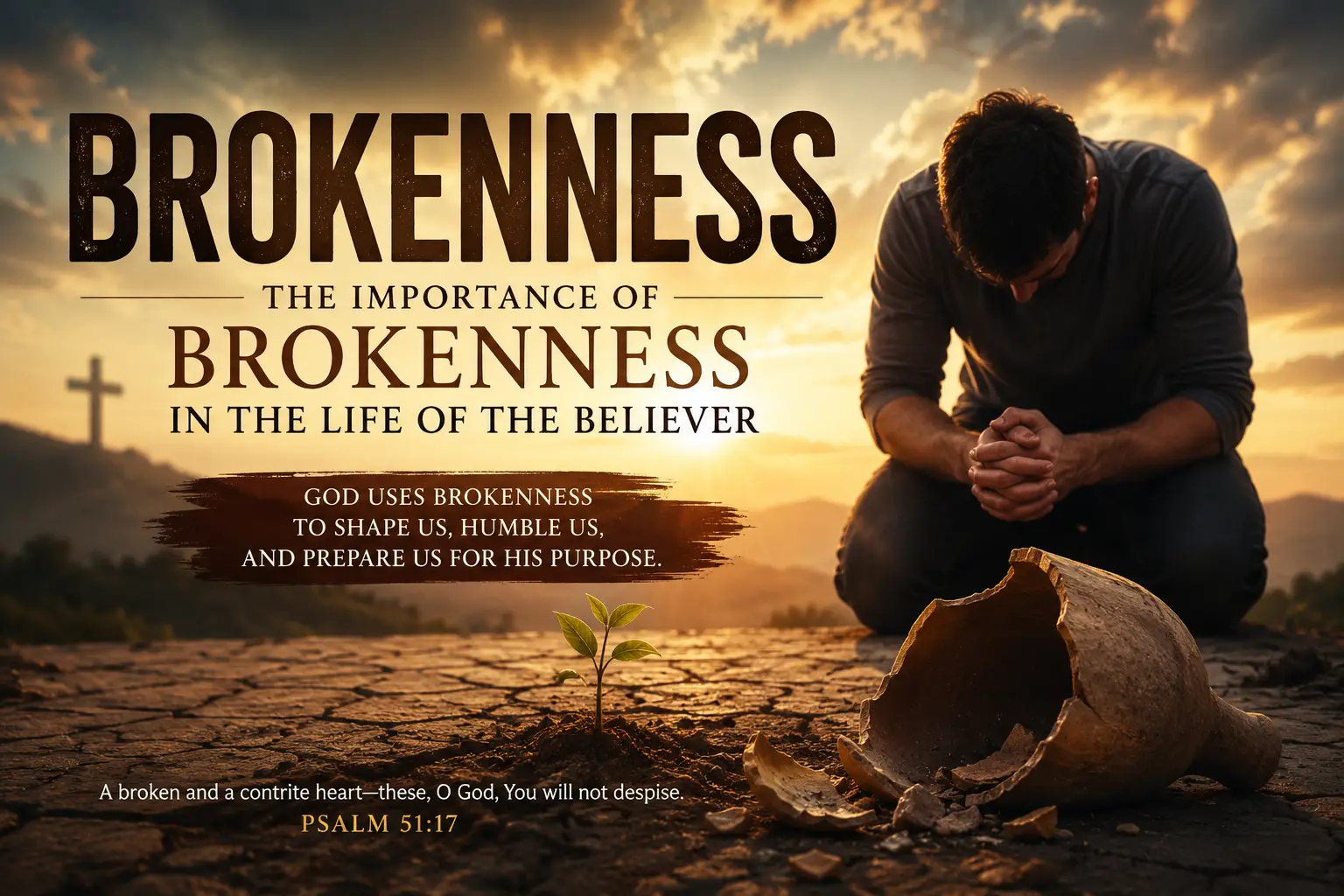
BROKENNESS—THE IMPORTANCE OF BROKENNESS IN THE LIFE OF THE BELIEVER
INTRODUCTION
Brokenness is one of the most misunderstood realities in the Christian life. Many people associate brokenness with weakness, failure, rejection, shame, or defeat. Yet in the Kingdom of God, brokenness is not destruction; it is surrender. It is not God crushing a person to ruin them; it is God dealing with pride, self-will, independence, hardness of heart, and fleshly confidence so that Christ may be formed within them.
Brokenness is the condition of a heart that has stopped resisting God. It is the posture of a believer who no longer argues with the Lord, hides from correction, defends sin, or insists on his own way. A broken person is not necessarily a depressed person. A broken person is one who has yielded deeply to the dealings of God.
David understood this when he declared:
Psalms 51:17 NKJV
(17) The sacrifices of God are a broken spirit, A broken and a contrite heart—These, O God, You will not despise.
God does not despise brokenness. He is attracted to it. He draws near to the humble, contrite, surrendered heart. Brokenness creates space for grace, healing, obedience, purity, and spiritual usefulness.
-
Brokenness Is the Breaking of Pride and Self-Sufficiency
One of the greatest enemies of spiritual maturity is pride. Pride causes a believer to trust in himself, defend himself, promote himself, and live independently from God. Pride says, “I can do this without God.” Brokenness says, “Lord, without You I am nothing.”
Scripture says:
James 4:6 NKJV
(6) But He gives more grace. Therefore He says: “GOD RESISTS THE PROUD, BUT GIVES GRACE TO THE HUMBLE.”
Pride attracts resistance from God, but humility attracts grace. This is why brokenness is so important. Until pride is broken, grace cannot freely operate in a person’s life.
Biblical Example: Nebuchadnezzar
King Nebuchadnezzar is a powerful biblical example of pride being broken. He looked at Babylon and said:
Daniel 4:30 NKJV
(30) The king spoke, saying, “Is not this great Babylon, that I have built for a royal dwelling by my mighty power and for the honor of my majesty?”
His language revealed the condition of his heart: “I have built,” “my power,” “my majesty.” He had become intoxicated with self-importance. God dealt with him until he was humbled. After his season of humiliation, Nebuchadnezzar lifted his eyes to heaven and acknowledged that God rules over all.
The lesson is clear: when man exalts himself, God must bring him low. But when a person humbles himself, God can restore him.
-
Brokenness Produces a Contrite Heart Before God

Brokenness is not merely emotional sorrow. It is a deep inward conviction that causes a person to come honestly before God. A contrite heart does not excuse sin, blame others, or minimize disobedience. It agrees with God.
David’s brokenness after his sin with Bathsheba is one of the clearest examples in Scripture. When Nathan confronted him, David did not defend himself. He said:
1 Samuel 12:13 NKJV
(13) “Now therefore, here is the king whom you have chosen and whom you have desired. And take note, the LORD has set a king over you.
Psalm 51 reveals the depth of David’s repentance. He cried:
Psalms 51:10 NKJV
(10) Create in me a clean heart, O God, And renew a steadfast spirit within me.
David did not merely ask God to remove consequences. He asked God to cleanse his heart. That is true brokenness. It does not only want relief; it wants transformation.
A believer who is broken before God does not merely want to escape exposure. He wants to be purified.
-
Brokenness Makes the Believer Teachable
A proud heart is difficult to teach because it already thinks it knows. A broken heart is teachable because it has been softened by God. Brokenness opens the believer to correction, instruction, rebuke, and spiritual growth.
Proverbs says:
Proverbs 9:9 NKJV
(9) Give instruction to a wise man, and he will be still wiser; Teach a just man, and he will increase in learning.
A broken believer does not reject correction as personal attack. He receives correction as an instrument of growth. This is vital for discipleship. No believer can mature while remaining uncorrectable.
Biblical Example: Peter
Peter was bold, sincere, and zealous, but he was also self-confident. He told Jesus:
Mark 14:29 NKJV
(29) Peter said to Him, “Even if all are made to stumble, yet I will not be.”
Peter believed he was stronger than he truly was. He declared loyalty, but when pressure came, he denied the Lord three times. After the rooster crowed, Scripture says Peter went out and wept bitterly.
His failure broke his self-confidence. Yet Jesus restored him. In John 21, Jesus asked Peter three times, “Do you love Me?” Then He recommissioned him: “Feed My sheep.”
Peter’s brokenness did not disqualify him; it prepared him. The man who once trusted in his own courage became a shepherd dependent on grace.
-
Brokenness Purifies Motives
Many people serve God, but not everyone serves from pure motives. Some serve for recognition, platform, control, approval, influence, money, or personal significance. Brokenness deals with hidden motives.
Hebrews 4:12 says the Word of God is:
Hebrews 4:12 NKJV
(12) For the word of God is living and powerful, and sharper than any two-edged sword, piercing even to the division of soul and spirit, and of joints and marrow, and is a discerner of the thoughts and intents of the heart.
God is not only interested in what we do. He is interested in why we do it. Brokenness allows the Lord to expose the hidden ambitions, insecurities, fears, and desires that contaminate service.
Biblical Example: Simon the Sorcerer
In Acts 8, Simon saw the apostles laying hands on believers and the Holy Spirit being given. He offered money, wanting the same power. Peter rebuked him sharply:
Acts 8:20 NKJV
(20) But Peter said to him, “Your money perish with you, because you thought that the gift of God could be purchased with money!
Simon desired spiritual power, but his motive was corrupt. He wanted the visible manifestation without the inward transformation. Brokenness was needed to purify his heart.
In the same way, believers today must allow God to examine their motives. Ministry without brokenness easily becomes performance. Leadership without brokenness becomes control. Giftedness without brokenness becomes dangerous.
-
Brokenness Brings the Believer Into Dependence on God
Brokenness teaches us that we are not the source. God is the source. We are vessels. Paul understood this deeply:
2 Corinthians 4:7 NKJV
(7) But we have this treasure in earthen vessels, that the excellence of the power may be of God and not of us.
The treasure is divine; the vessel is earthen. God deliberately places His treasure in weak vessels so that the glory belongs to Him.
Biblical Example: Paul
Paul was highly educated, zealous, and religiously accomplished. Yet after encountering Christ, he learned that human achievement was not the foundation of Kingdom usefulness. He wrote:
Philippians 3:7 NKJV
(7) But what things were gain to me, these I have counted loss for Christ.
Later, Paul spoke about his weakness and the grace of God:
2 Corinthians 12:9 NKJV
(9) And He said to me, “My grace is sufficient for you, for My strength is made perfect in weakness.” Therefore most gladly I will rather boast in my infirmities, that the power of Christ may rest upon me.
Brokenness taught Paul to rely on grace rather than personal strength. This is one of the greatest lessons a believer can learn. God does not need our self-confidence. He requires our surrender.
-
Brokenness Prepares the Believer for Greater Fruitfulness
Jesus said:
John 12:24 NKJV
(24) Most assuredly, I say to you, unless a grain of wheat falls into the ground and dies, it remains alone; but if it dies, it produces much grain.
Fruitfulness requires death. The seed must be broken open before life can multiply. In the same way, the believer must experience the breaking of selfish ambition, personal agendas, fleshly desires, and independent living.
Many believers want fruitfulness without death. They want increase without surrender. They want influence without pruning. But the Kingdom does not operate that way.
Brokenness is the process through which God prepares the believer to carry more fruit without being destroyed by pride.
Biblical Example: Jacob
Jacob was a man of striving, manipulation, and self-preservation. His name was connected to deception and grasping. He manipulated Esau, deceived Isaac, and wrestled through life by human cleverness.
But in Genesis 32, Jacob had an encounter with God. He wrestled through the night, and the Lord touched the socket of his hip. Jacob left that encounter with a limp, but also with a new name: Israel.
The limp was a mark of brokenness. The new name was a mark of transformation. Jacob entered the encounter as a self-reliant struggler; he left as a man marked by God.
Brokenness may leave a limp, but it also releases identity.
-
Brokenness Restores Sensitivity to God
A hard heart cannot easily hear God. A proud heart resists God. A wounded but unhealed heart often misinterprets God. But a broken heart becomes sensitive to the voice, presence, and correction of the Lord.
Isaiah 66:2 NKJV
(2) For all those things My hand has made, And all those things exist,” Says the LORD. “But on this one will I look: On him who is poor and of a contrite spirit, And who trembles at My word.
God looks with favour upon the one who trembles at His Word. This does not mean unhealthy fear or religious terror. It means reverence, sensitivity, and holy responsiveness.
A broken believer does not treat God’s Word casually. He does not read Scripture merely to collect information. He allows Scripture to search him, correct him, cleanse him, and direct him.
-
Brokenness Produces Obedience
True brokenness always leads to obedience. A person can cry emotionally and still remain rebellious. Tears alone are not brokenness. Brokenness is proven by surrender.
Jesus said:
John 14:15 NKJV
(15) “If you love Me, keep My commandments.
Obedience is the fruit of a yielded heart.
Biblical Example: Saul and David
King Saul often appeared sorry when confronted, but his sorrow did not produce lasting obedience. He was more concerned about reputation than repentance. In 1 Samuel 15, after disobeying God’s instruction, Saul said:
1 Samuel 15:30 NKJV
(30) Then he said, “I have sinned; yet honor me now, please, before the elders of my people and before Israel, and return with me, that I may worship the LORD your God.”
Saul wanted public honour even after private disobedience. His heart was not truly broken before God.
David also sinned, but his response was different. David humbled himself, confessed, and cried out for cleansing. This difference is important. Brokenness is not measured by the absence of failure, but by the response to correction.
-
Brokenness Deepens Worship
There is a kind of worship that only flows from a broken heart. It is not performance. It is not religious routine. It is love poured out from a surrendered life.
Biblical Example: The Woman With the Alabaster Flask
In Luke 7, a sinful woman came to Jesus with an alabaster flask of fragrant oil. She stood at His feet weeping, washed His feet with her tears, wiped them with her hair, kissed His feet, and anointed them with oil.
The Pharisee saw a sinner. Jesus saw a broken worshipper.
Jesus said:
Luke 7:47 NKJV
(47) Therefore I say to you, her sins, which are many, are forgiven, for she loved much. But to whom little is forgiven, the same loves little.”
Brokenness produced extravagant worship. She was not trying to impress people. She was responding to mercy.
When a believer understands how much grace has been given, worship becomes deep, personal, and costly.
-
Brokenness Protects the Believer From Spiritual Pride
One of the greatest dangers in the Christian life is becoming gifted but unbroken. A person may preach, teach, prophesy, lead, sing, write, or serve with visible ability, yet still carry pride, insecurity, ambition, and rebellion.
Brokenness keeps the believer safe. It reminds us that everything we have is received from God.
1 Corinthians 4:7 NKJV
(7) For who makes you differ from another? And what do you have that you did not receive? Now if you did indeed receive it, why do you boast as if you had not received it?
This question destroys boasting. Every gift, opportunity, revelation, open door, and measure of influence comes from God. Brokenness helps the believer carry spiritual responsibility without becoming arrogant.
-
Brokenness Is Not Condemnation
It is important to distinguish brokenness from condemnation. Condemnation drives a person away from God. Brokenness draws a person toward God. Condemnation says, “You are worthless.” Brokenness says, “You need God.” Condemnation produces shame. Brokenness produces repentance.
Romans 8:1 NKJV
(1) There is therefore now no condemnation to those who are in Christ Jesus, who do not walk according to the flesh, but according to the Spirit.
God does not break His children to destroy their identity. He breaks false identity so that true identity can emerge. He does not crush the believer’s spirit in order to abandon him. He removes hardness so the believer can be healed, restored, and transformed.
-
Jesus Is the Perfect Pattern of Brokenness
Jesus was never broken because of sin, because He had no sin. Yet He demonstrated perfect surrender to the Father. In Gethsemane, He prayed:
Matthew 26:39 NKJV
(39) He went a little farther and fell on His face, and prayed, saying, “O My Father, if it is possible, let this cup pass from Me; nevertheless, not as I will, but as You will.”
This is the highest expression of yieldedness. Jesus submitted His will fully to the Father. He did not live independently. He did not seek His own glory. He walked in total obedience.
Philippians 2 shows the humility of Christ:
Philippians 2:8 NKJV
(8) And being found in appearance as a man, He humbled Himself and became obedient to the point of death, even the death of the cross.
The cross is the ultimate picture of surrendered obedience. Every believer is called to follow this pattern.
Jesus said:
Luke 9:23 NKJV
(23) Then He said to them all, “If anyone desires to come after Me, let him deny himself, and take up his cross daily, and follow Me.
Brokenness is not an optional extra for deep Christians. It is part of discipleship.
-
The Fruit of Brokenness in the Believer’s Life
When brokenness has done its work, it produces visible fruit. The believer becomes more humble, more teachable, more compassionate, more obedient, more dependent on grace, and more sensitive to the Holy Spirit.
Brokenness produces:
Humility: The believer no longer needs to prove himself, defend himself, or exalt himself.
Repentance: The believer becomes quick to acknowledge sin and return to God.
Obedience: The believer no longer negotiates with God’s instructions.
Compassion: The believer becomes tender toward others because he knows his own need for mercy.
Purity: The believer allows God to deal with motives, desires, attitudes, and hidden sins.
Spiritual Usefulness: The believer becomes a vessel fit for the Master’s use.
Paul wrote:
2 Timothy 2:22 NKJV
(22) Flee also youthful lusts; but pursue righteousness, faith, love, peace with those who call on the Lord out of a pure heart.
Brokenness prepares the vessel.
-
How God Brings Brokenness
God may use different instruments to bring brokenness into the life of a believer. He may use His Word, correction, failure, waiting, suffering, discipline, spiritual authority, relationships, disappointment, or hidden seasons.
Hebrews 12 teaches that God disciplines His children because He loves them. His correction is not rejection; it is proof of sonship.
Hebrews 12:6 NKJV
(6) FOR WHOM THE LORD LOVES HE CHASTENS, AND SCOURGES EVERY SON WHOM HE RECEIVES.”
The process is not always pleasant, but it is fruitful.
Hebrews 12:11 NKJV
(11) Now no chastening seems to be joyful for the present, but painful; nevertheless, afterward it yields the peaceable fruit of righteousness to those who have been trained by it.
Brokenness may be painful, but it produces righteousness.
-
The Danger of Resisting Brokenness
When a believer resists the dealings of God, the heart becomes harder. Repeated resistance to conviction can produce spiritual dullness. The person may continue religious activity while inwardly remaining unchanged.
Pharaoh is a serious warning. Each time he resisted God, his heart became harder. He saw signs, heard warnings, and experienced consequences, but he continued to resist.
A hard heart is dangerous because it can stand in the presence of truth and still refuse to change.
The believer must therefore respond quickly when God convicts, corrects, or confronts.
Hebrews 3:15 NKJV
(15) while it is said: “TODAY, IF YOU WILL HEAR HIS VOICE, DO NOT HARDEN YOUR HEARTS AS IN THE REBELLION.”
Brokenness keeps the heart soft.
-
Brokenness and Restoration
Brokenness is not the end of the story. God breaks in order to restore. He wounds in order to heal. He exposes in order to cleanse. He humbles in order to lift up.
James 4:10 NKJV
(10) Humble yourselves in the sight of the Lord, and He will lift you up.
God does not leave the humble in the dust. He raises them in due time.
Peter also wrote:
1 Peter 5:6 NKJV
(6) Therefore humble yourselves under the mighty hand of God, that He may exalt you in due time,
There is a “due time” for the broken believer. The season of breaking is not wasted. God uses it to prepare, purify, mature, and establish His people.
Conclusion: Brokenness Is the Gateway to Spiritual Maturity
Brokenness is essential in the life of the believer because it brings the heart into alignment with God. It breaks pride, purifies motives, produces obedience, deepens worship, restores sensitivity, and prepares the believer for greater usefulness.
The unbroken life remains self-centered, defensive, independent, and resistant. The broken life becomes humble, surrendered, teachable, and fruitful.
God is not looking for perfect people who have never failed. He is looking for surrendered people who will allow Him to shape them.
David said:
Psalms 51:17 NKJV
(17) The sacrifices of God are a broken spirit, A broken and a contrite heart—These, O God, You will not despise.
The believer must therefore stop running from the dealings of God. Do not despise the season of correction. Do not resist the hand of the Father. Do not harden your heart when He exposes what must change.
Let God break what is false so He can establish what is true. Let Him break pride so humility can grow. Let Him break self-will so obedience can flourish. Let Him break hardness so love can flow again.
Brokenness is not the end of your usefulness. It is often the beginning of your true usefulness.
Call to Action
Ask the Holy Spirit to search your heart. Are there areas of pride, resistance, independence, offense, hidden sin, wrong motives, or self-will that you have protected from the dealings of God?
OTHER PUBLICATIONS BY THIS AUTHOR CAN BE FOUND AT: