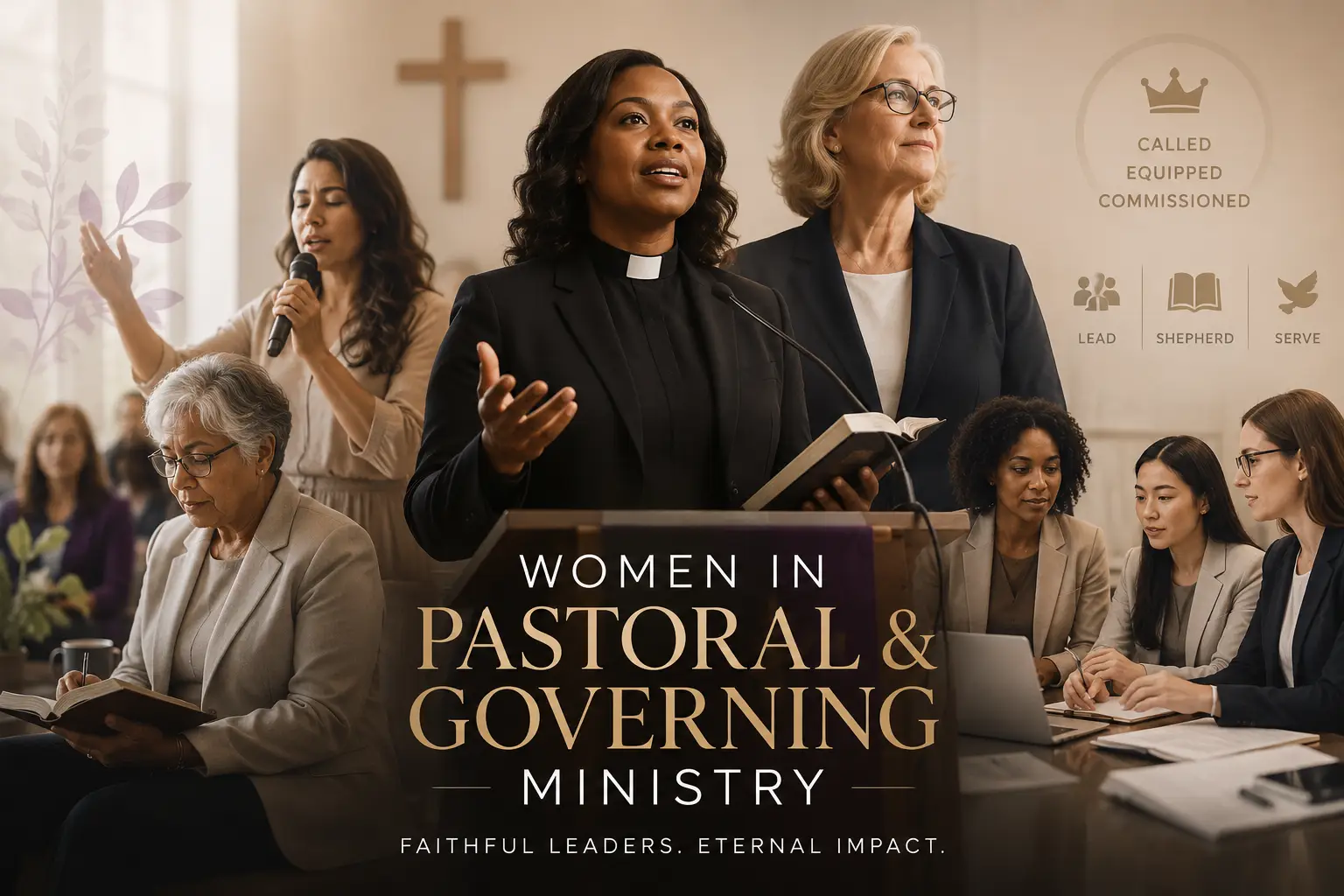
A BIBLICAL AND RELATIONAL FRAMEWORK FOR CALLING, COVERING, RECOGNITION AND ACCOUNTABILITY
A woman may honour covenantal order in marriage while exercising pastoral or governing authority delegated by Christ and recognised by the ministry in which she serves.
1. Introduction
The question of whether women may serve as pastors or governing elders has produced sincere disagreement among Bible-believing Christians. The disagreement is not primarily about whether women can be called, anointed, gifted or fruitful in ministry; Scripture plainly records women participating meaningfully in the purposes of God. The central debate concerns whether certain New Testament instructions permanently exclude women from governing and teaching offices in the church.
This document presents an affirmative biblical framework: a woman may be recognised and appointed to pastoral, governing or overseeing responsibility when Christ has called her, her character and fruit meet biblical standards, and the ministry in which she serves corporately confirms and defines her assignment. Such authority can coexist with covenantal order in marriage and with accountable spiritual covering.
Foundational conclusion
Women may serve as pastors and governing elders. Their authority does not arise merely from a husband or spiritual father; it comes from Christ, is empowered by the Holy Spirit, and is recognised and stewarded within accountable church leadership.
2. Women Are Called and Empowered for Ministry
From creation onwards, women share the dignity of bearing God’s image and participating in His purposes (Genesis 1:27–28). At Pentecost, the promised outpouring of the Spirit was explicitly given to sons and daughters, menservants and maidservants. The Spirit’s activity was not restricted to one sex.
Acts 2:17–18 (BSB)
‘In the last days, God says, I will pour out My Spirit on all people. Your sons and daughters will prophesy, your young men will see visions, your old men will dream dreams. Even on My menservants and maidservants I will pour out My Spirit in those days, and they will prophesy.’
Scripture provides a substantial witness to women serving God and strengthening His people:
- Deborah led and judged Israel while functioning prophetically (Judges 4–5).
- Huldah delivered the word of the Lord to national and religious leaders (2 Kings 22:14–20).
- Anna spoke publicly about Christ to those awaiting redemption (Luke 2:36–38).
- Priscilla joined Aquila in explaining the way of God more accurately to Apollos (Acts 18:26).
- Philip’s daughters prophesied under the New Covenant outpouring of the Spirit (Acts 21:9).
- Phoebe was commended by Paul as a trusted servant of the church in Cenchrea (Romans 16:1–2).
- Junia was recognised with Andronicus as outstanding among the apostles (Romans 16:7).
- Euodia and Syntyche contended at Paul’s side in the cause of the gospel (Philippians 4:2–3).
These examples do not all describe the same office, but together they establish an important principle: women were not passive observers in God’s redemptive mission. They spoke, served, led, taught, prophesied, laboured and carried responsibility.
Acts 18:26 (BSB)
And he began to speak boldly in the synagogue. When Priscilla and Aquila heard him, they took him in and explained to him the way of God more accurately.
3. Pastoral Gifting and Governing Office
Ephesians 4:11 names apostles, prophets, evangelists, pastors and teachers as gifts Christ gives for the equipping and maturing of His body. The passage does not state that pastoral gifting is limited to men. A woman may therefore carry a genuine shepherding grace expressed through teaching, discipling, counselling, protecting, restoring and equipping people.
In the New Testament, the functions of elder, overseer and shepherd are closely related (Acts 20:17, 28; 1 Peter 5:1–3). Within the position developed in this paper, the governing office is also open to a woman who is called, qualified and corporately recognised. Appointment does not manufacture a calling; it identifies proven grace and entrusts an appropriate sphere of responsibility.
Authority is therefore assignment-based. A woman appointed as a pastor or governing elder exercises authority within the sphere, people and responsibilities entrusted to her. She remains accountable to Christ, Scripture and the recognised governance of the spiritual house.
4. Marriage Covenant and Ministry Authority
A married woman’s ministry calling does not abolish the covenantal order of her marriage. Her governing responsibility in the church and her relationship with her husband operate in related but distinguishable spheres.
Ephesians 5:23 (BSB)
For the husband is the head of the wife as Christ is the head of the church, His body, of which He is the Savior.
1 Corinthians 11:3, 5 (BSB)
But I want you to understand that the head of every man is Christ, and the head of the woman is man, and the head of Christ is God. … And every woman who prays or prophesies with her head uncovered dishonors her head, for it is just as if her head were shaved.
Paul acknowledged women praying and prophesying while also requiring them to honour relational order. He did not treat public spiritual expression and marital honour as mutually exclusive. A woman may therefore govern responsibly within the church without becoming the head of her husband within their marriage.
| Sphere | Primary order | Practical meaning |
| Discipleship | Christ is Lord and Head | Every believer, married or unmarried, receives identity, salvation, calling and ultimate authority from Christ. |
| Marriage | Covenantal headship | The husband loves and serves his wife sacrificially; the wife honours the covenantal order of the marriage. This does not give every man authority over every woman. |
| Ministry | Christ through recognised oversight | Calling is confirmed through character, fruit and corporate recognition. Authority is exercised within a defined assignment and accountable leadership structure. |
The husband does not create or personally confer his wife’s divine calling. His love, agreement and support are valuable, but the church must still discern her calling and qualifications. Likewise, a ministry title must never be used by a wife to dominate her husband or by a husband to suppress the grace of God in his wife. Where tension arises, it should be addressed through prayer, mature counsel, mutual honour and accountable pastoral care.
5. The Unmarried Woman and Spiritual Covering
An unmarried woman is not spiritually incomplete, unprotected or disqualified from leadership because she does not have a husband. Christ is her Lord, and singleness can provide an undivided capacity for devotion and service (1 Corinthians 7:32–35). She does not require a human mediator in order to approach God, receive the Spirit or obey her calling.
Within a father–son or apostolic household, her spiritual father may remain her relational covering in ministry. This means that he, together with the recognised elders or governing team, provides counsel, affirmation, protection, correction, commissioning and accountability. Spiritual fatherhood serves both sons and daughters by helping them mature and enter their inheritance and assignment.
Essential distinction
Christ is the source of her identity and calling. Her spiritual father does not own her calling or stand between her and God; he helps recognise, steward and release what Christ has entrusted to her.
If she later marries, two relationships coexist: covenantal order within the marriage and accountable oversight within ministry. Her husband becomes the head within the marriage covenant, while the ministry’s recognised leadership continues to oversee the ministerial assignment. A husband does not automatically become an elder, apostolic overseer or ministry governor merely by marrying a woman who serves in leadership.
6. What Spiritual Covering Should Mean
The language of covering must be defined carefully. It should describe covenantal relationship and accountable oversight, never possession, dependency or unchallengeable human control. Healthy covering has the following characteristics:
- Relationship, not ownership. The leader knows, loves and serves the person without treating her as personal property.
- Recognition, not origination. Covering recognises a calling that begins in Christ; it does not pretend to be the source of that calling.
- Protection, not isolation. Oversight helps guard doctrine, character and relationships without cutting the minister off from healthy counsel.
- Accountability, not control. Correction is biblical, transparent and proportionate; it does not govern every private decision.
- Release, not permanent dependency. Spiritual fatherhood develops mature heirs who can carry responsibility faithfully.
- Plurality, not absolute power. A spiritual father should function with other recognised elders rather than as an unaccountable solitary ruler.
2 Corinthians 1:24 (BSB)
Not that we lord it over your faith, but we are fellow workers with you for your joy, because it is by faith that you stand firm.
1 Peter 5:2–3 (BSB)
Be shepherds of God’s flock that is among you, watching over them not out of compulsion, but because it is God’s will; not out of greed, but out of eagerness; not lording it over those entrusted to you, but being examples to the flock.
7. Recognition and Appointment to Governing Ministry
A governing appointment should never be based on gender, sentiment, pressure or title-seeking. It should follow a deliberate process of discernment. The same seriousness applied to male leaders must be applied to female leaders.
- Discern the call. Identify the grace, burden and assignment that appear to originate in Christ.
- Examine biblical character. Apply the moral, relational and spiritual standards reflected in 1 Timothy 3:1–13 and Titus 1:5–9.
- Observe proven fruit. Confirm that her ministry consistently strengthens people, protects truth and produces maturity.
- Evaluate competence. Assess her ability to teach, shepherd, make wise decisions, resolve conflict and work with other leaders.
- Define the sphere. State clearly the people, responsibilities, decisions and limits entrusted to her.
- Confirm corporately. Appointment should be recognised by the appropriate governing leadership, not only by one private relationship.
- Commission and review. Pray, lay hands where appropriate, establish accountability and review the assignment periodically.
A title should follow demonstrated stewardship. A woman does not need to imitate a masculine personality in order to lead. She should govern in the grace, wisdom, strength and relational design God has given her.
8. Addressing the Debated Passages
1 Timothy 2:11–12
1 Timothy 2:11–12 (BSB)
A woman must learn in quietness and full submissiveness. I do not permit a woman to teach or to exercise authority over a man; she is to remain quiet.
Those who reserve eldership for men understand this as a universal prohibition grounded in creation. That interpretation deserves honest acknowledgement. The affirmative position developed here understands Paul to be correcting a specific disorder involving teaching and authority in Ephesus, where false doctrine was a major concern throughout the letter. The command begins positively: ‘A woman must learn.’ On this reading, Paul restricts uninformed, disruptive or wrongly exercised authority rather than permanently forbidding every qualified woman from teaching or governing.
The husband’s covering must not be used as a shortcut that simply cancels this passage. The passage itself must be interpreted in its literary, historical and canonical context. The affirmative conclusion rests on reading it alongside the wider New Testament witness to women praying, prophesying, teaching, labouring and carrying recognised responsibility.
1 Corinthians 14:34–35
Paul’s instruction that women should be silent cannot reasonably mean absolute silence in every gathering, because 1 Corinthians 11:5 already acknowledges women praying and prophesying. The surrounding concern in chapter 14 is orderly, edifying participation. The restriction is therefore best read as addressing a particular form of disruptive or disorderly speech, not as erasing women’s Spirit-enabled contribution.
1 Timothy 3 and Titus 1
The qualifications for overseers and elders are expressed in masculine language and include the requirement to be the husband of one wife. Those who exclude women see this as decisive. Within the affirmative framework, the language describes the normal first-century officeholder while establishing the enduring standard of marital faithfulness, household integrity, maturity, hospitality, self-control and sound doctrine. The corresponding moral standard must be applied fully to any woman considered for office. This interpretation is disputed, but it does not treat character qualifications lightly.
9. Safeguards for Healthy Governing Authority
Whether the leader is male or female, governing authority should be protected by the following safeguards:
- Christ and Scripture remain the highest authority; no leader’s word is beyond biblical examination.
- A plurality of recognised leaders shares governance and prevents unchecked personal power.
- The leader’s delegated sphere and decision-making limits are written and understood.
- Character, doctrine, relationships and fruit are reviewed consistently.
- Financial and administrative decisions are transparent and subject to appropriate controls.
- Members and leaders have a safe, honourable process for raising concerns or appealing decisions.
- Marriage is honoured without allowing either a ministry title or marital headship to become an instrument of domination.
- Appropriate relational and sexual boundaries protect both the leader and those she serves.
- Spiritual fatherhood and eldership develop maturity, responsibility and eventual release rather than unhealthy dependence.
10. Proposed Ministry Position Statement
The following statement may be adopted or adapted for a ministry policy, leadership manual or governance document:
Ministry position
We affirm that women may be called, recognised and appointed to pastoral, governing and overseeing ministry. A woman’s authority originates in Christ, is empowered by the Holy Spirit, is evidenced through biblical character and proven fruit, and is confirmed by the recognised leadership of the ministry in which she serves.
A married woman continues to honour the covenantal order of her marriage while exercising the authority entrusted to her in ministry. Her husband’s headship within marriage does not remove her calling, nor does her ministry office make her the head of her husband.
An unmarried woman is complete in Christ and may serve fully in ministry. Within an apostolic or father–son household, her spiritual father, together with recognised elders, may provide relational covering through counsel, protection, correction, affirmation, commissioning and accountability. Such covering never replaces Christ, owns her calling or reduces her to dependency.
All governing authority must be servant-hearted, accountable, exercised within a defined sphere and protected by plural leadership. We recognise calling without partiality, appoint according to character and fruit, and release both sons and daughters to fulfil the assignments entrusted to them by God.
11. Final Summary
- Women are clearly called and empowered by the Holy Spirit to minister.
- A qualified woman may be recognised and appointed as a pastor or governing elder within this biblical framework.
- A married woman may exercise church authority while honouring covenantal order in her marriage.
- An unmarried woman is complete in Christ and may walk under the relational covering of her spiritual father and governing elders.
- Human covering confirms, protects and stewards calling; it does not originate, own or control it.
- All spiritual authority must be servant-hearted, accountable, plural and directed toward the maturity of God’s people.
The goal is neither to suppress women nor to disregard biblical order. It is to recognise the grace of Christ faithfully, honour covenantal relationships, preserve sound governance and release every qualified servant of God to fulfil the assignment entrusted to them.
Galatians 3:28 (BSB)
There is neither Jew nor Greek, slave nor free, male nor female, for you are all one in Christ Jesus.
Scripture quotations are from the Berean Standard Bible (BSB), public domain.