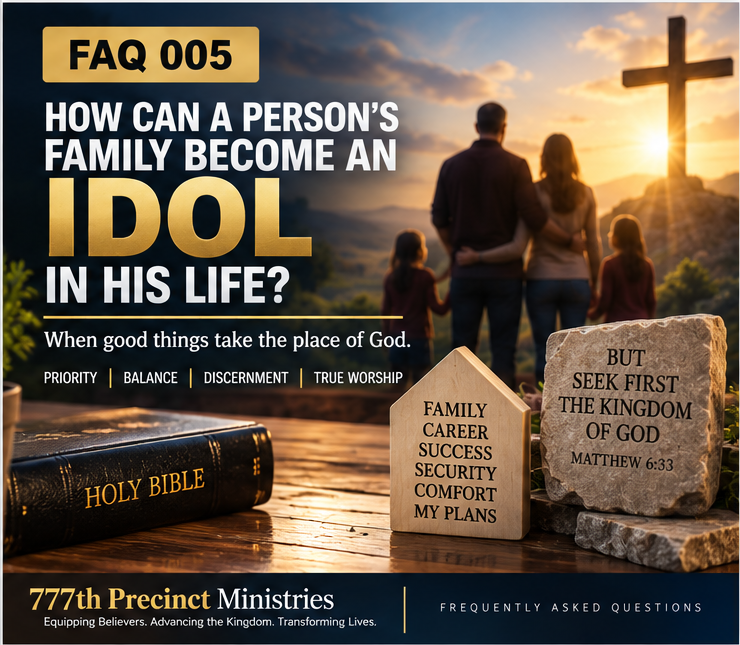
FAQ 005
HOW CAN A PERSON’S FAMILY BECOME AN IDOL IN THEIR LIFE?
Loving Family Deeply Without Placing Family Above God
Family is one of God’s greatest gifts, but even a good gift can become disordered when it takes the place that belongs to God alone. Biblical discipleship teaches us to love our families faithfully while keeping Christ first in worship, identity, obedience and ultimate loyalty.
1. Introduction
The family is not the enemy of discipleship. Scripture honours marriage, parenthood, children, responsibility, inheritance, hospitality and care for relatives. Yet Jesus also teaches that no natural relationship may take the place of our supreme allegiance to Him.
The original question asks how a person’s family can become an idol. The answer is not that attending a family event, caring for relatives, or preferring one family obligation over a church event automatically constitutes idolatry. Idolatry is deeper: it occurs when family becomes the controlling centre of our identity, security, obedience or worship in a way that displaces God.
QUESTION
How can a person’s family become an idol in their life?
SHORT ANSWER
A family becomes an idol when love, loyalty, fear, approval, obligation or dependence upon family is elevated above obedience to God. This may happen when a believer consistently compromises Scripture to keep relatives happy, derives ultimate identity and security from family rather than Christ, refuses God’s calling because of family pressure, or treats family approval as more important than the approval of God.
This does not mean that every conflict between a family activity and a church activity is proof of idolatry. Biblical priorities require wisdom. Caring for a spouse, children, elderly parents or a genuine family responsibility can itself be obedience to God. The key question is not merely, ‘Which event did I attend?’ but, ‘Who ultimately governs my heart and my obedience?’
2. What Is an Idol?
An idol is anything created that receives the place in our heart that belongs to the Creator. Idolatry is therefore not limited to statues or pagan images. A person, relationship, career, possession, dream, ministry, comfort, reputation or family can become an idol when it becomes ultimate.
Romans 1:25 (BSB)
They exchanged the truth of God for a lie, and worshiped and served the creature rather than the Creator, who is forever worthy of praise! Amen.
The danger is often greatest with good things. We rarely idolise something because it is obviously worthless; we idolise it because it is precious to us. Family can therefore become an idol precisely because family is genuinely valuable.
3. Jesus’ Words About ‘Hating’ Father and Mother
Luke 14:26 (BSB)
If anyone comes to Me and does not hate his father and mother and wife and children and brothers and sisters – yes, even his own life – he cannot be My disciple.
Jesus is not commanding emotional hatred, cruelty or neglect. Scripture elsewhere commands love, honour and practical care for family. His language is intentionally forceful because discipleship requires a supreme loyalty that makes every other loyalty secondary by comparison.
Matthew 10:37 (BSB)
Anyone who loves his father or mother more than Me is not worthy of Me; anyone who loves his son or daughter more than Me is not worthy of Me.
Matthew clarifies the meaning. The issue is comparative love: no family relationship may be loved more than Christ in the sense of becoming our final authority.
4. Seeking the Kingdom First
Matthew 6:33 (BSB)
But seek first the kingdom of God and His righteousness, and all these things will be added unto you.
To seek the Kingdom first means that God’s rule, righteousness and will become the governing priority of life. This principle does not require us to neglect natural responsibilities. Instead, it teaches us to carry those responsibilities under God’s rule.
A mature believer therefore does not ask only, ‘What does my family want?’ or ‘What does my church want?’ but ‘What is obedience to God in this situation?’
5. Family Idolatry Can Take Several Forms
- Approval idolatry – needing family acceptance so strongly that you will disobey God to preserve it.
- Identity idolatry – defining your worth primarily by being someone’s spouse, parent, child, surname or family member rather than by your identity in Christ.
- Control idolatry – allowing family members to control decisions God has entrusted to you.
- Fear idolatry – refusing obedience because you fear family conflict, rejection or disappointment.
- Security idolatry – trusting family connections more than God’s provision and direction.
- Image idolatry – protecting the reputation of the family at the expense of truth and righteousness.
- Dependency idolatry – becoming so emotionally dependent upon relatives that separation, calling or healthy boundaries feel impossible.
- Tradition idolatry – treating family customs as untouchable even when they contradict Scripture.
- Possessive love – trying to control a spouse or child because your sense of meaning depends upon them.
- Excusing sin – defending sinful conduct merely because the person involved is family.
6. Loving Family Is a Biblical Duty
The answer to family idolatry is not emotional distance, neglect or spiritual superiority. Scripture repeatedly commands believers to care for their households.
1 Timothy 5:8 (BSB)
If anyone does not provide for his own, and especially his own household, he has denied the faith and is worse than an unbeliever.
Ephesians 5:25 (BSB)
Husbands, love your wives, just as Christ loved the church and gave Himself up for her.
Ephesians 6:4 (BSB)
Fathers, do not provoke your children to wrath; instead, bring them up in the discipline and instruction of the Lord.
Family responsibility is therefore spiritual obedience. A believer can wrongly neglect family in the name of ministry just as easily as another believer can idolise family.
7. The Difference Between Priority and Neglect
Saying that Christ comes first does not mean that every church meeting automatically takes precedence over every family responsibility.
For example, caring for a sick spouse, attending to a child’s genuine need, honouring a major family responsibility, or caring for elderly parents may be the very expression of obedience to God.
Therefore, the original statement that choosing a natural family event over a spiritual-family event automatically makes the natural family an idol should be refined. The biblical test is not the calendar event by itself, but the heart, the pattern and the obedience involved.
8. When Family Pressure Causes Disobedience
Acts 5:29 (BSB)
But Peter and the other apostles replied, ‘We must obey God rather than men.’
This principle also applies to family pressure. Where relatives directly demand something contrary to God’s Word, the believer must obey God.
Examples may include pressure to participate in dishonesty, immorality, occult practices, abusive behaviour, corruption, ungodly rituals, or relationships that clearly require compromise.
9. Honour Parents Without Making Them Ultimate
Ephesians 6:2-3 (BSB)
‘Honor your father and mother’ – which is the first commandment with a promise – ‘that it may go well with you and that you may have a long life on the earth.’
Honour is biblical, but honour is not the same as absolute obedience in adulthood. A mature son or daughter can respect parents while still making decisions under Christ.
Honour does not require allowing a parent to govern a marriage, calling, finances or conscience in ways that belong to God and to the responsible adult believer.
10. Marriage Creates a New Primary Human Covenant
Genesis 2:24 (BSB)
For this reason a man will leave his father and mother and be united to his wife, and they will become one flesh.
One of the common forms of family disorder appears when parents or extended family continue to control a married couple. Marriage establishes a new primary human covenant. Honour for parents remains, but the marriage must not be continually subordinated to extended-family demands.
Likewise, a spouse should not use the marriage relationship to prevent legitimate obedience to God. The solution is not unilateral domination but prayerful covenant agreement, wisdom and mutual honour.
11. Children Can Also Become Idols
Parents can love children so intensely that the child’s happiness becomes more important than truth, discipline or obedience to God.
Signs may include:
- refusing necessary discipline because the child may become upset;
- excusing serious sin because ‘it is my child’;
- living entirely through the child’s achievements;
- making every family decision revolve around the child’s preferences;
- allowing fear for the child to replace trust in God;
- placing a child’s approval above marital or spiritual responsibilities.
12. Family Reputation Can Become an Idol
Some families preserve appearances at all costs. Problems are hidden because exposure would embarrass the family name.
This can become particularly dangerous where abuse, addiction, violence, sexual sin, financial dishonesty or manipulation is concealed in the name of ‘protecting the family.’
Biblical honour never requires us to protect darkness. Truth, safety, repentance and justice matter more than maintaining an impressive image.
13. Family Traditions Must Remain Under Scripture
Mark 7:8 (BSB)
You have disregarded the commandment of God to keep the tradition of men.
Traditions can be beautiful carriers of identity and memory. They become spiritually dangerous when they are treated as more authoritative than Scripture.
A believer should therefore honour what is good in family culture while refusing customs that clearly conflict with faithfulness to Christ.
14. The Fear of Losing Family Can Become Bondage
Some believers know what obedience requires but fear rejection, exclusion or loss of financial and emotional support.
Proverbs 29:25 (BSB)
The fear of man is a snare, but whoever trusts in the LORD is set securely on high.
The fear of man becomes idolatrous when another person’s reaction controls our obedience. This does not mean that we become insensitive or provocative; it means that fear cannot become our master.
15. Family Must Not Replace God as Our Source
Psalm 73:25-26 (BSB)
Whom have I in heaven but You? And on earth I desire no one besides You. My flesh and my heart may fail, but God is the strength of my heart and my portion forever.
Family can provide comfort, belonging and security, but no family relationship can carry the weight of being our ultimate source.
People change. Children grow up. Parents die. Marriages pass through seasons. Healthy relationships flourish when we do not demand from people what only God can give.
16. The Family Must Be Loved in God, Not Instead of God
Kingdom order does not reduce love for family; it purifies it. When God is first, we are better able to love family without controlling, idolising or using them to meet needs they were never designed to fulfil.
Christ-centred love becomes more patient, truthful, sacrificial, free and responsible.
17. Practical Questions for Self-Examination
- Would I knowingly disobey Scripture to keep a family member happy?
- Does fear of family rejection control my decisions?
- Do I excuse behaviour in relatives that I would recognise as wrong in others?
- Is my identity so tied to family that I do not know who I am in Christ apart from them?
- Do I neglect God, my calling or conscience because family approval matters more?
- Do I neglect my family in the name of ministry and then call it ‘putting God first’?
- Do family traditions govern me more strongly than Scripture?
- Do I hide serious wrongdoing to protect the family name?
- Do I believe I cannot survive emotionally, spiritually or financially without a particular family member?
- Can I love my family deeply while still saying no when obedience to Christ requires it?
18. How to Restore Kingdom Order
- Return Christ to the centre of your identity and worship.
- Repent where you have knowingly placed family approval above obedience to God.
- Honour relatives without surrendering responsibilities God has personally entrusted to you.
- Establish healthy boundaries where family control has become destructive.
- Fulfil genuine duties to spouse, children, parents and household faithfully.
- Bring family decisions before God in prayer rather than reacting only to pressure.
- Allow Scripture – not guilt, fear, tradition or emotion – to govern moral decisions.
- Seek mature counsel where family relationships are complicated or abusive.
- Refuse to conceal serious wrongdoing under the label of loyalty.
- Practise love that tells the truth and pursues reconciliation without compromise.
19. DIRECT ANSWER TO THE QUESTION
A person’s family becomes an idol when family receives the place of ultimate loyalty, identity, security, authority or worship that belongs to God.
This can happen when a believer repeatedly compromises God’s Word to please relatives, cannot obey God without family permission, protects family sin because of loyalty, or allows family fear and approval to govern life.
But family idolatry should not be diagnosed merely because someone chooses a family responsibility over a church programme. The believer must discern whether the choice itself is obedience to God, because Scripture also commands faithful care for one’s household.
20. 777th Precinct Ministries – Position Statement
777th Precinct Ministries affirms the family as a God-given sphere of covenant, stewardship, nurture and responsibility. We reject any teaching that uses ‘putting God first’ as an excuse to neglect spouses, children, parents or legitimate household obligations.
At the same time, no natural relationship may become the believer’s highest authority. Christ remains Lord over the family. Where family expectations, traditions, fears or loyalties contradict Scripture, the believer must remain faithful to Christ while continuing to act with honour, love and humility.
We therefore define family idolatry not merely by how much time a believer gives to family, but by whether family has displaced God as the ultimate source of identity, obedience, security and worship.
21. Conclusion
Family is a gift, but the gift must never replace the Giver.
When Christ is first, family love is not diminished; it is brought into right order. We become free to honour parents without being controlled by them, love spouses without possessing them, nurture children without worshipping them, and serve relatives without compromising truth.
The call of discipleship is therefore not to love family less in a careless sense, but to love Christ supremely so that every other relationship can be loved rightly.
Seek first the Kingdom. Honour your family. Fulfil your responsibilities. Refuse idolatry. And let every human relationship remain under the lordship of Jesus Christ.
Grace to you.
Scripture quotations are from the Berean Standard Bible (BSB), public domain.
OTHER PUBLICATIONS BY THIS AUTHOR CAN BE FOUND AT: