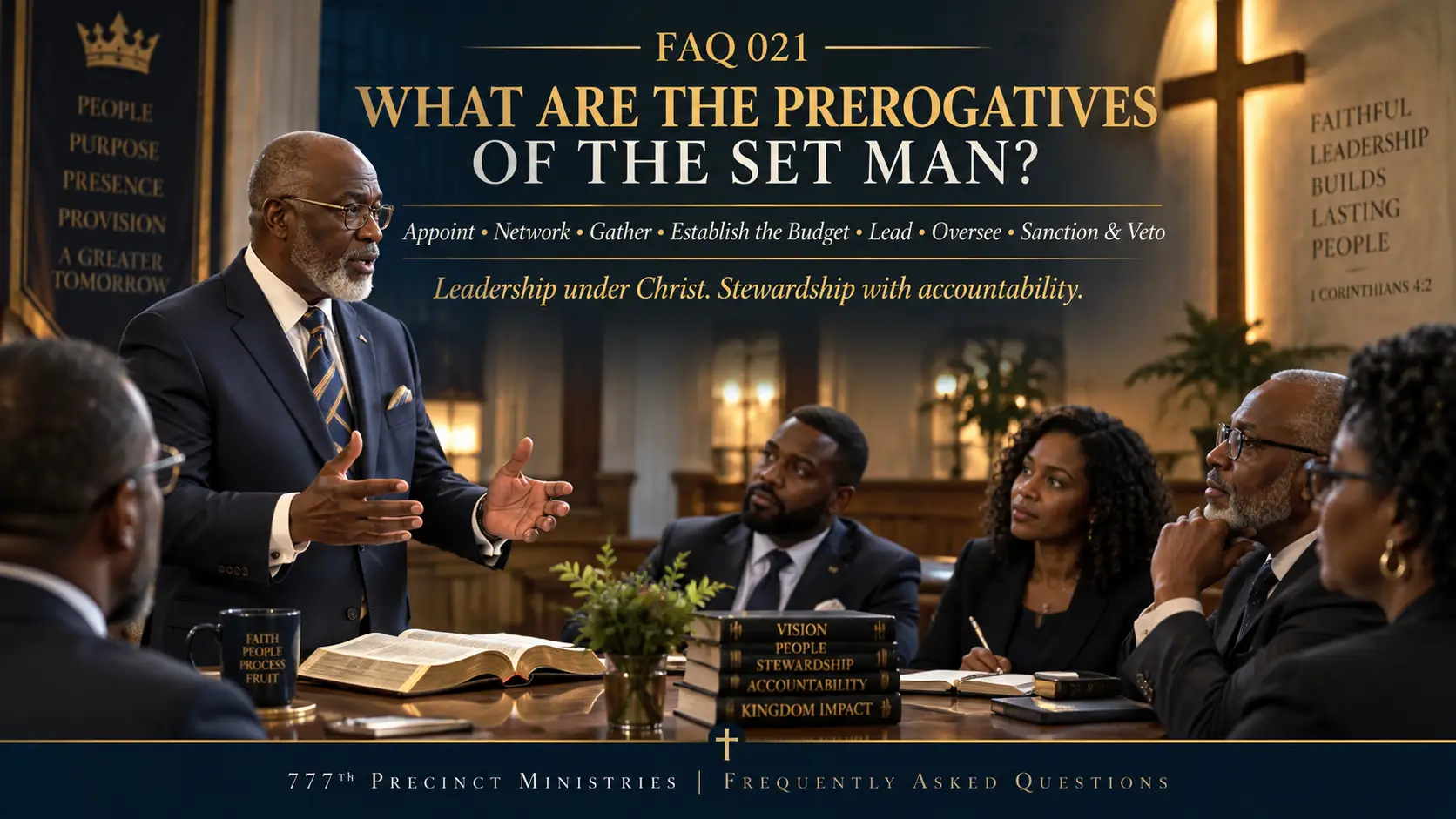
FAQ 0121
BIBLICAL MINISTRY FRAMEWORK OF FREQUENTLY ASKED QUESTIONS
WHAT ARE THE PREROGATIVES OF THE SET MAN?
Authority as Stewardship: Appointment, Networking, Gathering, Budget, Vision, Oversight, Sanction and Veto
Based on Lesson 14 of the ABC Curriculum (source document supplied)
Within the ABC Curriculum, the “set man” is the recognised leader entrusted with primary responsibility for the order, direction and stewardship of a local house. His prerogatives are not personal privileges to dominate people, but ministry responsibilities to be exercised under Christ, according to Scripture, and with accountability.
1. Introduction
The expression “set man” is used in the ABC Curriculum to describe the principal leader whom God has positioned to carry responsibility for a particular household, congregation or ministry environment. The term is a ministry framework rather than a formal New Testament office-title. Scripture more commonly uses terms such as elder, overseer, shepherd, apostle and leader.
Lesson 14 presents a set of prerogatives attached to this leadership function. In this FAQ, the word prerogative should not be understood as an unrestricted personal right. It is better understood as an assigned sphere of responsibility and decision-making necessary to preserve order, vision, stewardship and accountability in the house.
| QUESTION |
| What are the prerogatives of the set man? |
| SHORT ANSWER |
| According to Lesson 14 of the ABC Curriculum, the set man carries seven primary prerogatives: to appoint, network, gather, establish the budget, lead the vision, oversee the house, and exercise sanction and veto. These functions give the set man real leadership responsibility, but they must be exercised as stewardship under Jesus Christ, the Chief Shepherd, and never as unchecked or self-serving authority. |
2. The Foundational Principle: Christ Remains the Head
| Colossians 1:18 (BSB)
And He is the head of the body, the church; He is the beginning and firstborn from among the dead, so that in all things He may have preeminence. |
Any teaching on the set man must begin here. The set man is not the head of the universal Church; Christ is. He does not own the flock; Christ purchased the Church with His own blood. He does not replace the Holy Spirit; he must be led by the Spirit. His authority is therefore delegated and accountable.
This distinction prevents the language of prerogative from becoming authoritarian. The set man may carry primary responsibility in a local house, but he remains a servant under a greater authority.
3. What Does “Prerogative” Mean in This Framework?
A prerogative is a responsibility attached to an office or function that enables the leader to act decisively within the sphere entrusted to him. In the ABC framework, the set man must be able to establish order, make appointments, convene the house, direct resources, protect the vision and intervene when conduct or doctrine threatens the wellbeing of the congregation.
Prerogative therefore carries both authority and accountability. The greater the authority, the greater the responsibility to exercise it biblically, transparently and without partiality.
4. PREROGATIVE ONE: APPOINT
| Numbers 11:16 (BSB)
Then the LORD said to Moses, “Bring Me seventy of the elders of Israel whom you know to be elders and officers of the people. Bring them to the Tent of Meeting and have them stand there with you.” |
| Acts 14:23 (BSB)
Paul and Barnabas appointed elders for them in each church, praying and fasting as they entrusted them to the Lord in whom they had believed. |
| Titus 1:5 (BSB)
The reason I left you in Crete was that you would set in order what was unfinished and appoint elders in every town, as I directed you. |
Lesson 14 places appointment first. Leadership cannot function without recognising and setting qualified people into responsibility. Moses was instructed to identify known elders. Paul and Barnabas appointed elders in the churches. Titus was instructed to appoint elders in every town.
The set man therefore carries responsibility to recognise proven grace, character and capacity and to appoint people into appropriate spheres of service. Appointment should not be based on friendship, loyalty alone, financial influence or personal preference. Biblical qualifications, proven character and spiritual maturity matter.
Appointment also implies the responsibility to clarify function. People should know what has been entrusted to them, what authority accompanies that responsibility, and to whom they remain accountable.
5. PREROGATIVE TWO: NETWORK
| Acts 11:25-26 (BSB)
Then Barnabas went to Tarsus to look for Saul, and when he found him, he brought him back to Antioch. So for a full year they met together with the church and taught large numbers of people. The disciples were first called Christians at Antioch. |
Lesson 14 uses Barnabas bringing Saul into Antioch as a model of purposeful networking. The principle is that ministry relationships should not develop as private alliances that bypass the recognised order of the house.
The curriculum uses strong language, stating that networking without the set man becomes conspiracy. This is best understood as a warning against factions, secret coalitions and independent power-centres that operate inside a house without transparency or accountability.
Healthy networking, by contrast, connects people, gifts and ministries for the advance of the Kingdom while preserving trust and order. The set man does not need to control every friendship, but he should be aware of ministry alliances that directly affect the vision, governance or people of the house.
The curriculum also describes the set man as “the door of the sheep.” This should be read functionally within the local leadership framework, not as a replacement for Christ. Jesus alone declares Himself to be the Door in John 10. The set man may function as a recognised point of access and accountability in the local house, but Christ remains the true Door and Chief Shepherd.
6. PREROGATIVE THREE: GATHER
| Acts 14:27 (BSB)
When they arrived, they gathered the church together and reported all that God had done through them and how He had opened the door of faith to the Gentiles. |
| Acts 15:30-31 (BSB)
So the men were sent off and went down to Antioch, where they assembled the congregation and delivered the letter. When the people read it, they rejoiced at its encouraging message. |
A leader must be able to gather the house. Gathering creates a legitimate environment for communication, instruction, celebration, correction, testimony, decision-making and alignment.
The set man therefore carries responsibility to call the people together when matters affecting the whole house need to be communicated or resolved. This prerogative helps prevent disorder caused by fragmented communication and competing meetings.
Gathering should serve clarity and participation, not merely display authority. The purpose is to strengthen the people, transmit vision and allow the house to move together.
7. PREROGATIVE FOUR: ESTABLISH THE BUDGET
| Acts 4:34-35 (BSB)
There were no needy ones among them, because those who owned lands or houses would sell their property, bring the proceeds from the sales, and lay them at the apostles’ feet for distribution to anyone as he had need. |
Lesson 14 connects financial administration to apostolic responsibility. Resources were brought into the house and then distributed according to need. The principle is the setman is responsible for the financial administration.
The set man therefore has a legitimate role in establishing the financial priorities that serve the vision. This includes ensuring that resources are directed toward ministry responsibilities, people, projects, maintenance, missions, care and the practical work of the house.
Financial stewardship therefore requires truthfulness and transparency.
8. PREROGATIVE FIVE: LEAD THE VISION
| Acts 16:9-10 (BSB)
During the night, Paul had a vision of a man of Macedonia standing and pleading with him, “Come over to Macedonia and help us.” As soon as Paul had seen the vision, we got ready to leave for Macedonia, concluding that God had called us to preach the gospel to them. |
| Nehemiah 2:12 (BSB)
I set out at night with a few men. I had not told anyone what my God had laid on my heart to do for Jerusalem. |
| Nehemiah 2:18 (BSB)
I also told them about the gracious hand of my God upon me and what the king had said to me. “Let us start rebuilding,” they replied, and they set their hands to this good work. |
Lesson 14 states that the set man leads the vision and is the custodian of the vision. This means someone must carry primary responsibility for discerning, articulating, protecting and advancing the direction of the house.
Vision often begins in the heart of a leader before it is fully communicated. Nehemiah first carried the burden privately, examined the situation, and then released the vision to the people. The response was corporate: “Let us rise up and build.”
The set man therefore does not merely announce ideas. He must translate vision into direction, priorities, structures and mobilisation. At the same time, true vision is not private ambition. It must be tested by Scripture, prayer, wisdom, fruit and the witness of mature co-labourers.
9. PREROGATIVE SIX: OVERSEE
| Acts 20:28 (BSB)
Keep watch over yourselves and the entire flock of which the Holy Spirit has made you overseers. Be shepherds of the church of God, which He purchased with His own blood. |
| 1 Peter 5:2-3 (BSB)
Be shepherds of God’s flock that is among you, watching over them not out of compulsion, but because it is God’s will; not out of greed, but out of eagerness; not lording it over those entrusted to you, but being examples to the flock. |
Oversight includes guarding doctrine, watching over spiritual welfare, protecting people from destructive influences, correcting disorder and ensuring that delegated ministries remain consistent with the vision and values of the house.
The curriculum says the set man can enter any meeting without permission. Within the framework, this should be understood as oversight access to ministry meetings conducted under the authority and resources of the house. It should not be interpreted as a licence to invade personal privacy, disregard lawful boundaries, or behave without accountability.
Peter places an essential limitation on oversight: leaders must not lord it over the flock. Oversight is shepherding, not domination. The set man must therefore be present enough to know what is happening while creating enough trust and delegation for other leaders to function responsibly.
10. PREROGATIVE SEVEN: SANCTION AND VETO
| Acts 15:19 (BSB)
It is my judgment, therefore, that we should not cause trouble for the Gentiles who are turning to God. |
Lesson 14 uses Acts 15 to illustrate the right to sanction – to approve, affirm or authorise a direction – and to veto – to stop something judged harmful, disorderly or contrary to the purpose of God.
James gave a decisive judgment, but the decision emerged within a council where apostles and elders had gathered, testimony had been heard, Scripture had been considered and the matter was communicated to the churches. This is important: decisive leadership and communal discernment are not enemies.
The set man may therefore need to stop a proposed ministry, teaching, appointment, financial action or relationship when it threatens doctrine, integrity, order or the wellbeing of the people. He may likewise approve and release what is judged consistent with the vision and Scripture.
Sanction and veto must never become impulsive personal preference. They should be exercised for identifiable biblical, ethical or strategic reasons, with the leader willing to explain the principle involved to appropriate elders and accountable leaders.
11. Summary of the Seven Prerogatives
| PREROGATIVE | PRIMARY FUNCTION | KEY SCRIPTURE |
| 1. Appoint | Recognise and set qualified people into delegated responsibility. | Numbers 11:16; Acts 14:23; Titus 1:5 |
| 2. Network | Coordinate ministry relationships and prevent factions or hidden power-centres. | Acts 11:22-26 |
| 3. Gather | Convene the house for communication, testimony, instruction and alignment. | Acts 14:27; Acts 15:30-31 |
| 4. Establish the Budget | Set financial priorities and ensure ordered stewardship of resources. | Acts 4:34-35; 2 Chronicles 24:10-13 |
| 5. Lead | Carry, communicate and steward the vision of the house. | Acts 16:9-10; Nehemiah 2:12,18 |
| 6. Oversee | Guard the flock, doctrine, ministries and delegated responsibilities. | Acts 20:28-31; 1 Peter 5:2-3 |
| 7. Sanction and Veto | Approve what serves the vision and stop what threatens biblical order or integrity. | Acts 15:13-20 |
12. The Relationship Between the Set Man and Elders
Lesson 14 states that elders operate under the jurisdiction of the set man and do not possess co-equal authority within this model. The intended emphasis is functional order: delegated leaders are not independent power-centres operating against the recognised vision of the house.
At the same time, biblical eldership is not decorative. Elders are expected to shepherd, teach, discern, protect and contribute mature counsel. A healthy set man does not surround himself with silent supporters; he develops strong elders who can carry responsibility and speak truthfully.
The healthiest expression is therefore distinguishable authority with genuine teamwork: one person may carry primary vision responsibility, while elders carry real delegated authority and provide accountability, wisdom and shared shepherding.
13. The Set Man Is a Custodian, Not an Owner
The language of custody is important. A custodian protects something that belongs to another. The vision ultimately belongs to God, the people belong to Christ, and the resources are entrusted stewardship.
This means the set man must never say, in effect, “This is my church, my people and my money.” A Kingdom leader should think, “These are God’s people, God’s resources and God’s assignment, and I must give an account for how I steward them.”
| Hebrews 13:17 (BSB)
Obey your leaders and submit to them, for they keep watch over your souls as those who must give an account. To this end, allow them to lead with joy and not with grief, for that would be of no advantage to you. |
14. What the Prerogatives Do Not Mean
- The set man is not a substitute for Jesus Christ or the Holy Spirit.
- He is not infallible and is not above correction.
- He does not own the people, their consciences or their private lives.
- He may not use appointment or removal merely to reward loyalty or punish disagreement.
- He may not treat church finances as personal property.
- He may not use oversight to justify secrecy, intrusion or abusive control.
- He may not use veto power to silence legitimate biblical questions.
- He should not isolate himself from elders, external accountability or wise counsel.
- His authority cannot legitimately require anyone to disobey Scripture or civil law.
15. Safeguards for Healthy Set-Man Leadership
- Christ and Scripture remain the highest authority.
- Appointments are based on character, calling, competence and proven faithfulness.
- Financial systems include transparent records and accountable administration.
- Elders have meaningful responsibility rather than functioning as ceremonial approval.
- Major decisions are communicated with appropriate explanation and process.
- Sanction and veto are exercised for biblical and strategic reasons, not personal insecurity.
- Correction flows in both directions through legitimate accountability.
- The leader builds mature sons and co-labourers rather than permanent dependence.
- The fruit of the model should be greater order, maturity, mission, integrity and Christlikeness.
16. A Warning Against Two Opposite Errors
There are two opposite errors in leadership. The first is leaderless individualism, where everyone does what is right in his own eyes and no one carries final responsibility. The second is authoritarian centralisation, where one leader becomes untouchable and every decision is treated as unquestionable.
The ABC framework seeks to establish order by recognising a set man. For that order to remain biblical, the set man must carry real authority without becoming absolute. Authority and accountability must grow together.
17. Direct Answer to the Question
According to Lesson 14 of the ABC Curriculum, the prerogatives of the set man are:
- APPOINT – to recognise and appoint qualified elders and leaders;
- NETWORK – to coordinate ministry relationships within the order of the house;
- GATHER – to convene the congregation or leadership when necessary;
- ESTABLISH THE BUDGET – to determine and steward financial priorities for the vision;
- LEAD – to carry and communicate the God-given vision;
- OVERSEE – to guard the flock, ministries, doctrine and delegated functions; and
- SANCTION AND VETO – to approve what serves the vision and to stop what threatens biblical order, integrity or purpose.
These prerogatives are best understood as stewardship responsibilities, not personal privileges. They provide the authority needed to lead, while Scripture provides the boundaries within which that authority must operate.
18. 777th Precinct Ministries – Position Statement
777th Precinct Ministries recognises the set-man principle as a useful framework for identifying the person who carries primary responsibility for the vision, order and stewardship of a local ministry house. We affirm the seven prerogatives presented in Lesson 14 of the ABC Curriculum: appointment, networking, gathering, budgeting, leading, oversight, and sanction/veto.
We understand these prerogatives as delegated responsibilities under Jesus Christ rather than unrestricted personal rights. Christ remains the Head and Chief Shepherd. The set man is accountable to Scripture, to the Lord, and to appropriate mature oversight and relationships.
We affirm strong leadership, but reject domination, financial ownership of the house, manipulation, secrecy and the suppression of legitimate biblical accountability. Healthy set-man leadership should produce mature elders, ordered ministry, transparent stewardship, protected doctrine, clear vision and believers who become increasingly dependent upon Christ rather than permanently dependent upon the leader.
19. Conclusion
The prerogatives of the set man answer a practical question: who carries responsibility to act when a house needs direction? Someone must appoint. Someone must call the gathering. Someone must ensure that resources serve the vision. Someone must lead. Someone must oversee. And at times someone must approve or stop a proposed direction.
Lesson 14 places those responsibilities with the set man. The strength of the model lies in clarity of responsibility. Its safety lies in remembering that every prerogative is delegated from God and bounded by the character of Christ.
The mature set man therefore does not ask, “How much authority can I exercise?” He asks, “How faithfully can I steward what God has entrusted to me?”
Authority that serves produces order. Authority that protects produces safety. Authority that equips produces maturity. Authority that remains submitted to Christ produces Kingdom fruit.
Grace to you.
Scripture quotations are from the Berean Standard Bible (BSB), public domain. Source framework: ABC Curriculum, Lesson 14, as supplied for this FAQ.
OTHER PUBLICATIONS BY THIS AUTHOR CAN BE FOUND AT: