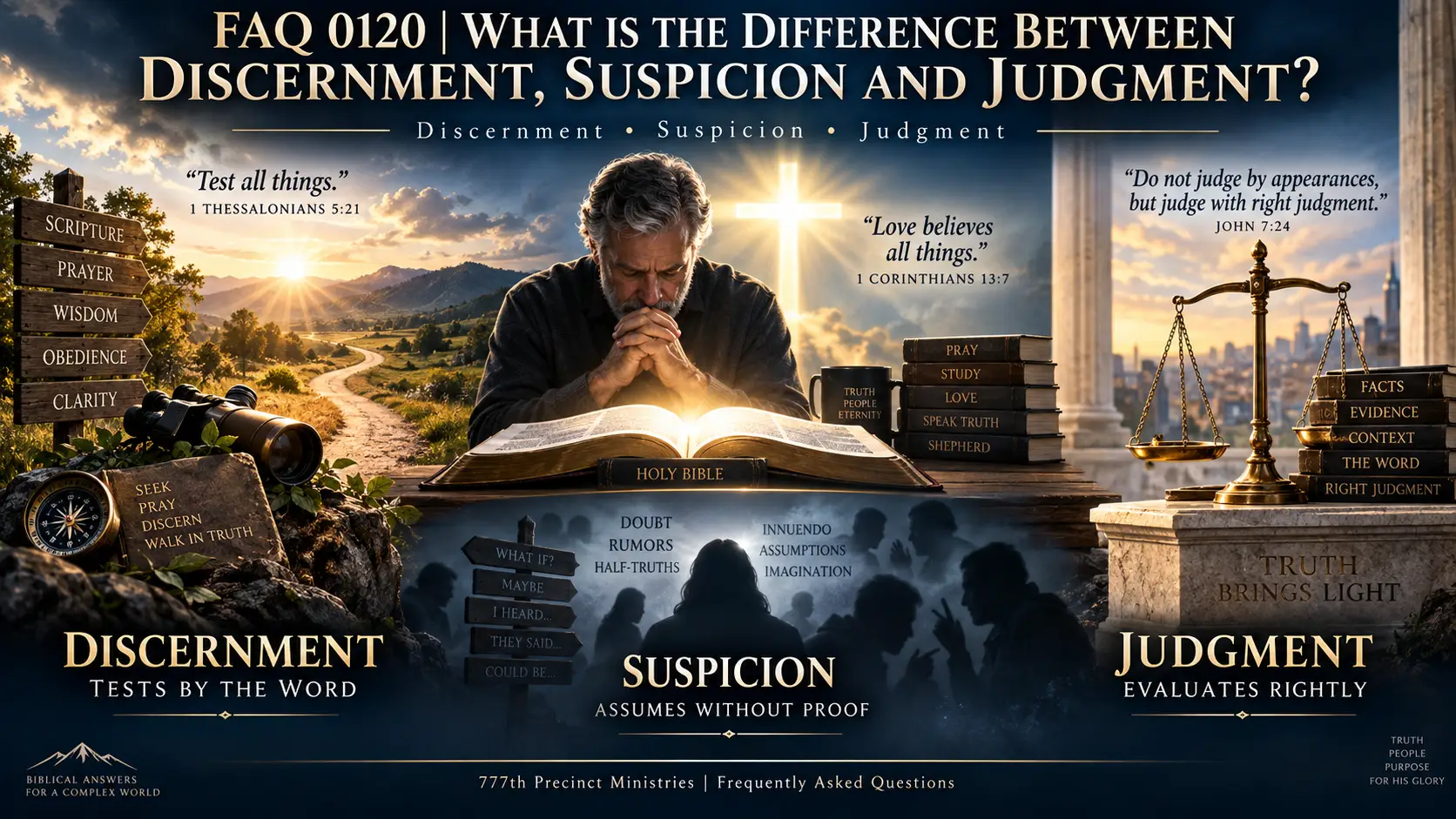
FAQ 0120
WHAT IS THE DIFFERENCE BETWEEN DISCERNMENT, SUSPICION AND JUDGMENT?
Testing • Verifying • Evaluating Righteously
Discernment seeks the truth under the Word and the Holy Spirit. Suspicion treats an unverified impression as though it were fact. Righteous judgment makes a careful evaluation after truth has been tested; unrighteous judgment condemns, assumes motives, or pronounces a verdict without humility, evidence, or due process.
QUESTIONWhat is the difference between discernment, suspicion and judgment?
SHORT ANSWERDiscernment is the Spirit-enabled, Scripture-governed ability to distinguish truth from error, good from evil, and what is spiritually sound from what is deceptive.
| Suspicion is an unverified assumption or negative interpretation that goes beyond the available evidence. Judgment is an evaluation or verdict. Scripture forbids hypocritical, condemning and presumptuous judgment, but it also commands believers to make righteous, evidence-based judgments. The key difference is process: discernment tests; suspicion assumes; righteous judgment evaluates after testing. |
1. Introduction
The words discernment, suspicion and judgment are often used as though they mean the same thing. They do not. Confusing them can produce two opposite errors: people may call suspicion “discernment” and accuse others without evidence, or they may call every biblical evaluation “judgment” and refuse to confront error or sin.
Scripture calls believers to maturity: we must test what we hear, examine fruit, listen before answering, avoid evil suspicion, refuse hypocritical condemnation, and still make righteous evaluations when truth and responsibility require it.
2. The Biblical Foundation: Mature Believers Learn to Discern
Hebrews 5:14 (BSB)
But solid food is for the mature, who by constant use have trained their senses to distinguish good from evil.
Discernment is therefore not merely a sudden feeling. Biblical discernment grows through maturity, repeated practice, knowledge of Scripture, obedience, prayer, and sensitivity to the Holy Spirit. It learns to distinguish rather than merely react.
Philippians 1:9-10 (BSB)
And this is my prayer: that your love may abound more and more in knowledge and depth of insight, so that you may be able to test and prove what is best and may be pure and blameless for the day of Christ.
Notice that Paul joins discernment to love. True discernment is not cynical. It sees clearly while still seeking what is true, pure, redemptive, and pleasing to Christ.
3. What Is Discernment?
Discernment is the ability to distinguish accurately. In a biblical context it includes distinguishing truth from error, good from evil, sound doctrine from deception, godly fruit from ungodly fruit, and spiritual influences that are from God from those that are not.
1 John 4:1 (BSB)
Beloved, do not believe every spirit, but test the spirits to see whether they are from God. For many false prophets have gone out into the world.
John does not tell believers to believe everything, nor does he tell them to suspect everything. He commands them to test. That is the heart of discernment.
1 Thessalonians 5:21-22 (BSB)
Test all things. Hold fast to what is good. Abstain from every form of evil.
Discernment has a positive purpose: after testing, it holds fast to what is good. It is not a ministry of fault-finding.
4. The Spiritual Gift of Distinguishing Between Spirits
1 Corinthians 12:10 (BSB)
…to another miraculous powers, to another prophecy, to another distinguishing between spirits, to another speaking in various tongues, and to still another the interpretation of tongues.
The gift of distinguishing between spirits is a specific manifestation of the Holy Spirit. It should not be confused with suspicion. A spiritual impression still needs to be handled humbly and tested according to Scripture; it should not automatically be announced as an accusation against another person.
A person may genuinely sense that something is wrong and still misunderstand the cause. The mature response is: “I need to test this,” not, “I already know exactly what this person is doing.”
5. Marks of Genuine Discernment
- It is submitted to Scripture rather than personal preference.
- It tests rather than assumes.
- It distinguishes facts, impressions, interpretations, motives and conclusions instead of mixing them together.
- It is willing to listen to more than one side of a matter.
- It produces sobriety, prayer, wisdom and appropriate action rather than gossip and excitement.
- It remains humble enough to be corrected.
- It looks at fruit and truth, not merely appearances.
- It seeks restoration and protection rather than humiliation.
6. What Is Suspicion?
Suspicion is a belief or fear that someone may be guilty, dishonest, dangerous, disloyal or wrongly motivated when the matter has not yet been established. A concern may begin as a legitimate warning signal, but suspicion becomes spiritually dangerous when an impression is promoted into a conclusion without sufficient evidence.
1 Timothy 6:4 (BSB)
He is conceited and understands nothing. Instead, he has an unhealthy interest in controversies and disputes about words, out of which come envy, strife, abusive talk, evil suspicions.
Paul explicitly identifies “evil suspicions” as one of the fruits of unhealthy controversy. Suspicion feeds on fragments, assumptions, unresolved fear, rivalry, past wounds and the tendency to interpret uncertain information negatively.
7. Suspicion Answers Before It Has Heard
Proverbs 18:13 (BSB)
He who answers a matter before he hears it—this is folly and disgrace to him.
Suspicion often completes the story before the facts have been heard. It sees a delayed reply and concludes rejection; sees a private meeting and concludes conspiracy; sees a mistake and concludes deliberate betrayal. Scripture calls this folly because the conclusion precedes the hearing of the matter.
Proverbs 18:17 (BSB)
The first to state his case seems right until another comes and cross-examines him.
One side can sound entirely convincing until another side is heard. Discernment therefore resists premature certainty.
8. Suspicion Is Not the Same as Caution
Biblical wisdom is not gullibility. A believer may notice inconsistencies, recognise risk, set boundaries, verify information, or delay trust until facts are clearer. That is caution. Suspicion becomes sinful when it assigns guilt, motives or character without adequate grounds and then treats those assumptions as truth.
A useful distinction is this: caution says, “I do not yet know, so I will verify.” Suspicion says, “I already know what they are really doing,” even when the evidence has not established it.
9. What Is Judgment?
The word judgment can refer to several different things in Scripture. It can mean evaluation, discernment, a decision in a dispute, moral assessment, discipline, or final condemnation. Therefore the statement “Christians must never judge” is too broad. Scripture forbids some kinds of judgment and commands others.
10. Jesus Forbids Hypocritical and Condemning Judgment
Matthew 7:1-5 (BSB)
Do not judge, or you will be judged. For with the judgment you pronounce, you will be judged; and with the measure you use, it will be measured to you. Why do you look at the speck in your brother’s eye, but fail to notice the beam in your own eye? … You hypocrite! First take the beam out of your own eye, and then you will see clearly to remove the speck from your brother’s eye.
Jesus does not end by saying the speck must never be addressed. He commands self-examination first. The forbidden judgment is hypocritical, self-righteous and harsh. Righteous correction begins with humility before God.
Luke 6:37 (BSB)
Do not judge, and you will not be judged. Do not condemn, and you will not be condemned. Forgive, and you will be forgiven.
Judgment becomes sinful condemnation when we take the seat that belongs to God, pronounce a person beyond mercy, or treat our limited knowledge as though we know the entire heart and final standing of another person.
11. Jesus Also Commands Righteous Judgment
John 7:24 (BSB)
Stop judging by outward appearances, and start judging justly.
Jesus therefore distinguishes between wrong judgment and righteous judgment. The issue is not whether an evaluation is made, but how it is made: not by appearance, prejudice, partial information, personal offence or hypocrisy, but according to truth and justice.
12. The Church Must Sometimes Make Judgments
1 Corinthians 5:12 (BSB)
What business of mine is it to judge those outside the church? Are you not to judge those inside?
In the context of open, serious and unrepentant sin, Paul requires the church to make a moral judgment. Christian love does not mean moral neutrality. Where Scripture speaks clearly, leaders and believers must sometimes identify conduct as right or wrong and take appropriate action.
This must always be governed by truth, proportionality, due process, impartiality, the possibility of repentance, and a desire for restoration where restoration is possible.
13. Righteous Judgment Is Not Judgment of the Heart
1 Corinthians 4:5 (BSB)
Therefore judge nothing before the appointed time; wait until the Lord comes. He will bring to light what is hidden in darkness and will expose the motives of men’s hearts. At that time each will receive his praise from God.
Human beings can often evaluate words, doctrine, behaviour and fruit. We are far less qualified to make absolute pronouncements about hidden motives. God alone sees the heart perfectly. Discernment may identify a pattern; suspicion claims certainty about motives; righteous judgment limits itself to what can responsibly be known.
14. A Practical Comparison
MethodTests Scripture, fruit, facts, context and spiritual witness.Language“Let us test this.”“I know something is wrong with them.”“Based on the established facts, this conduct is right/wrong.”AttitudeHumble, sober, teachable, prayerful.EvidenceSeeks adequate confirmation.FruitClarity, wisdom, protection, restoration.
| AREA | DISCERNMENT | SUSPICION | JUDGMENT | ||||
|---|---|---|---|---|---|---|---|
| Purpose | To distinguish what is true, good, sound or spiritually genuine. | ||||||
| To protect oneself by assuming a possible negative explanation. | To reach an evaluation, decision or verdict. | ||||||
| Connects incomplete facts to a feared or negative conclusion. | Weighs tested evidence against a standard. | ||||||
| Anxious, defensive, cynical or accusatory. | Righteous when humble and just; sinful when proud or condemning. | ||||||
| Often moves beyond the evidence. | Should follow evidence, witnesses and due process. | ||||||
| Fear, gossip, mistrust, division. | Justice and correction when righteous; condemnation and division when unrighteous. |
15. Biblical Discernment Examines Fruit
Matthew 7:16 (BSB)
By their fruit you will recognize them. Are grapes gathered from thornbushes, or figs from thistles?
Jesus directs attention to fruit. Discernment watches patterns over time. Suspicion often focuses on isolated incidents and then constructs a whole character judgment from them. Fruit provides something observable; hidden motives are much easier to imagine than to prove.
16. Biblical Discernment Listens Before Concluding
James 1:19 (BSB)
My beloved brothers, understand this: Everyone should be quick to listen, slow to speak, and slow to anger.
Listening is a spiritual discipline. Many false judgments would disappear if believers asked questions before forming conclusions. A mature person can say, “I may be wrong. Help me understand what happened.”
17. Biblical Discernment Does Not Slander
James 4:11-12 (BSB)
Brothers, do not slander one another. Anyone who speaks against his brother or judges him speaks against the law and judges it. … There is only one Lawgiver and Judge, the One who is able to save and destroy. But who are you to judge your neighbor?
Even when a concern is legitimate, the method matters. Slander, exaggeration, malicious interpretation and reputational destruction are not made righteous merely because they are introduced with the words, “I discerned.”
18. When an Inner Warning May Be Genuine
There are times when the Holy Spirit may alert a believer before all the facts are visible. Scripture also teaches watchfulness and sobriety. However, an inner warning is best handled as a prompt to pray, observe, test and seek wisdom—not as automatic proof of another person’s guilt.
1 Peter 5:8 (BSB)
Be sober-minded and alert. Your adversary the devil prowls around like a roaring lion, seeking someone to devour.
Spiritual alertness is biblical. But alertness is not permission for accusation. The Spirit of truth will never require us to abandon truthfulness.
19. Discernment and the Principle of Witnesses
2 Corinthians 13:1 (BSB)
This is the third time I am coming to you. “Every matter must be established by the testimony of two or three witnesses.”
Where an accusation could damage another person’s reputation, ministry, family or livelihood, confirmation matters. A spiritual impression may alert us, but formal action should normally rest on established facts and proper testimony.
20. How Suspicion Becomes False Judgment
- Something feels unusual or concerning.
- Instead of testing the concern, a negative explanation is chosen.
- The explanation becomes an assumption about motive.
- The assumption is repeated to others as though it were fact.
- A verdict is reached before the person has been heard.
- The person is treated as guilty even though the matter has never been properly established.
At that point suspicion has become unrighteous judgment, and often slander.
21. How Discernment Becomes Righteous Judgment
- Notice the concern without immediately deciding what it means.
- Pray and test the matter against Scripture.
- Separate observable facts from impressions and interpretations.
- Listen to the people involved and seek context.
- Look for corroborating evidence, witnesses and fruit where needed.
- Ask whether personal hurt, fear, prejudice or previous experience is influencing your interpretation.
- Make only the judgment that the available truth justifies.
- Respond proportionately and redemptively.
22. Questions to Ask Before Calling Something “Discernment”
- What do I actually know, and what am I assuming?
- What Scripture governs this situation?
- Have I heard the other side?
- Am I trying to understand, or am I trying to prove my suspicion?
- Is my conclusion based on fruit and evidence, or primarily on a feeling?
- Could fear, jealousy, past betrayal, offence or insecurity be affecting me?
- Have mature, impartial believers confirmed the concern?
- Would I be willing to say this directly and graciously to the person involved?
- Does my response aim at truth, protection and restoration—or exposure and punishment?
23. The Role of Love in Discernment
1 Corinthians 13:6 (BSB)
Love takes no pleasure in evil, but rejoices in the truth.
Love does not deny evil; it refuses to rejoice in it. Love and truth belong together. Suspicion enjoys constructing a case. Discernment grieves over what is wrong, verifies what is true, and seeks the good of people without compromising righteousness.
24. The Role of Humility
Romans 12:3 (BSB)
For by the grace given me I say to every one of you: Do not think of yourself more highly than you ought, but think of yourself with sober judgment, according to the measure of faith God has given you.
Humility allows a believer to say, “My perception may be incomplete.” This does not weaken discernment; it protects it from becoming pride. The more serious the accusation, the more careful the discernment process should be.
25. What About “Do Not Judge Me”?
“Do not judge” cannot be used as a shield against all correction. Jesus forbids hypocritical and condemning judgment, yet He commands just judgment. Scripture also requires the church to address open sin, false teaching, exploitation and destructive behaviour. The biblical question is not simply, “Are you judging?” but, “Is the judgment righteous, truthful, humble, properly established and within your responsibility?”
26. Practical Ministry Application
In ministry relationships, leaders and believers should create a culture where concerns can be raised without gossip and where questions are not treated as rebellion. This protects both the person raising a concern and the person being evaluated.
A healthy ministry should distinguish clearly between:
- a spiritual impression that needs testing;
- a concern that needs clarification;
- an allegation that needs evidence and witnesses;
- a confirmed pattern that needs intervention;
- and a moral or doctrinal judgment that Scripture authorises the church to make.
27. 777th Precinct Ministries – Position Statement
777th Precinct Ministries affirms biblical discernment as an essential part of Christian maturity. We encourage believers to test teachings, spiritual manifestations, conduct and fruit according to Scripture and the leading of the Holy Spirit.
We reject suspicion when unverified assumptions are treated as facts, and we reject judgment when it becomes hypocritical, slanderous, prejudicial or condemning. We also reject the idea that all judgment is forbidden. Scripture calls believers and leaders to make righteous evaluations when truth, holiness, justice, protection and accountability require them.
Our standard is therefore: discern carefully, verify responsibly, judge righteously, speak truthfully, act humbly, and leave final condemnation of the heart to God.
28. Conclusion
Discernment, suspicion and judgment are related, but they are not the same. Discernment tests. Suspicion assumes. Judgment evaluates. Discernment becomes mature when it is governed by Scripture, love, humility, evidence and the Holy Spirit. Suspicion becomes dangerous when fear or assumption is promoted into certainty. Judgment is righteous when it is just, truthful and properly grounded; it becomes sinful when it is hypocritical, prejudicial or condemning.
The mature believer does not believe everything, suspect everyone, or condemn quickly. He learns to test all things, hold fast to what is good, listen before answering, judge justly, and walk in love.
Grace to you.
Scripture quotations are from the Berean Standard Bible (BSB), public domain.
OTHER PUBLICATIONS BY THIS AUTHOR CAN BE FOUND AT: