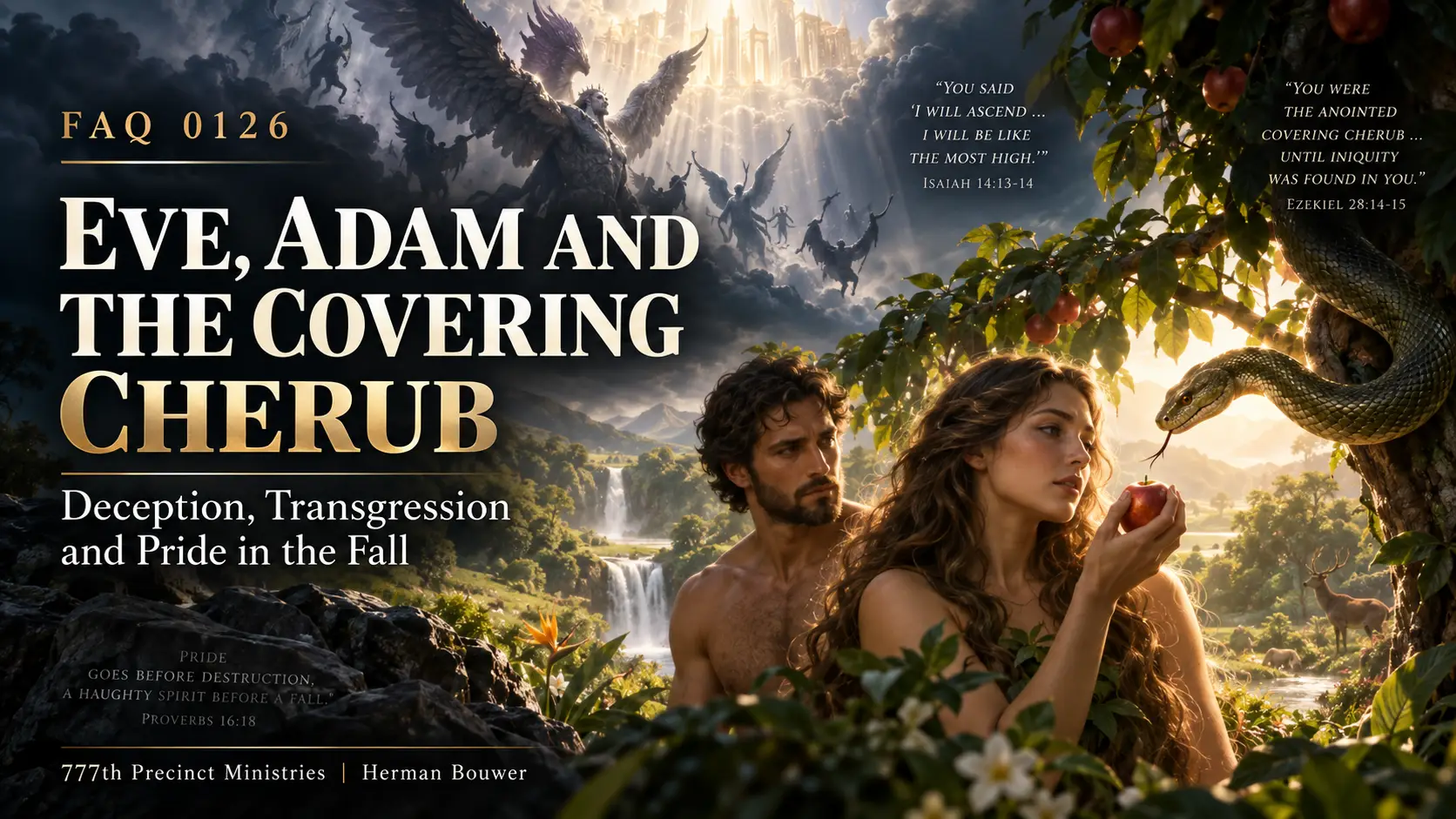
FAQ 0126
HOW DO WE RECONCILE EVE’S DECEPTION, ADAM’S TRANSGRESSION, AND THE COVERING CHERUB PASSAGES?
Eve’s Deception • Adam’s Conscious Transgression • Pride • Isaiah 14 • Ezekiel 28
Eve was deceived, Adam knowingly transgressed, and Isaiah 14 and Ezekiel 28 reveal the recurring pattern of pride and self-exaltation; Scripture, however, does not explicitly identify Adam as the guardian or covering cherub.
1. Introduction
The apparent tension arises because Genesis 3 and Paul’s comments emphasise Eve’s deception, while Romans places representative responsibility for humanity’s fall upon Adam. A further question arises when Isaiah 14 and Ezekiel 28 are read as descriptions of a primordial fall involving pride, self-exaltation, Eden and a guardian or covering cherub.
The passages should not be forced into a single description of one person or one moment. They address different dimensions of rebellion: deception, conscious transgression, representative responsibility, pride, self-exaltation and judgment. The task is therefore to distinguish what each text explicitly says from what later theological interpretation infers.
| QUESTION |
| How do we reconcile Eve’s deception in Genesis 3, 1 Timothy 2:14 and 2 Corinthians 11:3 with Adam’s responsibility for the fall, and with interpretations that connect Adam to the pride and covering-cherub language of Isaiah 14 and Ezekiel 28? |
| SHORT ANSWER |
| There is no necessary contradiction. Eve was deceived by the serpent; Adam was not deceived but knowingly transgressed God’s command. The New Testament consequently places representative responsibility for the entrance of sin into humanity upon Adam. Isaiah 14 and Ezekiel 28 reveal the wider biblical pattern of pride, self-exaltation and downfall, but Scripture does not explicitly call Adam a cherub. The view that Adam was the covering or guardian cherub may be explored as a theological inference or typological reading, but it should not be presented as an explicit biblical statement. |
2. Biblical Foundation and Wider Scriptural Witness
Genesis 3 gives the narrative of the human fall. The serpent directs his deception toward the woman, attacks the reliability of God’s word, contradicts God’s warning, and offers an alternative promise of wisdom and likeness to God.
Genesis 3:6 (BSB)
When the woman saw that the tree was good for food and pleasing to the eyes, and that it was desirable for obtaining wisdom, she took the fruit and ate it. She also gave some to her husband who was with her, and he ate it.
Three movements are visible in the temptation: appetite, sight and a desire for wisdom or elevation. These correspond conceptually with John’s later description of the world-system.
1 John 2:16 (BSB)
For all that is in the world – the desires of the flesh, the desires of the eyes, and the pride of life – is not from the Father but from the world.
This is a legitimate canonical comparison, but it should be handled carefully. John is not offering a technical commentary on Genesis 3:6. Rather, the same recurring pattern of disordered desire can be recognised in both passages.
1 Timothy 2:14 (BSB)
And it was not Adam who was deceived, but the woman who was deceived and fell into transgression.
2 Corinthians 11:3 (BSB)
I am afraid, however, that just as Eve was deceived by the serpent’s cunning, your minds may be led astray from your simple and pure devotion to Christ.
Paul is therefore explicit about Eve’s deception. Yet he is equally explicit elsewhere that Adam carries a representative role in the entrance of sin and death into humanity.
Romans 5:12 (BSB)
Therefore, just as sin entered the world through one man, and death through sin, so also death was passed on to all men, because all sinned.
Romans 5:19 (BSB)
For just as through the disobedience of the one man the many were made sinners, so also through the obedience of the one man the many will be made righteous.
Taken together, these passages establish two truths: Eve was deceived, while Adam’s disobedience carries covenantal and representative significance for the human race.
3. Key Terms and Necessary Distinctions
Several distinctions prevent the passages from being made to contradict one another or from being stretched beyond what they actually teach.
| TERM OR SPHERE | BIBLICAL PRINCIPLE | PRACTICAL MEANING | ||
|---|---|---|---|---|
| Deception | Eve was deceived by the serpent’s cunning (1 Timothy 2:14; 2 Corinthians 11:3). | |||
| The fall includes a process in which truth is distorted and desire is redirected away from trust in God. | ||||
| Adam crosses the revealed boundary knowingly; lack of deception does not reduce responsibility. | ||||
| Representative responsibility | Sin entered through one man (Romans 5:12, 19). | Adam functions as the representative head of fallen humanity in Paul’s Adam-Christ contrast. | ||
| Pride / self-exaltation | Isaiah 14 and Ezekiel 28 portray pride, exaltation and downfall. | Pride is a recurring biblical principle of rebellion against God’s assigned order. | ||
| Guardian / covering cherub | Ezekiel 28:14 uses cherubic language in its poetic oracle. | The text does not explicitly identify the cherub as Adam; that identification is interpretive. | ||
| Typology / theological inference | Biblical patterns may illuminate one another without proving identity. | Parallels can be meaningful, but similarity must not be treated as direct identification unless Scripture makes it explicit. |
The most important distinction is between explicit statement and theological inference. Scripture explicitly says that Adam was a man, that Eve was deceived, that Adam transgressed, and that sin entered the human order through Adam. Scripture does not explicitly say, ‘Adam was the guardian cherub.’
4. The Primary Biblical Position
The clearest biblical synthesis is that Eve’s deception and Adam’s responsibility describe different aspects of the same fall.
Eve’s sin involved deception. The serpent persuaded her to distrust God’s word and to view the prohibited tree through a different interpretive lens. Adam, however, is specifically said not to have been deceived. His act is therefore best understood as conscious disobedience to a known command.
Genesis 2:16-17 (BSB)
And the LORD God commanded him, ‘You may eat freely from every tree of the garden, but you must not eat from the tree of the knowledge of good and evil; for in the day that you eat of it, you will surely die.’
The prohibition was originally given to Adam before the creation of Eve. This makes Adam’s responsibility especially significant. He possessed the command and nevertheless participated in the transgression.
Paul’s argument in Romans 5 is therefore not a denial of Eve’s role. It is a theological statement about Adam’s representative role. The contrast is Adam and Christ: through the disobedience of one man came condemnation; through the obedience of One Man comes righteousness and life.
The divergence is thus resolved: Eve explains the mechanism of deception; Adam represents conscious transgression and the representative entrance of sin into the human order.
5. Isaiah 14 and Ezekiel 28: Context, Pattern and Interpretation
Isaiah 14 and Ezekiel 28 must first be read in their own literary and historical contexts. Isaiah 14 is an oracle concerning the king of Babylon. Ezekiel 28 addresses the ruler and king of Tyre. Both employ elevated poetic language to expose human pride, self-exaltation and divine judgment.
Isaiah 14:13-14 (BSB)
You said in your heart: ‘I will ascend to the heavens; I will raise my throne above the stars of God. I will sit on the mount of assembly, in the far reaches of the north. I will ascend above the tops of the clouds; I will make myself like the Most High.’
The repeated ‘I will’ reveals the anatomy of self-exaltation: the creature seeks a position beyond the order assigned by God. This principle resonates strongly with the serpent’s promise in Genesis 3 that humanity could become ‘like God’ through an act of disobedience.
Ezekiel 28 intensifies the imagery by referring to Eden, created perfection, beauty, wisdom, a holy mountain, a guardian cherub, pride and expulsion.
Ezekiel 28:13-15 (BSB)
You were in Eden, the garden of God. Every kind of precious stone adorned you… You were anointed as a guardian cherub, for I had ordained you. You were on the holy mountain of God; you walked among the fiery stones. From the day you were created you were blameless in your ways – until wickedness was found in you.
Ezekiel 28:17 (BSB)
Your heart grew proud of your beauty; you corrupted your wisdom because of your splendor. So I cast you to the earth; I made you a spectacle before kings.
Because this language reaches beyond the ordinary vocabulary used of an earthly monarch, many Christian interpreters have seen the human ruler as reflecting or embodying a deeper spiritual rebellion associated with Satan. Other interpreters understand the oracle primarily as exalted poetic taunt-language against the king of Tyre. A third approach sees layered or typological significance.
An Adamic reading observes real parallels: Adam was created by God, lived in Eden, initially existed without sin, received delegated authority, transgressed, and was expelled. These parallels are worth examining. They do not, however, prove that Adam was literally the cherub of Ezekiel 28.
6. What the Adam-as-Cherub Interpretation Should and Should Not Mean
If the Adam-as-covering-cherub interpretation is used, it should be presented as a theological proposal rather than as the plain statement of Genesis.
- It may highlight meaningful parallels between Adam’s Edenic vocation and Ezekiel 28’s Eden imagery.
- It may draw attention to the recurring biblical relationship between delegated authority, pride, corrupted wisdom and expulsion.
- It may help expose the deeper issue of attempting to rise beyond God’s assigned order.
- It should not be used to say that Scripture explicitly calls Adam an angelic or cherubic being.
- It should not erase the distinction Genesis makes between Adam and the cherubim stationed at Eden after his expulsion.
- It should not make Eve solely responsible for the fall when Paul places representative responsibility on Adam.
- It should not turn Isaiah 14 or Ezekiel 28 into descriptions of Adam without acknowledging their immediate references to Babylon and Tyre.
Genesis 3:24 (BSB)
So He drove out the man and stationed cherubim on the east side of the Garden of Eden, along with a whirling sword of flame to guard the way to the tree of life.
Genesis 3:24 is an important restraint on the Adam-as-cherub claim. The narrative refers to ‘the man’ and then to ‘cherubim’ as distinct actors. This does not settle every typological argument, but it means that a literal identification of Adam as a cherub requires a theological step that Genesis itself does not make.
7. The Deeper Issue: Government, Autonomy and Pride
The deepest point of convergence among Genesis 3, Isaiah 14, Ezekiel 28 and 1 John 2:16 is not the identity of every character but the nature of rebellion.
In Genesis 3, the serpent invites humanity to seek wisdom and likeness to God apart from obedience to God. In Isaiah 14, the proud ruler says, ‘I will ascend’ and ‘I will make myself like the Most High.’ In Ezekiel 28, wisdom is corrupted because the heart becomes proud. In 1 John 2:16, the world-system is characterised by disordered desire and the pride of life.
The central issue is therefore government: Who determines good and evil? Who defines identity and boundaries? Will the creature live under the word and order of the Creator, or will the creature attempt to become autonomous?
Pride says, ‘I will establish my own position.’ Kingdom obedience says, ‘Your will be done.’ This is why the Adam-Christ contrast is so important. Adam’s disobedience is answered by Christ’s obedience.
Romans 5:18-19 (BSB)
So then, just as one trespass brought condemnation for all men, so also one act of righteousness brought justification and life for all men. For just as through the disobedience of the one man the many were made sinners, so also through the obedience of the one man the many will be made righteous.
8. Addressing the Main Apparent Divergences
Eve Was Deceived – Does That Reduce Adam’s Guilt?
No. Paul’s statement that Adam was not deceived increases rather than decreases the seriousness of his act. Eve succumbed to deception; Adam knowingly crossed the divine boundary. Both transgressed, but not by exactly the same pathway.
Does 1 John 2:16 Prove That Genesis 3:6 Is About the Same Three Sins?
It establishes a strong biblical pattern, but it should not be treated as though John were giving a formal three-point exegesis of Genesis 3:6. The correspondence is conceptual: appetite, sight and self-exalting desire recur as mechanisms by which desire is disordered away from the Father.
Does Isaiah 14 Describe Adam?
Its immediate referent is the king of Babylon. The language of arrogant ascent can illuminate the principle of rebellion seen elsewhere in Scripture, and some theological readings connect it with a deeper satanic pattern. The text itself does not name Adam.
Does Ezekiel 28 Prove Adam Was the Covering Cherub?
No. It provides Edenic and cherubic imagery that invites theological comparison, but it does not explicitly identify the figure as Adam. The strongest responsible formulation is that the passage may contain Adamic parallels while its direct oracle concerns the king of Tyre and its deeper spiritual referent remains debated among interpreters.
9. Safeguards, Boundaries and Pastoral Wisdom
- Begin with the clearest texts. Build doctrine first on what Scripture states directly before moving to typology or inferred correspondences.
- Respect immediate context. Isaiah 14 and Ezekiel 28 address historical rulers even when a reader also discerns a wider spiritual pattern.
- Distinguish identity from similarity. Two figures may share Eden, pride, wisdom, authority or expulsion imagery without therefore being the same person.
- Do not minimise Adam’s representative responsibility. Romans 5 deliberately frames the fall through Adam in contrast with Christ.
- Do not use Paul’s reference to Eve’s deception to blame women for the fall or to suggest that deception is uniquely female.
- Do not make a disputed interpretation a test of fellowship. Believers may differ on the deeper referent of Isaiah 14 and Ezekiel 28 while affirming the essential biblical doctrine of the fall.
- Keep Christ at the centre. The biblical purpose of the Adam-Christ contrast is not merely to diagnose the fall but to proclaim the obedience, righteousness and life found in Christ.
10. 777th Precinct Ministries – Position Statement
777th Precinct Ministries affirms that Genesis 3, 1 Timothy 2:14, 2 Corinthians 11:3 and Romans 5 present complementary rather than contradictory dimensions of the fall. Eve was deceived by the serpent; Adam was not deceived but knowingly transgressed the command of God. Adam therefore bears representative responsibility in Paul’s theological contrast between the first Adam and Christ.
We recognise that Isaiah 14 and Ezekiel 28 contain powerful imagery of pride, self-exaltation, Eden, corrupted wisdom and downfall. These passages may legitimately be studied alongside Genesis 3 as part of the wider biblical theology of rebellion against God.
We do not, however, present the claim that Adam was literally the guardian or covering cherub as an explicit statement of Scripture. Where that interpretation is explored, it should be identified as a theological inference or typological proposal and tested against the whole counsel of Scripture.
Our governing conviction is that the central issue in the fall is rebellion against the government of God: the creature seeking wisdom, identity, position or autonomy independently of the Creator. The answer to Adamic disobedience is found in the obedient Christ, through whom righteousness and life are given.
11. Final Summary
- Eve was deceived by the serpent and fell into transgression.
- Adam was not deceived; he knowingly disobeyed a command he had received from God.
- Paul places representative responsibility for the human fall upon Adam and contrasts Adam’s disobedience with Christ’s obedience.
- Genesis 3:6 and 1 John 2:16 display a meaningful recurring pattern of fleshly desire, visual desire and pride, although 1 John is not a formal commentary on Genesis 3.
- Isaiah 14 exposes the principle of self-exaltation, while Ezekiel 28 joins pride, corrupted wisdom, Edenic imagery and downfall.
- The immediate historical settings of Isaiah 14 and Ezekiel 28 are the kings of Babylon and Tyre respectively.
- The view that Adam was the guardian or covering cherub is an interpretive proposal, not an explicit biblical identification.
- The deeper biblical issue is government: whether the creature lives under God’s word or seeks autonomous wisdom, identity and authority.
- Christ answers Adamic rebellion through perfect obedience and becomes the source of righteousness and life.
The passages therefore do not need to be forced into competition. Eve reveals the dynamics of deception. Adam reveals conscious and representative transgression. Isaiah 14 and Ezekiel 28 reveal the wider anatomy of pride and self-exaltation. Together they warn against every attempt to function independently of the government of God and point us toward the obedience of Christ.
Grace to you.
Scripture quotations are from the Berean Standard Bible (BSB), public domain.
OTHER PUBLICATIONS BY THIS AUTHOR CAN BE FOUND AT: