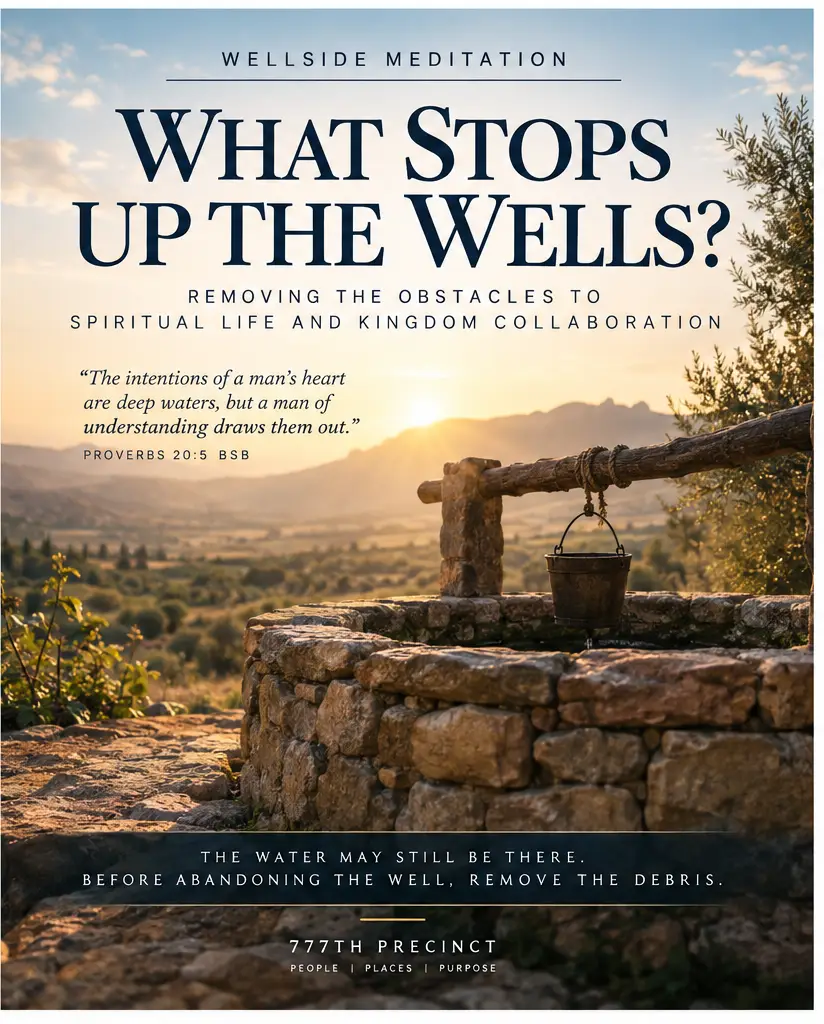
MEDITATIONS FROM THE WELL
WHAT STOPS UP THE WELLS?
Removing the Obstacles to Spiritual Life and Kingdom Collaboration
Editorial Note: This meditation has been developed from the notes prepared for Wellside Dialogue – Part 2. The planned live dialogue could not proceed because of network connectivity problems experienced by attendees. The material is therefore being shared in meditation form so that the conversation can continue at the Wellside.
Proverbs 20:5 BSB
(5) The intentions of a man’s heart are deep waters, but a man of understanding draws them out.
WHEN THE WATER IS STILL THERE BUT THE FLOW IS BLOCKED
There are times when the problem is not that the water has disappeared.
The problem is that the well has become blocked.
Genesis 26 gives us a powerful picture of this reality. Isaac returned to wells that had been dug in the days of his father Abraham, only to discover that the Philistines had deliberately filled them with dirt.
Genesis 26:15 BSB
(15) So the Philistines took dirt and stopped up all the wells that his father’s servants had dug in the days of his father Abraham.
The underground water was still there.
The source had not failed.
The supply had not disappeared.
But something had come between the people and the water.
This presents us with a profound spiritual question:
What has entered our wells and begun restricting the flow of the life of Christ?
Sometimes we ask God for fresh water when what is actually required is for us to remove the debris from the well.
The presence of God has not disappeared.
The Word of God has not lost its power.
The Holy Spirit has not ceased working.
The purposes of God have not changed.
Yet the channels through which His life should flow can become obstructed. This can happen in an individual, a family, a congregation, a ministry, an apostolic network, or even between generations.
The question is therefore not merely: “Where is the water?”
We must also be willing to ask: “What has stopped up the well?”
1. PRIDE — WHEN SELF BECOMES LARGER THAN THE WELL
One of the most dangerous things that can enter a spiritual well is pride. Pride slowly shifts the centre from Christ and His Kingdom to ourselves.
It begins to speak the language of ownership:
- My revelation.
- My ministry.
- My people.
- My platform.
- My achievements.
- My reputation.
- My position.
But Kingdom life speaks a completely different language:
Everything belongs to Christ.
Pride closes our ears because we assume we already know. It closes our hearts because we believe we have nothing to receive. It prevents collaboration because another person’s gifting begins to feel like a threat. It resists correction because correction is interpreted as rejection. It destroys genuine dialogue because we enter conversations wanting to prove rather than wanting to understand.
James 4:6 BSB
(6) But He gives us more grace. This is why it says: “God opposes the proud, but gives grace to the humble.”
That Scripture should cause us to examine ourselves carefully.
Pride is not simply something God dislikes. God Himself resists pride.
A ministry may possess gifting, resources, influence and opportunity, yet gradually lose the flow of grace because pride has entered the well.
Humility clears the obstruction.
Philippians 2:3–4 BSB
(3) Do nothing out of selfish ambition or empty pride, but in humility consider others more important than yourselves.
(4) Each of you should look not only to your own interests, but also to the interests of others.
Humility does not mean denying what God has placed inside us. Humility means recognising that whatever God placed inside us was never given merely for us.
It was given so that others may drink.
We do not gather around the well to establish who possesses the deepest well. We gather because every person may carry something from which another person needs to drink.
2. FEAR — WHEN WE BECOME AFRAID OF WHAT GOD MAY RELEASE THROUGH OTHERS
Fear also stops wells.
- Leaders may fear losing control.
- Younger believers may fear speaking in the presence of older leaders.
- Older leaders may fear becoming irrelevant.
- People may fear asking difficult questions.
- Ministries may fear collaboration because partnership seems to threaten their identity.
- Others may remain silent because previous environments punished honesty.
When fear enters relationships, people become guarded. Guarded relationships rarely produce deep Kingdom dialogue.
2 Timothy 1:7 BSB
(7) For God has not given us a spirit of fear, but of power, love, and self-control.
A healthy spiritual well should become a place where people can draw without fear. This does not mean abandoning boundaries. It does not mean compromising truth. It means allowing our boundaries to be governed by love rather than suspicion.
Fear produces:
- Control
- Defensiveness
- Secrecy
- Maniplation
- Avoidance
- Resistance
Love produces:
- Honesty
- Honour
- Accountability
- Patience
- Room for sincere questions.
1 John 4:18 BSB
(18) There is no fear in love, but perfect love drives out fear, because fear involves punishment. The one who fears has not been perfected in love.
Kingdom relationships must therefore become environments where truth and love are not enemies.
- We can speak truth without attacking.
- We can disagree without dishonouring.
- We can ask questions without being rebellious.
- We can listen without surrendering biblical conviction.
When love displaces fear, the water begins flowing again.
3. COMPETITION — WHEN WE FIGHT OVER WATER THAT BELONGS TO GOD
Genesis 26 also records conflict around the wells.
Genesis 26:20 BSB
(20) But the herdsmen of Gerar quarrelled with Isaac’s herdsmen and said, “The water is ours!” So he named the well Esek, because they contended with him.
Notice their words:
“The water is ours!”
Sadly, that language can still appear within the Body of Christ.
- Our congregation.
- Our members.
- Our territory.
- Our revelation.
- Our network.
- Our ministry.
But Kingdom water cannot become private property. The grace of God was never intended to become material for personal empire building.
1 Corinthians 3:6–7 BSB
(6) I planted the seed and Apollos watered it, but God made it grow.
(7) So neither he who plants nor he who waters is anything, but only God, who makes things grow.
Paul and Apollos were not supposed to be competitors. They carried different assignments within the same purpose of God.
Your success does not diminish my calling.
Your gift does not threaten mine.
Your revelation does not cancel what God has entrusted to me.
There is room at the well.
1 Corinthians 12:21 BSB
(21) The eye cannot say to the hand, “I do not need you.” Nor can the head say to the feet, “I do not need you.”
The Body of Christ was deliberately designed by God around interdependence. We need one another.
Competition diminishes when we recover our identity in Christ. When I know who I am and what God has entrusted to me, I no longer need to diminish another person to establish my own significance.
Instead of asking, “How can I enlarge my influence?” perhaps the greater Kingdom question is:
“How can the grace God has placed within me serve His Body?”
4. TRADITION WITHOUT LIFE — WHEN YESTERDAY’S CONTAINER REPLACES TODAY’S WATER
Not all tradition is wrong. There are spiritual inheritances worth preserving. There are truths that must never be surrendered. There are ancient paths that every generation must rediscover.
But there is a danger when we preserve a method, structure, programme or practice after the life that originally produced it has disappeared.
Mark 7:8 BSB
(8) You have disregarded the commandment of God to keep the tradition of men.
Tradition becomes dangerous when we begin protecting the container more passionately than the life the container was designed to carry.
We must learn to distinguish between eternal principles and temporary methods.
The Gospel does not change.
Christ does not change.
Truth does not change.
But our methods of expressing Kingdom life may need continual examination.
One of the most dangerous phrases in any ministry is: “We have always done it this way.”
The important question is not whether we have always done it that way.
The important question is: “Is living water still flowing?”
Reopening ancient wells does not mean recreating yesterday. It means rediscovering the water that gave yesterday its life.
Jeremiah 6:16 BSB
(16) This is what the LORD says: “Stand at the crossroads and look. Ask for the ancient paths: ‘Where is the good way?’ Then walk in it, and you will find rest for your souls. But they said, ‘We will not walk in it!’”
Returning to ancient paths is not a return to dead religious forms. It is a return to the eternal ways of God.
PERHAPS THE WELL DOES NOT NEED REPLACING
Sometimes we become discouraged because something no longer seems to flow as it once did. Our instinct may be to abandon the well and search for another one.
But perhaps the well itself is not the problem.
Perhaps there is still water beneath the surface.
Perhaps God is not telling us to abandon what He established.
Perhaps He is inviting us to remove what has accumulated around it.
- Some wells need to be reopened.
- Some relationships need to be restored.
- Some conversations need to happen.
- Some offences need to be released.
- Some pride needs to be humbled.
- Some fears need to be confronted.
- Some competition needs to end.
- Some traditions need to be examined.
Because beneath the debris there may still be living water.
A PERSONAL WELLSIDE QUESTION
Before examining the Church, the ministry, the network or somebody else, perhaps we should first look into our own well.
Ask yourself:
- What has entered my well?
- Has pride prevented me from receiving from others?
- Has fear caused me to withdraw?
- Has competition caused me to compare myself with others?
- Have I protected familiar methods because change makes me uncomfortable?
- Have I confused my assignment with ownership?
- Have I stopped listening?
- Have I stopped learning?
- Have I stopped honouring the grace God has placed in others?
The purpose of this examination is not condemnation. It is restoration.
God desires His water to flow again.
AT THE WELLSIDE
The Kingdom of God was never designed around isolated wells guarded by individual owners. It is a landscape of grace in which God supplies different people, generations and ministries with something that contributes to the life of the whole Body.
There is room at the well.
- There is room for the older generation.
- There is room for the younger generation.
- There is room for different gifts.
- There is room for questions.
- There is room for wisdom.
- There is room for correction.
- There is room for learning.
- There is room for one another.
But for the water to flow freely, we must continually be willing to remove whatever blocks the well.
And perhaps that is one of the purposes of gathering at the Wellside: not merely to draw water, but also to help one another keep the wells open.
WELLSIDE REFLECTION
- What is presently flowing freely in my spiritual life, and where have I noticed restriction?
- Is there pride, fear, competition or lifeless tradition obstructing something God desires to release?
- Am I able to receive from people whose gifts, methods or backgrounds differ from mine?
- Do people feel safe enough around me to ask honest questions?
- Do I celebrate the grace of God in others, or quietly compare myself with them?
- Am I preserving an eternal principle, or merely protecting a familiar method?
- What debris is the Holy Spirit asking me to remove from my well?
FROM THE WELLSIDE
The water may still be there.
Before abandoning the well, remove the debris.
OTHER PUBLICATIONS BY THIS AUTHOR CAN BE FOUND AT: