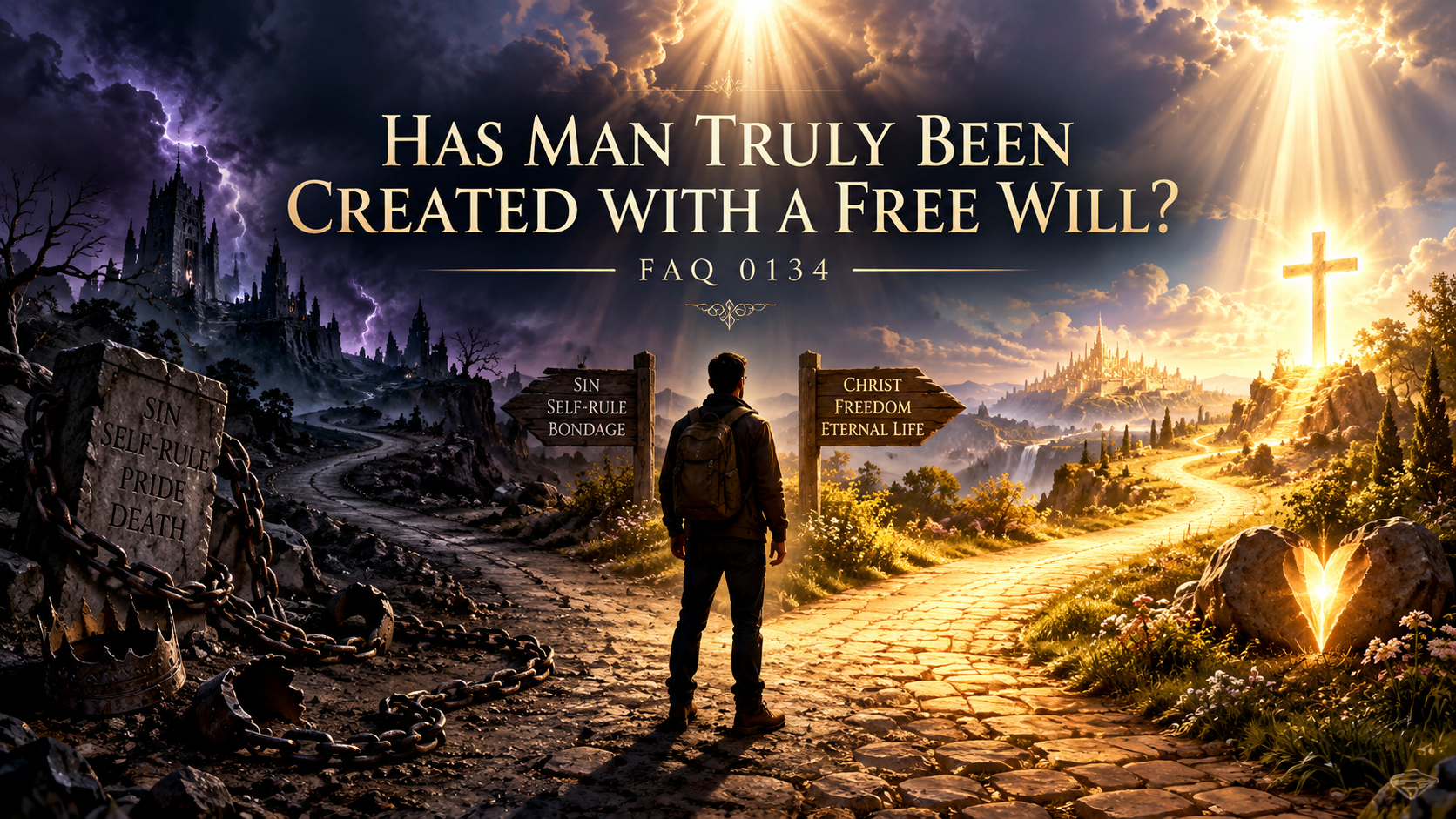
FAQ 0134
HAS MAN TRULY BEEN CREATED WITH A FREE WILL?
Human beings were created with a real, creaturely and morally accountable will, but never with an autonomous will independent of God. The fall did not erase the power of choosing; it corrupted the heart from which choices arise. Saving freedom is therefore not self-produced: God chooses, calls, draws, gives new birth and renews the will so that the sinner genuinely comes to Christ in repentance and faith.
| QUESTION |
| Has man truly been created with a free will? If fallen humanity is dead in sin and salvation rests on God’s election, calling and mercy, are human choices genuine and are people still responsible? |
| SHORT ANSWER |
| Humanity was created with a real but creaturely will. Adam and Eve could understand God’s command, act intentionally and be held accountable, but they were never independent of their Creator. Through the fall, human beings did not cease making choices; the mind, affections and will became corrupted and enslaved to sin. Fallen people willingly act according to what they love, yet they neither seek God nor come savingly to Christ unless the Father draws and grants it. God does not save by violating the will but by giving new life, a new heart and new desires. The renewed person genuinely repents, believes and obeys. Scripture therefore rejects both autonomous free will and fatalism: grace is decisive, human response is real, and God remains sovereign. |
1 Introduction
The expression free will is often used without definition. It may mean the ordinary ability to make voluntary choices, or it may mean an absolute power of self-determination that is morally neutral, unaffected by sin and independent of God’s purpose. Scripture supports the first idea in a qualified sense but not the second. Human beings deliberate, desire, choose and act; yet every human faculty belongs to a dependent creature and, after the fall, is affected by sin.
The question must therefore be answered across the whole biblical story: humanity as created, humanity after the fall, humanity renewed by grace and humanity perfected in glory. A single command to choose cannot cancel passages about spiritual inability, and a passage about election cannot be used to erase commands, warnings or accountability. The Bible holds divine initiative and genuine human responsibility together.
Dr S Y Govender’s Penal Substitutionary Atonement is especially relevant because it connects the atonement with total depravity, sovereign election, the divine drawing of sinners and regeneration. The book’s argument is incorporated below and tested within the wider scriptural witness.
2 What Does Free Will Mean?
| CONCEPT | MEANING | BIBLICAL ASSESSMENT |
| Autonomous freedom | The creature determines itself independently of God, created nature, moral character and divine purpose. | Rejected. No creature is self-existent or sovereign; in God we live, move and exist (Acts 17:28). |
| Neutral moral will | The fallen will stands equally poised between God and sin and can produce saving faith without inward grace. | Rejected. Fallen humanity loves darkness, does not seek God and cannot submit to or please God. |
| Voluntary agency | A person chooses intentionally according to what the heart knows, loves and desires, without external compulsion. | Affirmed. Scripture commands, invites, warns and judges people as responsible actors. |
| Liberated will | God renews the heart by the Spirit so that a sinner willingly repents, believes and begins to obey. | Affirmed. Grace does not make faith unreal; it makes the saving response possible and certain. |
A better biblical expression is creaturely moral agency or a responsible will. It preserves the reality of human choosing without suggesting that human beings possess the absolute independence that belongs to God alone.
The Old Testament also speaks of freewill offerings, using language related to voluntary generosity. Such texts show that an offering was not exacted as a compulsory tribute. They do not establish that fallen sinners possess an autonomous power to create spiritual life or choose Christ apart from grace.
3 Humanity’s Will at Creation
| Genesis 2:16-17 (BSB)
And the LORD God commanded him, ‘You may eat freely from every tree of the garden, but you must not eat from the tree of the knowledge of good and evil; for in the day that you eat of it, you will surely die.’ |
The command assumes that Adam could understand God’s word, live in obedient fellowship and be accountable for transgression. Adam was created in God’s image and placed under God’s authority. His freedom was therefore never sovereignty; it was the freedom of an upright creature within a divinely ordered covenant.
| Ecclesiastes 7:29 (BSB)
Only this have I found: I have discovered that God made men upright, but they have sought out many schemes. |
Human wickedness cannot be blamed on a defect in God’s creative goodness. Humanity was made upright, but human beings sought sinful schemes. Genesis 3 portrays Eve seeing, desiring, taking and eating, and Adam eating with her. The act was voluntary and culpable, yet it was a rejection of the Creator’s word rather than an exercise of independence from Him.
| CREATION CONCLUSION |
| Adam possessed an upright, dependent and morally responsible will. He was able to obey and able to disobey, but he was never able to become autonomous, cease being a creature or place himself beyond God’s authority. |
4 The Will After the Fall
The fall changed the moral condition from which human choices proceed. It did not turn people into stones, machines or beings without preferences. Fallen people continue to reason, plan, love, hate and choose. The bondage lies not in the absence of willing but in the sinful orientation of the heart: people freely choose what they desire, while their natural desires are hostile to God.
| Ephesians 2:1-5 (BSB)
And you were dead in your trespasses and sins, in which you used to walk when you conformed to the ways of this world and of the ruler of the power of the air, the spirit who is now at work in the sons of disobedience. All of us also lived among them at one time, fulfilling the cravings of our flesh and indulging its desires and thoughts. Like the rest, we were by nature children of wrath. But because of His great love for us, God, who is rich in mercy, made us alive with Christ even when we were dead in our trespasses. It is by grace you have been saved! |
Spiritual death is not physical inactivity. Those described as dead are walking, conforming and fulfilling desires. Death means alienation from God’s life and inability to make oneself spiritually alive. The decisive change is expressed by the subject and verb: God made us alive.
| Romans 3:10-12 (BSB)
As it is written: ‘There is no one righteous, not even one. There is no one who understands, no one who seeks God. All have turned away, they have together become worthless; there is no one who does good, not even one.’ |
| Romans 8:7-8 (BSB)
The mind of the flesh is hostile to God: It does not submit to God’s law, nor can it do so. Those controlled by the flesh cannot please God. |
Paul joins unwillingness and inability. The fleshly mind does not submit and cannot submit. The inability is moral and spiritual, not a lack of created faculties. Fallen people do not desire God as God, and their hostility is blameworthy because it arises from their own corrupt heart.
| John 5:39-40 (BSB)
You pore over the Scriptures because you presume that by them you possess eternal life. These are the very words that testify about Me, yet you refuse to come to Me to have life. |
Jesus identifies a real refusal: they are unwilling to come. John 6 adds the corresponding inability: no one can come unless the Father draws and grants it. The biblical diagnosis is therefore not either cannot or will not. Fallen humanity cannot because it will not, and it will not because the heart loves darkness rather than the Light.
5 Commands to Choose and the Reality of Responsibility
| Joshua 24:15, 19 (BSB)
‘But if it is unpleasing in your sight to serve the LORD, then choose for yourselves this day whom you will serve … As for me and my house, we will serve the LORD!’ But Joshua said to the people, ‘You are not able to serve the LORD, for He is a holy God; He is a jealous God; He will not forgive your rebellion or your sins.’ |
The same chapter contains both choose and you are not able. Joshua’s demand exposes divided allegiance and requires a public commitment; his warning destroys shallow confidence in Israel’s natural strength. A command reveals duty, but it does not by itself prove moral ability. God’s law commands perfect love, even though sinners cannot produce it from an unrenewed heart.
Biblical invitations are sincere. Everyone who hears the gospel is commanded to repent and believe, and everyone who comes to Christ will be received. Human inability does not create innocence, because the sinner’s refusal is voluntary. A debtor’s inability to repay through self-inflicted ruin does not cancel the debt; likewise, sinful bondage does not remove accountability for loving the darkness.
Scripture can therefore address the will directly while assigning the saving efficacy to grace. People hear the gospel, repent, believe and call upon Christ. God opens the heart, grants repentance, gives faith and makes alive. These are not rival explanations of one event; they describe the human response and its divine source.
6 Election, Selection and the Priority of Grace
| Ephesians 1:4-6 (BSB)
For He chose us in Him before the foundation of the world to be holy and blameless in His presence. In love He predestined us for adoption as His sons through Jesus Christ, according to the good pleasure of His will, to the praise of His glorious grace, which He has freely given us in the Beloved One. |
Election or selection begins in God’s eternal purpose, is centred in Christ and aims at holiness and adoption. The text does not say that God chose people because they had already made themselves holy. He chose them to be holy, according to the good pleasure of His will, so that grace—not human superiority—receives the praise.
| Romans 9:15-16 (BSB)
For He says to Moses: ‘I will have mercy on whom I have mercy, and I will have compassion on whom I have compassion.’ So then, it does not depend on man’s desire or effort, but on God’s mercy. |
Paul does not deny that the saved person believes or that believers pursue obedience. He denies that mercy originates in human desire or exertion. Election is gracious precisely because God is not paying a debt or rewarding foreseen merit. Justice gives what sin deserves; mercy gives what no sinner can demand.
Romans 8:28-30 presents an unbroken saving purpose: those God foreknew He predestined, called, justified and glorified. In the Reformed reading followed by Dr Govender, foreknowledge is God’s prior loving regard for persons, not merely advance awareness of a self-generated decision. Other evangelical traditions understand election in relation to foreknown faith or corporate union with Christ. Those interpretations should be represented fairly, but none should be used to make grace optional or salvation a ground for boasting.
| ELECTION AND THE GOSPEL |
| Election is not a message that tells sinners to discover whether they are elect before coming. The gospel command is to repent and believe in Christ. Jesus promises that the one who comes to Him will never be driven away (John 6:37). The person who comes discovers that saving mercy began with God. |
7 Regeneration Renews Rather Than Cancels the Will
| John 1:12-13 (BSB)
But to all who did receive Him, to those who believed in His name, He gave the right to become children of God—children born not of blood, nor of the desire or will of man, but born of God. |
Receiving and believing are genuine human acts, but the birth that accounts for becoming God’s children is not produced by ancestry, fleshly desire or the will of man. It is from God. The text does not make faith unreal; it removes human willing as the efficient cause of the new birth.
| Ezekiel 36:26-27 (BSB)
I will give you a new heart and put a new spirit within you; I will remove your heart of stone and give you a heart of flesh. And I will put My Spirit within you and cause you to walk in My statutes and to carefully observe My ordinances. |
Regeneration is not divine coercion applied to an otherwise holy will. It is resurrection and heart replacement. God does not drag a renewed person toward a hated Christ; He removes the stony heart, gives spiritual life and changes the governing disposition so that the person sees Christ as desirable and comes willingly.
| John 6:37, 44, 65 (BSB)
Everyone the Father gives Me will come to Me, and the one who comes to Me I will never drive away. … No one can come to Me unless the Father who sent Me draws him, and I will raise him up at the last day. … This is why I told you that no one can come to Me unless the Father has granted it to him. |
The Father’s gift and drawing do not replace coming; they secure it. Those given to the Son come, and those who come are welcomed. Divine sovereignty and personal faith meet in the same saving movement.
| Philippians 2:12-13 (BSB)
Therefore, my beloved, just as you have always obeyed, not only in my presence, but now even more in my absence, continue to work out your salvation with fear and trembling. For it is God who works in you to will and to act on behalf of His good purpose. |
Believers work because God is at work in them, including at the level of willing. Grace does not produce passivity. It creates willing obedience and sustained action. The renewed will remains a creaturely will, dependent upon the Spirit and still engaged in conflict with the flesh, but it is no longer under sin’s former dominion.
Four States of the Human Will
| STATE | MORAL CONDITION | WILL AND ABILITY |
| Creation | Upright and without sin | Able to obey and able to disobey; dependent on God and accountable. |
| Fall | Dead in sin and hostile to God | Still choosing voluntarily, but unable to come savingly or please God apart from grace. |
| Regeneration | Made alive, given a new heart and indwelt by the Spirit | Freed to come to Christ, believe, obey and fight sin; still dependent and not yet perfected. |
| Glory | Fully conformed to Christ and free from sin’s presence | Perfectly and joyfully free for holiness; no loss of personhood because freedom reaches its proper goal. |
8 Original-Language Observations
| PASSAGE | ROOT WORD | SIGNIFICANCE |
| Joshua 24:15 | Hebrew bachar — choose/select | Israel is summoned to a responsible act of allegiance; verse 19 immediately warns against confidence in natural ability. |
| John 5:40 | Greek thelo — will, desire, be willing | Jesus locates unbelief in a culpable refusal: they are unwilling to come to Him for life. |
| John 6:44, 65 | Greek dynamai — be able, have power | The statements concern ability, not mere permission: no one is able to come unless the Father draws and grants it. |
| John 1:13 | Greek thelema — will, desire, purpose | The new birth is not sourced in the will of the flesh or of man, but in God. |
| Romans 9:16 | Greek thelo and trecho — will/desire and run/strive | Saving mercy is not grounded in human desire or exertion but in the mercy of God. |
| Philippians 2:13 | Greek thelo and energeo — will and work | God’s inward operation produces both renewed willing and obedient action without erasing the believer’s activity. |
No single word settles the entire theology. The cumulative pattern matters: Scripture speaks of choosing and refusing, inability and divine granting, human willing and God’s work within the will. The lexical evidence supports the distinction between genuine agency and autonomous saving power.
9 The Supplied Resource and Major Theological Readings
Dr S Y Govender’s Contribution
In Penal Substitutionary Atonement, Dr Govender argues that original sin affects the whole person—mind, emotions and will. His treatment of total depravity states that fallen humanity is dead in sin, inclined toward self-will, unable to seek or choose God savingly, and unable to change itself. He then traces God’s saving initiative through calling, choosing, drawing, enabling, heart renewal and the granting of repentance and faith.
The book interprets John 1:13 and Ezekiel 36:26-27 as teaching that regeneration is God’s act and that new birth enables the response of faith. Its election chapters emphasize that God chose in Christ before the foundation of the world, not because of foreseen merit, but according to His purpose, love and mercy. This is a Reformed or monergistic account: God alone creates spiritual life, and the regenerated sinner truly responds.
One point requires careful wording. Classical Wesleyan and Arminian theology does not normally claim that fallen humanity can save itself without grace. It usually affirms depravity but teaches prevenient grace given broadly, restoring the ability to respond and remaining resistible. The disagreement is therefore not simply grace versus no grace; it concerns the extent, intention and efficacy of enabling grace and the basis of election.
| VIEW | CLAIM ABOUT THE FALLEN WILL | ASSESSMENT IN THIS FAQ |
| Pelagian | People retain natural moral power to initiate saving obedience without an inward work of grace. | Rejected as inconsistent with spiritual death, inability and the necessity of new birth. |
| Wesleyan/Arminian | Prevenient grace graciously restores a response-capacity to all; grace may be resisted; election is often related to foreknown faith. | Recognized as a historic evangelical view that affirms grace, but not adopted as the ministry’s primary reading. |
| Reformed/monergistic | Effectual grace gives life and renews those God elected; regeneration produces a willing response of repentance and faith. | Adopted as the reading that best integrates John 1:13, John 6:37-65, Ephesians 2, Romans 8-9 and Philippians 2:13. |
| Fatalism | Human decisions, means, preaching and prayer are meaningless because outcomes are fixed impersonally. | Rejected. God’s personal purpose ordains both the saving end and the gospel means, and Scripture holds people responsible. |
10 777th Precinct Ministries Position Statement
777th Precinct Ministries affirms that God created humanity upright, in His image, with intelligence, affections and a real, morally accountable will. Human beings are responsible creatures, not machines. Adam’s original freedom was nevertheless creaturely and covenantal; it was never independence from God’s sustaining power, command or sovereign purpose.
We affirm that the fall corrupted the whole person. Fallen humanity retains the faculty of choosing and makes voluntary decisions, but the natural heart is not morally neutral. It is dead in trespasses, hostile to God, unwilling to come to Christ and unable to submit to or please God savingly. Total depravity does not mean every person is as outwardly wicked as possible; it means no part of the person, including the will, remains untouched by sin, and no sinner can create spiritual life or merit salvation.
We affirm unconditional election in Christ. God chose His people before the foundation of the world according to the good pleasure of His will and the riches of His mercy, not because He foresaw superior merit, works or an independent act of faith. Election is unto holiness, adoption and conformity to Christ, and therefore gives no permission for pride or sin.
We affirm that regeneration is the sovereign work of God through His Word and Spirit. God gives a new heart, makes the sinner alive, draws to the Son and works within the person to will and to act. This grace does not destroy personhood or turn faith into fiction. The renewed sinner genuinely sees, desires, repents, believes, comes to Christ and continues in Spirit-enabled obedience.
We affirm the universal duty to proclaim the gospel and call every hearer to repent and believe. We do not ask people to discover God’s hidden decree before coming to Christ. We announce Christ freely and trust God to save through the ordained means of His Word. Everyone who comes to the Son will be received; everyone who refuses remains responsible for that refusal.
We reject autonomous free will, Pelagian self-salvation, fatalism and coercive caricatures of sovereign grace. The biblical answer is responsible agency under sovereign grace: salvation is of the Lord, faith is the believer’s real response, and all boasting is excluded.
11 Final Summary
- Humanity was created upright with a real, creaturely and accountable will, not an autonomous will independent of God.
- Adam’s command and transgression show understanding, intention and responsibility.
- The fall did not remove ordinary choosing; it corrupted the heart, mind, affections and will from which choices arise.
- Fallen people are active in sin, willingly refuse Christ and cannot come savingly unless the Father draws and grants it.
- A divine command establishes duty but does not prove that the fallen person possesses natural power to fulfil it without grace.
- Election is God’s gracious choice in Christ, according to His purpose and mercy rather than foreseen merit or effort.
- New birth is from God, not from blood, fleshly desire or the will of man.
- Grace renews rather than abolishes the will: God works in believers both to will and to act.
- Repentance and faith are genuine human responses whose saving source and efficacy are God’s grace.
- The gospel must be preached to all, and everyone who comes to Christ will be received.
- The most accurate conclusion is not autonomous free will, but responsible creaturely agency liberated by sovereign grace.
Has man truly been created with a free will? If free will means a real capacity for intentional and accountable choice, the answer is yes, with essential qualifications. If it means moral neutrality, independence from God or an unaided ability to create saving faith after the fall, the answer is no. Humanity’s deepest freedom is not independence from its Creator but liberation from sin to know, love and obey God through Jesus Christ.
Grace to you.
Scripture quotations are from the Berean Standard Bible (BSB), public domain.
OTHER PUBLICATIONS BY THIS AUTHOR CAN BE FOUND AT: