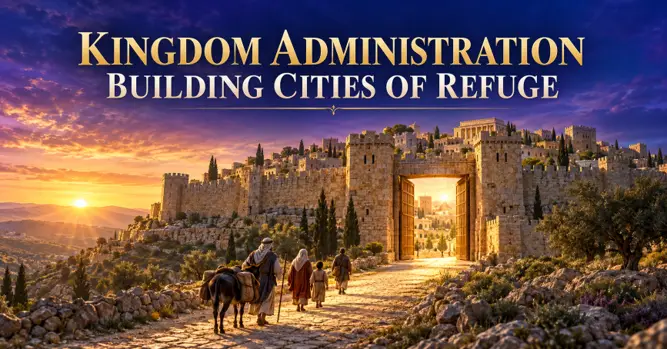
Building cities of refuge is a vital expression of kingdom administration. It becomes visible when the church builds communities in which righteousness, justice, protection, truth, grace and restoration are held together. The six cities of refuge show us that a safe spiritual city must protect the vulnerable, judge matters fairly, form mature sons and keep Christ at the centre of its life.
Heavenly Administration Made Visible on Earth
Revelation 21 presents the holy city coming down from God. The direction matters. Our calling is not to reproduce the systems of the earthly city in heaven; it is to make the character and order of heaven visible on earth. Kingdom administration therefore reaches beyond personal organisation. It includes the ordering of households, the government of the church, the formation of sons, the stewardship of inheritance and the righteous influence of the people of God within their communities.
“The one who overcomes will inherit all things, and I will be his God, and he will be My son.” Revelation 21:7 BSB
The city in Revelation 21 is a holy city. Its life cannot be sustained by corruption, deceit, exploitation or violence. Proverbs says that when the righteous thrive, the city rejoices, and that the blessing of the upright exalts a city (Proverbs 11:10–11). God has not called us to escape broken communities. He has called us to arise as light within them, to occupy faithfully and to reveal another order of life.
In the previous teaching on kingdom administration, we considered the building of dynasties through fathers and sons who labour together. The present question follows naturally: how do fathers and sons help to build cities that are spiritually safe? The Old Testament cities of refuge provide a valuable biblical pattern.
The Biblical Purpose of the Cities of Refuge
The law distinguished intentional murder from an accidental or unpremeditated death. Before Israel had a centralised court system, an avenger of blood could pursue the person responsible for a death. God therefore commanded that cities of refuge be set apart. The accused could flee there, state the case before the elders and remain protected until the congregation judged the matter (Numbers 35:9–34; Deuteronomy 19:1–13; Joshua 20:1–9).
“Tell the Israelites to designate the cities of refuge, as I instructed you through Moses, so that anyone who kills another unintentionally or accidentally may flee there.” Joshua 20:2–3 BSB
These cities did not abolish justice. They prevented private vengeance from deciding guilt before the facts were heard. The elders had to listen, distinguish accident from hatred or premeditation, protect the accused while the matter was judged and uphold the sanctity of life. Refuge and accountability therefore belonged together.
Moses first set apart Bezer, Ramoth in Gilead and Golan on the eastern side of the Jordan (Deuteronomy 4:41–43). Under Joshua, Israel designated the full network of six cities, adding Kedesh, Shechem and Hebron on the western side (Joshua 20:7–8). They were accessible to Israelites and to foreigners living among them. Safety was not reserved for a privileged group.
The Six Cities and the Culture They Represent
The names of the six cities give us a homiletic framework for the spiritual qualities needed in a safe city. Name meanings should be handled with care, because some Hebrew names have more than one proposed derivation. The applications below are therefore prophetic and pastoral readings built on the teaching, while the governing doctrine remains grounded in the clear witness of Scripture.
| East City | Prophetic Emphasis | West City | Prophetic Emphasis |
| Bezer | Fortress and protection | Hebron | Joining and covenant |
| Ramoth | Height and elevation | Shechem | Shoulder and responsibility |
| Golan | Joy and rejoicing | Kedesh | Holiness and sanctuary |
Moses and Joshua in a Father Son Pattern
Scripture presents Joshua as Moses’ assistant and commissioned successor (Exodus 24:13; Numbers 27:18–23; Deuteronomy 34:9). Within the father-son framework of this teaching, Moses represents the fathering function and Joshua represents the mature son who continues the assignment. This is a prophetic application of their relationship, not a replacement for the historical meaning of the text.
The father does not build a private kingdom around himself. He establishes foundations, transmits the word of the Lord, protects the household and prepares sons to carry responsibility. The son does not discard the assignment merely to prove independence. He receives, matures, serves and carries the work forward under God. The city becomes safer when fathers refuse domination and sons refuse irresponsibility.
Protection in Bezer
Bezer is associated with a fortified or inaccessible place. It speaks of protection. A biblical fathering grace helps to establish sound doctrine, clear boundaries and a secure spiritual environment. Paul warned the Ephesian elders that savage wolves would arise and distort the truth after his departure (Acts 20:28–30). Fathers therefore protect the flock by teaching the whole counsel of God and by helping believers discern carnality, error and manipulation.
The father is never the son’s ultimate refuge. He points the son to God. Psalm 91 declares that the one who dwells in the shelter of the Most High may say of the Lord, ‘He is my refuge and my fortress.’ Healthy fathering strengthens a believer’s dependence upon Christ; it does not replace Christ with dependence upon a human leader.
Elevation in Ramoth
Ramoth speaks of height or exaltation. A true father labours for the maturity and elevation of sons, not for their permanent subordination. He sets a godly standard, addresses blind spots and teaches humility. Scripture joins humility to elevation: ‘Humble yourselves before the Lord, and He will exalt you’ (James 4:10).
Joshua served Moses, and Elisha served Elijah before receiving the mantle of responsibility. Their service was not servility. It formed capacity, character and faithfulness. Jesus taught that the greatest must become a servant (Matthew 23:11–12). Kingdom promotion is safest when it rests on humility and tested service.
Joy in Golan
Traditional name studies have rendered Golan as ‘their rejoicing,’ while other lexicons connect the name with captivity or exile. In this teaching, the rejoicing association gives us a pastoral lens: a father is a helper of a son’s joy. Paul said, ‘We do not lord it over your faith, but we work with you for your joy’ (2 Corinthians 1:24).
The father is not the source of joy. Christ is. Jesus said that His joy would remain in His disciples as they abode in His love and obeyed His commands (John 15:9–11). Healthy spiritual fathering cultivates the presence of God, teaches perseverance through sowing and reaping, and helps sons recognise joy within their God-given identity and assignment.
Sanctification in Kedesh
Kedesh is associated with holiness, consecration and sanctuary. A son who represents the Father’s house must be set apart to God. ‘For it is God’s will that you should be sanctified’ (1 Thessalonians 4:3). Sanctification involves separation from what corrupts and consecration to the Lord’s purpose. It includes the renewing of the mind, the circumcision of the heart and the disciplined surrender of conduct, motives and desires.
Paul describes the cleansed vessel as sanctified, useful to the Master and prepared for every good work (2 Timothy 2:20–21). Gift cannot substitute for character. A city cannot remain safe when leaders protect talent while ignoring impurity, manipulation or abuse.
Responsibility in Shechem
Shechem means shoulder and speaks of burden-bearing responsibility. The son gives his shoulder to the assignment of the house. He is not a visitor waiting to be entertained; he is a steward who sees what must be carried and develops the capacity to carry it. The government resting on the Messiah’s shoulder in Isaiah 9:6 reminds us that kingdom government is carried under Christ’s lordship, not through personal ambition.
Joshua continued the assignment entrusted through Moses. Solomon built the temple prepared for by David. Timothy represented Paul’s ways in Christ because he had learned the father’s burden and pattern of life (1 Corinthians 4:17; Philippians 2:19–22). Mature sons do not merely repeat a father’s vocabulary. They embody the same obedience to Christ and faithfully advance the entrusted work.
Covenant in Hebron
Hebron is associated with joining, association, fellowship and alliance. It therefore speaks to us of covenant. Covenant joins hearts around God’s purpose and carries inheritance from one generation to another. Ruth remained joined to Naomi. Elisha refused to abandon Elijah. Timothy served with Paul as a son with a father in the work of the gospel.
Covenant must never become control, enforced loyalty or protection from accountability. Biblical covenant remains submitted to Christ, truth and righteousness. The son pursues relationship, remains faithful and carries the work forward; the father offers truth, love, correction and space for the son to mature. Both remain accountable to the Lord.
Three Paired Principles for Safe Cities
The broad north-to-south arrangement of the cities on the two sides of the Jordan forms three corresponding pairs: Bezer with Hebron, Ramoth with Shechem, and Golan with Kedesh. These pairings provide three practical principles for building safe spiritual communities.
Covenant Strengthens Protection
Bezer and Hebron bring protection and covenant together. Covenant creates a context in which people are known, instructed, corrected and defended. The Lord reveals His covenant to those who fear Him (Psalm 25:14). Ruth’s covenantal faithfulness brought her under the wings of the God of Israel (Ruth 2:12). Where covenant is truthful and Christ-centred, isolation decreases and protection grows.
Servanthood Leads to Elevation
Ramoth and Shechem join elevation to the shoulder of responsibility. Joshua’s service prepared him to lead. Elisha was known as the one who poured water on Elijah’s hands before he carried the prophetic mantle (2 Kings 3:11). Jesus made the principle plain: the greatest among us must become a servant. Promotion without service produces entitlement; service under God produces capacity for trustworthy authority.
Sanctification Sustains Joy
Golan and Kedesh join joy to sanctification. Jesus connected abiding in His love and keeping His commands with the fullness of His joy (John 15:9–11). Holiness is not joyless restriction. It removes what fractures fellowship with God and brings our lives into agreement with His nature. A sanctified son can rejoice in a clear conscience, a settled identity and a fruitful assignment.
Justice Grace and Restoration
The city of refuge was a place of due process, not a hiding place for deliberate violence. That distinction must shape the church today. A safe church protects people from gossip, vengeance and premature condemnation, but it does not conceal wrongdoing, suppress evidence or intimidate those who report harm. Elders must hear matters impartially, establish facts, protect vulnerable people and act within both biblical responsibility and the law.
The gospel also declares that repentant sinners can be washed, sanctified and justified in the name of the Lord Jesus Christ (1 Corinthians 6:9–11). Grace therefore creates a real path to confession, forgiveness, healing and restored fellowship. Yet restoration to fellowship is not the same as automatic restoration to office. Leadership requires biblical qualification, tested character, accountability and safeguarding. Some consequences remain, and some positions may no longer be appropriate.
Where conduct may be criminal, the proper authorities must be involved. Victims must never be pressured to reconcile prematurely, to remain in danger or to carry responsibility for an offender’s reputation. The church becomes a refuge when truth can be spoken safely, justice can proceed without partiality and grace can do its transforming work without being used to avoid accountability.
What a City of Refuge Must Be
A kingdom city of refuge should display the following qualities:
- Christ is the centre and final source of refuge, identity, truth and joy.
- Righteousness shapes both public teaching and private conduct.
- Leaders hear matters carefully and refuse mob judgment, favouritism and secrecy.
- The vulnerable are protected, and allegations of harm are treated seriously.
- Repentance is met with grace, while accountability and necessary consequences remain.
- Fathers equip sons to mature; they do not dominate faith or demand personal dependence.
- Sons carry responsibility, preserve covenant and advance the work entrusted to the house.
- Doctrine, fellowship, the breaking of bread and prayer form a shared kingdom culture in the pattern of Acts 2:42.
Building Cities of Refuge in Our Time
Kingdom administration is the administration of heaven on earth. It must be visible in the way we handle truth, money, relationships, authority, accusation, discipline, repentance and restoration. It must also reach beyond one congregation. The father-son wineskin, the culture of Acts 2:42 and the city church all call believers to move from isolated ministries toward covenantal responsibility for the welfare of the wider community.
This does not mean that the church takes over civil government or claims expertise it does not possess. It means that mature sons of God bring wisdom, integrity, service and hope into every sphere where they are called. Like Joseph and Daniel, they can stand before leaders with tested character and a word that serves the common good. Their authority is demonstrated through righteousness and wisdom, not religious entitlement.
We build safe cities when covenant strengthens protection, when service prepares people for elevation, and when sanctification preserves joy. We build them when fathers release mature sons, sons carry the burden of the house, and both remain under the lordship of Christ. We build them when the innocent are protected, the guilty are called to repentance, the wounded receive care and justice is never sacrificed to preserve appearances.
Conclusion
The six cities of refuge remind us that God’s city has both gates and foundations. Its gates are open to those who need refuge, truth and restoration. Its foundations are righteousness, justice, holiness and covenant. A city without grace becomes harsh; a city without truth becomes unsafe. Kingdom administration holds both together under Christ.
Our mandate is not to flee the darkness but to arise within it as a people formed by another order. May our households, congregations and citywide relationships become places where people can encounter Christ, where matters are judged righteously, where sons mature, and where grace restores without hiding sin. In this way the heavenly city becomes visible on earth.
Questions for Reflection
- Does our spiritual community make it safe for people to tell the truth and ask for help?
- Do we protect people from gossip and premature judgment without concealing wrongdoing?
- Does our model of fathering produce mature sons who depend upon Christ rather than upon a leader?
- Are sons carrying responsibility for the house, or remaining spectators?
- Where must covenant, servanthood or sanctification be strengthened so that protection, elevation and joy can grow?
Scripture note Scripture quotations are from the Berean Standard Bible BSB
OTHER PUBLICATIONS BY THIS AUTHOR CAN BE FOUND AT: