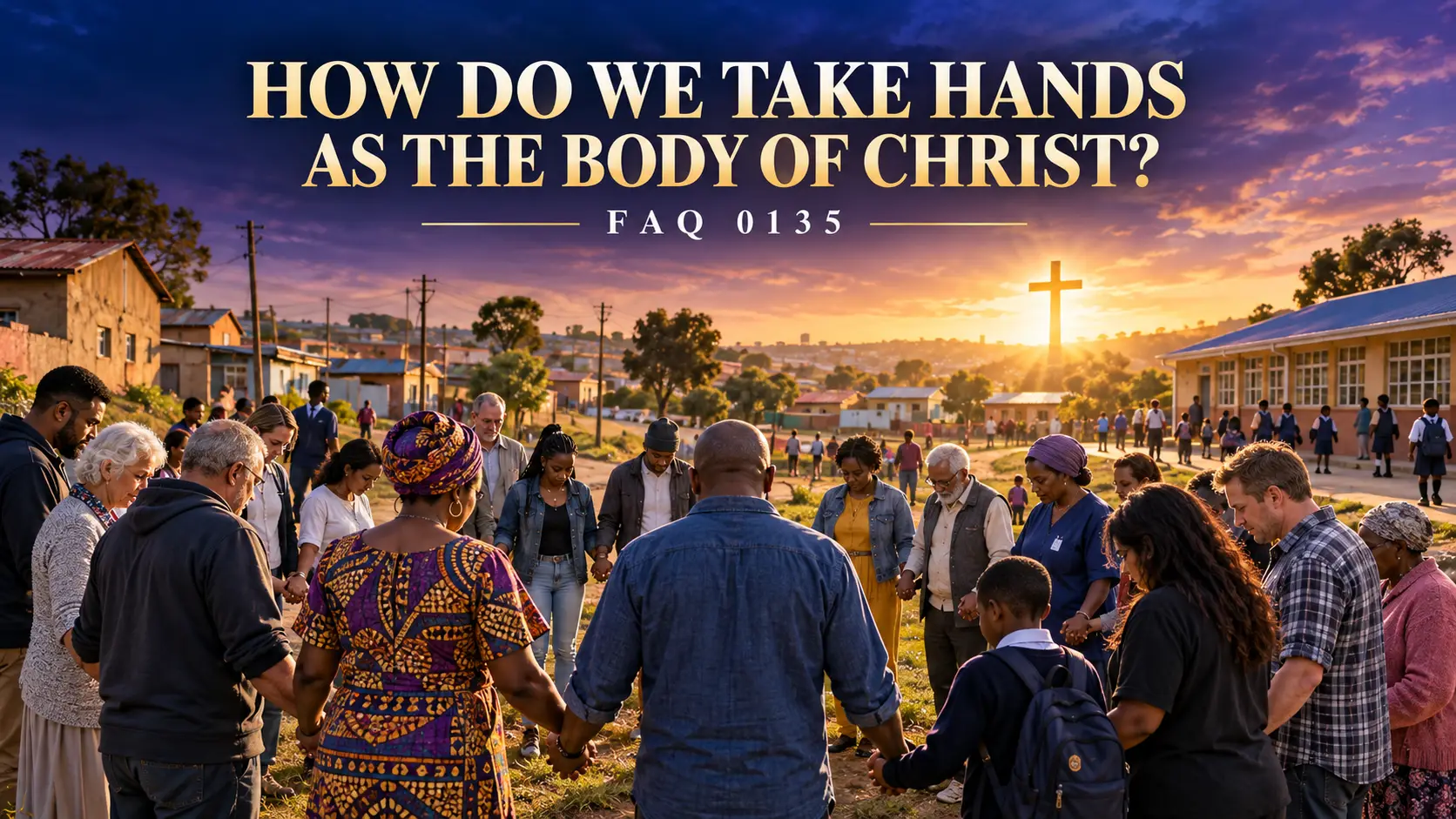
FAQ 0135
How do we take hands as the Body of Christ to have a greater impact?
Union • Unity • Representation • Prayer • Service • Witness
The Body of Christ has its greatest local impact when believers live from their shared union with Christ, preserve the unity of the Spirit, honour one another’s gifts and serve real community needs together. The goal is not control of society, but faithful representation of Jesus Christ so that faith becomes visible, love becomes practical and hope is proclaimed.
Herman Bouwer & Marchell le Roux
777th Precinct Ministries
Question
How do we take hands as the Body of Christ to have a greater impact, bringing faith, love and hope into local communities? Should believers seek to bring governments and society into Kingdom alignment, and what does faithful cooperation look like in practice?
Short Answer
We take hands by beginning with Christ rather than with an organisation, event or political programme. The Holy Spirit has formed one Body with many members and gifts. Believers and congregations can therefore pray together, build trustworthy relationships, listen to their communities, identify shared needs, coordinate their gifts, serve consistently, proclaim the gospel and disciple those who respond. The purpose is not to seize control of the world-system or create a Christian version of Babel. It is to represent Jesus Christ faithfully within the world. When the Body lives in God-formed unity, its work of faith, labour of love and enduring hope become a visible witness that the Father sent the Son.
1 Introduction
The desire to see communities changed by faith, love and hope is biblical. Scripture commands believers to pray for those in authority, love their neighbours, care for the vulnerable, pursue righteousness, proclaim the truth and do good to everyone. The question is how local believers can act together without confusing the Kingdom of God with political control, institutional power or a human programme.
The answer begins with identity. The Church is the Body of Christ, and Christ is its Head. Unity is not created by persuading every congregation to become alike or by placing all ministries under one human structure. The Spirit has already created one Body. Our responsibility is to preserve that unity, mature in Christ and give practical expression to our shared life.
To take hands therefore means that believers recognise one another as members of Christ, form covenant relationships, share responsibility and combine their different gifts for the common good. Local impact follows when this unity becomes visible through prayer, truth, sacrificial service, mercy, justice, discipleship and a clear witness to Jesus Christ.
2 The Biblical Foundation of Restored Representation
Genesis 1:26 (BSB) Then God said, ‘Let Us make man in Our image, after Our likeness, to rule over the fish of the sea and the birds of the air, over the livestock, and over all the earth itself and every creature that crawls upon it.’
Humanity was created to represent God within creation. Image, likeness and rule belong together. Dominion was never autonomous human sovereignty; it was delegated responsibility exercised according to God’s character and purpose.
The fall corrupted that representation. Humanity retained the image of God but no longer expressed Him faithfully. Babel then displayed the corporate form of fallen independence: people united around their own project and declared, ‘Let us make a name for ourselves’ (Genesis 11:4). Unity by itself is therefore not automatically godly. Its source, centre, character and purpose matter.
Colossians 1:13-15, 18 (BSB) He has rescued us from the dominion of darkness and brought us into the kingdom of His beloved Son, in whom we have redemption, the forgiveness of sins. The Son is the image of the invisible God, the firstborn over all creation. … And He is the head of the body, the church.
Jesus Christ is the perfect Image and representative Son. Restoration does not occur when human beings build a stronger religious system. It occurs when people are transferred into Christ’s Kingdom, united with Him and progressively conformed to His life. The Body represents God only by remaining joined to its Head.
| BIBLICAL STAGE | WHAT IT REVEALS | COMMUNITY IMPLICATION |
| Creation | Humanity was made in God’s image for delegated representation. | Community engagement should express God’s character rather than human self-rule. |
| The fall | Sin corrupted personal and corporate representation. | Good intentions and organisational strength cannot replace inner transformation. |
| Babel | Humanity united around self-exaltation and an independent name. | Christian unity must not become a project for status, control or institutional empire. |
| Jesus Christ | The true Image, King and Head has fulfilled God’s purpose and defeated the powers. | The Church serves from Christ’s victory and under His authority. |
| The Body | Believers participate in Christ’s life and represent Him together. | Local impact flows from union, transformation, diverse gifts and shared witness. |
3 Unity Begins in Christ
Ephesians 4:1-6 (BSB) As a prisoner in the Lord, then, I urge you to walk in a manner worthy of the calling you have received: with all humility and gentleness, with patience, bearing with one another in love, and with diligence to preserve the unity of the Spirit through the bond of peace. There is one body and one Spirit, just as you were called to one hope when you were called; one Lord, one faith, one baptism; one God and Father of all, who is over all and through all and in all.
Paul does not command the Church to manufacture spiritual unity. He commands believers to preserve the unity the Spirit has given. Humility, gentleness, patience, love and peace are therefore not optional courtesies. They are the relational environment in which the Body can work together.
1 Corinthians 12:4-7, 12-13 (BSB) There are different gifts, but the same Spirit. There are different ministries, but the same Lord. There are different ways of working, but the same God works all things in all people. Now to each one the manifestation of the Spirit is given for the common good. … The body is a unit, though it is composed of many parts. And although its parts are many, they all form one body. So it is with Christ. For in one Spirit we were all baptized into one body.
Biblical unity does not erase diversity. A local Body becomes effective when apostles, prophets, evangelists, pastors, teachers, intercessors, administrators, helpers, artisans, businesspeople, caregivers and ordinary believers recognise that their gifts belong to Christ and are given for the common good. No congregation or ministry contains every grace needed for a community.
Unity Principle
We do not unite around the importance of our own ministry. We recognise the one Lord, listen to one another, honour the gifts Christ has placed across His Body and cooperate wherever biblical conviction and a shared Kingdom purpose allow us to do so.
4 Why a United Body Influences Communities
John 17:18, 20-23 (BSB) As You sent Me into the world, I have also sent them into the world. … I am not asking on behalf of them alone, but also on behalf of those who will believe in Me through their message, that all of them may be one, as You, Father, are in Me, and I am in You. May they also be in Us, so that the world may believe that You sent Me. I have given them the glory You gave Me, so that they may be one as We are one—I in them and You in Me—that they may be perfectly united, so that the world may know that You sent Me and have loved them just as You have loved Me.
Jesus connects the oneness of His people with the world’s recognition of His mission. The Church’s unity is therefore missional. It gives credibility to the gospel when people who differ in background, culture, congregation and gifting love one another and serve together under Christ.
This oneness begins with ‘I in them.’ Individual believers must participate in Christ’s life before organisational cooperation can become a faithful corporate expression. Shared events cannot substitute for transformed character. Mature oneness grows as believers speak truth in love, forgive one another, bear burdens and allow Christ to direct the whole Body.
The sequence is important: union with Christ leads to transformation; transformed believers learn to live as one Body; the Body then represents Christ; and the world receives a visible witness. Community impact is the fruit of Christ’s life among His people, not the proof of human organisational power.
5 How We Take Hands in Practice
Begin With Prayer and Relationship
Pastors, elders, ministry leaders and believers should meet first to pray, listen and build trust. Cooperation that begins only with a project often ends when the project becomes difficult. Covenant relationship allows people to resolve differences, correct misunderstanding and remain accountable.
Listen Before Designing a Response
The Body should listen to residents and to those already serving the area, including schools, clinics, community organisations, social workers and lawful local authorities. Listening prevents the Church from imposing solutions that answer questions the community is not asking. It also helps identify neglected people, existing strengths and trustworthy partners.
Discern a Shared Assignment
Prayer and local knowledge should lead to a clear, manageable assignment. A network may begin with one shared priority such as food insecurity, family support, youth mentorship, care for older or disabled people, addiction recovery, school assistance or employment preparation. Starting with a defined need allows the Body to serve faithfully and learn together.
Coordinate Different Gifts
One group may provide volunteers, another a venue, another professional expertise, another prayer support and another financial administration. Written responsibilities, safeguarding measures, transparent finances and agreed reporting protect relationships and ensure that no ministry uses a shared initiative merely to enlarge its own platform.
Serve Consistently and Proclaim Christ Clearly
The Church should meet practical needs without manipulating vulnerable people, and it should speak about Jesus without embarrassment. Service and proclamation belong together. Love makes the gospel tangible; truth explains the source of that love; discipleship helps people grow into mature followers of Christ.
Acts 2:42, 44-47 (BSB) They devoted themselves to the apostles’ teaching and to the fellowship, to the breaking of bread and to prayer. … All the believers were together and had everything in common. Selling their possessions and goods, they shared with anyone who was in need. With one accord they continued to meet daily in the temple courts and to break bread from house to house, sharing their meals with gladness and sincerity of heart, praising God and enjoying the favor of all the people. And the Lord added to their number daily those who were being saved.
The early Church joined doctrine, fellowship, prayer, shared meals, generosity, public presence and evangelistic fruit. Local cooperation should keep these elements connected rather than reducing Kingdom impact to a relief programme or a public event.
6 Prayer for Leaders and Local Communities
1 Timothy 2:1-4 (BSB) First of all, then, I urge that petitions, prayers, intercessions, and thanksgiving be offered for everyone—for kings and all those in authority—so that we may lead tranquil and quiet lives in all godliness and dignity. This is good and pleasing in the sight of God our Savior, who wants everyone to be saved and to come to the knowledge of the truth.
The Body should pray for national and local leaders, whether or not those leaders share Christian faith. We may rightly ask God to save them, grant wisdom, restrain injustice and enable conditions in which people can live peacefully and hear the truth. Prayer also protects the Church from treating political opponents as enemies.
Jeremiah 29:7 (BSB) Seek the prosperity of the city to which I have sent you as exiles. Pray to the LORD on its behalf, for if it prospers, you too will prosper.
Jeremiah addressed exiles living under a pagan empire, yet God instructed them to seek the city’s prosperity and pray for it. The Church can therefore cooperate lawfully with civic structures, offer sound counsel, oppose corruption, defend the vulnerable and contribute to public wellbeing without surrendering its allegiance to Christ.
A leader’s conversion is a reason for thanksgiving, but no political officeholder becomes the source of the Kingdom. Jesus Christ remains King. The Church’s public responsibility is faithful prayer, truthful witness, righteous conduct and practical service, whether those in authority receive or reject its message.
7 Bringing Faith Love and Hope
1 Thessalonians 1:2-3 (BSB) We always thank God for all of you, remembering you in our prayers and continually recalling before our God and Father your work of faith, your labor of love, and your enduring hope in our Lord Jesus Christ.
| KINGDOM REALITY | HOW THE BODY EXPRESSES IT | LOCAL COMMUNITY FRUIT |
| Faith | Proclaim Christ, pray, disciple, act on God’s Word and serve with integrity. | People encounter a credible gospel expressed in word and deed. |
| Love | Share resources, bear burdens, protect dignity, forgive, welcome and remain present. | People experience practical care rather than promises without relationship. |
| Hope | Point to Christ’s resurrection and Kingdom, remain faithful in hardship and help people take constructive next steps. | Communities see that present pain does not have the final word. |
James 2:14-17 (BSB) What good is it, my brothers, if someone claims to have faith, but has no deeds? Can such faith save him? Suppose a brother or sister is without clothes and daily food. If one of you tells him, ‘Go in peace; stay warm and well fed,’ but does not provide for his physical needs, what good is that? So too, faith by itself, if it does not result in action, is dead.
Good works do not replace the gospel, and the gospel does not excuse neglect of physical need. Biblical witness holds both together. Faith acts, love labours and hope endures.
Matthew 5:14-16 (BSB) You are the light of the world. A city on a hill cannot be hidden. Neither do people light a lamp and put it under a basket. Instead, they set it on a lampstand, and it gives light to everyone in the house. In the same way, let your light shine before men, that they may see your good deeds and glorify your Father in heaven.
The desired outcome is that the Father is glorified. Community work should not advertise the importance of the Church or its leaders. It should make God’s goodness visible and direct attention to Jesus Christ.
8 What the Church Must Avoid
John 18:36-37 (BSB) Jesus answered, ‘My kingdom is not of this world; if it were, My servants would fight to prevent My arrest by the Jews. But now My kingdom is not of this realm.’ ‘Then You are a king!’ Pilate said. ‘You say that I am a king,’ Jesus answered. ‘For this reason I was born and have come into the world, to testify to the truth. Everyone who belongs to the truth listens to My voice.’
Jesus’ Kingdom concerns the earth, but it does not originate from the fallen world-order or advance by its methods. The Church witnesses to truth from within society while receiving its identity, authority and character from Christ.
| ERROR TO AVOID | BIBLICAL CORRECTION |
| A Christian version of Babel | Do not unite around a name, empire or programme that glorifies human achievement. Gather around Christ. |
| Political domination | Engage government through prayer, truth, lawful cooperation and prophetic accountability, not the seizure of control. |
| Uniformity | Do not require every congregation or ministry to look alike. One Body contains many members and gifts. |
| Competition and platform-building | Shared initiatives exist for the common good, not to enlarge one leader’s reputation or membership. |
| Treating people as enemies | Our struggle is not against flesh and blood. Speak truth, resist evil and honour the humanity of those who disagree. |
| Service without truth | Practical help should be joined to honest witness, prayer and an invitation to discipleship. |
| Words without practical love | Faith that refuses to meet visible need contradicts the message it claims to believe. |
| Unity without discernment | Cooperation must not require silence about the gospel, moral compromise or participation in wrongdoing. |
The Church does not need to manufacture victory over spiritual powers. Christ has already disarmed the powers and authorities and triumphed over them by the cross (Colossians 2:15). We serve from His victory, relying on truth, righteousness, the gospel of peace, faith, salvation, the Word and prayer.
9 A Practical Local Community Framework
STAGE SHARED ACTION ESSENTIAL SAFEGUARD 1 Pray Gather believers and leaders to seek God for the community and those in authority. Let prayer shape the assignment rather than bless a predetermined ambition. 2 Build trust Develop relationships across congregations and ministries before demanding cooperation. Use humility, patience, honour and honest conversation. 3 Listen Hear residents, vulnerable groups and existing community servants. Do not assume that outsiders know the community’s greatest need. 4 Discern Choose one or two shared priorities that fit the gifts and capacity available. Keep the purpose specific, realistic and centred on Christ. 5 Align Agree on roles, leadership, finances, safeguarding, communication and accountability. Use transparent written arrangements and protect the dignity of beneficiaries. 6 Serve and witness Meet needs consistently, proclaim the gospel, pray with people and invite discipleship. Never make aid conditional upon conversion or use people for publicity. 7 Review and multiply Evaluate faithfulness, fruit, relationships and lessons; improve or reproduce what serves well. Celebrate shared fruit without claiming ownership of what God has done. Galatians 6:9-10 (BSB) Let us not grow weary in well-doing, for in due time we will reap a harvest if we do not give up. Therefore, as we have opportunity, let us do good to everyone, and especially to the family of faith.
Local transformation normally requires sustained presence rather than occasional events. The Body should begin at a scale it can serve faithfully, keep its promises and allow trust to grow over time.
Key Original Language Insights
| PASSAGE | KEY WORD | SIGNIFICANCE |
| John 17:21-23 | Greek hen – one | The oneness Jesus prays for arises from shared participation in the Father and Son, not merely structural agreement. |
| Ephesians 4:3 | Greek spoudazo and tereo – be diligent and preserve | Believers actively guard a unity the Spirit has already given. |
| Acts 2:42 | Greek koinonia – fellowship, sharing, participation | Biblical fellowship involves shared life and responsibility, not attendance alone. |
| Ephesians 4:12 | Greek diakonia – service or ministry | Christ equips the saints so the whole Body participates in service. |
| 1 Corinthians 12:7 | Greek symphero – what benefits or contributes | Spiritual gifts are given for the common good rather than private status. |
| John 17 | Greek kosmos – world or ordered sphere | The disciples are sent into the world but do not derive their identity and life from its fallen order. |
10 777th Precinct Ministries Position Statement
777th Precinct Ministries affirms that the Church is the Body of Christ and that Jesus Christ alone is its Head, King and source of authority. The Spirit has formed one Body containing many members, congregations, ministries and gifts. We therefore seek relational and functional cooperation without demanding institutional uniformity.
We affirm that the Church is sent into the world to represent Jesus Christ through gospel proclamation, discipleship, prayer, holy conduct, mercy, justice and practical service. Our public witness should bring faith, love and hope into local communities by making Christ’s life visible in both word and deed.
We affirm the duty to pray for leaders and to seek the wellbeing of the places where God has positioned us. We may cooperate with lawful government and community structures, offer truthful counsel and challenge injustice. We will not confuse political influence with the Kingdom of God or place our hope in a Christianised political order.
We reject competition, platform-building, coercion, manipulation and any attempt to construct a Christian version of Babel. Shared ministry must honour local relationships, transparent stewardship, the dignity of those served and the different graces Christ has placed within His Body.
We believe mature corporate representation grows from union with Christ, personal transformation and Spirit-formed relationships. Our aim is not the glorification of the Body but the revelation of the Son, so that the world may know that the Father sent Him.
11 Final Summary
- The Church’s local impact begins with union with Christ and submission to Him as Head.
- The Spirit has already created one Body; believers must preserve that unity through humility, love and peace.
- Taking hands means covenant relationship, mutual honour, shared responsibility and coordinated service.
- Different gifts and ministries are necessary because no congregation carries every grace needed by a community.
- Prayer for leaders should be joined to truthful witness, righteous conduct and practical participation in community wellbeing.
- Faith becomes visible through obedient action, love through sacrificial service and hope through enduring confidence in Christ.
- The Church should listen to local people, discern real needs and begin with a clear assignment it can sustain.
- Service and gospel proclamation belong together, but aid must never be used to coerce conversion.
- The objective is faithful representation of Christ, not control of the world-system or the creation of a Christian political order.
- Unity must not become uniformity, doctrinal compromise, competition or a platform for human recognition.
- The desired witness is that the world sees the life of Christ in His people and knows that the Father sent the Son.
We take hands as the Body of Christ when we stop treating our congregations and ministries as isolated centres, recognise the life and gifts of Christ in one another and accept shared responsibility for the communities where God has placed us. As we pray, listen, serve, speak the truth and disciple people together, the community encounters a visible expression of faith, love and hope.
Grace to you.
Scripture quotations are from the Berean Standard Bible (BSB), public domain.
OTHER PUBLICATIONS BY THIS AUTHOR CAN BE FOUND AT: