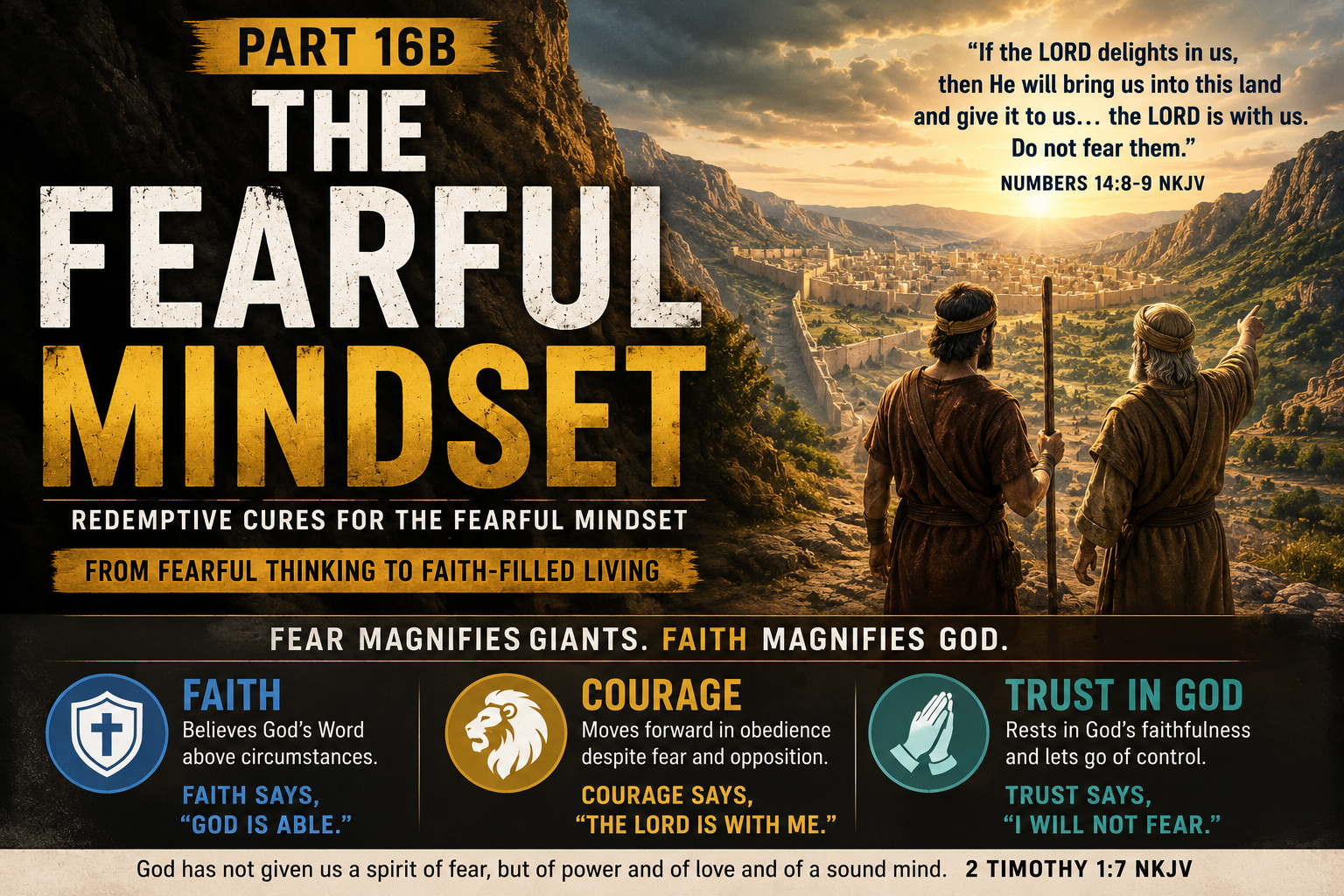
THE FEARFUL MINDSET – REDEMPTIVE CURES FOR THE FEARFUL MINDSET
FROM FEARFUL THINKING TO FAITH-FILLED LIVING
The fearful mindset cannot be overcome by human willpower alone. Fear is not defeated merely by trying to be positive, ignoring danger, or pretending that problems do not exist. Fear is conquered when the mind is brought back under the government of God’s Word, God’s presence, and God’s faithfulness. The cure for fear is not denial; it is renewed confidence in the Lord.
When Israel stood at the border of Canaan, the issue was not the absence of giants. The issue was the absence of faith in the hearts of the people. The giants were real, the cities were fortified, and the warfare was unavoidable. However, God’s promise was greater than the opposition. The ten spies allowed fear to interpret the situation, but Joshua and Caleb allowed faith to interpret the same reality.
Numbers 14:8-9 NKJV
(8) If the LORD delights in us, then He will bring us into this land and give it to us, ‘a land which flows with milk and honey.’
(9) Only do not rebel against the LORD, nor fear the people of the land, for they are our bread; their protection has departed from them, and the LORD is with us. Do not fear them.”
This passage reveals the redemptive cure for the fearful mindset. Joshua and Caleb did not deny the challenge; they declared the Lord’s presence. They did not surrender to intimidation; they called the people back to obedience. They did not speak defeat; they spoke confidence in God. Their mindset was governed by faith, courage, and trust.
God does not want His people to live controlled by fear, panic, intimidation, or negative expectation. He has given them power, love, and a sound mind.
2 Timothy 1:7 NKJV
(7) For God has not given us a spirit of fear, but of power and of love and of a sound mind.
Therefore, the fearful mindset must be replaced with a renewed mindset. Faith must replace unbelief. Courage must replace paralysis. Trust in God must replace anxiety and self-protection. The believer must learn to see through the eyes of God’s promise, speak in agreement with God’s Word, and move forward in obedience even when giants are still present.
The redemptive cure for the fearful mindset can be developed under three powerful Kingdom principles: Faith, Courage, and Trust in God.
Cure 1 for the Fearful Mindset: Faith
Faith is the first and foundational cure for the fearful mindset. Fear governs the mind by making the problem appear greater than God, but faith restores the believer’s focus to the character, Word, promise, and power of God. Faith does not deny the existence of giants, danger, opposition, uncertainty, or warfare. Faith simply refuses to give those things a higher authority than what God has spoken.
- The fearful mindset says, “What if we fail?” Faith says, “If God is with us, who can stand against us?”
- The fearful mindset says, “The giants are too strong.” Faith says, “The Lord is greater than the giants.”
- The fearful mindset says, “We are not able.” Faith says, “God is able.”
Faith is not positive thinking. Faith is not pretending that problems do not exist. Faith is confidence in God’s Word above visible circumstances. It is the decision to allow God’s truth to govern the mind more than fear, emotion, pressure, intimidation, or human reasoning.
Hebrews 11:1 NKJV
(1) Now faith is the substance of things hoped for, the evidence of things not seen.
Faith gives substance to what God has promised before it becomes visible in the natural realm. Fear is controlled by what it sees, but faith is anchored in what God has said. This is why faith is essential for conquering fear. Fear looks at the visible threat; faith looks at the invisible God.
Faith Comes by Hearing the Word of God
The fearful mindset is cured when the mind is continually exposed to the Word of God. Fear grows when a person repeatedly hears the voice of intimidation, failure, danger, accusation, and defeat. Faith grows when a person hears, receives, believes, and meditates on the Word of God.
Romans 10:17 NKJV
(17) So then faith comes by hearing, and hearing by the word of God.
This means faith is not produced by willpower alone. It is produced by hearing God’s Word. When a believer fills the heart with Scripture, the mind begins to be renewed. The voice of God becomes stronger than the voice of fear.
Israel failed at the border of Canaan because they listened more carefully to the report of the ten spies than to the promise of God. God had already declared that He was giving them the land, but they allowed a fearful report to dominate their thinking.
Numbers 13:31 NKJV
(31) But the men who had gone up with him said, “We are not able to go up against the people, for they are stronger than we.”
This negative report became louder to them than God’s promise. Faith was weakened because fear was allowed to preach. The believer must be careful what voice is being allowed to shape the mind. A fearful report will produce fearful decisions, but the Word of God produces faith-filled obedience.
Faith is strengthened when a believer says, “I will not build my decisions on the report of fear. I will build my life on what God has said.”
Faith Believes God’s Promise Above Circumstances
Faith does not ignore circumstances, but it refuses to make circumstances the final authority. The ten spies interpreted Canaan through giants, fortified cities, and danger. Caleb interpreted the same land through the promise of God.
Numbers 13:30 NKJV
(30) Then Caleb quieted the people before Moses, and said, “Let us go up at once and take possession, for we are well able to overcome it.”
Caleb’s faith did not come from self-confidence. It came from God-confidence. He knew that the land was not being taken because Israel was strong in itself, but because God was faithful to His promise.
Faith says, “The promise of God is more reliable than the pressure of the present.”
The fearful mindset allows circumstances to define possibility. Faith allows God’s Word to define possibility. Fear asks, “What can happen to me?” Faith asks, “What has God promised me?” Fear says, “This situation is too difficult.” Faith says, “Nothing is too hard for the Lord.”
Jeremiah 32:17 NKJV
(17) ‘Ah, Lord GOD! Behold, You have made the heavens and the earth by Your great power and outstretched arm. There is nothing too hard for You.
When the believer truly accepts that nothing is too hard for God, fear loses its right to govern decisions. The issue is no longer the size of the problem, but the greatness of the God who has spoken.
Faith Changes the Confession of the Mouth
A fearful mindset produces negative confession, but faith produces agreement with God. The mouth is important because words reveal what the heart is believing. When fear dominates the heart, the mouth begins to speak defeat. When faith dominates the heart, the mouth begins to speak trust, courage, obedience, and promise.
2 Corinthians 4:13 NKJV
(13) And since we have the same spirit of faith, according to what is written, “I BELIEVED AND THEREFORE I SPOKE,” we also believe and therefore speak,
Faith speaks because it believes God. It does not speak arrogance, presumption, or denial. It speaks agreement with God’s Word.
The ten spies said:
Numbers 13:31 NKJV
(31) But the men who had gone up with him said, “We are not able to go up against the people, for they are stronger than we.”
Joshua and Caleb spoke differently:
Numbers 14:8-9 NKJV
(8) If the LORD delights in us, then He will bring us into this land and give it to us, ‘a land which flows with milk and honey.’
(9) Only do not rebel against the LORD, nor fear the people of the land, for they are our bread; their protection has departed from them, and the LORD is with us. Do not fear them.”
Numbers 14:8–9 NKJV
“If the LORD delights in us, then He will bring us into this land and give it to us, ‘a land which flows with milk and honey.’ Only do not rebel against the LORD, nor fear the people of the land, for they are our bread; their protection has departed from them, and the LORD is with us. Do not fear them.”
This is the confession of faith: “The LORD is with us.” Faith does not allow fear to control the language of the believer. It brings the mouth back into agreement with the presence and promise of God.
A believer who is being cured from the fearful mindset must learn to replace fear-filled speech with faith-filled confession:
- Instead of saying, “I am not able,” say, “God is able to strengthen me.”
- Instead of saying, “This will destroy me,” say, “The Lord is my refuge and strength.”
- Instead of saying, “I cannot face this,” say, “I can do all things through Christ who strengthens me.”
- Instead of saying, “The enemy is too strong,” say, “Greater is He who is in me than he who is in the world.”
Philippians 4:13 NKJV
(13) I can do all things through Christ who strengthens me.
Faith-filled confession does not glorify human strength; it glorifies Christ’s strength working in the believer.
Faith Produces Obedience
Faith is not only something a believer says; it is something a believer obeys. True faith moves. It steps forward when God speaks. It responds to the Word of God with action.
James 2:17 NKJV
(17) Thus also faith by itself, if it does not have works, is dead.
The fearful mindset often waits for all fear to disappear before obeying. Faith obeys while trusting God in the presence of pressure. Faith does not require the absence of fear; it requires submission to God above fear.
Abraham is a powerful example of this kind of faith.
Hebrews 11:8 NKJV
(8) By faith Abraham obeyed when he was called to go out to the place which he would receive as an inheritance. And he went out, not knowing where he was going.
Abraham did not obey because he had every detail. He obeyed because he trusted the God who called him. This is the cure for fear-driven paralysis and avoidance of risk. Faith moves because God has spoken, not because every outcome is visible.
Faith says, “I may not know everything, but I know the One who leads me.”
Israel’s first generation failed because they refused to obey through faith. They saw the promise, but fear kept them from entering. Joshua and Caleb had a different spirit because they trusted God enough to move forward.
Numbers 14:24 NKJV
(24) But My servant Caleb, because he has a different spirit in him and has followed Me fully, I will bring into the land where he went, and his descendants shall inherit it.
Faith follows God fully. It does not negotiate with fear. It does not allow intimidation to cancel obedience. It says yes to God even when the assignment requires courage.
Faith Remembers What God Has Already Done
One reason fear becomes powerful is because people forget God’s past faithfulness. Israel had seen the plagues in Egypt, the Red Sea opened, Pharaoh defeated, manna provided, water released from the rock, and the presence of God leading them. Yet when they saw giants, they forgot the God who had already delivered them.
Faith is strengthened by remembrance. A believer must learn to recall the works, faithfulness, provision, protection, and deliverance of God.
Psalms 77:11 NKJV
(11) I will remember the works of the LORD; Surely I will remember Your wonders of old.
Remembering God’s faithfulness weakens fear because it reminds the heart that God has already proven Himself. The same God who delivered before can deliver again. The same God who provided before can provide again. The same God who made a way before can make a way again.
David overcame fear by remembering the Lord’s past deliverance. Before facing Goliath, he remembered how God had delivered him from the lion and the bear.
1 Samuel 17:37 NKJV
(37) Moreover David said, “The LORD, who delivered me from the paw of the lion and from the paw of the bear, He will deliver me from the hand of this Philistine.” And Saul said to David, “Go, and the LORD be with you!”
David’s faith was strengthened by remembrance. He did not face Goliath with empty confidence. He faced him with a testimony. The fearful mindset forgets testimonies, but faith remembers them and uses them as fuel for obedience.
Faith Shifts the Focus from Self to God
Fear often grows when a person focuses too much on self: “Can I do this? Am I strong enough? What if I fail? What if people reject me?” Faith shifts the focus from human limitation to divine sufficiency.
The ten spies said, “We are not able.” Caleb said, “We are well able.” Joshua and Caleb later clarified why: not because Israel was naturally superior, but because the Lord was with them.
Numbers 14:9 NKJV
(9) Only do not rebel against the LORD, nor fear the people of the land, for they are our bread; their protection has departed from them, and the LORD is with us. Do not fear them.”
The foundation of faith is not self-confidence but God-confidence. The believer does not overcome fear by pretending to be strong. The believer overcomes fear by trusting the strength of the Lord.
Ephesians 6:10 NKJV
(10) Finally, my brethren, be strong in the Lord and in the power of His might.
Faith does not say, “I am strong enough in myself.” Faith says, “I am strong in the Lord.” This shift is essential. Fear loses power when the believer stops looking inward for sufficiency and begins looking upward to God.
Faith Receives God’s Presence as Enough
The greatest cure for fear is the assurance of God’s presence. Again and again in Scripture, when God calls people to courage, He attaches courage to His presence.
Isaiah 41:10 NKJV
(10) Fear not, for I am with you; Be not dismayed, for I am your God. I will strengthen you, Yes, I will help you, I will uphold you with My righteous right hand.’
God does not merely say, “Do not fear.” He says, “For I am with you.” His presence is the reason fear does not have to govern the believer.
When Joshua had to lead Israel after Moses, God strengthened him with the promise of His presence.
Joshua 1:9 NKJV
(9) Have I not commanded you? Be strong and of good courage; do not be afraid, nor be dismayed, for the LORD your God is with you wherever you go.”
Faith receives this truth: God’s presence is greater than uncertainty. God’s presence is greater than opposition. God’s presence is greater than lack, rejection, warfare, and pressure.
The believer does not need to know everything when he knows God is with him.
Faith as a cure for fear must be practiced daily. A fearful mindset is often built over time through repeated thoughts, negative experiences, disappointments, trauma, failures, or intimidation. Therefore, the renewed mind must be trained to respond differently.
The believer must daily choose to believe God’s Word, pray through fear, confess truth, obey despite pressure, and remember God’s

faithfulness.
Psalm 56:3–4 NKJV
“Whenever I am afraid, I will trust in You. In God (I will praise His word), In God I have put my trust; I will not fear. What can flesh do to me?”
David did not say he never felt fear. He said, “Whenever I am afraid, I will trust in You.” This is the practical life of faith. Faith does not always mean fear is absent. It means fear is no longer in charge.
- The believer may feel fear, but still choose trust.
- The believer may face uncertainty, but still choose obedience.
- The believer may see giants, but still choose God’s promise.
- The believer may feel weak, but still choose the strength of the Lord.
Faith becomes the cure when trust in God becomes greater than the voice of fear.
Conclusion: Faith Breaks the Rule of Fear
Faith is the cure that breaks the government of fear over the mind. Fear loses its authority when the believer returns to the Word of God, remembers the faithfulness of God, speaks in agreement with God, obeys the instruction of God, and rests in the presence of God.
- Fear says, “You cannot.”
Faith says, “God is able.” - Fear says, “The giants are too strong.”
Faith says, “The Lord is with us.” - Fear says, “Stay where it is safe.”
Faith says, “Obey God and possess the promise.” - Faith does not remove every battle, but it gives the believer courage to move forward with God.
The fearful mindset is cured when the heart becomes fully persuaded that God is faithful, God is present, God is powerful, and God will do what He has promised.
Hebrews 10:23 NKJV
(23) Let us hold fast the confession of our hope without wavering, for He who promised is faithful.
The believer who walks by faith will not be governed by fear. He may face giants, but he will not bow to them. He may face uncertainty, but he will not be ruled by it. He may face opposition, but he will not surrender the promise.
Faith is the cure because faith brings the mind back under the government of God’s Word.
CURE 2 FOR THE FEARFUL MINDSET: COURAGE
Courage is the second major cure for the fearful mindset. If faith restores the believer’s confidence in God, courage gives the believer the strength to act on that faith. Faith believes God; courage obeys God in the presence of fear, pressure, opposition, uncertainty, and risk.
Courage does not mean the absence of fear. Many people misunderstand courage because they think courageous people never feel afraid. Biblical courage is not the denial of fear; it is the refusal to let fear rule. Courage is the inner strength to obey God even when the circumstances are intimidating.
The fearful mindset says, “I am afraid, so I cannot move.” Courage says, “I may feel afraid, but God has commanded me to move.”
The fearful mindset says, “The giants are too strong.” Courage says, “The Lord is stronger than the giants.”
The fearful mindset says, “Let us go back.” Courage says, “Let us go forward with God.”
Courage is not natural boldness, human arrogance, or reckless confidence. True courage is rooted in the presence, command, and faithfulness of God.
Joshua 1:9 NKJV
“Have I not commanded you? Be strong and of good courage; do not be afraid, nor be dismayed, for the LORD your God is with you wherever you go.”
This verse reveals the foundation of biblical courage. God did not tell Joshua to be courageous because Joshua was naturally strong. He told him to be courageous because the Lord would be with him. Courage is born when the believer becomes more aware of God’s presence than the pressure of the assignment.
Courage Confronts Intimidation
A fearful mindset becomes intimidated by the size of the enemy, the strength of opposition, or the possibility of failure. Courage confronts intimidation by refusing to let the enemy define the outcome.
The ten spies were intimidated by the giants in Canaan. They measured themselves against the enemy and concluded that they were not able.
Numbers 31:31 NKJV
(31) So Moses and Eleazar the priest did as the LORD commanded Moses.
Their fear caused them to see the people of the land as stronger than themselves. But courage would have caused them to see God as greater than the people of the land.
Joshua and Caleb carried a different spirit. They did not deny the existence of the giants, but they refused to be intimidated by them.
Numbers 14:8-9 NKJV
(8) If the LORD delights in us, then He will bring us into this land and give it to us, ‘a land which flows with milk and honey.’
(9) Only do not rebel against the LORD, nor fear the people of the land, for they are our bread; their protection has departed from them, and the LORD is with us. Do not fear them.”
This is courage speaking. Joshua and Caleb saw the same giants, but they interpreted the battle through the presence of God. They said, “The LORD is with us.” That statement is the language of courage.
Courage does not pretend there are no giants. Courage says, “The giants are real, but God is greater.” Courage does not deny opposition. Courage says, “The opposition is present, but the Lord is with us.”
Courage Breaks Paralysis
Fear paralyzes people. It causes them to delay obedience, avoid responsibility, postpone decisions, and remain stuck at the border of promise. Courage breaks paralysis by moving the believer from fear-filled hesitation into faith-filled action.
Israel stood at the edge of the Promised Land, but fear stopped them from entering. They cried, complained, and spoke of returning to Egypt.
Numbers 14:3-4 NKJV
(3) Why has the LORD brought us to this land to fall by the sword, that our wives and children should become victims? Would it not be better for us to return to Egypt?”
(4) So they said to one another, “Let us select a leader and return to Egypt.”
Fear made them passive toward promise and active toward retreat. They did not simply refuse to move forward; they began planning a return to bondage. This is what fear-driven paralysis does. It does not keep people neutral. It eventually turns their hearts backward.
Courage is necessary because many assignments from God require movement before comfort is felt. A person may never feel fully ready to confront a giant, step into a calling, obey a difficult instruction, or embrace a new season. If they wait until fear disappears completely, they may never move.
Courage says, “God has spoken, therefore I will obey.”
When God called Joshua to lead Israel into Canaan, He repeatedly commanded him to be strong and courageous. Joshua needed courage because the assignment was not small. There were enemies to face, cities to conquer, rivers to cross, and territories to possess.
Joshua 1:6 NKJV
(6) Be strong and of good courage, for to this people you shall divide as an inheritance the land which I swore to their fathers to give them.
God connected courage to inheritance. Without courage, Joshua would not possess what God had promised. The same is true today. Many believers do not lack promise; they lack courage to obey the process required to possess the promise.
Courage Replaces Negative Confession with Bold Declaration
Fear produces negative confession. It says, “We are not able.” Courage changes the confession of the mouth. Courage speaks in agreement with God’s Word, even when circumstances are difficult.
The ten spies confessed defeat before the battle began. Caleb confessed victory before the land was possessed.
Numbers 13:30 NKJV
(30) Then Caleb quieted the people before Moses, and said, “Let us go up at once and take possession, for we are well able to overcome it.”
Caleb’s words were not careless optimism. They were courageous faith. His confession was not based on Israel’s military strength, but on God’s promise. He spoke differently because he believed differently.
Courage gives the believer language that refuses to bow to fear. It does not speak arrogance; it speaks confidence in God.
A courageous confession sounds like this:
- “I will obey God.”
- “The Lord is with me.”
- “God is faithful.”
- “This battle is not greater than God.”
- “I will not return to bondage.”
- “I will possess what God has promised.”
- “I can do all things through Christ who strengthens me.”
Philippians 4:13 NKJV
(13) I can do all things through Christ who strengthens me.
This kind of confession does not glorify human ability. It glorifies the strength of Christ working in the believer.
Courage Accepts the Risk of Obedience
A fearful mindset avoids risk. It wants certainty before obedience, comfort before movement, and safety before surrender. Courage accepts that obedience to God may involve risk, but it also understands that disobedience is more dangerous than risk.
The ten spies wanted to avoid the risk of warfare in Canaan. But their refusal to enter the land cost them the inheritance of that generation. What looked like safety became judgment. What looked like caution became disobedience.
Numbers 14:22-23 NKJV
(22) because all these men who have seen My glory and the signs which I did in Egypt and in the wilderness, and have put Me to the test now these ten times, and have not heeded My voice,
(23) they certainly shall not see the land of which I swore to their fathers, nor shall any of those who rejected Me see it.
This is sobering. Fear made them avoid the risk of battle, but that avoidance caused them to miss the promise. Courage understands that the safest place is not always the easiest place. The safest place is the will of God.
Abraham demonstrated this kind of courage when he obeyed God and left what was familiar.
Hebrews 11:8 NKJV
(8) By faith Abraham obeyed when he was called to go out to the place which he would receive as an inheritance. And he went out, not knowing where he was going.
Abraham’s obedience required courage. He moved without knowing every detail. He trusted God beyond the borders of familiarity. Courage does not need every answer before it obeys; it needs a word from God.
Courage Is Strengthened by Remembering God’s Faithfulness
Fear grows when people forget what God has already done. Courage is strengthened when the believer remembers the faithfulness of God. David gives us a powerful example of this.
When David faced Goliath, the entire army of Israel was afraid. Goliath’s voice had intimidated the soldiers for forty days. But David’s courage came from remembering previous victories God had given him.
1 Samuel 17:37 NKJV
(37) Moreover David said, “The LORD, who delivered me from the paw of the lion and from the paw of the bear, He will deliver me from the hand of this Philistine.” And Saul said to David, “Go, and the LORD be with you!”
David did not face Goliath with empty confidence. He faced him with testimony. He remembered the lion. He remembered the bear. He remembered the delivering power of God.
Courage is often awakened by testimony. When the believer remembers how God protected, provided, healed, restored, delivered, and strengthened before, courage rises to face the present battle.
The fearful mindset says, “What if God does not come through?” Courage says, “God has been faithful before, and He is faithful now.”
Courage Requires a Different Spirit
Caleb is one of the strongest biblical examples of courage because he refused to follow the fear of the majority. Ten spies spoke fear. The congregation cried in unbelief. The atmosphere became filled with panic, complaint, and rebellion. Yet Caleb stood with faith and courage.
God Himself identified something different in Caleb.
Numbers 14:24 NKJV
(24) But My servant Caleb, because he has a different spirit in him and has followed Me fully, I will bring into the land where he went, and his descendants shall inherit it.
Caleb had a different spirit. He did not allow the fear of the crowd to become his own. He did not surrender his conviction because the majority disagreed. He followed the Lord fully.
Courage often requires a believer to stand differently from the crowd. The majority may choose fear, but the courageous person chooses faith. The majority may complain, but the courageous person declares God’s promise. The majority may retreat, but the courageous person moves forward.
Courage is not controlled by popularity. It is controlled by obedience to God.
Courage Must Be Rooted in God’s Word
God did not only tell Joshua to be strong and courageous; He connected courage to obedience to the Word.
Joshua 1:7–8 NKJV
(7) Only be strong and very courageous, that you may observe to do according to all the law which Moses My servant commanded you; do not turn from it to the right hand or to the left, that you may prosper wherever you go.
(8) This Book of the Law shall not depart from your mouth, but you shall meditate in it day and night, that you may observe to do according to all that is written in it. For then you will make your way prosperous, and then you will have good success.
Biblical courage is not emotional excitement. It is not impulsive bravery. It is courage rooted in the Word of God. Joshua’s courage had to be governed by obedience, meditation, and alignment with God’s instruction.
A person can be naturally bold but spiritually reckless. Biblical courage is different. It does not act outside the Word. It does not move in pride. It does not prove itself through foolish risks. It obeys God with strength, humility, and submission.
The Word of God strengthens courage because it reminds the believer who God is, what God has said, and what God has promised. A mind filled with God’s Word becomes less available to intimidation.
Courage Is Empowered by God’s Presence
The command to be courageous is always connected to the assurance of God’s presence. God never calls His people to courage without also promising His nearness, help, and strength.
Deuteronomy 31:6 NKJV
(6) Be strong and of good courage, do not fear nor be afraid of them; for the LORD your God, He is the One who goes with you. He will not leave you nor forsake you.”
The reason Israel could be courageous was not because the enemies were weak. The reason was that the Lord would go with them. God’s presence is the believer’s courage.
The same truth was spoken to Joshua:
Joshua 1:5 NKJV
(5) No man shall be able to stand before you all the days of your life; as I was with Moses, so I will be with you. I will not leave you nor forsake you.
Courage becomes possible when the believer knows, “I am not facing this alone.” Fear often isolates the mind and makes a person feel abandoned. But courage rises when the heart becomes persuaded that God is present.
Courage Enables the Believer to Confront What Fear Avoids
Fear avoids difficult conversations, hard decisions, spiritual battles, leadership responsibilities, correction, confrontation, new assignments, and unknown territory. Courage enables the believer to face what fear has been avoiding.
David confronted Goliath while others remained silent. Esther approached the king at the risk of her life. Nehemiah rebuilt the wall despite threats and mockery. Daniel continued to pray despite the decree against prayer. The apostles preached Christ even when threatened by authorities.
Each of these examples shows that courage is necessary for obedience.
Esther’s courage is especially powerful. She understood the risk of approaching the king, yet she chose obedience for the sake of her people.
Esther 4:16 NKJV
(16) “Go, gather all the Jews who are present in Shushan, and fast for me; neither eat nor drink for three days, night or day. My maids and I will fast likewise. And so I will go to the king, which is against the law; and if I perish, I perish!”
This is not reckless speech; it is surrendered courage. Esther reached a place where obedience became greater than self-preservation. Fear asks, “How can I protect myself?” Courage asks, “What does God require of me?”
Courage Must Be Practiced
Courage grows through obedience. A person does not become courageous by merely studying courage; courage is formed when the believer repeatedly chooses obedience over fear.
Every time a believer obeys God despite fear, courage is strengthened. Every time a believer confronts intimidation with truth, courage grows. Every time a believer refuses negative confession and speaks God’s Word, courage becomes stronger. Every time a believer steps forward instead of retreating, fear loses ground.
Courage is not only a feeling; it is a discipline of obedience.
Psalms 27:14 NKJV
(14) Wait on the LORD; Be of good courage, And He shall strengthen your heart; Wait, I say, on the LORD!
This verse shows that courage and strength are connected to waiting on the Lord. The believer does not manufacture courage in the flesh. He receives strength from God. As the heart waits on the Lord, courage is renewed.
Practical Signs That Courage Is Replacing Fear
When courage begins to cure the fearful mindset, certain changes become visible:
- The believer stops postponing obedience.
- The believer begins to confront what fear previously avoided.
- The believer speaks God’s Word instead of rehearsing defeat.
- The believer becomes less controlled by people’s opinions.
- The believer is willing to step into new assignments.
- The believer refuses to return to bondage for the sake of comfort.
- The believer moves forward even when circumstances are not perfect.
- The believer chooses God’s will over personal safety and convenience.
Courage does not make life free from battles. Courage makes the believer ready to face battles with God.
Conclusion: Courage Moves Where Fear Refuses to Go
Courage is a necessary cure for the fearful mindset because fear always tries to stop movement. Fear intimidates, paralyzes, speaks negatively, and avoids risk. Courage rises against these patterns and says, “God has spoken, and I will obey.”
Courage does not come from human pride. It comes from faith in God, obedience to His Word, remembrance of His faithfulness, and confidence in His presence.
The fearful mindset asks, “What if I fail?” Courage asks, “What has God commanded?”
The fearful mindset says, “The enemy is too strong.” Courage says, “The Lord is with me.”
The fearful mindset says, “Go back to Egypt.” Courage says, “Move forward into promise.”
God is still calling His people to be strong and courageous. He is calling believers to stop allowing fear to govern decisions, delay obedience, silence confession, and forfeit inheritance.
Joshua 1:9 NKJV
(9) Have I not commanded you? Be strong and of good courage; do not be afraid, nor be dismayed, for the LORD your God is with you wherever you go.”
Courage is the cure that causes faith to move. It is the strength to step forward when fear says retreat. It is the decision to obey God even when the giants are present, the path is uncertain, and the cost is real.
Fear retreats from promise, but courage advances with God.
CURE 3 FOR THE FEARFUL MINDSET: TRUST IN GOD
Trust in God is the third major cure for the fearful mindset. Faith believes what God has said. Courage moves in obedience to what God has said. Trust rests in who God is, even when the outcome is not yet visible.
A fearful mindset is often rooted in misplaced trust. It trusts danger more than God’s protection. It trusts past pain more than God’s healing. It trusts human limitation more than God’s power. It trusts the voice of intimidation more than the voice of the Lord. Fear grows when the heart becomes more persuaded by what could go wrong than by the faithfulness of God.
Trust in God brings the heart back to rest. It teaches the believer to say, “I do not have to understand everything in order to obey God. I do not have to control every outcome in order to follow Him. I do not have to see the full path in order to take the next step.”
Proverbs 3:5-6 NKJV
(5) Trust in the LORD with all your heart, And lean not on your own understanding;
(6) In all your ways acknowledge Him, And He shall direct your paths.
This scripture gives a clear cure for fear. Fear leans heavily on human understanding. It wants to calculate every risk, predict every outcome, and control every possibility. Trust says, “My understanding is limited, but God’s wisdom is perfect. My sight is partial, but God sees the end from the beginning.”
Trust in God Breaks the Need to Control Everything
A fearful mindset often tries to control everything because it does not trust God fully. It wants guarantees before obedience. It wants visible proof before movement. It wants the path to be safe before stepping forward. But the life of faith requires trust beyond what the natural eye can see.
The ten spies failed because they leaned on their own understanding. They saw giants, fortified cities, and strong people, and they concluded that entering the land was impossible.
Numbers 13:31 NKJV
(31) But the men who had gone up with him said, “We are not able to go up against the people, for they are stronger than we.”
Their conclusion was based only on human calculation. They measured Israel against the giants, but they did not measure the giants against God. They looked at military strength, city walls, and physical size, but they forgot the God who had delivered them from Egypt.
Trust in God would have said, “The giants are strong, but God is stronger. The cities are fortified, but God is our fortress. The enemy looks powerful, but the Lord has already promised the land.”
Fear demands control. Trust surrenders control to God.
Trust Remembers That God Is Faithful
Trust is strengthened when the believer remembers that God has never failed His Word. Israel had seen God’s faithfulness again and again. They saw the plagues in Egypt. They saw the Red Sea open. They saw Pharaoh’s army destroyed. They saw manna fall from heaven. They saw water come from the rock. They saw the cloud by day and fire by night.
Yet at the border of Canaan, fear made them forget God’s faithfulness.
Numbers 14:11 NKJV
(11) Then the LORD said to Moses: “How long will these people reject Me? And how long will they not believe Me, with all the signs which I have performed among them?
This verse shows that fear is not a small issue. God connected their unbelief to their failure to remember His signs. They had evidence of His faithfulness, but fear caused them to interpret the future as though God had never helped them before.
Trust says, “The God who brought me out will also bring me in.”
Deuteronomy 7:9 NKJV
(9) “Therefore know that the LORD your God, He is God, the faithful God who keeps covenant and mercy for a thousand generations with those who love Him and keep His commandments;
Trust rests in the covenant faithfulness of God. He is not unstable. He is not unreliable. He is not forgetful. He does not make promises casually. What He speaks, He is able to perform.
Trust Replaces Anxiety with Dependence
Fear produces anxiety because it makes the believer feel responsible for carrying what only God can carry. Anxiety says, “What if I cannot handle this?” Trust says, “God is able to carry me through this.”
Psalms 56:3-4 NKJV
(3) Whenever I am afraid, I will trust in You.
(4) In God (I will praise His word), In God I have put my trust; I will not fear. What can flesh do to me?
David did not pretend that he never experienced fear. He said, “Whenever I am afraid, I will trust in You.” Trust is the decision to turn fear into dependence on God. It is the movement of the heart away from panic and toward reliance on the Lord.
Trust does not always remove the feeling of fear immediately, but it removes fear from the throne. The believer may still feel pressure, but pressure no longer governs the decision. The believer may still face uncertainty, but uncertainty no longer controls obedience.
1 Peter 5:7 NKJV
(7) casting all your care upon Him, for He cares for you.
Fear carries cares. Trust casts cares. Fear rehearses the burden repeatedly. Trust releases the burden to God. Fear says, “I must carry this alone.” Trust says, “God cares for me, and I can place this weight in His hands.”
Trust Keeps the Heart Steady in Uncertainty
The fearful mindset becomes unstable when circumstances are uncertain. It panics when outcomes are unclear. It becomes restless when the path is not fully visible. Trust gives the heart stability because it rests in God’s character, not in perfect conditions.
Isaiah 26:3-4 NKJV
(3) You will keep him in perfect peace, Whose mind is stayed on You, Because he trusts in You.
(4) Trust in the LORD forever, For in YAH, the LORD, is everlasting strength.
This scripture shows the connection between trust and peace. A mind stayed on God is not easily governed by fear. Trust anchors the mind in the Lord instead of allowing it to drift into panic, imagination, suspicion, and worst-case thinking.
- Fear says, “What if everything goes wrong?” Trust says, “God is my everlasting strength.”
- Fear says, “I do not know what will happen.” Trust says, “God knows, and He is faithful.”
- Fear says, “I cannot see the way.” Trust says, “God will direct my path.”
Trust does not require the believer to know everything. Trust requires the believer to know God.
Trust in God Confronts the Fear of Failure
One of the reasons people remain trapped in a fearful mindset is the fear of failure. They fear stepping out and not succeeding. They fear being embarrassed, rejected, disappointed, or defeated. This fear often leads to paralysis and avoidance of risk.
The servant in the parable of the talents is an example of fear-driven failure avoidance.
Matthew 25:25 NKJV
(25) And I was afraid, and went and hid your talent in the ground. Look, there you have what is yours.’
This servant trusted his fear more than his master’s purpose. He protected himself from loss, but he also prevented increase. His fear made him inactive. He thought hiding was safer than stewardship, but his inactivity was judged as unfaithfulness.
Trust in God breaks the fear of failure because it shifts the believer’s confidence from personal perfection to God’s sufficiency. The believer no longer says, “I must be strong enough in myself.” Instead, he says, “God is faithful, and I will obey Him with what He has placed in my hands.”
Psalms 37:5 NKJV
(5) Commit your way to the LORD, Trust also in Him, And He shall bring it to pass.
Trust commits the way to the Lord. It does not bury the assignment in fear. It does not hide the gift in insecurity. It does not refuse obedience because the outcome feels uncertain. Trust places the matter in God’s hands and moves forward in faithfulness.
Trust Receives God’s Presence as Security
Fear looks for security in circumstances. It wants the enemy removed, the path cleared, the money available, the people approving, and the outcome guaranteed. Trust finds security in the presence of God.
Joshua and Caleb understood this. Their courage was not based on the weakness of the enemy but on the presence of the Lord.
Numbers 14:9 NKJV
(9) Only do not rebel against the LORD, nor fear the people of the land, for they are our bread; their protection has departed from them, and the LORD is with us. Do not fear them.”
The statement “the LORD is with us” is the foundation of trust. If God is with us, the presence of giants does not cancel the promise. If God is with us, the size of the battle does not define the outcome. If God is with us, fear does not have the right to govern our decisions.
Psalms 23:4 NKJV
(4) Yea, though I walk through the valley of the shadow of death, I will fear no evil; For You are with me; Your rod and Your staff, they comfort me.
David did not say there was no valley. He did not say there was no shadow. He said he would not fear because God was with him. Trust does not always remove the valley, but it strengthens the heart to walk through it with God.
Trust Rejects the Lie That God Will Abandon You
Fear often whispers, “God brought you this far, but He will not help you now.” This was the lie Israel believed at the border of Canaan. They accused God of bringing them out of Egypt only to destroy them.
Numbers 14:3 NKJV
(3) Why has the LORD brought us to this land to fall by the sword, that our wives and children should become victims? Would it not be better for us to return to Egypt?”
This was a deeply distorted view of God. Fear made them suspicious of the very God who had delivered them. They interpreted God’s purpose through fear and concluded that His intention was harm.
A fearful mindset often does this. It says, “God will fail me. God will abandon me. God will let me be ashamed. God will not provide. God will not protect. God will not come through.”
Trust rejects these lies and returns to the truth of God’s character.
Hebrews 13:5-6 NKJV
(5) Let your conduct be without covetousness; be content with such things as you have. For He Himself has said, “I WILL NEVER LEAVE YOU NOR FORSAKE YOU.”
(6) So we may boldly say: “THE LORD IS MY HELPER; I WILL NOT FEAR. WHAT CAN MAN DO TO ME?”
Trust is strengthened by the assurance that God will not abandon His people. The believer can boldly say, “The LORD is my helper; I will not fear.” This confession is not based on human confidence but on divine faithfulness.
Trust Allows God to Lead the Process
Fear wants the promise without the process. It wants inheritance without wilderness, victory without warfare, maturity without testing, and fruit without obedience. Trust allows God to lead the process, even when the process is uncomfortable.
Israel struggled because they wanted deliverance from Egypt but resisted the process of entering Canaan. They wanted the land, but they did not want the battle. They wanted the fruit, but they feared the giants.
Trust says, “God knows the way He is taking me.”
Psalms 32:8 NKJV
(8) I will instruct you and teach you in the way you should go; I will guide you with My eye.
The believer does not need to manipulate the process. God is able to guide. He instructs, teaches, and watches over the way of His people. Trust submits to His leading.
Psalms 37:23-24 NKJV
(23) The steps of a good man are ordered by the LORD, And He delights in his way.
(24) Though he fall, he shall not be utterly cast down; For the LORD upholds him with His hand.
This scripture gives comfort to the fearful heart. God orders steps. God upholds His people. Even when weakness appears, He does not abandon those who trust Him.
Trust Produces Rest Instead of Panic
The fearful mindset lives in panic. It imagines defeat, rehearses danger, and expects disaster. Trust produces rest because it places confidence in the Lord rather than in human ability.
Psalms 62:5-8 NKJV
(5) My soul, wait silently for God alone, For my expectation is from Him.
(6) He only is my rock and my salvation; He is my defense; I shall not be moved.
(7) In God is my salvation and my glory; The rock of my strength, And my refuge, is in God.
(8) Trust in Him at all times, you people; Pour out your heart before Him; God is a refuge for us. Selah
This passage shows the posture of trust. The soul waits for God. Expectation comes from Him. He is the rock, salvation, defense, strength, and refuge. Trust gives the soul a place to rest.
- Fear asks the soul to panic. Trust calls the soul to wait on God.
- Fear says, “You will be moved.” Trust says, “He is my defense; I shall not be moved.”
- Fear says, “You are exposed.” Trust says, “God is my refuge.”
Trust does not mean the believer is passive. It means the believer acts from rest instead of panic, obedience instead of pressure, and faith instead of fear.
Trust Must Be Practiced in Daily Decisions
Trust in God is not only for major crises. It must be practiced in daily decisions. Every day the believer must choose whether fear or trust will govern the mind.
- Trust is practiced when the believer prays instead of panicking.
- Trust is practiced when the believer obeys instead of delaying.
- Trust is practiced when the believer speaks God’s Word instead of rehearsing fear.
- Trust is practiced when the believer releases control instead of trying to manipulate outcomes.
- Trust is practiced when the believer remembers God’s faithfulness instead of magnifying the threat.
- Trust is practiced when the believer chooses God’s will over personal comfort.
Psalms 9:10 NKJV
(10) And those who know Your name will put their trust in You; For You, LORD, have not forsaken those who seek You.
Trust grows as the believer knows God more deeply. The more the heart knows His name, His nature, His ways, His faithfulness, and His love, the more fear loses its authority.
The fearful mindset is often healed by a deeper revelation of God’s character. When the believer truly knows that God is Father, Shepherd, Refuge, Strength, Helper, Provider, Defender, and Deliverer, the mind begins to rest.
Biblical Example: Daniel Trusted God in the Lions’ Den
Daniel is a powerful example of trust in God overcoming fear. When a decree was signed forbidding prayer to anyone except the king, Daniel did not allow fear to control his devotion. He continued to pray to God as he had done before.
Daniel 6:10 NKJV
(10) Now when Daniel knew that the writing was signed, he went home. And in his upper room, with his windows open toward Jerusalem, he knelt down on his knees three times that day, and prayed and gave thanks before his God, as was his custom since early days.
Daniel’s trust was not circumstantial. He did not trust God only when it was safe. He trusted God when obedience could cost him his life.
When Daniel was thrown into the lions’ den, God delivered him.
Daniel 6:23 NKJV
(23) Now the king was exceedingly glad for him, and commanded that they should take Daniel up out of the den. So Daniel was taken up out of the den, and no injury whatever was found on him, because he believed in his God.
The phrase “because he believed in his God” reveals Daniel’s trust. He was not preserved because there were no lions. He was preserved because his trust was in God. Trust does not always prevent the den, but it reveals God’s power in the den.
Biblical Example: Shadrach, Meshach, and Abed-Nego Trusted God in the Fire
Shadrach, Meshach, and Abed-Nego also demonstrated powerful trust in God. When commanded to bow to Nebuchadnezzar’s golden image, they refused. Their trust was not based on guaranteed deliverance from the furnace; it was based on loyalty to God.
Daniel 3:17–18 NKJV
(17) If that is the case, our God whom we serve is able to deliver us from the burning fiery furnace, and He will deliver us from your hand, O king.
(18) But if not, let it be known to you, O king, that we do not serve your gods, nor will we worship the gold image which you have set up.”
This is mature trust. They believed God was able to deliver them, but their obedience was not dependent on knowing exactly how God would deliver. Their trust was deeper than their desired outcome.
Fear says, “Bow so you can survive.” Trust says, “Obey God and leave the outcome in His hands.”
God met them in the fire.
Daniel 3:25 NKJV
(25) “Look!” he answered, “I see four men loose, walking in the midst of the fire; and they are not hurt, and the form of the fourth is like the Son of God.”
Trust does not always keep the believer out of the fire, but it reveals that God is present in the fire.
Practical Signs That Trust in God Is Replacing Fear
When trust begins to cure the fearful mindset, certain changes become visible:
- The believer becomes less anxious about outcomes.
- The believer stops trying to control every detail.
- The believer obeys even when the future is unclear.
- The believer prays instead of panicking.
- The believer rests in God’s faithfulness.
- The believer stops accusing God when pressure comes.
- The believer speaks with confidence in God’s help.
- The believer is able to wait without losing peace.
The believer sees God as Father, not as an enemy. - The believer moves forward because God is trusted more than fear is believed.
Trust transforms the inner government of the mind. Fear no longer has the final word. God’s character becomes the believer’s resting place.
Conclusion: Trust in God Silences the Rule of Fear
Trust in God is a powerful cure for the fearful mindset because fear loses authority when the heart becomes anchored in God’s faithfulness. Fear is strengthened by uncertainty, but trust is strengthened by knowing who God is.
- Fear says, “You are alone.” Trust says, “The Lord is with me.”
- Fear says, “God will abandon you.” Trust says, “He will never leave me nor forsake me.”
- Fear says, “You must control everything.” Trust says, “God will direct my path.”
- Fear says, “This will destroy you.” Trust says, “God is my refuge and strength.”
Trust does not mean the believer understands everything. It means the believer has surrendered everything into the hands of the God who is faithful, wise, powerful, and good.
Psalms 46:1-2 NKJV
(1) To the Chief Musician. A Psalm of the Sons of Korah. A Song For Alamoth. God is our refuge and strength, A very present help in trouble.
(2) Therefore we will not fear, Even though the earth be removed, And though the mountains be carried into the midst of the sea;
The fearful mindset is cured when the believer stops trusting fear’s predictions and starts trusting God’s promises. Fear may speak loudly, but trust answers with confidence: “God is my refuge, God is my strength, God is my helper, and God is with me.”
Fear loses its rule when trust in God becomes the foundation of the mind.
CONCLUSION: REFUSE TO LET FEAR GOVERN YOUR DECISIONS
The fearful mindset is dangerous because it does not always appear as open rebellion. Sometimes it appears as caution, delay, overthinking, self-protection, negative confession, or the desire to remain where life feels familiar. Yet when fear becomes the ruling voice of the mind, it begins to govern decisions instead of faith in God.
The ten spies in Numbers 13–14 show us how fear can distort reality. They saw the fruit of the Promised Land, but they focused on the giants. They heard the promise of God, but they agreed with the voice of intimidation. They stood at the border of inheritance, but fear kept them from entering. Their fear did not only affect them personally; it influenced an entire generation and turned the hearts of the people away from obedience.
Numbers 14:11 NKJV
(11) Then the LORD said to Moses: “How long will these people reject Me? And how long will they not believe Me, with all the signs which I have performed among them?
This verse reveals that fear is not a small issue when it causes us to reject God’s Word, question His faithfulness, and refuse His instruction. Fear becomes destructive when it makes us forget what God has already done and doubt what God has promised to do.
- A fearful mindset magnifies giants, but faith magnifies God.
- A fearful mindset produces paralysis, but courage moves forward.
- A fearful mindset speaks defeat, but faith agrees with God’s Word.
- A fearful mindset avoids risk, but trust in God obeys beyond comfort.
God never intended His people to live under the government of fear. Fear torments, weakens, delays, and enslaves. But God gives His people power, love, and a sound mind.
2 Timothy 1:7 NKJV
(7) For God has not given us a spirit of fear, but of power and of love and of a sound mind.
The cure for the fearful mindset is found in returning to God. Faith restores confidence in His Word. Courage empowers obedience in the face of opposition. Trust in God brings rest to the heart, even when the outcome is not yet visible.
Joshua and Caleb carried another spirit. They saw the same giants, the same cities, and the same challenges as the ten spies, but they interpreted everything through the presence and promise of God.
Numbers 14:8-9 NKJV
(8) If the LORD delights in us, then He will bring us into this land and give it to us, ‘a land which flows with milk and honey.’
(9) Only do not rebel against the LORD, nor fear the people of the land, for they are our bread; their protection has departed from them, and the LORD is with us. Do not fear them.”
This is the language of a renewed mind. They did not deny the battle, but they refused to fear the enemy. They did not deny the giants, but they declared the presence of God. They did not allow fear to interpret their future. They allowed faith to speak.
- The fearful mindset asks, “What if we fail?” The renewed mind asks, “What has God said?”
- The fearful mindset says, “We are not able.” The renewed mind says, “God is able.”
- The fearful mindset says, “Let us go back to Egypt.” The renewed mind says, “Let us go forward and possess what God has promised.”
Fear will always try to keep you at the border of promise. It will allow you to see what God has prepared, but it will resist your entrance into it. It will make you admire the land from a distance while convincing you that the giants are too strong. But God has not called His people to live at the edge of inheritance. He has called them to walk by faith and possess what He has promised.
Hebrews 10:38 NKJV
(38) NOW THE JUST SHALL LIVE BY FAITH; BUT IF ANYONE DRAWS BACK, MY SOUL HAS NO PLEASURE IN HIM.”
The believer must make a decision: fear will not be allowed to govern my mind, my mouth, my obedience, my relationships, my assignment, or my future. I will not draw back because of intimidation. I will not remain paralyzed because of uncertainty. I will not speak defeat over what God has promised. I will not return to bondage because the promise requires courage.
The time has come to silence the report of fear and believe the report of the Lord.
CALL TO ACTION: CHOOSE FAITH OVER FEAR
Today, examine the areas of your life where fear has been making decisions for you.
- Has fear stopped you from obeying God?
- Has fear made you delay what God told you to do?
- Has fear caused you to speak negatively about your future?
- Has fear convinced you to return to familiar bondage?
- Has fear made you avoid responsibility, confrontation, growth, or Kingdom assignment?
Do not excuse fear. Confront it with the Word of God. Bring every fearful thought under the authority of Christ. Replace intimidation with faith. Replace paralysis with courage. Replace negative confession with the promises of God. Replace avoidance of risk with trust in the Lord.
Psalms 56:3-4 NKJV
(3) Whenever I am afraid, I will trust in You.
(4) In God (I will praise His word), In God I have put my trust; I will not fear. What can flesh do to me?
This must become the confession of the believer: “Whenever I am afraid, I will trust in You.”
Do not wait until every giant disappears before you obey. Do not wait until every risk is removed before you move. Do not wait until every feeling of fear is gone before you step forward. Faith is not proven in the absence of giants; faith is proven when you obey God while giants are still present.
- Rise with faith.
- Move with courage.
- Speak the Word of God.
- Trust the faithfulness of the Lord.
- Refuse to return to Egypt.
- Possess what God has promised.
Joshua 1:9 NKJV
(9) Have I not commanded you? Be strong and of good courage; do not be afraid, nor be dismayed, for the LORD your God is with you wherever you go.”
Let this be your decision: fear will no longer govern my life. I will be strong and of good courage. I will trust the Lord. I will obey His Word. I will move forward by faith.
The fearful mindset keeps people in the wilderness, but faith brings them into promise.
OTHER PUBLICATIONS BY THIS AUTHOR CAN BE FOUND AT: