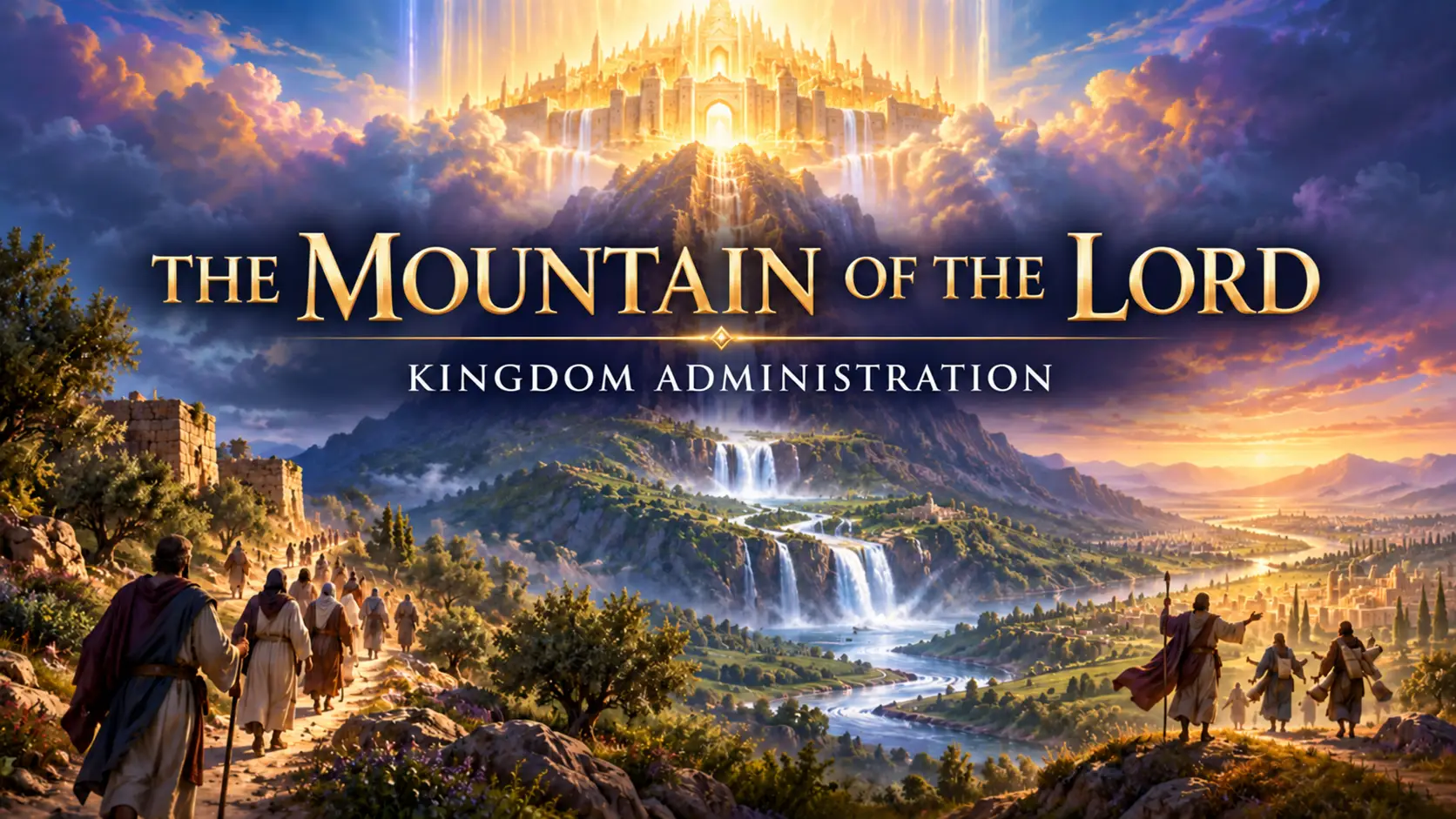
The Mountain of the Lord and the Order of His Kingdom
The Bible’s picture of the mountain of the Lord gives us a way to understand the rule, worship, instruction and witness of God’s people. It is not a call to build a human empire or to claim spiritual superiority. It is a call to draw near to God through Christ, learn His ways, live under His rule and make His life visible in the places where He has sent us.
The outline for this teaching opens with Revelation 21:10. John is carried in the Spirit to a great and high mountain and sees the holy city, Jerusalem, coming down from God. The direction matters: the city comes from God. Its life and pattern originate in Him. The Church does not manufacture heaven by human power; it receives from God and bears witness to His Kingdom on earth.
Isaiah 2:2–3 gives the complementary picture. The mountain of the LORD’s house is established, and people from many nations come to learn His ways and walk in His paths. The mountain is therefore a place of God’s presence and instruction, and a public testimony that His ways are good. Kingdom administration is the faithful ordering of life and service under the King, so that people are taught, cared for and equipped to obey Him.
1. Ascending to the Mountain of the Lord
Isaiah’s vision begins with people saying, “Come, let us go up to the mountain of the LORD.” Their ascent is a response to God’s invitation. Scripture calls believers to draw near with confidence through Jesus (Hebrews 4:16), to seek first God’s Kingdom (Matthew 6:33), and to set their minds on things above (Colossians 3:1–2). The movement is not self-promotion; it is deeper surrender and fellowship with God.
Psalm 24:3–4 asks who may stand in the Lord’s holy place and answers by pointing to clean hands and a pure heart. Intimacy with God and holiness belong together. We ask Him to expose divided loyalties, renew our hunger for His presence, and form obedience in us. The Church ascends as it learns God’s ways and then walks in them. Revelation received but not obeyed has not yet become Kingdom administration.
2. Remaining Faithful to the Lord
Jeremiah 3:6 uses the language of unfaithfulness to describe Israel’s pursuit of other gods on every high mountain and beneath every green tree. The image warns God’s covenant people against giving to another source the trust, worship and allegiance that belong to the Lord. In our own day, worldly values can shape our ambitions and decisions while we continue to use spiritual language.
Romans 12:2 calls believers not to conform to this age, but to be transformed by the renewing of the mind. This does not mean withdrawing from people or refusing to serve in society. It means learning to serve faithfully without allowing the surrounding culture to define success, truth, identity or worship. Joshua 24:15 places the choice before households: serve the Lord. The prayer outline therefore asks God to purify our motives and govern our homes and churches by His Word.
The prophetic metaphor should be handled carefully. It names covenant unfaithfulness; it is not a label to use carelessly against people. The call is first to examine our own hearts, reject idolatry and remain devoted to Christ.
3. The City Descends and Heaven’s Order Becomes Visible
Revelation shows the holy city descending from God. Isaiah 40:4 describes valleys lifted, mountains and hills brought low, and crooked places made straight. In the prayer guide, this picture is applied to God bringing stability and order: He lifts what is low, levels what is proud or obstructive, and makes the path clear.
This is not a promise that life will never include hardship. Scripture instead calls us to be steadfast in the work of the Lord (1 Corinthians 15:58) and no longer tossed about by every wind of teaching (Ephesians 4:14). God forms a people who can remain faithful through changing circumstances. His order corrects what is crooked, strengthens what is weak, and makes room for the body to grow together in love (Ephesians 4:15–16).
Kingdom administration is seen in practical care as well as spiritual language. Acts 6:1–7 shows the apostles responding to a real distribution problem with an orderly solution that protected the vulnerable and preserved the ministry of prayer and the Word. The result was that the Word spread and disciples multiplied. Good administration serves people and protects the Church’s spiritual purpose.
4. Babylon Falls, and God’s Kingdom Endures
Daniel 2:44 declares that the God of heaven will establish a Kingdom that will never be destroyed. In Nebuchadnezzar’s dream, the stone cut without human hands strikes the statue and becomes a great mountain filling the earth (Daniel 2:34–35). The contrast is between kingdoms built on human power and the reign God establishes.
The outline connects this promise with the declaration that Babylon has fallen and that the kingdoms of the world become the Kingdom of our Lord and of His Christ (Revelation 18:2; 11:15). The Church must not confuse this victory with a mandate to seize worldly systems or imitate their methods. Jesus sends His disciples to make disciples and teach obedience to His commands (Matthew 28:19–20). We represent the Kingdom within our communities by living truthfully, serving faithfully and announcing Christ’s reign.
The assurance that Babylon falls gives courage to resist its deceptions and values. It also keeps our hope fixed on God’s action. The Kingdom belongs to Him, and its advance depends on His power and the faithful witness of His people, not on the Church becoming another empire.
5. The Mountain Drips with New Wine
Joel 3:18 pictures the mountains dripping with new wine, the hills flowing with milk, and a fountain coming from the house of the LORD. It is a picture of abundance and life flowing from God’s presence. The prayer guide applies this image to a Church refreshed by God, carrying life outward into dry places.
Romans 12:2 again points to renewed minds. We cannot carry what God is doing faithfully if old patterns of thought continue to govern us. Jesus’ teaching about new wine and wineskins (Matthew 9:17) warns that new wine requires a suitable wineskin. Applying that image to relationships between fathers and sons is a ministry framework, not the direct definition of the passage. In this application, a healthy father-and-son relationship forms, equips and entrusts; a maturing son receives responsibility and helps the household serve God’s purpose across generations.
This must remain under Christ’s lordship. The Church belongs to God, Christ is its Head, and leaders are stewards (1 Corinthians 3:5–11; Ephesians 2:19–22). New wine is not a reason for novelty without discernment. The Spirit who brings life also leads the Church in truth and builds the body in love. We ask for fresh revelation that agrees with Scripture and produces faithful, mature service.
6. Ambassadors of the Kingdom
Isaiah 52:7 celebrates the feet of the one who brings good news and proclaims, “Your God reigns!” Paul later describes believers as ambassadors for Christ, entrusted with the message of reconciliation (2 Corinthians 5:18–20). The mountain is not a place where God’s people gather only for their own benefit. Those who learn His ways are sent to make His reign known.
An ambassador represents the character and message of the one who sent him. We do not carry our own kingdom. We carry the gospel of Jesus Christ, calling people to be reconciled to God and teaching them to obey all that Christ commanded. Fathers and sons serving together can help pass the faith and responsibility to another generation, while every believer bears witness in the environment God has entrusted to them.
A Household That Carries the Mountain’s Witness
The prayer resource closes by encouraging families to gather, read Scripture, pray and share communion. Acts 2:42–47 describes the early believers devoted to the apostles’ teaching, fellowship, breaking of bread and prayers. Their worship shaped a shared life marked by generosity, hospitality and witness. This is a practical picture of a people being formed by God’s order.
The six movements belong together. We ascend by drawing near to God; remain faithful by rejecting rival loyalties; receive His ordering work in our lives and communities; trust that His Kingdom will outlast Babylon; become a people able to carry the life He gives; and go as ambassadors announcing that our God reigns. The mountain of the Lord is therefore both a place of encounter and a testimony to the nations: God teaches His people His ways, and He sends them to walk in those ways.
May the Lord give us clean hands and pure hearts, renew our minds, establish His order in our households and churches, and make us faithful witnesses of the Kingdom of Jesus Christ.
Prayer
Father, draw us nearer to You through Jesus Christ. Give us a greater hunger for Your presence and teach us to walk in Your ways. Keep our hearts faithful and renew our minds by Your Word. Bring stability where we are weak, straighten what has become crooked, and establish the life of Your Kingdom among us. Deliver us from the values and deceptions of Babylon. Refresh Your Church with the life of Your Spirit, form mature servants across generations, and make us faithful ambassadors of reconciliation. Let our households and churches declare in word and deed that You reign. In Jesus’ name, amen.