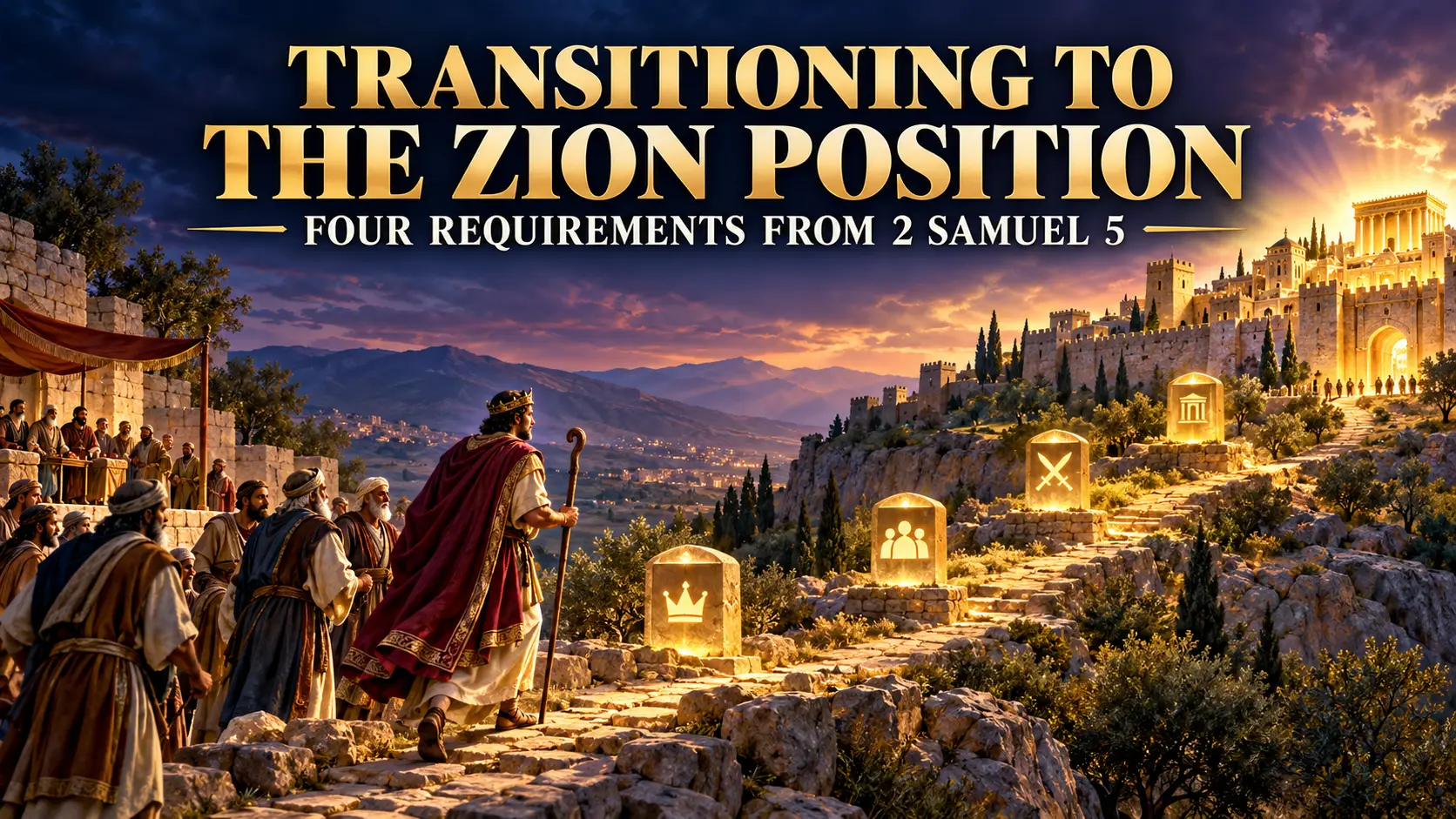
This is Part Two of this two-part teaching series. Read Part One on David’s three anointings and the journey from Adullam to Zion.
Purpose of This Teaching
This teaching explains how a Setman transitions from the covenantal position represented by Hebron into the mature governmental position represented by Zion. Using David’s transition in 2 Samuel 5, it identifies four requirements: covenant recognition, proven governmental capacity, conquest of the stronghold and establishment for corporate purpose.
The Central Principle
David was already anointed before he reached Zion. The move to Zion was therefore not another private experience or a promotion into personal status. It was the enlargement of his responsibility from governing Judah at Hebron to administering a united kingdom from an established governmental centre.
Adullam formed the man. Hebron joined the man and a people covenantally. Zion established the Setman and the people in mature Kingdom administration. The transition to Zion is not rebellion against Hebron; it is the intended fruit of Hebron.
And David realized that the LORD had established him as king over Israel and had exalted his kingdom for the sake of His people Israel.
2 Samuel 5:12 BSB
This provides the governing conclusion: God establishes a Setman so that the people may be protected, matured, equipped and brought into corporate purpose.
The Four Requirements at a Glance
| Requirement | David’s Example | Setman Application |
|---|---|---|
| Covenant recognition | All Israel recognized David and entered covenant at Hebron | Authority is relationally and corporately confirmed |
| Governmental capacity | David had already shepherded and led Israel | The Setman must function faithfully before receiving a greater position |
| Conquest of the stronghold | David captured the fortress of Zion | Entrenched personal, relational and territorial resistance must be overcome |
| Corporate establishment | David occupied, built and governed from Zion | Government is established under God’s presence for the sake of the people |
Requirement One Covenant Recognition and Corporate Alignment
All the tribes of Israel came to David at Hebron. They declared that they were his own flesh and blood, acknowledged his proven leadership while Saul was king and recognized the word of the Lord concerning his call to shepherd and rule Israel. David then made covenant with the elders before the Lord, and they anointed him king over all Israel (2 Samuel 5:1–3).
Four Witnesses Confirmed David
- Relational identity. The tribes recognized that they belonged to one covenant people with David.
- Proven function. They acknowledged that David had already led Israel before receiving the national title.
- Divine declaration. They recognized that the Lord had called David to shepherd and rule His people.
- Covenant agreement. David and the elders entered covenant before the Lord and the grace upon him was publicly confirmed.
David did not install himself over Israel. His private anointing eventually produced corporate recognition. In the same way, a Setman may know that God has called him, but Zion government requires a covenantal people who can recognize the grace, fruit and responsibility upon his life.
This is not government by popularity. It is divine appointment confirmed through relationship, proven service, the Word of God and covenantal agreement.
Requirement Two Proven Shepherding and Governmental Capacity
Israel remembered that David had already led them while Saul occupied the throne. His function preceded his title. He did not suddenly become capable when he received the third anointing.
The order in God’s declaration is important: David would first “shepherd My people Israel” and then rule them (2 Samuel 5:2). Biblical government cannot be separated from shepherding responsibility. The Setman must carry both compassionate care and the capacity to establish righteous order.
David had passed through Bethlehem, Saul’s court, the wilderness, Adullam and Hebron. Each environment developed a different dimension of his capacity. At Adullam he learned to develop distressed and indebted men. At Hebron he learned to govern Judah covenantally. Zion would require him to administer a united kingdom.
Capacity Required for Zion
- A shepherding heart that protects, feeds and develops people
- Freedom from manipulation, insecurity, revenge and premature ambition
- The ability to work with elders and mature leaders
- Sound doctrine and clear communication of the house vision
- Transparent administration and faithful financial stewardship
- The ability to resolve conflict and administer justice
- The development of sons who can carry responsibility
- The capacity to release others into ministry rather than creating dependence
Shepherding without government may produce affection without order. Government without shepherding may produce control without care. Zion requires both the heart of a shepherd and the maturity of a responsible ruler.
Requirement Three Conquest of the Stronghold
Although David had been anointed king over all Israel, the fortress of Zion remained under Jebusite control. His anointing did not automatically remove resistance, and his new title did not automatically give him possession of the city.
The Jebusites mocked David and treated their position as impenetrable. Nevertheless, David “captured the fortress of Zion” (2 Samuel 5:6–7). Anointing gave him divine authority, but faith, obedience, courage and strategy were still required to possess the territory.
Strongholds That Can Resist the Transition
- Personal strongholds such as fear, insecurity, offence, ambition or dependence upon recognition
- Household strongholds such as disorder, financial opacity, immature relationships and controlling leadership
- Governmental strongholds such as the absence of accountable elders, weak administration or perpetual crisis management
- Territorial strongholds such as unbelief, injustice, religious tradition and systems that resist Kingdom order
Resistance should not automatically be interpreted as evidence that the Setman has missed God. The opposition appeared precisely when David moved toward the place God intended him to occupy. He did not return to Hebron because Zion resisted him.
The language concerning the blind and lame in 2 Samuel 5 records the Jebusites’ taunt and the hostility surrounding the battle. It must never be used to demean people with disabilities or portray them as spiritual obstacles. The principle is the overcoming of entrenched resistance, not contempt for vulnerable people.
Zion cannot be administered until the stronghold has been possessed.
Requirement Four Establishment under God’s Presence for the People
Capturing Zion did not complete David’s responsibility. He took up residence in the fortress, called it the City of David and built around it from the supporting terraces inward. David became greater because “the LORD God of Hosts was with him” (2 Samuel 5:9–10).
David Took Up Residence
David did not merely visit Zion. He occupied it. A Setman must inhabit the governmental position God has entrusted to him and accept responsibility for the new territory. He cannot continue governing Zion with an Adullam survival mentality or from the security of the previous Hebron season.
David Built the City
David transformed a captured stronghold into a governmental centre. In the same way, Zion requires sustainable building: accountable leadership, apostolic doctrine, discipleship, financial stewardship, pastoral care, the development of ministry gifts, justice, mission and the capacity to send people into wider assignments.
A powerful gathering does not by itself constitute Zion. Zion is demonstrated by sustained presence, righteous order and responsible administration.
The Lord Was with David
The decisive factor was not David’s personality, military skill or organisational ability. God was with him. A Zion-positioned Setman must remain dependent upon the Word of God, the Holy Spirit, prayer, worship, covenant accountability and the headship of Christ.
Administration without God’s presence becomes bureaucracy. Spiritual manifestations without order produce instability. Zion joins presence and government.
David Understood the Purpose
David realized that God had established him and enlarged the kingdom “for the sake of His people Israel” (2 Samuel 5:12). This is the final test of the Zion position. God did not establish David merely to make David prominent. He established him so that Israel could be protected, governed, matured and brought into divine purpose.
The Setman therefore does not own the people. He is a steward under Christ. His elevation must result in the maturity, function and advancement of the household.
The Complete Transition
- Adullam forms the Setman through adversity, responsibility and hidden preparation.
- Hebron joins the Setman and the household through covenant recognition and partial government.
- Zion establishes the Setman and the people in mature Kingdom administration.
The movement is from formation to covenant, from covenant to government and from government to the corporate representation of God’s purpose.
Diagnostic Questions for the Setman
- Recognition. Is the grace upon my life covenantally recognized or am I merely claiming a position?
- Capacity. Have I demonstrated a shepherding heart and the ability to carry greater governmental responsibility?
- Conquest. Which personal household or territorial strongholds still prevent mature Kingdom function?
- Establishment. Am I building sustainable Christ-centred order that serves and matures the people?
Conclusion
The clearest evidence that a Setman has transitioned into the Zion position is not the acquisition of a more impressive title. It is that the house becomes stable, sons mature, elders function, strongholds are overcome, righteous order is established, God’s presence is honoured and people are equipped and released into purpose.
David remains a biblical pattern, but Jesus Christ is the ultimate King and Head of the Church. Every Setman functions under His lordship and remains accountable to His Word, His Spirit and His Body. Zion is therefore not personal prominence. It is mature, Christ-centred government for the sake of God’s people.
Primary Scripture
2 Samuel 5:1–12. Scripture references and quoted phrases use the Berean Standard Bible BSB.
Return to Part One: David’s Three Anointings From Adullam to Hebron to Zion.