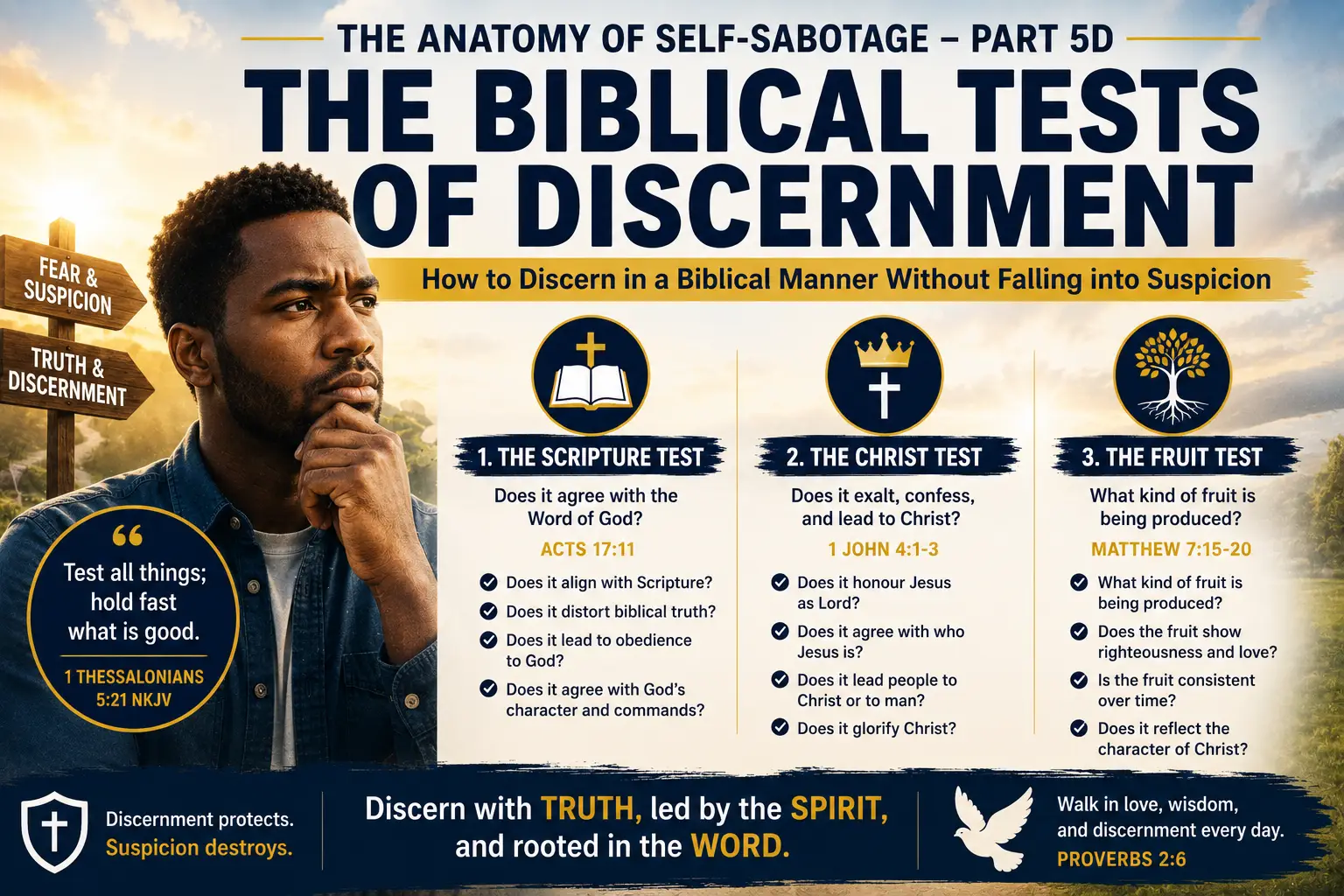
THE ANATOMY OF SELF-SABOTAGE – PART 5D
THE BIBLICAL TESTS OF DISCERNMENT
How to Discern in a Biblical Manner Without Falling into Suspicion
Biblical tests for discernment is not based on fear, suspicion, emotion, personal preference, past wounds, or imagination. True discernment is the ability to judge, test, recognise, and understand matters according to the Word of God, the Spirit of God, the character of Christ, and the fruit that is produced.
A suspicious mindset often says, “I feel something is wrong,” and then treats that feeling as truth. But biblical discernment does not begin and end with feelings. Feelings may alert us, but they must be tested. Not every uneasy feeling is the Holy Spirit. Sometimes it is fear. Sometimes it is past rejection. Sometimes it is jealousy. Sometimes it is trauma. Sometimes it is insecurity. Sometimes it is genuine warning. This is why Scripture commands us to test matters.
1 Thessalonians 5:21 NKJV
(21) Test all things; hold fast what is good.
The believer is not called to believe everything blindly, but neither is the believer called to suspect everything fearfully. We are called to test all things and hold fast what is good.
The following are important biblical tests for discernment.
-
The Scripture Test
The first and most important test of discernment is the Word of God. Anything that contradicts Scripture must be rejected, no matter how spiritual, emotional, powerful, impressive, prophetic, popular, or convincing it may appear.
The Bereans provide a powerful example of biblical discernment. They did not reject Paul’s message suspiciously, but they also did not receive it blindly. They searched the Scriptures to see whether what was being taught was true.
Acts 17:11 NKJV
(11) These were more fair-minded than those in Thessalonica, in that they received the word with all readiness, and searched the Scriptures daily to find out whether these things were so.
This is healthy discernment. The Bereans were open, but not gullible. They were teachable, but not careless. They received the word with readiness, but they tested it by Scripture.
A believer must ask:
- Does this agree with the written Word of God?
- Does this teaching distort Scripture?
- Does this prophecy contradict biblical truth?
- Does this counsel lead me toward obedience to God or away from Him?
- Does this decision agree with the character and commandments of God?
Even if something sounds spiritual, if it contradicts Scripture, it is not from God.
Paul warned the Galatians about receiving a message that contradicted the gospel they had already received.
Galatians 1:8–9 NKJV
(8) But even if we, or an angel from heaven, preach any other gospel to you than what we have preached to you, let him be accursed.
(9) As we have said before, so now I say again, if anyone preaches any other gospel to you than what you have received, let him be accursed.
This is a strong warning. Even supernatural appearances must be tested by the truth of the gospel. An angelic manifestation, a dream, a vision, a prophecy, a teaching, or a spiritual experience must never be allowed to overrule the Word of God.
The Scripture test protects us from deception.
-
The Christ Test
True discernment must ask whether something exalts Christ, confesses Christ correctly, and leads people into obedience to Christ. The Holy Spirit does not draw attention away from Jesus. He glorifies Jesus.
John gave a clear test concerning spirits.
1 John 4:1–3 NKJV
(1) Beloved, do not believe every spirit, but test the spirits, whether they are of God; because many false prophets have gone out into the world.
(2) By this you know the Spirit of God: Every spirit that confesses that Jesus Christ has come in the flesh is of God,
(3) and every spirit that does not confess that Jesus Christ has come in the flesh is not of God. And this is the spirit of the Antichrist, which you have heard was coming, and is now already in the world.
The Christ test asks:
- Does this honour Jesus Christ as Lord?
- Does this agree with the truth of who Jesus is?
- Does this lead people to Christ or to man?
- Does this produce obedience to Christ?
- Does this magnify Christ or does it glorify personality, power, money, platform, or self?
A true move of God will not minimise Christ. It will not replace Christ with mystical experiences, human personalities, emotional excitement, or hidden revelations. The Holy Spirit always glorifies Jesus.
John 16:13–14 NKJV
(13) However, when He, the Spirit of truth, has come, He will guide you into all truth; for He will not speak on His own authority, but whatever He hears He will speak; and He will tell you things to come.
(14) He will glorify Me, for He will take of what is Mine and declare it to you.
If something claims to be spiritual but does not glorify Christ, it must be tested carefully.
-
The Fruit Test
Jesus taught that people are known by their fruit. Fruit reveals nature over time. Words may impress, gifts may amaze, and appearances may persuade, but fruit exposes the true condition of a life, ministry, doctrine, or spirit.
Matthew 7:15–20 NKJV
(15) “Beware of false prophets, who come to you in sheep’s clothing, but inwardly they are ravenous wolves.
(16) You will know them by their fruits. Do men gather grapes from thornbushes or figs from thistles?
(17) Even so, every good tree bears good fruit, but a bad tree bears bad fruit.
(18) A good tree cannot bear bad fruit, nor can a bad tree bear good fruit.
(19) Every tree that does not bear good fruit is cut down and thrown into the fire.
(20) Therefore by their fruits you will know them.
CONCLUSION: FROM SUSPICION TO HEALED DISCERNMENT
The suspicious mindset is destructive because it causes a person to live under the government of fear, distrust, jealousy, rejection, and assumption. It turns relationships into threats, kindness into hidden agendas, correction into rejection, and silence into accusation. It causes the heart to see enemies where God may have placed helpers, friends, counsellors, fathers, sons, brothers, sisters, or covenant relationships.
Suspicion does not only damage how we see others; it also damages how we see ourselves and how we respond to God. A suspicious person often lives guarded, defensive, isolated, and inwardly tormented. They may desire love, but fear receiving it. They may desire relationship, but resist vulnerability. They may desire truth, but interpret truth through pain. They may desire discernment, but confuse discernment with paranoia.
This is why the suspicious mindset must be brought under the authority of Christ. The believer cannot afford to allow fear and past wounds to become the lens through which every relationship is judged. The mind must be renewed. The heart must be healed. The tongue must be governed. The emotions must be submitted to the Holy Spirit. The believer must learn to discern without suspicion, trust without foolishness, love without fear, and communicate without accusation.
The Word of God gives us the pattern for this transformation.
Romans 12:2 NKJV
(2) And do not be conformed to this world, but be transformed by the renewing of your mind, that you may prove what is that good and acceptable and perfect will of God.
A suspicious mindset is not healed by denial. It is healed by renewal. The believer must allow the Word of God to confront false assumptions, expose fear, correct unhealthy interpretations, and restore the ability to see people through truth and love.
The life of Saul warns us of what happens when suspicion is left untreated. Saul’s jealousy caused him to “eye David” from that day forward. He turned a faithful servant into an imagined enemy. His suspicion robbed him of peace, corrupted his leadership, and damaged his relationships. Hanun also shows us the danger of suspicion when he interpreted David’s kindness as espionage. What was meant to comfort him became, in his mind, a threat. Suspicion turned kindness into conflict.
These examples remind us that suspicion can cause unnecessary battles. It can create wars that were never meant to exist. It can break relationships that God intended to strengthen. It can make a person fight against the very grace God sent to help them.
The cure is not foolish trust, but healed trust. It is not blindness, but biblical discernment. It is not pretending people cannot do wrong, but refusing to accuse without truth. It is not ignoring wounds, but allowing God to heal them so they no longer control our perception.
Love is central to this healing.
1 Corinthians 13:4–7 NKJV
(4) Love suffers long and is kind; love does not envy; love does not parade itself, is not puffed up;
(5) does not behave rudely, does not seek its own, is not provoked, thinks no evil;
(6) does not rejoice in iniquity, but rejoices in the truth;
(7) bears all things, believes all things, hopes all things, endures all things.
Love “thinks no evil.” This does not mean love is naïve. It means love does not live by evil assumptions. Love does not quickly assign wicked motives without evidence. Love does not rejoice in suspicion, accusation, or imagined betrayal. Love rejoices in the truth.
A renewed believer must therefore ask the Lord to remove every lens of fear, jealousy, rejection, and distrust. The prayer of the heart must become: “Lord, teach me to see clearly. Heal what has been wounded. Correct what has been distorted. Deliver me from false suspicion. Give me discernment without paranoia, wisdom without fear, and love without accusation.”
- Where suspicion has broken relationships, God can bring restoration.
- Where suspicion has produced isolation, God can restore fellowship.
- Where suspicion has caused division, God can make us peacemakers.
- Where suspicion has created misinterpretation, God can teach us honest communication.
- Where suspicion has been confused with discernment, God can train our senses by His Word and Spirit.
The suspicious mindset loses its power when the believer becomes secure in the love of God. Fear is cast out by perfect love. Rejection is healed by acceptance in Christ. Jealousy is healed by identity and gratitude. Isolation is healed by fellowship and humility. Defensive behaviour is healed by trust in God’s protection. Paranoia is healed by true discernment.
The final call is therefore not merely to stop being suspicious, but to walk in the renewed mind of Christ.
- A healed mind no longer assumes evil without evidence.
- A healed heart no longer punishes present relationships for past wounds.
- A healed believer no longer calls fear discernment.
- A healed disciple learns to love wisely, trust God fully, communicate truthfully, and discern biblically.
This is the pathway from suspicion to freedom. When Christ renews the mind and heals the heart, relationships are no longer governed by fear. They become places where truth, love, humility, wisdom, and grace can flow again.
OTHER PUBLICATIONS BY THIS AUTHOR CAN BE FOUND AT: