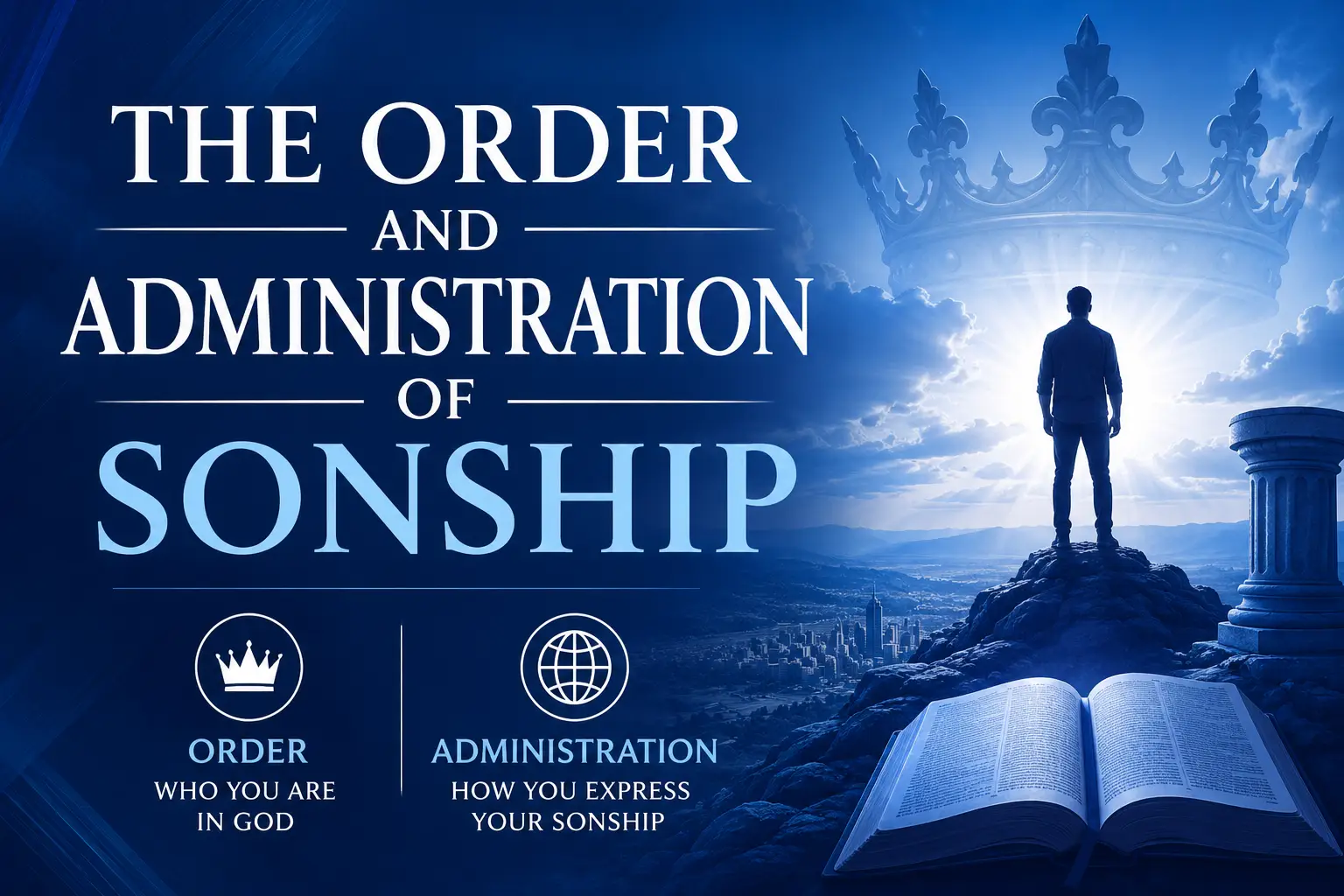
THE ORDER AND ADMINISTRATION OF SONSHIP: A BIBLICAL GUIDE TO SPIRITUAL IDENTITY
Sonship is one of the central themes of Scripture. From Genesis to Revelation, God reveals His intention to bring people into His image, nature, and divine purpose. In this blog post, I unpack the order and administration of sonship, showing how identity in God is meant to shape life, maturity, and spiritual expression on the earth.
Before exploring this subject in depth, it is helpful to define two important ideas: order and administration. These concepts help explain both the identity of sonship and the practical outworking of sonship in daily life.
UNDERSTANDING SONSHIP THROUGH ORDER AND ADMINISTRATION
- Order refers to identity, position, design, and divine arrangement.
- Administration refers to expression, function, stewardship, and manifestation in earthly reality.
When we define sonship in biblical terms, we begin to see that it is expressed in two complementary ways:
- Order describes who you are in essence before God.
- Administration describes how your sonship identity is expressed and manifested through your life on earth.
THE MEANING OF SONSHIP IN SCRIPTURE
Sonship carries both an eternal order and an earthly administration. The order of sonship speaks of our identity and origin in God: we are sons of God by spiritual birth and divine nature. The administration of sonship speaks of how that heavenly identity is expressed, governed, and manifested in the earth through our walk as believers, disciples, ambassadors, and representatives of Christ.
SONSHIP FROM GENESIS TO REVELATION
Genesis 1:26 NKJV
(26) Then God said, “Let Us make man in Our image, according to Our likeness; let them have dominion over the fish of the sea, over the birds of the air, and over the cattle, over all the earth and over every creeping thing that creeps on the earth.”
Genesis presents a foundational picture of sonship: image, likeness, and dominion. Humanity was created to reflect God and to carry His authority in the earth.
A consistent biblical principle emerges: dominion is connected to sonship. From Genesis onward, Scripture moves toward the fuller revelation of the sons of God coming into maturity and expression.
In Genesis 5, Seth is described in terms of image and likeness. Even where the word son is not heavily emphasized, the language of image and likeness points directly to sonship.
Exodus 4:22 NKJV
(22) Then you shall say to Pharaoh, ‘Thus says the LORD: “Israel is My son, My firstborn.
In Exodus, sonship expands from an individual pattern to a corporate reality. Israel, as a nation, is called God’s son, showing that sonship can describe a people chosen to represent God’s purpose in the earth.
HOW SONSHIP DEVELOPS THROUGH DAVID AND CHRIST
2 Samuel 7:14 NKJV
(14) I will be his Father, and he shall be My son. If he commits iniquity, I will chasten him with the rod of men and with the blows of the sons of men.
The narrative then narrows from national sonship to a singular individual: David. In David, the theme of sonship becomes more focused, preparing the way for its ultimate fulfillment in Christ.
Psalms 2:7 NKJV
(7) “I will declare the decree: The LORD has said to Me, ‘You are My Son, Today I have begotten You.
Psalm 2 deepens this revelation. The language of sonship is linked to enthronement, authority, and divine appointment. What appears in David prophetically reaches its fullness in Jesus Christ.
This trajectory becomes even clearer in the prophetic and apostolic witness of Scripture.
Amos 9:11 NKJV
(11) “On that day I will raise up The tabernacle of David, which has fallen down, And repair its damages; I will raise up its ruins, And rebuild it as in the days of old;
Acts 15 interprets Amos by showing that God is restoring the tabernacle of David in a way that reaches beyond form and ritual into divine purpose.
Acts 15:16-17 NKJV
(16) ‘AFTER THIS I WILL RETURN AND WILL REBUILD THE TABERNACLE OF DAVID, WHICH HAS FALLEN DOWN; I WILL REBUILD ITS RUINS, AND I WILL SET IT UP;
(17) SO THAT THE REST OF MANKIND MAY SEEK THE LORD, EVEN ALL THE GENTILES WHO ARE CALLED BY MY NAME, SAYS THE LORD WHO DOES ALL THESE THINGS.’
This restoration points to more than worship expression. It points to the restoration of sonship, authority, and the mature representation of God’s nature in His people.
Matthew 3:16-17 NKJV
(16) When He had been baptized, Jesus came up immediately from the water; and behold, the heavens were opened to Him, and He saw the Spirit of God descending like a dove and alighting upon Him.
(17) And suddenly a voice came from heaven, saying, “This is My beloved Son, in whom I am well pleased.”
By the time we reach the Gospels, the theme of sonship is unmistakable. Jesus is publicly affirmed as the beloved Son, revealing the true pattern of sonship that Scripture has been building toward all along.
Hosea 11:1 NKJV
(1) “When Israel was a child, I loved him, And out of Egypt I called My son.
Matthew 2:15 NKJV
(15) and was there until the death of Herod, that it might be fulfilled which was spoken by the Lord through the prophet, saying, “OUT OF EGYPT I CALLED MY SON.”
These passages show how the Word unfolds dynamically across history. What appears in Israel, in David, and in prophetic language finds its fullest meaning in Christ and then extends to all who are in Him.
John’s Gospel makes this deeply personal: all who receive Christ are given the right to become children of God. Sonship is not reserved for a spiritual elite; it is the inheritance of every believer born of God.
John 1:12 NKJV
(12) But as many as received Him, to them He gave the right to become children of God, to those who believe in His name:
YOUR IDENTITY AND THE WORK OF THE SPIRIT
Romans 8:14-17 NKJV
(14) For as many as are led by the Spirit of God, these are sons of God.
(15) For you did not receive the spirit of bondage again to fear, but you received the Spirit of adoption by whom we cry out, “Abba, Father.”
(16) The Spirit Himself bears witness with our spirit that we are children of God,
(17) and if children, then heirs—heirs of God and joint heirs with Christ, if indeed we suffer with Him, that we may also be glorified together.
Romans 8 shows that the sons of God are led by the Spirit of God. The Spirit confirms our relationship with the Father and bears witness that we belong to Him as heirs with Christ.
This is both assurance and invitation. Sonship is granted in Christ, yet believers are also called to grow into the maturity, likeness, and full expression of that sonship.
Throughout the New Testament, sonship remains a governing idea. Believers are not merely called to religious activity but to live from identity, transformation, and spiritual maturity.
By the time Scripture reaches Revelation, the theme of sonship has come into full view.
Revelation 21:7 NKJV
(7) He who overcomes shall inherit all things, and I will be his God and he shall be My son.
Revelation presents sonship not only as identity but also as inheritance, overcoming, and fullness. The goal is maturity into the image and measure of Christ.
The Bible begins with sonship and closes with sonship, revealing the consistency of God’s purpose from beginning to end.
Revelation 22:3-4 NKJV
(3) And there shall be no more curse, but the throne of God and of the Lamb shall be in it, and His servants shall serve Him.
(4) They shall see His face, and His name shall be on their foreheads.
The name of God upon His people speaks of shared nature, likeness, and fulfilled design. God’s intention has always been to form a people who reflect Him and carry His life faithfully in the earth.
Any authentic spiritual formation must move believers toward maturity in Christ and the growth of sonship.
Church communities should become growth centres where people are equipped to mature in identity, responsibility, and spiritual inheritance. Healthy leadership does not enslave believers; it helps them grow into sonship.
PRACTICAL SONSHIP FOR BELIEVERS TODAY
The call of God still brings His people out of bondage, limitation, and false systems into mature identity. Sonship calls believers out of spiritual captivity and into freedom, formation, and purpose.
For believers today, this means recognizing that spiritual identity is not built on titles, numbers, or external systems. True strength flows from knowing who you are in God.
Many believers are sons by birth in Christ but still need growth in maturity, understanding, and expression. The issue is often not identity itself, but the lack of awareness and development of that identity.
One of the deepest crises in the world is identity confusion. Sonship answers that crisis by grounding believers in the reality that they belong to the family of God.
When a believer understands sonship, life is no longer driven by insecurity. Sonship carries direction, inheritance, and the confidence that God is shaping His people into the image of His Son.
Growth in sonship is not sustained by constant external control, but by inward transformation. As identity matures, conduct begins to flow from nature rather than pressure.
Many believers carry great potential yet live beneath their calling because they do not fully understand who they are. Sonship lifts the believer beyond limitation and into spiritual clarity.
DISCIPLESHIP AND SONSHIP: WHAT IS THE DIFFERENCE?
Discipleship is a necessary process, but sonship is the goal. A disciple learns, follows, and is formed through obedience; a son lives from identity, nature, and inheritance. The journey of discipleship prepares the believer for the mature expression of sonship.
EMBRACING SONSHIP AS YOUR SPIRITUAL IDENTITY
Without process there is no outcome, but without identity there is no direction. Embrace your sonship, grow in spiritual maturity, and walk in the fullness of what God has declared over your life.
GRACE AND PEACE TO YOU.