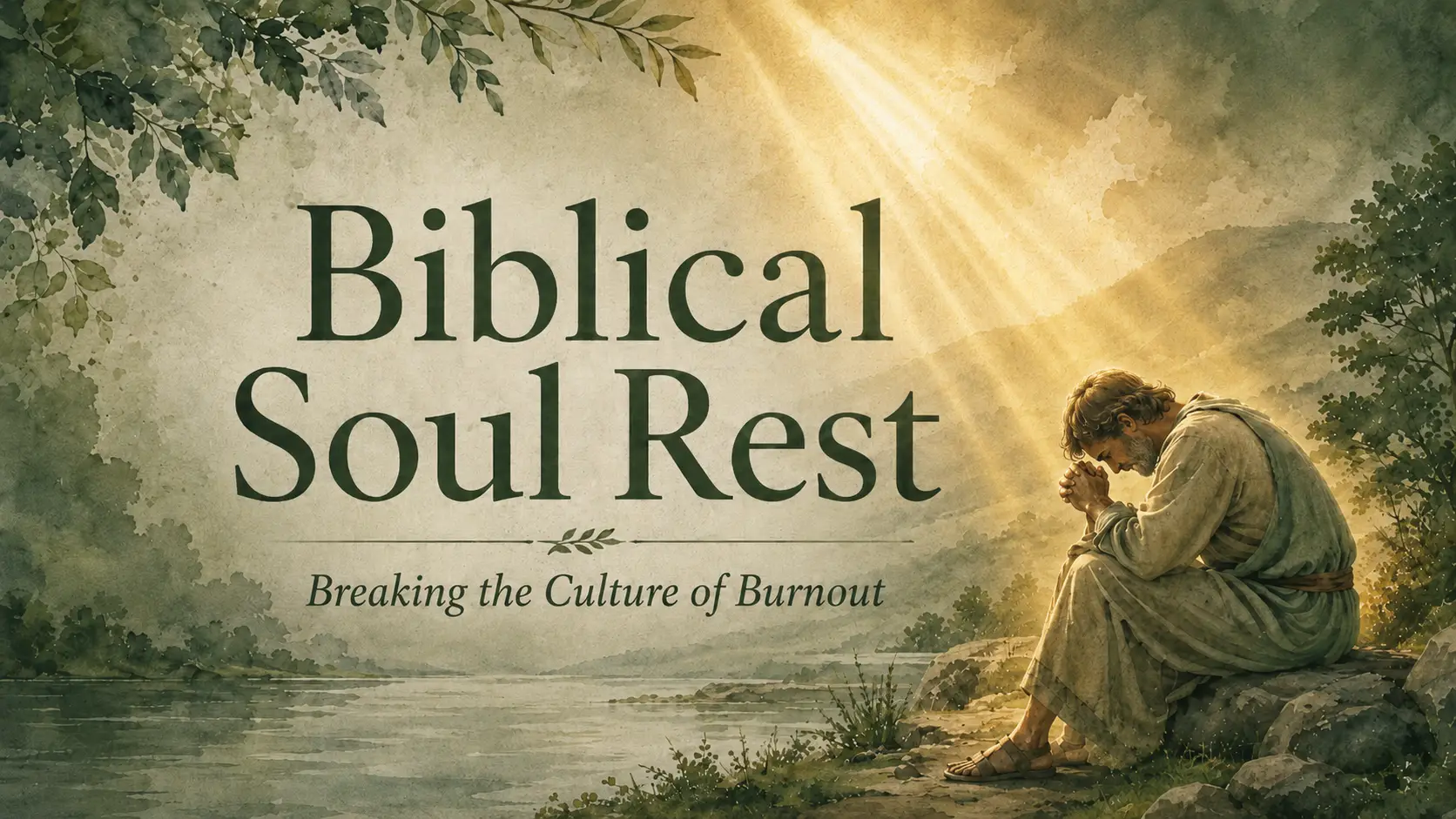
BREAKING THE CULTURE OF BURNOUT AND RECOVERING SOUL REST IN THE BODY OF CHRIST
Lack of Soul Rest — A Weapon of Mass Destruction Against the Body of Christ
INTRODUCTION — WHEN SERVICE BECOMES SELF-DESTRUCTION
God never intended His servants to destroy themselves while serving His purposes.
The call of God will sometimes require sacrifice. There will be seasons of unusual responsibility, long hours, spiritual warfare, inconvenience, opposition, fasting, prayer, travel, counselling, administration, giving, serving, and carrying burdens for others. Scripture does not present Christian service as a life of uninterrupted comfort.
Yet there is an important distinction that must be recovered:
Self-destruction is not the same as self-denial.
Jesus taught us to deny ourselves, take up our cross, and follow Him. But nowhere did Jesus teach that faithfulness requires the continual destruction of our physical health, emotional stability, marriages, families, friendships, or capacity to enjoy the life God has given us.
The problem of burnout is therefore much larger than pastors and senior church leaders.
Across the Body of Christ there are believers who carry enormous loads.
Some work full-time in secular employment while simultaneously:
- leading congregations;
- preaching several times every week;
- counselling people;
- leading Bible studies;
- running home fellowships;
- discipling believers;
- serving on ministry teams;
- leading worship;
- organising conferences;
- travelling for ministry;
- praying and interceding for others;
- visiting the sick;
- caring for struggling families;
- administering ministry organisations;
- managing finances;
- communicating continuously through digital platforms;
- and still attempting to fulfil responsibilities toward spouses, children, parents, employers, and households.
They leave home early for work, carry the demands of their occupation throughout the day, arrive home tired, eat quickly, and then begin what effectively becomes their second full-time occupation: ministry.
Eventually the body protests. The emotions become exhausted. Relationships suffer. Prayer becomes mechanical. Joy disappears. The servant continues functioning outwardly while slowly collapsing inwardly.
This is why lack of soul rest can become a weapon of mass destruction within the Body of Christ.
It does not merely affect one exhausted person.
It eventually affects:
- marriages;
- children;
- congregations;
- leadership teams;
- friendships;
- workplaces;
- physical health;
- emotional health;
- spiritual discernment;
- decision-making;
- and future generations of leaders.
There comes a moment when every servant of God must confront a dangerous belief and lie:
“If I stop, everything will fall apart.”
That statement may sound like commitment, but beneath it may lie fear, unhealthy responsibility, performance, identity in ministry, inability to delegate, the need to be needed, or an unconscious belief that everything ultimately depends upon us.
It does not. The Kingdom belongs to God. The Church belongs to Christ. The work belongs to God. We are servants and stewards. We are not the Saviour.
PART ONE — UNDERSTANDING SOUL REST
Soul rest is deeper than physical rest. A person may go on holiday while remaining inwardly anxious. A person may lie in bed while the mind continues racing. A person may sit quietly while internally carrying dozens of unresolved responsibilities. Conversely, a person may be extremely active while possessing a soul that remains anchored in the peace, presence, and government of God.
Biblical soul rest therefore describes an inward condition where the human soul ceases to be continually driven by:
- anxiety;
- fear;
- striving;
- performance;
- comparison;
- pressure;
- the expectations of people;
- compulsive responsibility;
- the need for recognition;
- the fear of disappointing others;
- and the belief that everything depends upon us.
Soul rest does not mean irresponsibility. It means learning to fulfil responsibility from a place of inward rest rather than inward torment.
Jesus located this rest in relationship with Himself.
Matthew 11:28–30 BSB
(28) Come to Me, all you who are weary and burdened, and I will give you rest.
(29) Take My yoke upon you and learn from Me; for I am gentle and humble in heart, and you will find rest for your souls.
(30) For My yoke is easy and My burden is light.
Jesus does not say that there will be no yoke. He offers His yoke. The problem may therefore not always be that we are carrying a burden. Sometimes the problem is that we are carrying a burden Jesus never placed upon us.
There is a burden that comes with obedience, and there is a burden created by human expectation. There is a burden associated with genuine responsibility, and there is another burden created by our inability to say no. There is a burden attached to calling, and there is another burden created when we attempt to become everything to everyone.
The invitation of Christ is not simply:
“Work less.”
It is:
“Come to Me.”
Soul rest begins with Christ before it becomes a management strategy.
David gives us one of Scripture’s most beautiful pictures of soul restoration.
Psalm 23:1–3 BSB
(1) The LORD is my shepherd; I shall not want.
(2) He makes me lie down in green pastures; He leads me beside quiet waters.
(3) He restores my soul; He guides me in the paths of righteousness for the sake of His name.
Notice the sequence.
The Shepherd:
- provides;
- makes us lie down;
- leads us beside quiet waters;
- restores the soul;
- and then leads us forward.
Sometimes we want God to continue leading us into the next assignment while He is saying:
“First lie down.”
There are occasions when lying down is not weakness. It is obedience. Sometimes God must make us lie down because we have forgotten how to stop voluntarily.
The phrase “He restores my soul” reveals something important.
- The soul can become depleted.
- The soul can become wounded.
- The soul can become exhausted.
- The soul can become overwhelmed.
- And the soul needs restoration.
-
REST IS FIRST A CONDITION OF TRUST
One of the reasons people cannot rest is that resting requires relinquishing control.
- When I stop, I must trust that God continues working.
- When I sleep, God does not.
- When I take leave, God’s Kingdom does not close.
- When I switch off my phone, the Holy Spirit remains available.
- When I delegate, God is capable of using another person.
- When someone else preaches, Christ remains Head of His Church.
True rest therefore contains an element of faith.
Psalm 62:1–2 BSB
(1) In God alone my soul finds rest; my salvation comes from Him.
(2) He alone is my rock and my salvation. He is my fortress; I will never be shaken.
The soul finds rest when it remembers where salvation comes from.
- Not from our performance.
- Not from our ministry.
- Not from our productivity.
- Not from our indispensability.
From Him.
PART TWO — THE DOUBLE BURDEN: WORKPLACE AND MINISTRY
Particular attention must be given to believers who carry both secular employment and significant ministry responsibility. These people often live under pressures that are poorly understood.
They may work eight to ten hours every day and still carry:
- evening meetings;
- weekend services;
- counselling appointments;
- ministry administration;
- sermon preparation;
- leadership meetings;
- telephone calls;
- crisis management;
- hospital visits;
- discipleship responsibilities;
- and ministry travel.
The secular occupation is treated as though it is simply something happening in the background.
It is not. It consumes mental, emotional, and physical energy. The person may already have spent eight hours:
- solving problems;
- managing employees;
- dealing with customers;
- driving;
- working physically;
- making decisions;
- operating machinery;
- carrying deadlines;
- working under management;
- or navigating workplace conflict.
Then ministry begins.
The danger is that neither environment recognises the load created by the other. The employer sees an employee. The church sees a ministry worker. The family sees a husband, wife, father, mother, son, or daughter. Each environment legitimately requires something. But together they can create a level of cumulative responsibility that becomes unsustainable.
-
PAUL THE TENTMAKER — WORK AND MINISTRY
Paul himself experienced the reality of working while ministering.
Acts 18:2–3 BSB
(2) There he found a Jew named Aquila, a native of Pontus, who had recently come from Italy with his wife Priscilla because Claudius had ordered all the Jews to leave Rome. Paul went to visit them,
(3) and he stayed and worked with them because they were tentmakers by trade, just as he was.
Paul understood the dignity of work. He did not divide life into a sacred ministry world and an unspiritual working world. Employment can itself become part of faithful stewardship. But Paul’s example must never be abused to justify an unsustainable lifestyle.
Being willing to work hard is biblical. Destroying yourself through continual overload is not therefore automatically spiritual.
A bi-vocational believer must recognise an important reality:
You do not have two bodies, two minds, two marriages, two emotional reserves, or two nervous systems—one for work and another for ministry.
Both draw from the same reservoir. If that reservoir is continuously drained and never replenished, depletion becomes inevitable.
-
THE HIDDEN THIRD SHIFT — FAMILY
There is frequently another dimension that receives even less attention.
The believer may have:
- a secular job;
- a ministry responsibility;
- a family responsibility.
The home must never receive only whatever energy remains after everybody else has taken their portion.
- Your spouse should not perpetually receive the exhausted version of you.
- Your children should not continually experience ministry as the activity that took their father or mother away.
- Serving strangers while becoming unavailable to those God entrusted directly to us represents an imbalance that must be confronted.
Faithfulness begins close to home.
PART THREE — WHEN MINISTRY BECOMES A BURDEN
-
CUMULATIVE LOAD — DEATH BY A THOUSAND RESPONSIBILITIES
Burnout rarely appears because of one difficult week. It develops through accumulated pressure.
The problem is cumulative load without adequate recovery.
Flow of Life Under a Cumulative Load |
||
| A person can survive a crisis | → | The body releases energy |
| The mind focuses | → | Adrenaline rises |
| The crisis passes | → | Recovery follows |
| But what happens when the crisis never seems to end? | → | Monday becomes Tuesday |
| Tuesday becomes Wednesday | → | One meeting follows another |
| One phone call follows another | → | One counselling situation is replaced by another |
| One sermon must be followed by another sermon | → | One project ends and another immediately begins |
| There is no margin | → | Eventually the person is no longer ministering from overflow |
| They are ministering from depletion. | ||
A dangerous ministry progression can develop:
Calling → Responsibility → Overload → Exhaustion → Irritability → Isolation → Resentment → Burnout → Withdrawal or Collapse
The earlier the pattern is recognised, the easier it is to interrupt.
-
BURNOUT — WHEN THE SOUL RUNS OUT OF RESERVES
Burnout is more than ordinary tiredness. Normal tiredness improves with adequate rest. Deeper exhaustion can begin affecting every dimension of life.
Physical warning signs
- persistent exhaustion;
- poor or interrupted sleep;
- headaches;
- constant muscular tension;
- recurring physical complaints;
- declining fitness;
- unhealthy eating patterns;
- excessive reliance upon stimulants;
- neglect of medical care.
Emotional warning signs
- irritability;
- unusual anger;
- emotional numbness;
- discouragement;
- unexplained sadness;
- loss of compassion;
- reduced tolerance for people;
- resentment toward people who need help.
Mental warning signs
- difficulty concentrating;
- forgetfulness;
- indecision;
- reduced creativity;
- negative thinking;
- inability to switch off;
- continually rehearsing problems.
Spiritual warning signs
- prayer becomes an obligation;
- Scripture is read only to prepare material;
- worship becomes work;
- ministry becomes mechanical;
- the presence of God is discussed publicly but neglected privately;
- joy disappears;
- discernment becomes clouded.
Relational warning signs
- withdrawal from spouse and children;
- short-tempered responses;
- avoidance of friends;
- inability to listen;
- isolation;
- defensive behaviour;
- seeing people primarily as demands.
A sobering truth must therefore be recognised:
A servant can continue functioning long after the soul has stopped flourishing.
- Gift can continue operating.
- Experience can keep sermons flowing.
- Habit can keep meetings functioning.
- Discipline can keep the programme running.
But inwardly the person may be empty.
PART FOUR — YOUR BODY IS PART OF YOUR STEWARDSHIP
-
YOUR BODY IS NOT AN INCONVENIENCE TO YOUR CALLING
Some Christian cultures unintentionally communicate that physical weakness should simply be ignored.
People say:
- “Just push through.”
- “Have faith.”
- “The Lord will strengthen you.”
- “The work must continue.”
- “Souls are at stake.”
God certainly strengthens His people. There are seasons where grace enables extraordinary endurance. But faith does not cancel stewardship.
1 Corinthians 6:19–20 BSB
(19) Do you not know that your body is a temple of the Holy Spirit who is in you, whom you have received from God? You are not your own;
(20) you were bought at a price. Therefore glorify God with your body.
The body matters to God.
Your body is the physical vessel through which you:
- preach;
- work;
- travel;
- embrace your family;
- serve;
- pray;
- counsel;
- labour;
- and fulfil your assignment.
Neglecting the vessel while claiming to honour the assignment eventually becomes contradictory.
Taking care of your body is not carnality. It is stewardship.
-
PASTORS AND BELIEVERS CAN BECOME SICK WHILE DOING GOOD THINGS
Not every illness is caused by overwork. It would be wrong and insensitive to suggest that sickness always indicates poor stewardship. Human illness has many causes.
Nevertheless, chronic sleep deprivation, prolonged stress, poor nutrition, inactivity, unresolved emotional strain, and refusal to seek appropriate medical care can damage health.
Being involved in ministry does not make the human body exempt from biological limitations. We should therefore reject the idea that ignoring our health somehow proves faith.
A mature believer takes responsibility for:
- adequate sleep;
- physical movement;
- nutrition;
- medical assessment;
- medication when properly prescribed;
- recreation;
- emotional wellbeing;
- and appropriate recovery.
3 John 1:2 BSB
(2) Beloved, I pray that in every way you may prosper and enjoy good health, as your soul also prospers.
God is concerned with the whole person.
PART FIVE — HOW MINISTRY CULTURE CREATES BURNOUT
-
THE MARTYR COMPLEX
Some believers have unconsciously developed a theology of exhaustion.
The assumption becomes:
“The more tired I am, the more committed I must be.”
- Busyness becomes spirituality.
- Exhaustion becomes proof of faithfulness.
- Saying yes becomes obedience.
- Saying no becomes selfishness.
- Taking leave creates guilt.
- Going on holiday produces embarrassment.
- Missing a meeting feels like spiritual failure.
- Eventually the individual derives identity from exhaustion itself.
People say:
“I haven’t had a holiday in five years.”
And instead of hearing a warning, the Christian community sometimes hears a testimony.
There is a profound difference between:
laying down your life in obedience
and
destroying your life because you have never learned healthy stewardship.
Jesus embraced the cross. But Jesus did not respond to every person, every request, every expectation, and every opportunity.
-
WHEN SERVICE BECOMES IDENTITY
One of the deepest roots of burnout is not workload, it is identity.
What happens when ministry becomes the place from which we derive significance?
Ask yourself:
- Who am I when I am not preaching?
- Who am I when nobody needs me?
- Who am I when someone else receives recognition?
- Can I enjoy an ordinary day?
- Can I sit quietly without producing something?
- Can another person fulfil the task without my involvement?
- Do I secretly need to be indispensable?
- Do I feel valuable primarily when I am useful?
Before you are:
- a pastor;
- elder;
- prophet;
- apostle;
- teacher;
- evangelist;
- worship leader;
- administrator;
- intercessor;
- counsellor;
- ministry volunteer;
- or marketplace minister—
you belong to Christ.
Your identity must sustain your ministry. Ministry must never become your identity.
-
THE MESSIAH COMPLEX — EVERYTHING DEPENDS ON ME
This problem is not confined to senior pastors. Any ministry worker can become functionally indispensable.
The person believes:
- I must organise it.
- I must open the building.
- I must counsel them.
- I must lead worship.
- I must solve the problem.
- I must answer the phone.
- I must preach.
- I must arrange transportation.
- I must manage the finances.
- I must visit them.
- I must make the decision.
Eventually the entire structure revolves around one exhausted person. The biblical answer is clearly illustrated in the life of Moses.
Exodus 18:17–18 BSB
(17) But Moses’ father-in-law said to him, “What you are doing is not good.
(18) Surely you and these people with you will wear yourselves out, because the task is too heavy for you. You cannot handle it alone.”
Notice Jethro’s assessment:
The task was legitimate.
- The people genuinely needed help.
- Moses was genuinely called.
But the method was unsustainable.
- The answer was not:
- “Pray for more strength.”
- The answer was:
Change the structure.
This is one of the most important lessons in the entire discussion. Sometimes spiritual people keep asking God for supernatural strength to maintain a structure that wisdom requires them to change.
PART SIX — GOD DESIGNED REST
-
REST EXISTED BEFORE EXHAUSTION
The principle of rest appears at creation.
Genesis 2:2–3 BSB
(2) By the seventh day God had finished the work He had been doing; so on that day He rested from all His work.
(3) Then God blessed the seventh day and sanctified it, because on that day He rested from all the work of creation that He had accomplished.
God did not rest because He was exhausted.
Rest therefore cannot merely be understood as the treatment for exhaustion. Rest is built into divine order.
This gives us an important principle:
Rest is preventative before it becomes restorative.
Many people rest only when their body forces them to.
God’s wisdom says:
Build rest into your life before collapse makes rest compulsory.
-
THE SABBATH PRINCIPLE — STOPPING IS AN ACT OF FAITH
The Sabbath taught God’s people that they were not created for uninterrupted production.
Rest teaches us to:
- stop;
- trust;
- worship;
- remember;
- receive;
- relinquish control.
Every time we intentionally stop, we are making a declaration:
God remains God while I rest.
- The crops continue growing.
- The earth continues rotating.
- The Kingdom continues.
- Christ continues building His Church.
Rest confronts our illusion of indispensability.
PART SEVEN — JESUS AND THE RHYTHM OF REST
-
JESUS WITHDREW FROM PEOPLE
No one carried a greater assignment than Jesus. No one had greater demands placed upon Him.
- Crowds followed Him.
- Sick people needed healing.
- Disciples required teaching.
- Religious leaders opposed Him.
Yet Jesus repeatedly withdrew.
Luke 5:15–16 BSB
(15) But the news about Jesus spread all the more, and great crowds came to hear Him and to be healed of their sicknesses.
(16) Yet He frequently withdrew to the wilderness to pray.
The word frequently matters.
- Withdrawal was not merely an emergency response.
- It formed part of His rhythm.
- There were still needs when Jesus withdrew.
- There were still sick people.
- There were still questions.
- There were still crowds.
But Jesus did not permit the urgency of human need to replace the direction of His Father.
A crucial principle emerges:
Need does not automatically constitute assignment.
There will always be another need. If you make human need the sole measure of your availability, you will never stop.
-
“COME AWAY AND REST”
Jesus recognised exhaustion in His disciples.
Mark 6:31 BSB
(31) And He said to them, “Come with Me privately to a solitary place, and let us rest for a while.” For many people were coming and going, and they did not even have time to eat.
What an extraordinary picture of ministry pressure. People were constantly arriving and leaving. The disciples were so busy that they did not even have adequate time to eat.
Jesus’ response was not:
“Be more committed.”
He said:
“Let us rest for a while.”
Sometimes the most spiritual instruction Jesus can give an exhausted servant is not:
Do more.
It is:
Come away.
PART EIGHT — ELIJAH: WHEN THE STRONG SERVANT COLLAPSES
-
AFTER CARMEL CAME THE JUNIPER TREE
Elijah experienced extraordinary spiritual victory on Mount Carmel. Shortly afterwards he was emotionally and physically depleted.
This is important because exhaustion often arrives after intense seasons of ministry, not necessarily during them.
- After the conference.
- After the revival.
- After the crisis.
- After the building project.
- After the funeral.
- After the counselling season.
- After the spiritual battle.
The adrenaline disappears, and the body presents the bill.
In 1 Kings 19 God’s response to Elijah is revealing.
God did not initially give him another assignment. He allowed him to sleep. Then He provided food. Then Elijah slept again. There is a profound lesson here:
Sometimes highly spiritual people need profoundly practical restoration.
- Sleep is not unbelief.
- Food is not carnality.
- Rest is not backsliding.
PART NINE — BREAKING THE CULTURE
-
BREAK THE CULTURE OF CONSTANT AVAILABILITY
One of the most destructive expectations in modern ministry is:
“You must always be available.”
Mobile phones have intensified this problem.
People can reach ministry workers:
- early morning;
- late at night;
- during meals;
- during family time;
- during holidays;
- on days off;
- while travelling;
- and even while attending other meetings.
Constant accessibility eventually produces constant interruption.
Healthy ministry therefore requires boundaries.
- Not every telephone call must be answered immediately.
- Not every message requires an immediate response.
- Not every crisis belongs to you.
- Not every person must have unlimited access.
- Not every meeting requires your attendance.
Availability without boundaries eventually destroys availability altogether.
-
BREAK THE CULTURE OF ONE-PERSON MINISTRY
The New Testament model is body ministry.
Ephesians 4:11–12 BSB
(11) And it was He who gave some to be apostles, some to be prophets, some to be evangelists, and some to be pastors and teachers,
(12) to equip the saints for works of ministry and to build up the body of Christ.
The saints are equipped for works of ministry. This means the pastor is not supposed to do everything. Neither is the ministry founder. Neither is the strongest volunteer. Neither is the person who has always done it before.
Healthy ministry multiplies capacity. Unhealthy ministry concentrates responsibility. If everything stops when one person takes a holiday, something is wrong with the structure.
-
BREAK THE CULTURE OF GUILT
Believers should not feel guilty about:
- taking leave;
- sleeping;
- exercising;
- travelling;
- spending time with family;
- enjoying hobbies;
- fishing;
- gardening;
- reading for pleasure;
- having an evening at home;
- switching off the telephone;
- declining invitations;
- allowing others to minister;
- or simply doing nothing for a period.
Rest is not desertion.
Rest can be obedience.
PART TEN — PRACTICAL STEPS TOWARD SOUL REST
-
BUILD REST BEFORE YOU NEED RECOVERY
Do not create a rest strategy after collapse. Build rhythm into your life now.
Daily rhythm
Include:
- prayer that is not ministry preparation;
- adequate sleep;
- quiet;
- healthy meals;
- exercise or movement;
- family engagement;
- moments without digital communication.
Weekly rhythm
Establish a meaningful period of rest.
A day off cannot simply become:
“The day when I catch up with everything I could not finish.”
Stopping must actually include stopping.
Monthly rhythm
Create space for:
- recreation;
- reflection;
- solitude;
- family;
- spiritual recalibration;
- enjoyable activities.
Annual rhythm
Take meaningful leave.
If possible, disconnect sufficiently for your body and soul to recognise that responsibility has temporarily been handed to others.
-
BI-VOCATIONAL MINISTRY REQUIRES DIFFERENT EXPECTATIONS
A person carrying a forty-hour working week cannot always sustain the same ministry schedule as someone whose daily occupation is ministry.
Churches and ministry networks must recognise this. Do not place full-time-ministry expectations upon people who already carry full-time employment. Bi-vocational workers must also recognise their own limitations. You may have the spiritual capacity to preach every week. That does not automatically mean you have the physical capacity to:
- work forty-five hours;
- commute ten hours;
- preach four times;
- attend three meetings;
- counsel five people;
- visit hospitals;
- manage administration;
- and remain emotionally present to your family.
Spiritual gifting does not remove human limitation.
Ask:
What is sustainable in this season of my life?
-
LEARN THE HOLY DISCIPLINE OF SAYING NO
Every yes spends something.
It spends:
- time;
- energy;
- attention;
- emotional capacity;
- physical strength;
- and opportunity.
Sometimes it spends family time. Therefore every request should not automatically receive a yes.
Ask:
Did God assign this to me, or did somebody merely ask me to do it?
There is a difference.
Some doors must be closed so that the right doors can remain open.
-
DELEGATE BEFORE YOU COLLAPSE
Do not wait until exhaustion forces delegation.
Ask three questions:
- What must I personally do?
These are responsibilities directly connected to your unique calling, authority, relationships, or accountability.
- What can someone else do?
- Train people.
- Release them.
- Allow them to learn.
- Allow them to make mistakes.
- What should no longer be done?
Some activities continue only because:
“We have always done it.”
Every programme has a cost. Some programmes have outlived their usefulness. Sometimes simplification is spiritual wisdom.
-
DEVELOP A TEAM, NOT DEPENDANTS
Healthy ministry creates mature people who can carry responsibility. Unhealthy ministry creates people who continually require the same person to solve every problem.
Train others to:
- pray;
- counsel;
- teach;
- visit;
- administer;
- organise;
- make decisions;
- care for people;
- disciple believers;
- and lead.
Delegation is not abandoning responsibility. It is multiplying ministry.
PART ELEVEN — RECOVERING RELATIONSHIPS
-
YOUR FAMILY MUST NOT LIVE ON THE LEFTOVERS
Ministry success cannot adequately compensate for family neglect. Your spouse needs more than your physical presence.
Your family needs:
- attention;
- conversation;
- affection;
- emotional presence;
- shared experiences;
- laughter;
- rest;
- and memories that have nothing to do with church meetings.
You can build a successful ministry while creating a wounded home. That is not success. The congregation may eventually have another leader. Your family cannot replace you as husband, wife, father, or mother.
-
RECOVER FRIENDSHIP
Ministry can become lonely. People know your title. They know your sermons. They know your ministry role. But who knows you?
Every servant of God needs relationships where they do not constantly have to function.
People around whom they can:
- laugh;
- talk;
- admit weakness;
- receive counsel;
- be corrected;
- express disappointment;
- process pain;
- and simply be human.
This may include:
- trusted friends;
- mature peers;
- spiritual fathers;
- mentors;
- accountability relationships;
- and professional counselling where appropriate.
The principle is simple:
Those who continually pour into others must also have places where they can receive.
PART TWELVE — RECOVER THE SECRET PLACE
-
DO NOT TURN YOUR ENTIRE RELATIONSHIP WITH GOD INTO MINISTRY
This is one of the great dangers of active ministry.
- Bible reading becomes sermon preparation.
- Prayer becomes intercession for other people.
- Worship becomes something we lead.
- Revelation becomes material we must distribute.
Eventually almost every interaction with God becomes connected to output. We must recover interaction with God that produces nothing for anybody else.
- Read Scripture because your own soul needs it.
- Pray because you love Him.
- Worship without leading anyone.
- Sit quietly.
- Listen
- Receive
You are not merely a vessel through which God ministers to others. You are also His child.
PART THIRTEEN — CREATING A NEW MINISTRY CULTURE
-
FROM BURNOUT CULTURE TO SOUL-REST CULTURE
Breaking burnout requires more than individuals taking holidays.
The culture itself must change.
Churches, ministries, networks, and leadership teams should consider implementing:
- protected weekly rest;
- genuine annual leave;
- sabbaticals after extended demanding seasons;
- shared preaching;
- shared pastoral care;
- emergency contact structures;
- trained counselling teams;
- delegation;
- health awareness;
- encouragement of medical examinations;
- family protection;
- leadership development;
- succession planning;
- reasonable digital communication policies;
- and limits upon unnecessary meetings.
We must stop asking only:
“How much can we get from this person?”
We should also ask:
“How do we preserve this person for a lifetime of fruitful service?”
-
CHANGE THE LANGUAGE OF MINISTRY
Culture is reinforced through language.
Stop glorifying statements such as:
- “I never take leave.”
- “I sleep four hours a night.”
- “Nobody else can do it.”
- “I haven’t had a weekend off in years.”
- “Ministry comes before everything.”
- “I’ll rest when I die.”
These are not necessarily testimonies of faithfulness. Sometimes they are warning signs.
Let us begin celebrating:
- healthy marriages;
- longevity;
- teamwork;
- delegation;
- emotional maturity;
- physical stewardship;
- healthy boundaries;
- spiritual depth;
- and sustainable service.
PART FOURTEEN — WHEN YOU ARE ALREADY RUNNING ON EMPTY
-
ACKNOWLEDGE YOUR CONDITION
The first step toward recovery is honesty. Stop pretending strength. You do not need to wait for collapse before admitting:
“I am tired.”
Tiredness is information. Listen to it.
-
REDUCE THE LOAD
Something may have to stop. Not forever. Perhaps for a season.
- Cancel unnecessary meetings.
- Share responsibility.
- Reduce travel.
- Create limits.
- Step away from activities that no longer belong to your present assignment.
You cannot recover while maintaining exactly the same load that created the depletion.
-
TAKE PHYSICAL HEALTH SERIOUSLY
Where health concerns exist, seek proper medical assessment. Do not automatically spiritualise every symptom. Prayer and appropriate medical care are not enemies.
Restore:
- sleep;
- nutrition;
- movement;
- appropriate recreation;
- medical care;
- and healthy routines.
-
SEEK HELP
If emotional exhaustion, persistent anxiety, depression, severe discouragement, anger, or other significant difficulties have developed, seeking appropriate professional help is not spiritual failure.
Wisdom receives help.
The stronger the culture of secrecy around leaders and ministry workers, the more dangerous burnout becomes.
-
DO NOT RETURN TO THE SAME STRUCTURE
This may be the most important practical principle in recovery:
Recovery without restructuring simply prepares you for another collapse.
A person takes three weeks of leave.
They feel better.
Then they return to:
- the same schedule;
- the same inability to say no;
- the same lack of delegation;
- the same digital availability;
- the same poor sleep;
- the same excessive meetings;
- the same neglected family.
Nothing has changed. The next collapse becomes only a matter of time. Recovery must therefore lead to reform.
PART FIFTEEN — LONGEVITY OVER MOMENTUM
-
CAN YOU LIVE LIKE THIS FOR ANOTHER TEN YEARS?
This is a powerful diagnostic question:
Can I sustain my present lifestyle for another ten years?
If the answer is no, something must change.
We often measure ministry by immediate momentum:
- attendance;
- meetings;
- activity;
- programmes;
- travel;
- invitations;
- visibility;
- growth.
God is also interested in longevity.
- Will your marriage survive your ministry?
- Will your health survive your schedule?
- Will your children still enjoy being around you?
- Will you still love God’s people?
- Will you still love Christ?
- Will you still possess joy twenty years from now?
Burning brightly for a season is not the same as burning faithfully for a lifetime.
-
THE GOAL IS NOT LESS COMMITMENT — IT IS SUSTAINABLE FAITHFULNESS
This teaching must never become an excuse for laziness.
Scripture celebrates:
- diligence;
- sacrifice;
- endurance;
- perseverance;
- faithfulness;
- hard work.
Galatians 6:9 BSB
(9) Let us not grow weary in well-doing, for in due time we will reap a harvest if we do not give up.
But perseverance does not mean refusing all rest. Biblical endurance requires rhythm.
- The athlete trains and recovers.
- The farmer works and waits.
- The soldier fights and sleeps.
- The disciple serves and abides.
The goal is not to escape responsibility. It is to become capable of carrying responsibility faithfully over time.
PART SIXTEEN — THE MINISTRY OF A RESTED SOUL
-
WHAT REST PRODUCES
A rested soul is not an inactive soul. A rested soul can become exceptionally fruitful because it is no longer continually operating under internal chaos.
A rested believer can:
- hear God more clearly;
- discern assignment more accurately;
- say no without excessive guilt;
- love people without resentment;
- exercise better judgment;
- respond instead of reacting;
- remain emotionally present;
- enjoy family;
- endure pressure;
- maintain healthy relationships;
- minister from overflow;
- and continue serving over decades.
Rest is therefore not the enemy of fruitfulness. Properly understood, rest becomes one of the guardians of long-term fruitfulness.
CONCLUSION — THE SERVANT MUST ALSO LIE DOWN
Psalm 23 is not merely a passage pastors use when comforting other people.
It is an invitation for every servant of God.
The Great Shepherd also shepherds the shepherd.
- He shepherds the worship leader.
- He shepherds the intercessor.
- He shepherds the administrator.
- He shepherds the marketplace believer.
- He shepherds the person working eight hours in an office before leading a meeting that evening.
- He shepherds the mother serving her family and her congregation.
- He shepherds the volunteer.
- He shepherds the missionary.
- He shepherds the apostle.
- He shepherds the pastor.
And sometimes the Shepherd says:
Lie down.
There comes a point when continuing to run is no longer evidence of faithfulness.
Sometimes obedience sounds like:
- Stop
- Sleep
- Eat
- Pray
- Take leave.
- Exercise
- Go home.
- Spend time with your family.
- Delegate
- Switch off the telephone.
- Let somebody else lead.
- Let somebody else preach.
- Trust the Body of Christ.
- Trust God.
Perhaps every servant of God eventually needs to be able to declare:
“The work belongs to God. The Church belongs to Christ. I am His servant, not its saviour. I will serve faithfully, but I will not attempt to carry what belongs to Him. Therefore I am permitted to rest.”
Soul rest is not retreat from Kingdom responsibility. It is the restoration of proper order. It is acknowledging that God is God and we are not.
It is recovering sonship before service, relationship before productivity, abiding before activity, family before public applause, stewardship before self-destruction, and obedience before human expectation.
God never intended His people to die carrying burdens He never assigned to them.
The answer to burnout is therefore not simply:
“Do less.”
The deeper answer is:
- Return to Christ.
- Recover identity.
- Restore order.
- Establish boundaries.
- Share responsibility.
- Care for the body.
- Protect the family.
- Build healthy rhythms.
- Remain in the secret place.
- Learn to stop.
And from that place of restored soul rest:
Serve again—not from depletion, but from overflow.
OTHER PUBLICATIONS BY THIS AUTHOR CAN BE FOUND AT: