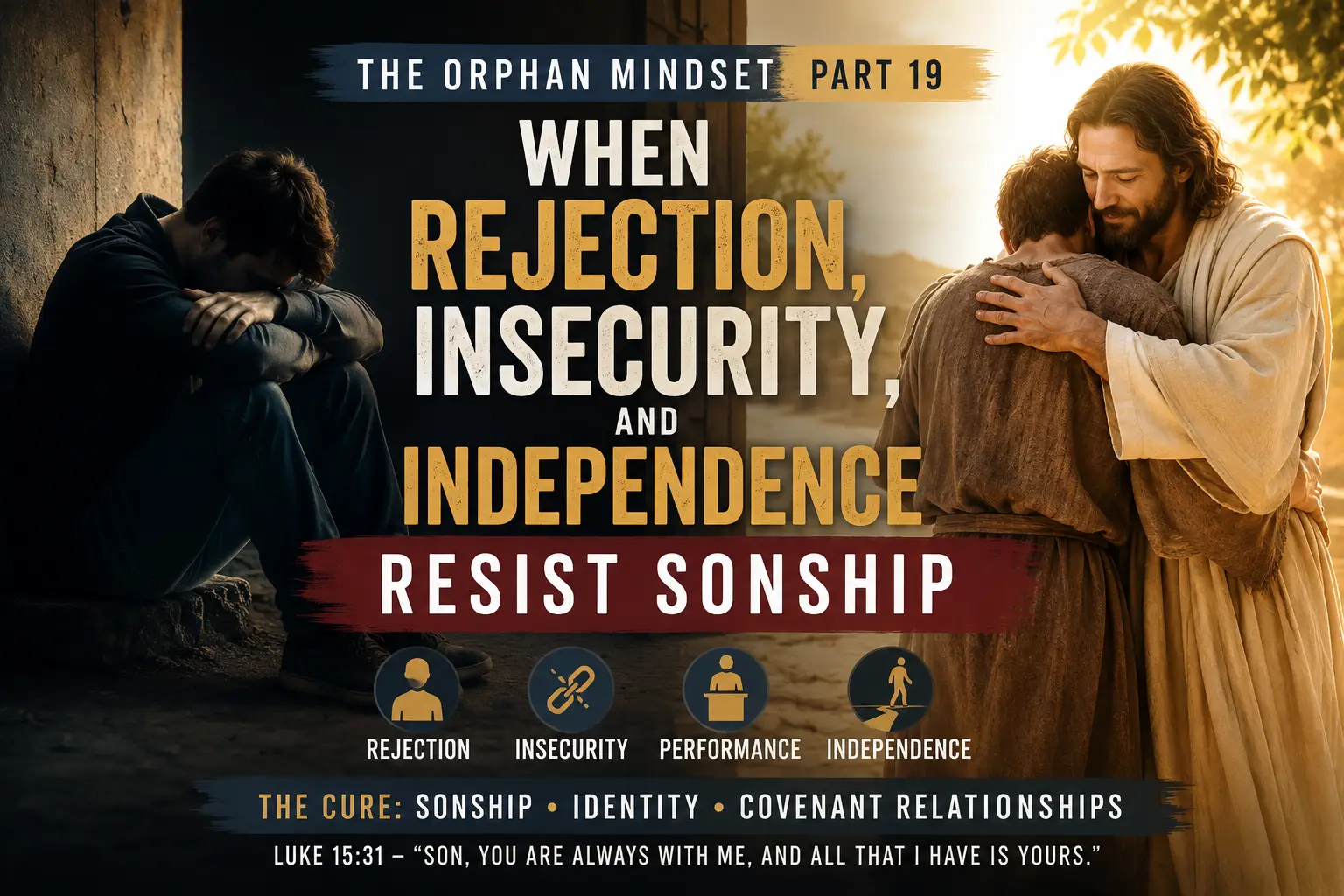
WHEN REJECTION, INSECURITY, AND INDEPENDENCE RESIST SONSHIP
INTRODUCTION
One of the most destructive mindsets a believer can carry is the orphan mindset. It is not always visible on the outside because a person may still attend church, serve faithfully, give consistently, and even live close to the Father’s house. Yet inwardly, they may still think, feel, respond, and relate as though they do not truly belong.
The orphan mindset is dangerous because it causes a person to live in the house of God without enjoying the heart of the Father. It produces striving instead of rest, suspicion instead of trust, competition instead of honour, and performance instead of sonship. A person with an orphan mindset may be present in the household, but disconnected from the spirit of family.
The tragedy of this mindset is that it often resists what God is trying to heal. God desires to bring people into sonship, identity, covenant, and belonging, but the orphan mindset interprets correction as rejection, honour as favouritism, another person’s promotion as personal loss, and responsibility as proof of worth.
The gospel does not merely forgive sinners; it restores sons. Through Christ, we are not only rescued from sin but also brought into the Father’s family. Romans 8:15 speaks of the “Spirit of adoption” by whom believers cry, “Abba, Father.” This means the cure for the orphan mindset is not merely better behaviour; it is a revelation of sonship.
DEFINITION OF THE ORPHAN MINDSET
The orphan mindset is a mindset rooted in rejection, insecurity, independence, and lack of identity.
It is a way of thinking that causes a person to live as though they are unloved, unchosen, unsupported, and unprotected, even when they are already positioned in a place of grace. It is the internal belief that says, “I must fight for myself, prove myself, protect myself, and compete for what I believe I deserve.”
An orphan mindset can form through natural rejection, absent fathers, broken relationships, betrayal, abandonment, comparison, spiritual abuse, disappointment, or repeated experiences of dishonour. However, once it becomes a stronghold, it begins to shape how a person sees God, authority, leadership, family, ministry, and themselves.
The orphan mindset does not only affect people outside the church. It can operate strongly within religious environments. A person may serve God but still not feel like a son. They may obey rules but not experience love. They may labor in the field but never enjoy intimacy with the Father.
Galatians 4:7 NKJV
(7) Therefore you are no longer a slave but a son, and if a son, then an heir of God through Christ.
This means any mindset that keeps a believer thinking like a slave, outsider, beggar, competitor, or rejected servant must be confronted by the truth of the gospel.
- The orphan mindset says, “I must earn my place.” Sonship says, “I belong because the Father has received me.”
- The orphan mindset says, “I must prove my value.” Sonship says, “My value is rooted in the Father’s love.”
- The orphan mindset says, “I must protect myself.” Sonship says, “The Father is my covering.”
- The orphan mindset says, “If someone else is celebrated, I am being forgotten.” Sonship says, “Another person’s restoration does not reduce my inheritance.”
Biblical Example: The Prodigal Son’s Older Brother
The clearest biblical picture of the orphan mindset is not found in the younger son who left the father’s house, but in the older brother who stayed.
In Luke 15, Jesus tells the parable of a father with two sons. The younger son demanded his inheritance, left home, wasted his possessions, and eventually returned in repentance. The father received him with compassion, restored him, clothed him, and celebrated his return.
Most people focus on the rebellion of the younger son, but the older brother reveals another kind of brokenness. He never left the house physically, but his heart was far from the father. He lived near the father but did not understand the father’s heart.
When the older brother heard the celebration, he became angry and refused to go in. His response revealed that he did not think like a son. He said, “these many years I have been serving you” and complained that he had never been given what he believed he deserved.
This is the language of an orphan spirit.
He did not say, “Father, I have enjoyed being your son.”
He said, “I have been serving you.”
He did not relate from inheritance.
He related from performance.
He did not rejoice over his brother’s restoration.
He resented his brother’s celebration.
He did not see the father’s generosity as love.
He interpreted it as unfairness.
The father’s response is powerful.
Luke 15:31 NKJV
(31) “And he said to him, ‘Son, you are always with me, and all that I have is yours.
The older brother had access, proximity, inheritance, and relationship, but he lacked revelation. He was in the house, but his mindset was still that of a servant competing for approval.
This is what the orphan mindset does. It blinds a person to what they already possess in the Father.
Though in the House, He Thought Like a Servant
The older brother’s tragedy was not his location but his perception. He was in the father’s house, but he did not understand his sonship. He had access to the father, yet he lived with the mentality of a hired worker.
Many believers function the same way. They serve in church, submit to spiritual environments, attend meetings, and participate in ministry, yet internally they still think like outsiders. They measure their worth by what they do. They become offended when others are honoured. They struggle to celebrate someone else’s restoration. They feel unseen, unappreciated, and overlooked.
This is why Jesus’ parable is so important. It shows that rebellion is not always leaving the house. Sometimes rebellion is remaining in the house with a heart that refuses the father’s nature.
- The younger son was lost in the world. The older brother was lost in the house.
- The younger son needed repentance from rebellion. The older brother needed deliverance from resentment.
- The younger son needed restoration to sonship. The older brother needed revelation of sonship.
Both needed the father.
CHARACTERISTICS OF THE ORPHAN MINDSET
-
Insecurity
Insecurity is one of the strongest marks of the orphan mindset. A person with an orphan mindset struggles to rest in love because they are unsure of their place. They constantly question whether they are accepted, valued, chosen, or remembered.
Insecurity causes people to compare themselves with others. They measure their worth by attention, position, opportunity, recognition, and affirmation. When someone else is celebrated, they feel threatened. When someone else is promoted, they feel rejected. When someone else is corrected gently, they feel treated unfairly.
The older brother was insecure because his brother’s restoration exposed what was unresolved in his own heart. The celebration was not against him, but he interpreted it as personal dishonor. His insecurity turned his brother’s healing into his own offense.
Insecurity often speaks through questions such as:
- “Why was I not chosen?”
- “Why did they honor that person and not me?”
- “Why does no one see what I do?”
- “Why am I always overlooked?”
- “Why does God bless others faster than He blesses me?”
These questions may sound reasonable, but when they come from an orphan mindset, they reveal a wounded identity. The person is not merely looking for answers; they are looking for proof that they matter.
The truth of Scripture confronts insecurity with identity. Ephesians 1:6 says believers are “accepted in the Beloved.”
Ephesians 1:6 NKJV
(6) to the praise of the glory of His grace, by which He made us accepted in the Beloved.
This means our acceptance is not based on performance, human recognition, or comparison. We are accepted because we are in Christ.
A son does not need to compete for a seat at the table. He belongs there because the Father has made room for him.
-
Performance
The orphan mindset is driven by performance. It believes love must be earned, approval must be maintained, and belonging must be proven. This causes a person to serve from fear rather than love.
The older brother said, “these many years I have been serving you.” His service was real, but his heart was wounded. He did not serve as a joyful son; he served as a frustrated servant. He had years of labour, but his labour had not produced intimacy.
Performance turns obedience into a transaction. It says, “Because I have done this, God must give me that.” It becomes angry when grace is given to someone who did not labour as long, suffer as much, or perform as consistently.
This is why the older brother could not celebrate the younger brother’s restoration. In his mind, the younger brother had not earned celebration. He had wasted his inheritance, damaged the family, and brought shame to the father’s name. Yet the father restored him because the father’s heart was governed by love, not by the older brother’s performance-based system.
Performance Christianity is exhausting because it has no rest. It keeps score. It remembers every sacrifice. It counts every act of service. It becomes bitter when there is no visible reward.
Jesus did not call His disciples into a relationship of mere servitude.
John 15:15 NKJV
(15) No longer do I call you servants, for a servant does not know what his master is doing; but I have called you friends, for all things that I heard from My Father I have made known to you.
Jesus brought them into friendship, intimacy, and shared purpose. This does not remove obedience, but it changes the foundation of obedience.
- Servants work for acceptance. Sons work from acceptance.
- Servants obey to be loved. Sons obey because they are loved.
- Servants fear replacement. Sons trust inheritance.
The cure for performance is not laziness. It is sonship. Sons still serve, but they serve from identity, not insecurity.
-
Competition
Competition is another fruit of the orphan mindset. When people do not know who they are in the Father, they begin to compete with others for affirmation, space, opportunity, and honour.
The older brother saw the younger brother as a rival rather than as family. His brother’s restoration should have brought joy, but instead it produced anger. He could not enter the celebration because competition had corrupted his heart.
The orphan mindset struggles with another person’s blessing because it believes there is not enough love, honour, provision, or opportunity for everyone. It thinks in terms of scarcity. It says, “If they are blessed, I am losing.” It says, “If they are honoured, I am forgotten.” It says, “If they are restored, my faithfulness is being ignored.”
This mindset destroys covenant relationships. It turns brothers into competitors, leaders into threats, fathers into unfair judges, and the house of God into a platform for rivalry.
Competition was also seen in Saul’s relationship with David. Saul became jealous when David was celebrated. Instead of recognizing David as a gift to Israel, Saul saw him as a threat to his throne. His insecurity produced suspicion, and his suspicion produced persecution.
The orphan mindset cannot properly steward another person’s gift because it feels threatened by what it should honour.
In the Kingdom, sons do not compete with sons. They complete, strengthen, and honour one another. Romans 12:10 calls believers to give preference to one another in honour. Honour is the opposite of rivalry. Honor celebrates grace wherever God places it.
When sonship is restored, another person’s success no longer feels like your failure. Their breakthrough becomes a testimony of the Father’s goodness, not a threat to your identity.
-
Independence
Independence is one of the most deceptive characteristics of the orphan mindset. It often disguises itself as strength, maturity, or self-sufficiency, but underneath it is usually fear of dependency, fear of disappointment, and fear of being hurt again.
A person with an orphan mindset may say, “I do not need anyone.” They may avoid accountability, resist correction, reject covering, and distance themselves from covenant relationships. They may prefer isolation because relationships require vulnerability.
Proverbs 18:1 NKJV
(1) A man who isolates himself seeks his own desire; He rages against all wise judgment.
Isolation may feel safe, but it often protects dysfunction. It prevents healing, correction, adjustment, and growth.
The older brother demonstrated independence when he refused to enter the celebration. The father came out and pleaded with him, but he remained outside. His physical posture revealed his inward condition. He separated himself from the joy of the house because he disagreed with the father’s heart.
- Independence says, “I will decide what is fair.” Sonship says, “I will trust the Father’s heart.”
- Independence says, “I will protect myself from disappointment.” Sonship says, “I will remain in covenant even when I do not understand.”
- Independence says, “I do not need family.” Sonship says, “God sets the solitary in families.”
Psalms 68:6 NKJV
(6) God sets the solitary in families; He brings out those who are bound into prosperity; But the rebellious dwell in a dry land.
This reveals that part of God’s healing process is relational. He does not only heal us privately; He places us in covenant environments where love, accountability, correction, honor, and belonging can restore us.
The orphan mindset resists covenant because covenant requires trust. It resists fathering because fathering requires humility. It resists correction because correction exposes insecurity. Yet Hebrews 12:6 teaches that the Lord chastens those He loves.
Hebrews 12:6 NKJV
(6) FOR WHOM THE LORD LOVES HE CHASTENS, AND SCOURGES EVERY SON WHOM HE RECEIVES.”
Correction is not rejection; in the Father’s house, correction is proof of sonship.
THE ROOT ISSUES BEHIND THE ORPHAN MINDSET
The orphan mindset does not begin with behaviour. It begins with broken identity. The outward actions are symptoms of an inward wound.
Rejection
Rejection teaches people to expect abandonment. It causes them to interpret delays, silence, correction, or lack of recognition as proof that they are unwanted. Even when love is present, rejection makes it difficult to receive.
Insecurity
Insecurity makes people unstable in relationships. They constantly need reassurance, but no amount of reassurance satisfies them until identity is healed. They may become suspicious, defensive, or overly sensitive.
Independence
Independence develops when people decide they are safer without needing others. It is often a survival mechanism. However, what protected them in one season can imprison them in another.
Lack of Identity
When identity is not rooted in Christ, people borrow identity from ministry, title, role, family name, achievement, spiritual gifting, or public affirmation. When those things are threatened, their sense of self collapses.
This is why sonship must be restored at the level of identity. John 1:12 says those who receive Christ are given the right “to become children of God.”
John 1:12 NKJV
(12) But as many as received Him, to them He gave the right to become children of God, to those who believe in His name:
This is not a religious slogan; it is a legal and spiritual reality. In Christ, believers receive a new position before the Father.
THE REDEMPTIVE CURE FOR THE ORPHAN MINDSET
The orphan mindset cannot be healed merely by more activity. It is not cured by giving a person a title, a platform, a microphone, or more responsibility. In fact, if identity is not healed, promotion may amplify the orphan wound.
The cure must go deeper. The orphan mindset is healed through sonship, identity, and covenant relationships.
-
Sonship
Sonship is the primary cure for the orphan mindset. It restores the believer’s understanding of relationship with the Father. Sonship teaches us that we are not spiritual beggars trying to earn attention. We are children who have been received by grace.
Romans 8:15 reveals that believers have received the “Spirit of adoption.”
Romans 8:15 NKJV
(15) For you did not receive the spirit of bondage again to fear, but you received the Spirit of adoption by whom we cry out, “Abba, Father.”
This means God does not merely tolerate us; He receives us into His family. Adoption speaks of belonging, inheritance, identity, and relationship.
The older brother needed this revelation. He was physically near the father, but emotionally distant. He had access to everything, but he lived as though he had nothing. The father had to remind him, “all that I have is yours.”
Many believers need to hear the same truth. You are not outside the house. You are not a stranger. You are not merely a worker. You are not forgotten. You are not competing for crumbs. In Christ, you have been brought near.
- Sonship heals striving because it gives the heart permission to rest in the Father’s love.
- Sonship heals comparison because it reveals that each son has a place.
- Sonship heals insecurity because it establishes identity.
- Sonship heals independence because it restores trust.
- Sonship heals performance because it teaches us to serve from love.
The Father does not want servants who live in fear while calling Him Lord only with their lips. He wants sons who know His heart and walk in mature obedience.
-
Identity
The second cure is identity. The orphan mindset survives where identity is unclear. When a person does not know who they are in Christ, they will constantly seek identity from people, positions, platforms, achievements, and approval.
Identity in Christ is not based on human opinion. It is not based on past failure. It is not based on family background. It is not based on ministry position. It is not based on who celebrates you or who rejects you.
1 John 3:1 NKJV
(1) Behold what manner of love the Father has bestowed on us, that we should be called children of God! Therefore the world does not know us, because it did not know Him.
This scripture points us to the love of the Father and declares that believers are called children of God. This identity must become stronger than every label placed on us by rejection, trauma, failure, or comparison.
The younger son returned expecting to be treated as a hired servant, but the father restored him as a son. He received a robe, a ring, sandals, and a celebration. Each of these speaks of restored identity. The father did not allow his son’s failure to become his final name.
The older brother also needed identity restored. His identity had become attached to labour, fairness, and comparison. He did not know how to live from love because he had built his self-worth around service.
True identity says:
- “I am loved by the Father.”
- “I am accepted in Christ.”
- “I am not rejected.”
- “I do not need to compete.”
- “I can honor others without losing myself.”
- “I can receive correction without feeling abandoned.”
- “I can serve without striving.”
- “I can belong without performing.”
When identity is healed, the believer no longer needs to live defensively. They can walk in humility because they are secure. They can celebrate others because they are not threatened. They can receive correction because correction does not destroy their worth. They can submit to covenant because they are no longer ruled by fear.
-
Covenant Relationships
The third cure is covenant relationships. The orphan mindset is often formed through broken relationships, but God frequently heals it through redeemed relationships.
Covenant relationships are not casual connections. They are relationships built on love, truth, accountability, honour, commitment, and spiritual responsibility. They provide a safe environment where identity can be affirmed, character can be shaped, and wounds can be healed.
The orphan mindset resists covenant because covenant exposes the areas where trust has been broken. It is easier to remain independent than to be known. It is easier to criticize family than to become part of one. It is easier to stand outside the celebration than to enter the house and be healed.
But sonship matures in family.
Spiritual growth requires more than information. It requires relationships where truth can be spoken in love, where correction is not rejection, where honor is practiced, where accountability is embraced, and where people learn to walk together despite imperfection.
The older brother was invited back into the joy of the house. The father came out to him. This is a picture of grace. The father did not only restore the younger son; he also pursued the offended son. The Father’s heart is not only for those who fall into visible sin, but also for those who remain outwardly faithful while inwardly wounded.
Covenant relationships help expose the orphan mindset when it hides behind service, distance, anger, silence, or spiritual language. They help bring the believer back into the reality of family.
A person cannot be fully healed from an orphan mindset while refusing every environment where sonship must be practiced.
PRACTICAL SIGNS THAT THE ORPHAN MINDSET IS BEING HEALED
The orphan mindset begins to lose power when a believer starts responding differently.
- You know healing is taking place when you can celebrate someone else’s blessing without feeling diminished.
- You know healing is taking place when correction no longer feels like rejection.
- You know healing is taking place when you can serve without secretly keeping score.
- You know healing is taking place when you stop interpreting another person’s promotion as your demotion.
- You know healing is taking place when you no longer need constant recognition to feel valuable.
- You know healing is taking place when you can stay in covenant even when emotions are uncomfortable.
- You know healing is taking place when you begin to trust the Father’s heart more than your own wounded interpretation.
- You know healing is taking place when you stop standing outside the celebration and allow the Father to bring you into joy.
THE FATHER’S HEART TOWARD THE ORPHANED SOUL
The message of Luke 15 is not merely about two sons. It is about the heart of the father. The father went out to both sons. He ran toward the younger son who returned from rebellion, and he came out to the older son who was trapped in resentment.
This reveals the mercy of God. The Father does not only pursue those who are visibly broken. He also pursues those who are inwardly wounded, offended, insecure, and unable to rejoice.
The Father is not intimidated by the orphan wound. He knows how to heal rejection. He knows how to restore identity. He knows how to bring the isolated into family. He knows how to turn servants into sons.
The question is whether we will allow Him to confront the mindset that has kept us outside the joy of the house.
CONCLUSION
The orphan mindset is one of the most subtle forms of self-sabotage because it can operate inside the Father’s house while resisting the Father’s heart. It causes believers to live as though they are rejected when they are accepted, poor when they have inheritance, servants when they are sons, and outsiders when they have been brought near.
The older brother in Luke 15 teaches us that proximity to the house does not automatically mean revelation of sonship. He was near the father but far from the father’s heart. He served for many years, but his service was poisoned by comparison, insecurity, and resentment.
God wants to heal this mindset in His people. He wants to deliver us from striving, competition, independence, and performance. He wants to restore the joy of belonging. He wants sons and daughters who know who they are, trust His love, honour their brothers, and walk in covenant relationships.
The orphan mindset says, “I am alone.” The Father says, “You are always with Me.”
The orphan mindset says, “I have nothing.” The Father says, “All that I have is yours.”
The orphan mindset says, “I must earn my place.” The Father says, “You are My son.”
CALL TO ACTION
Today, allow the Holy Spirit to search your heart. Ask yourself honestly:
- Am I serving God as a son or striving like a servant?
- Do I become insecure when others are celebrated?
- Do I interpret correction as rejection?
- Do I struggle to trust covenant relationships?
- Do I compete with those I should honour?
- Do I stand outside the joy of the house because of unresolved offense?
If the Holy Spirit reveals an orphan mindset, do not hide from the Father. Come near. Repent of insecurity, comparison, resentment, and independence. Receive again the truth of your identity in Christ.
- You are not rejected.
- You are not forgotten.
- You are not an outsider.
- You are not merely a servant.
In Christ, you are a son.
Step into sonship. Receive your identity. Embrace covenant relationships. Return to the joy of the Father’s house.
OTHER PUBLICATIONS BY THIS AUTHOR CAN BE FOUND AT: