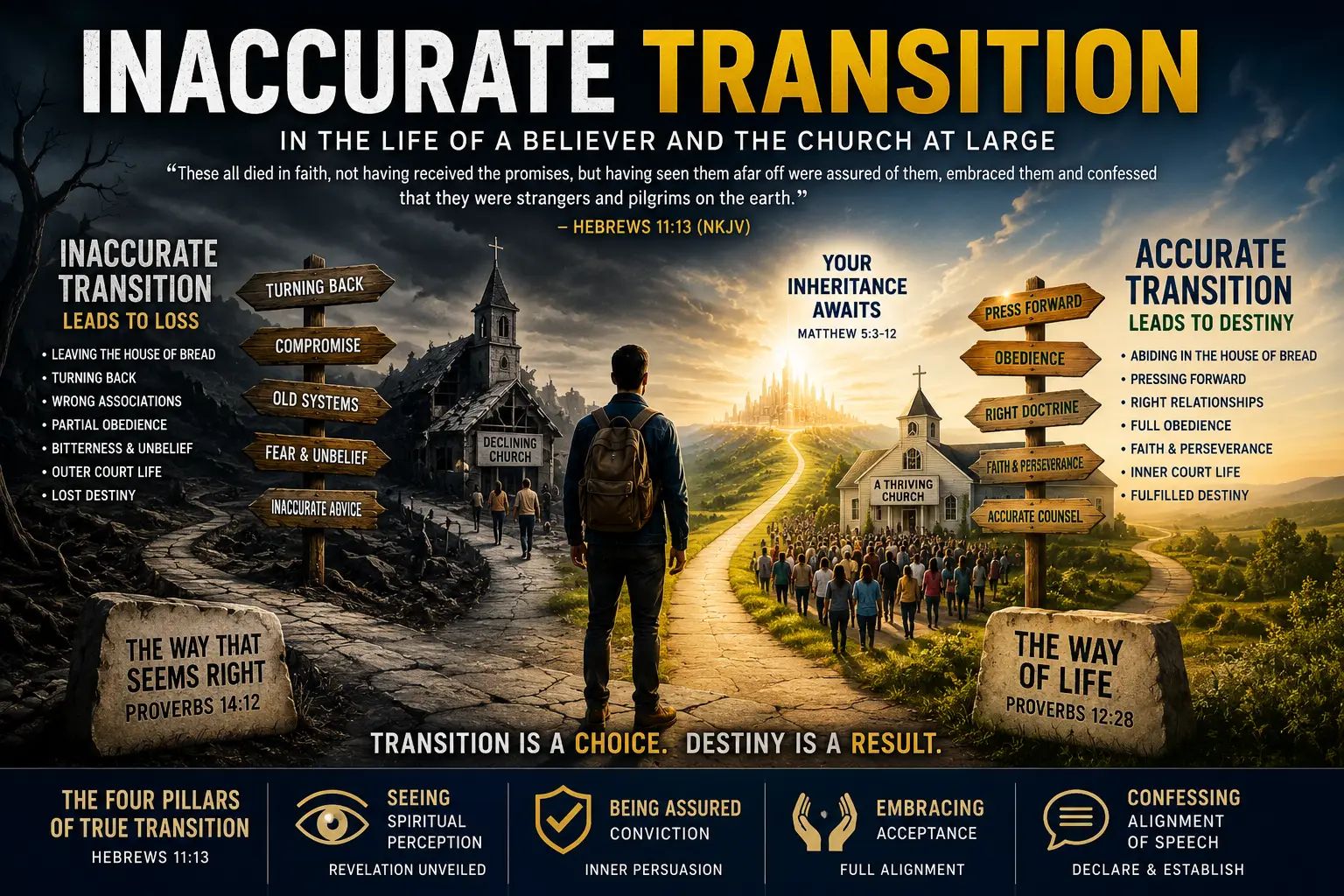
INTRODUCTION: A CHURCH IN GOD’S SIGHT
When God looked down the corridors of time, He saw a Church that would be united, unquenchable, unstoppable, and undeniable. Yet in contrast to this divine vision, we observe a Church struggling with transition. Transition is not merely movement—it is alignment with divine purpose.
Yet, alongside this vision, we must confront a sobering reality: many are failing in transition.
We are living in a time where sonship is defined not merely by confession, but by association—who we walk with, who we listen to, and what we align ourselves with. Transitions, therefore, are not casual movements; they are destiny-defining decisions.
Song of Solomon 3:4 (NKJV)
“Scarcely had I passed by them, When I found the one I love. I held him and would not let him go, Until I had brought him to the house of my mother, And into the chamber of her who conceived me.”
There is a dimension of pursuit, of holding on to what is divine, that must characterize every believer navigating transition.
I encourage you to take a moment and study the book of Ruth and the three women as well as Boaz representing the different transitions within the body of Christ that is visible and manifested today.
Ruth 1:1-18 NKJV
(1) Now it came to pass, in the days when the judges ruled, that there was a famine in the land. And a certain man of Bethlehem, Judah, went to dwell in the country of Moab, he and his wife and his two sons.
(2) The name of the man was Elimelech, the name of his wife was Naomi, and the names of his two sons were Mahlon and Chilion—Ephrathites of Bethlehem, Judah. And they went to the country of Moab and remained there.
(3) Then Elimelech, Naomi’s husband, died; and she was left, and her two sons.
(4) Now they took wives of the women of Moab: the name of the one was Orpah, and the name of the other Ruth. And they dwelt there about ten years.
(5) Then both Mahlon and Chilion also died; so the woman survived her two sons and her husband.
(6) Then she arose with her daughters-in-law that she might return from the country of Moab, for she had heard in the country of Moab that the LORD had visited His people by giving them bread.
(7) Therefore she went out from the place where she was, and her two daughters-in-law with her; and they went on the way to return to the land of Judah.
(8) And Naomi said to her two daughters-in-law, “Go, return each to her mother’s house. The LORD deal kindly with you, as you have dealt with the dead and with me.
(9) The LORD grant that you may find rest, each in the house of her husband.” So she kissed them, and they lifted up their voices and wept.
(10) And they said to her, “Surely we will return with you to your people.”
(11) But Naomi said, “Turn back, my daughters; why will you go with me? Are there still sons in my womb, that they may be your husbands?
(12) Turn back, my daughters, go—for I am too old to have a husband. If I should say I have hope, if I should have a husband tonight and should also bear sons,
(13) would you wait for them till they were grown? Would you restrain yourselves from having husbands? No, my daughters; for it grieves me very much for your sakes that the hand of the LORD has gone out against me!”
(14) Then they lifted up their voices and wept again; and Orpah kissed her mother-in-law, but Ruth clung to her.
(15) And she said, “Look, your sister-in-law has gone back to her people and to her gods; return after your sister-in-law.”
(16) But Ruth said: “Entreat me not to leave you, Or to turn back from following after you; For wherever you go, I will go; And wherever you lodge, I will lodge; Your people shall be my people, And your God, my God.
(17) Where you die, I will die, And there will I be buried. The LORD do so to me, and more also, If anything but death parts you and me.”
(18) When she saw that she was determined to go with her, she stopped speaking to her.
You need to understand the symbolic picture of the following characters as representing the following in the book of Ruth:
Boaz – Represents Jesus Christ
Elimelech – Transitioned inaccurately. His name means ‘My God is King.’ He left Bethlehem, the house of bread and praise and moved to Moab. This was not merely a geographic relocation; it was a spiritual misalignment. The end result was death, loss, and generational impact.
Naomi – Represents incomplete transition
Orpah – Represents regression
Ruth – Represents covenant alignment and full transition into divine purpose
THE NATURE OF TRANSITION
Transition is spiritual migration. It is the movement from one dimension of truth to another. It requires discernment, obedience, and courage. Many begin the journey but fail to complete it because transition demands death to comfort, familiarity, and your past identity.
Many of us comes from the charismatic or Pentecostal movement so we need to take a moment to reflect deeply on your current position. Ask yourself if you are aligned with God’s present day truth, or are you holding onto the past systems from where you came from? True transition demands obedience and courage to change to a place and position of accuracy.
THE DANGER OF INACCURATE TRANSITIONS
An inaccurate transition is not merely a wrong move—it is a departure from divine accuracy and destiny.
Let us again consider Elimelech:
- His name means “My God is King”
- Yet he left Bethlehem Judah (a house of bread and praise)
- He then transitioned into Moab—a place outside of covenant alignment
The result? His Death.
As a result we see that when you leave “Bethlehem” the House of Bread and Praise:
- The bread (Word)
- The praise (presence)
You step into spiritual decline.
Inaccurate transitions often look logical to our natural mins, but they are spiritually fatal.
DISCOVER THE POWER OF REFUSING WRONG MOVEMENT AND STAGNATION IN THE INACCURATE SYSTEMS
When on the other hand we take a moment and look at the life of Isaac we see that the life of Isaac presents to us a contrasting picture:
Genesis 26:2 NKJV
(2) Then the LORD appeared to him and said: “Do not go down to Egypt; live in the land of which I shall tell you.
Genesis 26:12 NKJV
(12) Then Isaac sowed in that land, and reaped in the same year a hundredfold; and the LORD blessed him.
God instructed him not to go to Gerar which was a place of limitation. As a result we see that Isaac:
- Stayed where God told him
- Refused an impartial transition
- Reaped a hundredfold in the same year
We need to understand that not every movement is progress. Sometimes, obedience demand us to stay.
THE THREE WOMEN IN THE BOOK OF RUTH REPRESENTS SYMBOLICLY THREE CHURCHES
The Book of Ruth reveals three dimensions of the Church through these three women:
ORPAH – THE CHURCH THAT TURNS BACK
- Represents incomplete transition
- Turns back to Moab (She returned to the old systems and old mindsets)
- Disappears from the narrative
Her name means “neck”—you only see her back.
Luke 9:62 NKJV
(62) But Jesus said to him, “No one, having put his hand to the plow, and looking back, is fit for the kingdom of God.”
Orpah teaches us that:
- Fear and unbelief causes missed visitation
- Wrong associations pull you back into the old systems
- Partial obedience results in loss of your destiny
NAOMI – THE BITTER TRANSITIONAL CHURCH
- Once pleasant, now bitter (Mara)
- Represents those who experienced loss in transition
- Unable to fully step into restoration
Bitterness is:
Unresolved pain that distorts spiritual judgment
Naomi could not give accurate counsel because she was emotionally compromised.
RUTH – THE CHURCH THAT TRANSITIONS CORRECTLY
Ruth embodies:
- Covenant loyalty
- Perseverance
- Accurate alignment
She declares
Ruth 1:16 NKJV
(16) But Ruth said: “Entreat me not to leave you, Or to turn back from following after you; For wherever you go, I will go; And wherever you lodge, I will lodge; Your people shall be my people, And your God, my God.
Ruth:
- Clung when others turned back
- Transitioned fully
- Encountered Boaz (the kinsman redeemer)
As a direct result she became:
- Part of the lineage of Christ
- A carrier of redemptive purpose
THE FOUR PILLARS OF TRUE TRANSITION
Hebrews 11:13 NKJV
(13) These all died in faith, not having received the promises, but having seen them afar off were assured of them, embraced them and confessed that they were strangers and pilgrims on the earth.
The Four Pillars of True Transition
A Kingdom Framework for Accurate Migration
Hebrews 11:13 (NKJV)
“These all died in faith, not having received the promises, but having seen them afar off were assured of them, embraced them and confessed that they were strangers and pilgrims on the earth.”
Transition in the Kingdom is never accidental—it is intentional, spiritual, and progressive. Hebrews 11:13 gives us a divine sequence, a pattern that governs how men and women move from promise to fulfilment, from calling to manifestation.
This scripture does not merely describe faith—it reveals the anatomy of transition.
There are four non-negotiable pillars:
PILLAR 1: SEEING – SPIRITUAL PERCEPTION (REVELATION)
Hebrews 11:13 (NKJV)
“These all died in faith, not having received the promises, but having seen them afar off were assured of them, embraced them and confessed that they were strangers and pilgrims on the earth.”
Every true transition begins with sight—not natural sight, but spiritual perception.
You cannot move into what you cannot see.
What is Seeing?
Seeing is:
- The ability to discern a new season
- The capacity to recognize what God is doing now
- The unveiling of present truth
It is not information—it is revelation.
Why Many Fail Here
Many remain stuck because:
- They are bound to past seasons
- They interpret new moves through old paradigms
- They lack spiritual illumination
Jesus repeatedly said:
Mark 8:18 NKJV
(18) Having eyes, do you not see? And having ears, do you not hear? And do you not remember?
This implies:
Not everyone who has eyes actually sees.
The Biblical Pattern
- The children of Israel saw Egypt, but could not see Canaan
- The Pharisees saw Jesus physically, but could not perceive Him spiritually as the Messiah
- Orpah saw difficulty—but Ruth saw destiny
Sight determines your movement.
If your vision is limited, your transition will be aborted.
True seeing and perceiving requires from you:
- Intimacy with God
- Exposure to authentic apostolic doctrine
- A willingness to let go of your mental strongholds
PILLAR 2: BEING ASSURED – CONVICTION (INNER PERSUASION)
Hebrews 11:13 (NKJV)
“These all died in faith, not having received the promises, but having seen them afar off were assured of them, embraced them and confessed that they were strangers and pilgrims on the earth.”
Seeing is not enough. Many see—but never move.
Assurance is what anchors revelation into conviction.
What is Assurance?
It is:
- Deep internal persuasion
- Unshakable belief in what God has revealed
- A settled heart that says: “This is truth.”
The Danger of Partial Assurance
You can:
- See correctly
- Even speak correctly
But if you are not fully assured, you will:
- Retreat under pressure
- Question in adversity
- Abandon transition midway
Let us take a moment and look at the life of John the Baptist as a Case Study:
John the Baptist:
- Saw Jesus (“Behold the Lamb of God”)
- Declared Him publicly
Yet later he asked:
“Are You the Coming One, or do we look for another?”
What failed?
Assurance.
Many leaders and believers today can:
- See the apostolic
- Acknowledge new truth
But lack the conviction to:
- Leave inaccurate systems
- Break from tradition
- Stand alone if necessary
Revelation introduces you – but conviction keeps you.
Without assurance, you will default back to familiarity and comfort.
PILLAR 3: EMBRACING – ACCEPTANCE (FULL ALIGNMENT)
Hebrews 11:13 (NKJV)
“These all died in faith, not having received the promises, but having seen them afar off were assured of them, embraced them and confessed that they were strangers and pilgrims on the earth.”
To embrace means more than agreeing—it means accepting at a cost.
It is here where transition becomes real and irreversible.
What is Embracing?
It is:
- Full acceptance of the new season
- Willingness to restructure your life
- Alignment of your:
- Relationships
- Doctrine
- Lifestyle
The Cost of Embracing
Embracing will require:
- Letting go of old associations
- Walking away from security systems
- Dying to reputation and comfort
You cannot embrace the new while holding onto the old.
Biblical Examples
- Abraham left his country, family, and father’s house
- Elisha burned his plow – it was a point of no return point
- Ruth left Moab permanently
The Tragedy of Non-Embrace
Many:
- See
- Even feel convinced
But never fully embrace
They:
- Hover between two worlds
- Maintain dual loyalties
- Become spiritually unstable
Embrace determines your separation.
What you embrace defines what you must leave behind.
PILLAR 4: CONFESSING – ALIGNMENT OF SPEECH (DECLARATION)
Hebrews 11:13 (NKJV)
“These all died in faith, not having received the promises, but having seen them afar off were assured of them, embraced them and confessed that they were strangers and pilgrims on the earth.”
Confession is the external expression of internal conviction.
It is where your mouth comes into agreement with your migration.
What is Confession?
It is:
- Declaring your new identity
- Verbal alignment with your new position
- Speaking what God has revealed
Why Confession Matters
Your words:
- Frame your reality
- Establish your direction
- Reinforce your transition
Many sabotage their transition because:
- Their speech contradicts their revelation
- They speak from fear instead of faith
The Biblical Principle we see here demonstrated is:
Matthew 12:34 NKJV
(34) Brood of vipers! How can you, being evil, speak good things? For out of the abundance of the heart the mouth speaks.
If your heart has transitioned, your mouth must follow.
What Did They Confess?
They confessed:
- They were strangers
- They were pilgrims
In other words:
“We no longer belong to the old system.”
True transition requires you to say:
- “I cannot go back”
- “I am aligned with present truth”
- “I belong to a different order”
Your Confession seals your transition.
What you consistently declare, you ultimately become.
THE CORE PROBLEM: WHY MANY NEVER TRANSITION
Many fail, not because opportunity is absent or that truth is unavailable
But because:
They never truly SEE.
And even if they see:
- They lack assurance
- They refuse to embrace
- They fear to confess
Final Synthesis: The Flow of Transition
The four pillars unfold in sequence:
Seeing → Opens your awareness
Assurance → Provides steadiness
Embracing → Distinguishes you
Confessing → Grounds your foundation
If any pillar is missing:
Your Transition remains incomplete.
FINAL THOUGHT AND CHARGE:
You must ask yourself:
- Have I truly seen, or am I still blind to this season?
- Am I fully assured, or still negotiating truth?
- Have I embraced, or am I holding onto the past?
- Is my confession aligned, or divided?
Because in the Kingdom:
Incomplete transition produces incomplete destiny.
But accurate transition releases inheritance.
FAILED TRANSITION THE CRISIS OF THE MODERN CHURCH
A central question confronts us:
Are we building attendees, or are we forming disciples?
The Church today faces a critical transition:
- From sermon-centric gatherings
- To apostolic discipleship systems
The Problem:
- Spectator Christianity
- Institutional control
- Lack of relational development
- Dependency on systems rather than Spirit
The Result:
- Decline
- Weak believers
- Shallow transformation
- From Institution to Organic Life
God is shifting the Church:
From:
- Performance → Participation
- Structure → Spirit
- Information → Transformation
- Consumers → Sons
The new wineskin is:
- Relational
- Spirit-led
- Generational
- Built on fathers and sons
Romans 8:14 NKJV
(14) For as many as are led by the Spirit of God, these are sons of God.
- Why Many Fail to Transition
Several hindrances block accurate transition:
- Spiritual blindness
- Wrong relationships
- Fear of loss (financial, positional)
- Sentimental attachments
- Lack of faith
- Insecurity
- Institutional loyalty over truth
Transition is not just spiritual—it is costly.
THE REMNANT PRINCIPLE
Despite widespread failure, God always preserves a remnant:
- A people who do not turn back
- A people who press into the Most Holy Place
- A people who embrace present truth
Ruth represents this remnant.
THE CALL TO ACCURATE TRANSITION
We are not called to:
- Maintain systems
- Preserve traditions
- Protect comfort
We are called to:
- Migrate with God
- Align with truth
- Embrace divine upgrades
Just as technology upgrades continuously, so must the Church:
Outdated systems cannot carry present revelation.
CONCLUSION: NO TURNING BACK
The Book of Ruth is ultimately:
- A story of redemption
- A picture of grace in chaos
- A prophetic blueprint for end-time alignment
In this hour:
- Do not quit
- Do not retreat
- Do not partially obey
Because:
Inaccurate transitions abort destiny—but accurate alignment releases inheritance.
A FINAL REFLECTION
Ask yourself honestly:
- Am I transitioning accurately, or emotionally?
- Am I building relationships, or attending services?
- Am I becoming a son, or remaining a spectator?
Because at the end of it all, the goal is not survival—but fulfillment:
“Well done, good and faithful servant.”
OTHER PUBLICATIONS BY THIS AUTHOR CAN BE FOUND AT: