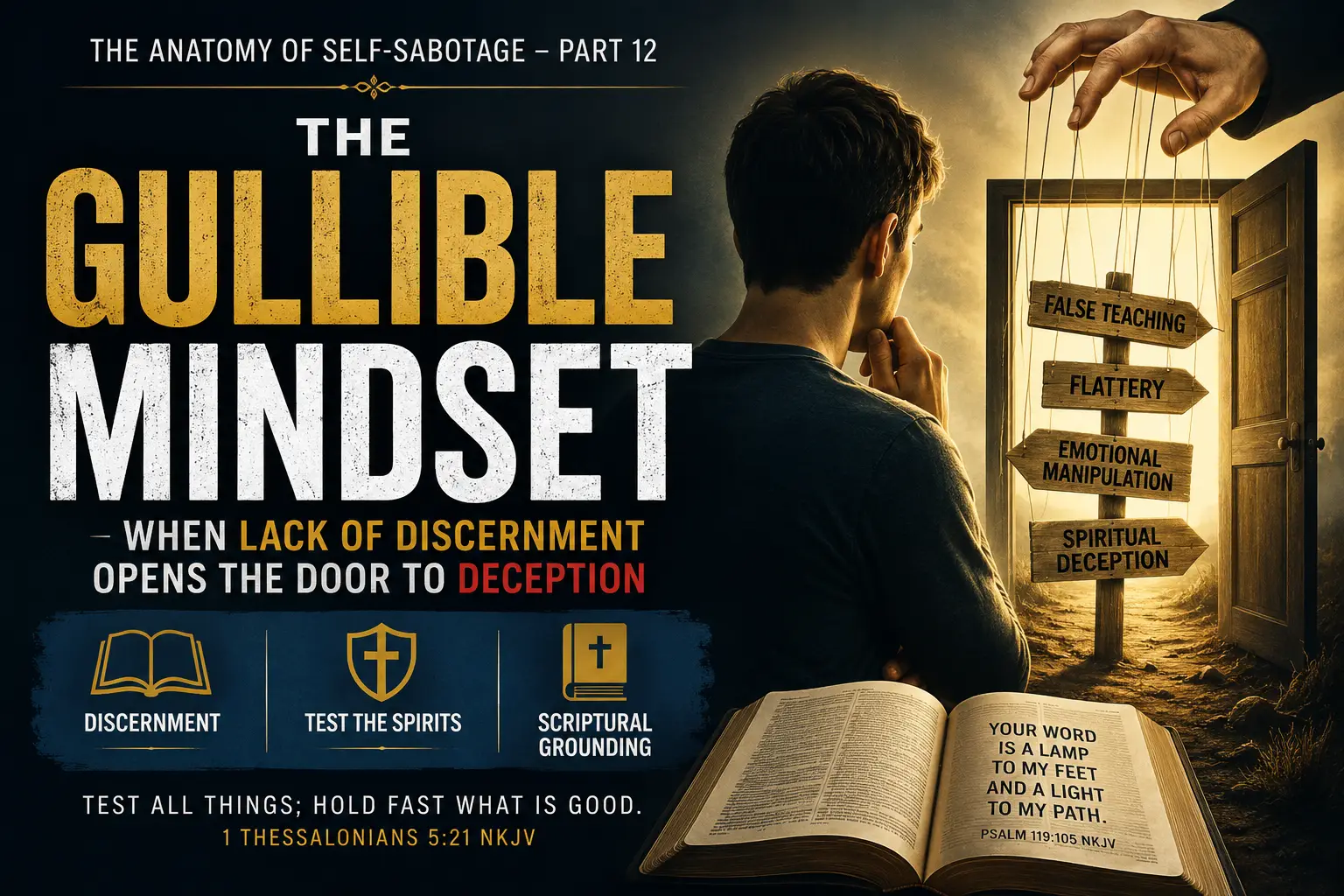
THE ANATOMY OF SELF-SABOTAGE – PART 12
THE GULLIBLE MINDSET—WHEN LACK OF DISCERNMENT OPENS THE DOOR TO DECEPTION
INTRODUCTION
Not every open door is from God. Not every voice that sounds spiritual carries truth. Not every person who uses religious language speaks by the Spirit of God. One of the most dangerous damaged mindsets in the life of a believer is the gullible mindset.
The gullible mindset is not the same as being humble, teachable, or trusting. A teachable person receives truth with discernment, but a gullible person receives information without testing it. A humble person listens carefully, but a gullible person believes too quickly. A trusting heart is beautiful when it is governed by wisdom, but trust without discernment can become a doorway to deception.
Scripture warns us clearly:
Proverbs 14:15 NKJV
(15) The simple believes every word, But the prudent considers well his steps.
This verse reveals the danger of spiritual simplicity. The simple person believes everything, accepts everything, and follows everything without proper testing. The prudent person, however, considers, evaluates, discerns, and weighs matters before acting.
The gullible mindset becomes self-sabotaging because it exposes a person to false teaching, wrong counsel, emotional manipulation, spiritual abuse, counterfeit prophecy, and ungodly influence. It opens the soul to voices that appear spiritual but are not submitted to the truth of God.
In a generation filled with opinions, platforms, teachings, prophecies, revelations, and spiritual claims, discernment is not optional. It is essential.
DEFINITION OF THE GULLIBLE MINDSET
The gullible mindset is a mindset lacking discernment and easily deceived.
It is a condition of the heart and mind where a person accepts people, messages, doctrines, prophecies, and spiritual experiences without proper testing. It is often marked by emotional openness without spiritual maturity, trust without wisdom, and hunger without grounding in truth.
A gullible person may sincerely desire God, but sincerity alone does not protect anyone from deception. Eve was deceived in the garden because she entertained a voice that questioned God’s word. Israel was deceived many times because they followed visible signs instead of covenant truth. Many believers today are deceived not because they hate God, but because they have not developed the spiritual discipline of testing what they hear.
Jesus warned that deception would be a major mark of the last days.
Matthew 24:4 NKJV
(4) And Jesus answered and said to them: “Take heed that no one deceives you.
This warning was not given to unbelievers only. Jesus was speaking to His disciples. That means believers can be deceived if they do not remain alert, grounded, and discerning.
The gullible mindset says, “It sounds spiritual, so it must be true.”
Discernment says, “Let us test whether this is aligned with Christ, Scripture, character, fruit, and the Spirit of God.”
Biblical Example 1: The Young Prophet
One of the clearest biblical examples of the gullible mindset is found in 1 Kings 13. A young prophet was sent by God from Judah to Bethel with a specific assignment. He was instructed to prophesy against the altar at Bethel and not to eat bread, drink water, or return by the same way he came.
The instruction of God was clear.
1 Kings 13:9 NKJV
(9) For so it was commanded me by the word of the LORD, saying, ‘You shall not eat bread, nor drink water, nor return by the same way you came.’ ”
The young prophet obeyed at first. He delivered the word of the Lord boldly. When the king invited him to stay and receive a reward, he refused because he remembered the command of God. Up to that point, he was accurate, obedient, and strong.
However, an older prophet heard about what had happened and went after him. The older prophet invited him to come home and eat bread. The young prophet repeated the instruction God had given him. But then the older prophet lied.
1 Kings 13:18 NKJV
(18) He said to him, “I too am a prophet as you are, and an angel spoke to me by the word of the LORD, saying, ‘Bring him back with you to your house, that he may eat bread and drink water.’ ” (He was lying to him.)
This is one of the most sobering statements in Scripture. The young prophet was not deceived by a pagan king. He was deceived by someone who claimed prophetic authority. He was not trapped by an obvious enemy. He was misled by someone who sounded spiritual and claimed angelic confirmation.
The young prophet believed the lying prophet and disobeyed the original instruction God had given him. As a result, judgment came upon him, and he died.
This account teaches us that no prophetic word, spiritual claim, angelic encounter, dream, vision, or ministerial title should override what God has clearly spoken.
The young prophet’s failure was not that he lacked a word from God. His failure was that he allowed another voice to cancel the word he had already received from God.
This is the danger of the gullible mindset. It can begin in obedience but end in deception when discernment is not maintained.
LESSONS FROM THE YOUNG PROPHET
The young prophet teaches us several important lessons.
- Firstly, spiritual language does not guarantee spiritual truth. The old prophet said, “I too am a prophet.” Yet Scripture says clearly that he was lying.
- Secondly, a person’s age, title, or experience does not automatically make their instruction accurate. The older prophet had influence, but his message contradicted God’s command.
- Thirdly, every word must be tested against what God has already revealed. God will not contradict His own truth.
- Fourthly, obedience must not be negotiated by emotional pressure, religious persuasion, or claims of superior revelation.
The gullible mindset becomes dangerous when it respects spiritual personalities more than the voice of God.
Biblical Example 2: Micah and the Levite
Another powerful example is found in Judges 17, where a man named Micah created a private shrine, made religious objects, and eventually hired a Levite to serve as his personal priest.
Judges 17:10 NKJV
(10) Micah said to him, “Dwell with me, and be a father and a priest to me, and I will give you ten shekels of silver per year, a suit of clothes, and your sustenance.” So the Levite went in.
Micah believed that because he had a Levite in his house, the Lord would bless him. However, his entire religious system was built on mixture, idolatry, and self-made spirituality.
Judges 17:13 NKJV says, “Now I know that the LORD will be good to me, since I have a Levite as priest!”
Micah assumed that religious appearance guaranteed divine approval. He believed that having the right religious title in his house meant he had God’s blessing. Yet the chapter reveals a spiritually confused environment where everyone was doing what was right in their own eyes.
Judges 17:13 NKJV
(13) Then Micah said, “Now I know that the LORD will be good to me, since I have a Levite as priest!”
Micah represents the gullible mindset that accepts false spirituality because it looks religious. He had a shrine, an ephod, household idols, and a Levite priest, but he did not have covenant accuracy. He confused religious structure with spiritual truth.
This is still a danger today. People may assume that because something has worship music, Christian language, prophetic vocabulary, religious symbols, or ministry titles, it must be from God. But external spirituality does not always prove internal accuracy.
Micah did not discern the difference between true worship and religious mixture.
LESSONS FROM MICAH AND THE LEVITE
Micah’s story teaches us that gullibility often hides behind religious comfort. He wanted spiritual assurance, but he created it on his own terms.
He did not ask, “Is this pleasing to God?”
He assumed, “This must be right because it feels spiritual.”
He did not test his worship by the covenant standard of God’s word. He measured it by convenience, personal desire, and religious appearance.
The gullible mindset is easily impressed by form but often blind to substance. It can recognize religious activity but fail to discern whether God is truly present.
True discernment asks deeper questions:
- Is this biblical?
- Is this Christ-centered?
- Is this producing holiness?
- Is this submitted to truth?
- Is this consistent with the character of God?
- Is this fruit righteous or manipulative?
CHARACTERISTICS OF THE GULLIBLE MINDSET
-
Naivety
Naivety is one of the main characteristics of the gullible mindset. It is the tendency to believe quickly without proper examination.
A naïve person often assumes that everyone who speaks confidently is truthful. They may believe every testimony, every prophecy, every dream, every accusation, every teaching, and every spiritual claim without asking whether it is accurate.
Scripture warns against this.
Proverbs 14:15 NKJV
(15) The simple believes every word, But the prudent considers well his steps.
Naivety is not innocence. Innocence is purity of heart, but naivety is the absence of discernment. Jesus does not call us to be suspicious, cynical, or hardened, but He does call us to be wise.
Matthew 10:16 NKJV
(16) “Behold, I send you out as sheep in the midst of wolves. Therefore be wise as serpents and harmless as doves.
This means believers must combine purity with wisdom. We must not become cruel, suspicious, or bitter, but neither must we become careless, undiscerning, and easily misled.
Naivety says, “I believe it because they said it.”
Wisdom says, “I will test it before I receive it.”
-
Lack of Discernment
The gullible mindset lacks the ability to distinguish between truth and error, spirit and flesh, wisdom and manipulation, genuine authority and controlling influence.
Discernment is not suspicion. Suspicion assumes evil without evidence. Discernment tests matters by truth.
The Bible teaches that mature believers develop discernment through use.
Hebrews 5:14 NKJV
(14) But solid food belongs to those who are of full age, that is, those who by reason of use have their senses exercised to discern both good and evil.
Discernment grows when believers consistently submit their minds to Scripture, obey the Holy Spirit, learn from correction, and test what they hear.
A person without discernment may be moved by charisma, emotion, popularity, eloquence, signs, titles, or dramatic spiritual claims. But discernment looks beyond appearance and asks whether something carries the nature, truth, and fruit of God.
Paul warned the church that deception can come through impressive spiritual language.
2 Corinthians 11:14 NKJV
(14) And no wonder! For Satan himself transforms himself into an angel of light.
This means deception does not always look dark. Sometimes it looks enlightened, spiritual, attractive, compassionate, powerful, or prophetic. That is why discernment is necessary.
-
Easily Manipulated
The gullible mindset is easily manipulated because it does not know how to test motives, boundaries, doctrine, or spiritual authority.
Manipulation often works through fear, flattery, urgency, guilt, emotional pressure, or false promises. A gullible person may be controlled by statements such as:
- “If you really trusted God, you would do this.”
- “If you dishonor me, you dishonor God.”
- “If you do not obey this word, you will miss your blessing.”
- “God told me you must submit to this.”
- “Do not question it; just receive it.”
Biblical authority does not fear testing. True spiritual leadership welcomes accountability to Scripture.
The Bereans are a powerful example of healthy discernment. They received the word with readiness, but they also searched the Scriptures.
Acts 17:11 NKJV
(11) These were more fair-minded than those in Thessalonica, in that they received the word with all readiness, and searched the Scriptures daily to find out whether these things were so.
They were not rebellious because they tested what Paul preached. They were called fair-minded. Their example shows us that testing a teaching by Scripture is not dishonour. It is wisdom.
A gullible mindset may confuse questioning with rebellion, but biblical discernment understands that truth can withstand examination.
-
Spiritual Instability
The gullible mindset often produces spiritual instability. When people do not have strong biblical foundations, they are easily moved from one teaching to another, one prophet to another, one movement to another, one emotional experience to another.
Paul warned about this condition.
Ephesians 4:14 NKJV
(14) that we should no longer be children, tossed to and fro and carried about with every wind of doctrine, by the trickery of men, in the cunning craftiness of deceitful plotting,
Spiritual children are easily tossed because they lack rootedness. They may be excited today, confused tomorrow, convinced by one teaching this week, and shaken by another teaching the next week.
Spiritual instability is dangerous because it prevents maturity. A gullible person may constantly chase the latest revelation but never become established in foundational truth.
- They may follow trends instead of truth.
- They may follow personalities instead of Christ.
- They may follow emotions instead of obedience.
- They may follow signs instead of Scripture.
The cure for instability is not more information. It is spiritual grounding.
MODERN EXPRESSIONS OF THE GULLIBLE MINDSET
The gullible mindset can appear in many modern ways.
It appears when believers accept every prophetic word without testing it.
It appears when Christians share every spiritual post, dream, warning, or message without verifying whether it is biblical.
It appears when people follow popular teachers simply because they are famous, emotional, persuasive, or successful.
It appears when believers confuse supernatural language with spiritual maturity.
It appears when people submit to controlling leaders because they are afraid to test what is being said.
It appears when someone believes accusations against others without witnesses, evidence, or biblical process.
It appears when believers move from church to church, teaching to teaching, and movement to movement because they are constantly impressed by new voices.
The gullible mindset is not always obvious. Sometimes it appears as hunger for God, but hunger without truth can become dangerous.
A hungry heart must also become a discerning heart.
REDEMPTIVE CURE FOR THE GULLIBLE MINDSET
The gullible mindset can be healed. God does not want His people to live suspiciously, but He also does not want them to live blindly. The redemptive cure involves discernment, testing spirits, and scriptural grounding.
Discernment is the ability to recognize the difference between what is of God and what is not. It is the spiritual capacity to judge rightly according to truth.
Discernment comes through relationship with God, knowledge of Scripture, obedience to the Holy Spirit, and maturity developed over time.
Solomon asked God for wisdom and discernment to govern well.
1 Kings 3:9 NKJV
(9) Therefore give to Your servant an understanding heart to judge Your people, that I may discern between good and evil. For who is able to judge this great people of Yours?”
This should also be the prayer of every believer. We need understanding hearts. We need minds renewed by truth and spirits sensitive to the voice of God.
Discernment does not make us proud. It makes us careful. It does not make us suspicious. It makes us accurate. It does not cause us to reject everything. It teaches us to test everything.
1 Thessalonians 5:21 NKJV
(21) Test all things; hold fast what is good.
This is a balanced command. We are not told to reject everything, and we are not told to receive everything. We are told to test everything and hold fast to what is good.
-
Testing the Spirits
The second redemptive cure is learning to test the spirits.
1 John 4:1 NKJV
(1) Beloved, do not believe every spirit, but test the spirits, whether they are of God; because many false prophets have gone out into the world.
This verse is a direct correction to the gullible mindset. It tells believers not to believe every spirit. Behind teachings, prophecies, doctrines, movements, and spiritual claims, there may be different spiritual influences. Not everything spiritual is holy.
Testing the spirits means asking whether a message agrees with the Lordship of Jesus Christ, the truth of Scripture, the character of God, the fruit of the Spirit, and the witness of the Holy Spirit.
- A message may sound powerful, but does it exalt Christ?
- A prophecy may sound impressive, but does it align with Scripture?
- A leader may sound authoritative, but do they display godly fruit?
- A movement may look successful, but is it producing holiness, humility, love, truth, and obedience?
Jesus said we would know false prophets by their fruits.
Matthew 7:16 NKJV
(16) You will know them by their fruits. Do men gather grapes from thornbushes or figs from thistles?
Fruit is more reliable than performance. Gifts can impress people, but fruit reveals character.
The third redemptive cure is scriptural grounding.
A believer who is not grounded in Scripture will be vulnerable to deception. The Word of God becomes the measuring line for truth. It teaches us the nature of God, the ways of God, the doctrine of Christ, and the boundaries of righteousness.
Psalms 119:105 NKJV
(105) Your word is a lamp to my feet And a light to my path.
Without the light of the Word, people walk in spiritual darkness while thinking they are following revelation. Scripture protects us from emotional confusion, false doctrine, and counterfeit spirituality.
Paul told Timothy that Scripture equips the man of God.
2 Timothy 3:16-17 NKJV
(16) All Scripture is given by inspiration of God, and is profitable for doctrine, for reproof, for correction, for instruction in righteousness,
(17) that the man of God may be complete, thoroughly equipped for every good work.
Scriptural grounding means we do not build our lives on feelings, opinions, dreams, trends, or personalities. We build on the written Word of God and the living Christ revealed through that Word.
The more grounded we are in Scripture, the less vulnerable we become to deception.
PRACTICAL STEPS TO OVERCOME THE GULLIBLE MINDSET
The gullible mindset is overcome through intentional spiritual discipline.
- First, slow down before receiving or acting on spiritual claims. Do not rush into agreement simply because something sounds urgent or emotional.
- Second, measure every teaching, prophecy, and counsel against Scripture. God’s Word is the standard.
- Third, examine fruit, not just gifts. A gifted person is not automatically a mature person.
- Fourth, seek wise counsel from proven, godly, accountable people.
- Fifth, refuse manipulation. True spiritual authority does not need fear, control, or intimidation to produce obedience.
- Sixth, grow in personal relationship with God so that you know His voice and His ways.
- Seventh, become rooted in sound doctrine. Stability comes from truth, not excitement.
THE DIFFERENCE BETWEEN TRUST AND GULLIBILITY
It is important to understand that God does not call us to become suspicious people. Suspicion damages relationships and assumes evil motives. Discernment protects relationships by testing matters truthfully.
Trust is not the absence of wisdom. Trust must be governed by truth.
Jesus trusted the Father completely, yet He did not entrust Himself blindly to people.
John 2:24-25 NKJV
(24) But Jesus did not commit Himself to them, because He knew all men,
(25) and had no need that anyone should testify of man, for He knew what was in man.
This shows perfect balance. Jesus loved people, served people, healed people, and gave His life for people, but He was never gullible concerning human nature.
Believers must learn the same balance. We must love deeply, forgive freely, serve faithfully, and remain open-hearted, but we must also walk in wisdom, discernment, and truth.
CONCLUSION: A CALL TO DISCERNMENT
The gullible mindset is dangerous because it opens the door to deception. It causes believers to believe every voice, follow every claim, trust every appearance, and accept every spiritual impression without testing.
The young prophet died because he allowed a lying prophet to override the clear instruction of God. Micah embraced false spirituality because he mistook religious appearance for divine approval. Both examples warn us that sincerity without discernment can still lead to destruction.
God is calling His people to maturity. He is calling us to move beyond spiritual childishness, emotional dependency, and blind acceptance. He is calling us to become people of the Word, people of the Spirit, people of wisdom, and people of discernment.
- Do not believe every word.
- Do not follow every voice.
- Do not accept every prophecy.
- Do not trust every appearance.
- Do not confuse religious language with spiritual truth.
Test all things. Hold fast what is good. Search the Scriptures. Examine the fruit. Follow Christ. Stay grounded in the Word of God.
The cure for gullibility is not suspicion. The cure is discernment.
A discerning believer is not easily deceived because their heart is anchored in truth, their mind is renewed by Scripture, and their spirit is governed by the voice of God.
OTHER PUBLICATIONS BY THIS AUTHOR CAN BE FOUND AT: