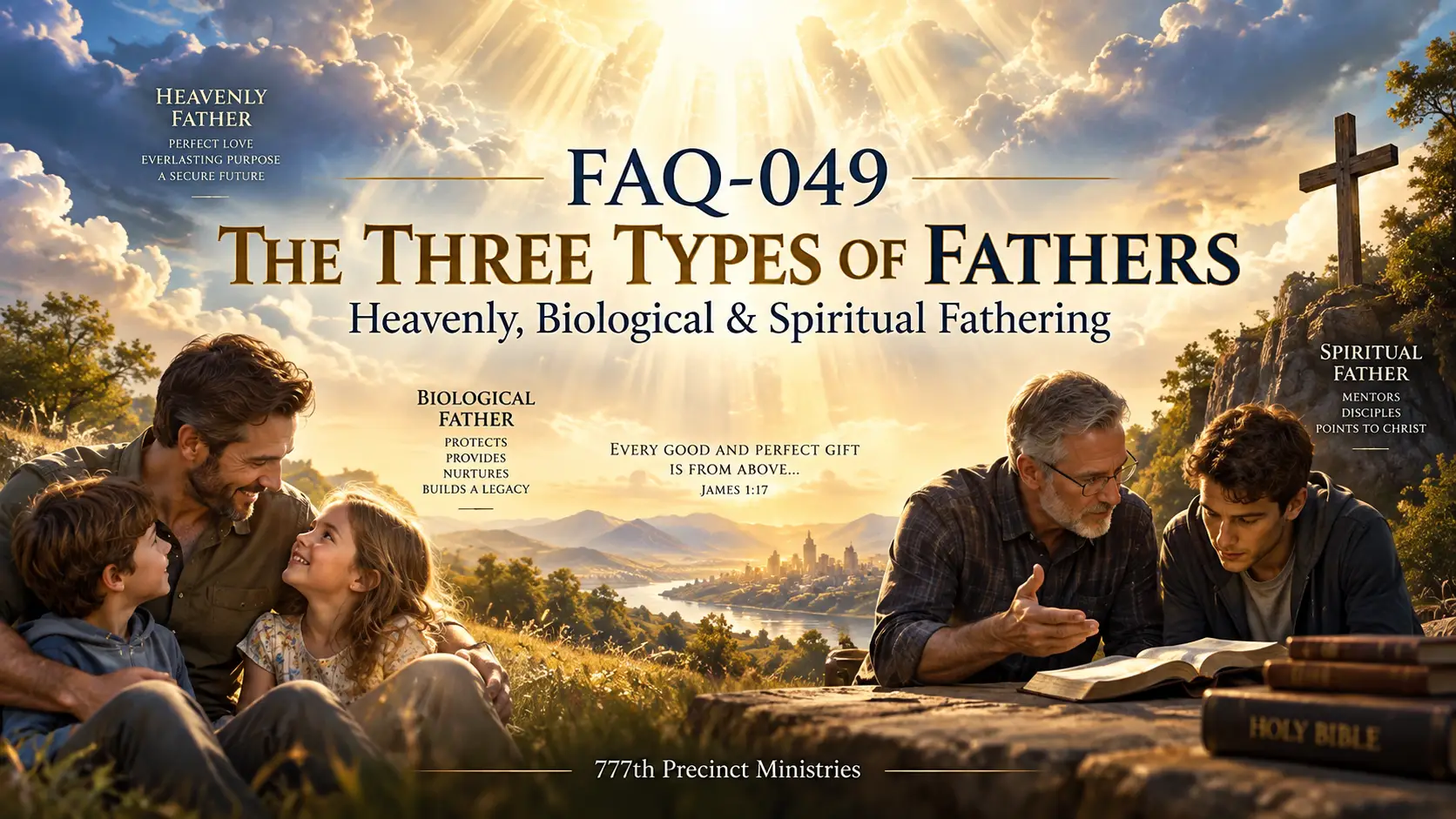
Scripture presents distinct dimensions of fathering in our lives. God is the Father of our spirits; biological fathers carry natural responsibility and influence, and spiritual fathers help nurture maturity, character and calling in Christ.
1. Introduction
Fathering is one of the most important relational themes in Scripture. It speaks not only of natural family, but also of God’s relationship with His children and of mature believers who help nurture others in the faith. When biblical fathering is established by the Spirit of God, it can become a source of blessing, identity, maturity, protection and release. When it is imposed in the flesh or turned into control, it can become deeply damaging.
Malachi 4:5-6 (BSB)
5 Behold, I will send you Elijah the prophet before the coming of the great and awesome Day of the LORD.
6 And he will turn the hearts of the fathers to their children, and the hearts of the children to their fathers. Otherwise, I will come and strike the land with a curse.
The biblical picture is therefore not merely about titles. It is about hearts being rightly connected, relationships being restored, and maturity being transmitted from one generation to another.
QUESTION
What are the three types of fathers that may function in a person’s life, and what is the biblical role of each?
SHORT ANSWER
This FAQ uses the threefold framework of Heavenly Father, biological father and spiritual father. The Heavenly Father is the ultimate and irreplaceable Father of our spirits. A biological father fathers in the natural sphere and profoundly influences identity, security and relational development. A spiritual father is a mature believer who walks relationally with another believer to nurture character, wisdom, spiritual maturity and obedience to Christ. These dimensions must never compete with one another: healthy fathering always serves God’s purpose and directs the believer more deeply toward Christ.
2. The Biblical Foundation for Fathering
Scripture plainly recognises natural fatherhood, God’s fatherhood and relational fathering within the life of faith. Paul did not hesitate to use father-child language for those he had helped establish in Christ.
1 Corinthians 4:15 (BSB)
15 Even if you have ten thousand guardians in Christ, you do not have many fathers; for in Christ Jesus I became your father through the gospel.
2 Timothy 1:2 (BSB)
2 To Timothy, my beloved child: Grace, mercy, and peace from God the Father and Christ Jesus our Lord.
Titus 1:4 (BSB)
4 To Titus, my true child in our common faith: Grace and peace from God the Father and Christ Jesus our Savior.
The language is relational, not institutional. Paul’s fathering was expressed through the gospel, shared life, proven character, teaching, example, correction and release into ministry.
Philippians 2:22 (BSB)
22 But you know Timothy’s proven worth, that as a child with his father he has served with me to advance the gospel.
3. The Heavenly Father – Father of Our Spirits
The first and highest dimension is the Heavenly Father. No human relationship can replace Him. Every believer ultimately belongs to God, receives identity from Him, is disciplined by Him and must live in direct submission to Him.
Hebrews 12:9-11 (BSB)
9 Furthermore, we have all had earthly fathers who disciplined us, and we respected them. Should we not much more submit to the Father of our spirits and live?
10 Our fathers disciplined us for a short time as they thought best, but God disciplines us for our good, so that we may share in His holiness.
11 No discipline seems enjoyable at the time, but painful. Later on, however, it yields a harvest of righteousness and peace to those who have been trained by it.
Hebrews deliberately distinguishes earthly fathers from the Father of our spirits. This establishes an important boundary: even the best biological or spiritual father remains a human steward. God alone is the ultimate Father, source, authority and owner of the believer’s life.
The Heavenly Father gives what no human father can finally give:
- spiritual identity and belonging;
- the life of sonship;
- perfect love and acceptance;
- divine discipline that produces holiness;
- direction by His Spirit;
- inheritance in Christ; and
- the final pattern of what true fatherhood should look like.
4. The Biological Father – Fathering in the Natural Sphere
The biological father is the natural father through whom a child enters earthly family life. Fatherhood in this sphere is more than biological paternity. The teaching distinguishes between merely fathering a child and faithfully being a father through presence, responsibility, nurture and example.
A biological father can profoundly influence a child’s development. In healthy form, natural fathering contributes to:
- physical and emotional security;
- healthy boundaries and discipline;
- confidence and a sense of worth;
- models for how relationships should function;
- patterns of respect, responsibility and courage;
- the formation of sons through example; and
- the expectations daughters may carry into later relationships.
Because natural fathers are human, their influence may be healthy, deficient or even harmful. Scripture therefore does not teach that an earthly father is infallible. Hebrews 12:10 acknowledges that earthly fathers discipline “as they thought best,” while God disciplines perfectly for our good. The believer may honour a biological father while still recognising that God’s fatherhood is the final standard.
5. The Spiritual Father – Fathering Soul-Life, Character and Calling
The third dimension is spiritual fathering. A spiritual father is not merely a preacher, teacher, supervisor or ministry leader. Paul says that believers may have many guardians, but not many fathers. Spiritual fathering therefore describes a deeper covenantal and relational investment in another believer’s maturity.
Within the framework of this teaching, the spiritual father helps nurture the believer’s soul-life and character. His primary goal is not to make the son dependent upon himself, but to help the son know the Lord, mature in character and fulfil the call of God.
Healthy spiritual fathering includes:
- nurturing and protecting without controlling;
- imparting knowledge, understanding, wisdom and counsel;
- modeling a life that can be observed and imitated;
- helping a believer discern and fulfil God’s call;
- creating relational access rather than distant hierarchy;
- training and empowering rather than keeping others permanently dependent;
- correcting when necessary with gentleness and humility;
- releasing sons and daughters into their own God-given assignment; and
- rejoicing when Christ’s influence increases and the father’s own influence becomes less necessary.
6. Jesus as the Model of Spiritual Fathering
The supplied teaching presents Jesus as the supreme model for how spiritual fathering should function. This does not confuse Jesus the Son with the Person of the Heavenly Father. Rather, it recognises that the way Jesus formed His disciples reveals the qualities of healthy spiritual fathering: relationship, access, instruction, demonstration, empowerment and release.
Mark 3:13-15 (BSB)
13 Then Jesus went up on the mountain and called for those He wanted, and they came to Him.
14 He appointed twelve of them, whom He designated as apostles, to accompany Him, to be sent out to preach,
15 and to have authority to drive out demons.
Notice the order: they were first called to be with Him, and then they were sent. Relationship preceded assignment. Jesus did not merely use disciples to accomplish His ministry. He shared His life with them and formed them for their own ministry.
Luke 9:1-2 (BSB)
1 Then Jesus called the Twelve together and gave them power and authority over all demons, and power to cure diseases.
2 And He sent them out to proclaim the kingdom of God and to heal the sick.
True spiritual fathers therefore do not hoard authority, platform or opportunity. They equip and release others according to the will of God.
7. A True Spiritual Father Always Points to Christ
John the Baptist provides another important pattern. He did not build disciples around his own permanent importance. When he identified Jesus, his disciples were free to follow Christ.
John 1:35-37 (BSB)
35 The next day John was there again with two of his disciples.
36 When he saw Jesus walking by, he said, “Look, the Lamb of God!”
37 And when the two disciples heard him say this, they followed Jesus.
This is one of the clearest safeguards in spiritual fathering: a true father does not compete with Jesus for the heart of a son or daughter. He does not make himself the destination. His success is seen when the believer becomes increasingly mature, obedient to Christ and capable of carrying spiritual responsibility without unhealthy dependence.
8. Correction and Discipline in Spiritual Fathering
Fathering includes correction, but biblical correction is never permission for humiliation, domination or emotional control. The goal is restoration.
Galatians 6:1 (BSB)
1 Brothers, if someone is caught in a trespass, you who are spiritual should restore him with a spirit of gentleness. But watch yourself, or you also may be tempted.
A mature spiritual father corrects with humility because he knows that he too stands under the grace, authority and discipline of God. Correction must be consistent with Scripture, aimed at restoration, and carried in a spirit of gentleness rather than coercion.
9. The Three Types of Fathers at a Glance
| Fathering dimension | Primary sphere | Main contribution | Key safeguard |
| Heavenly Father | Spirit / sonship | Identity, life, holiness, inheritance, divine discipline and ultimate belonging | He alone is the final Father and authority; no human father may replace Him. |
| Biological father | Natural life / family | Presence, security, discipline, example, relational formation and natural responsibility | Earthly fathers are human and imperfect; God remains the perfect standard. |
| Spiritual father | Soul-life / character / calling | Wisdom, example, nurture, correction, training, empowerment and release in Christ | Must be Spirit-established, Christ-centred, voluntary, non-controlling and aimed at maturity. |
10. Safeguards for Healthy Spiritual Fathering
Because father-son language can be powerful, it can also be abused. The original teaching expressly warns that a relationship established in the flesh can become damaging and that controlling leaders are not fit to function as spiritual fathers. The following safeguards arise from the teaching itself:
The relationship must not be forced. Only the Lord can bring a genuine spiritual father and son together. Healthy connection develops peacefully and relationally rather than through pressure.
The father must not control the son. Spiritual fathering is stewardship, not ownership. The father helps the son hear and obey God; he does not become a substitute for God.
Service must arise from relationship, not requirement. A son may gladly serve, but service should never become a mechanism of manipulation, obligation or extraction.
The father must point the son to Christ. Like John the Baptist, a true father is satisfied when the son follows Jesus more deeply, even when that means the father’s own influence decreases.
Correction must restore, not dominate. Biblical discipline is carried with gentleness, humility and awareness of one’s own vulnerability.
The goal is maturity and release. A healthy father wants sons and daughters to become mature enough to carry responsibility, fulfil their calling and eventually father others in a healthy way.
11. How Do I Recognise a True Spiritual Father?
Titles do not establish fatherhood. Fruit does. A true spiritual father can be recognised by what the relationship produces.
- You are drawn closer to Jesus, not merely closer to the leader.
- Your spiritual maturity increases rather than your dependence on a personality.
- You receive wisdom and correction without losing your God-given conscience and responsibility.
- The father serves your growth rather than using your loyalty to build his status.
- You are equipped, trusted and released into your assignment.
- The relationship carries family affection rather than institutional obligation.
- Correction aims at restoration and holiness, not fear and compliance.
- The relationship can celebrate your growth, fruitfulness and eventual ability to father others.
12. Proposed 777th Precinct Ministries Position
777th Precinct Ministries recognises three distinct but complementary dimensions of fathering: the Heavenly Father, biological fathers and spiritual fathers. We affirm God as the ultimate and irreplaceable Father of our spirits. We honour the natural role and responsibility of biological fathers. We also recognise biblically grounded spiritual fathering in which mature believers relationally nurture others toward Christlike character, wisdom, maturity and fulfilment of God’s calling.
We reject any model of spiritual fathering that is imposed, controlling, possessive, manipulative or designed to create permanent dependence upon a leader. Spiritual fathering must remain Christ-centred, servant-hearted, relational, accountable to Scripture and directed toward maturity and release. The true father does not own sons; he stewards relationships entrusted by God and rejoices when Christ is fully formed in them.
13. Conclusion
The three types of fathers describe different dimensions of God’s provision in a person’s journey. The Heavenly Father gives ultimate identity and spiritual life. Biological fathers carry a unique natural responsibility and formative influence. Spiritual fathers help believers mature in character, wisdom and calling through relationship, example, correction, empowerment and release.
These roles should never compete. Healthy natural and spiritual fathering should ultimately agree with the Father’s purpose: to form mature sons and daughters who know God, walk in obedience, carry His nature and become capable of nurturing the next generation.
The test of genuine spiritual fathering is therefore not how many people remain dependent upon a father, but how many become mature enough to follow Christ faithfully, fulfil their calling and reproduce healthy spiritual life in others.
1 Corinthians 4:15 (BSB)
15 Even if you have ten thousand guardians in Christ, you do not have many fathers; for in Christ Jesus I became your father through the gospel.
Scripture quotations are from the Berean Standard Bible (BSB), public domain.
OTHER PUBLICATIONS BY THIS AUTHOR CAN BE FOUND AT: