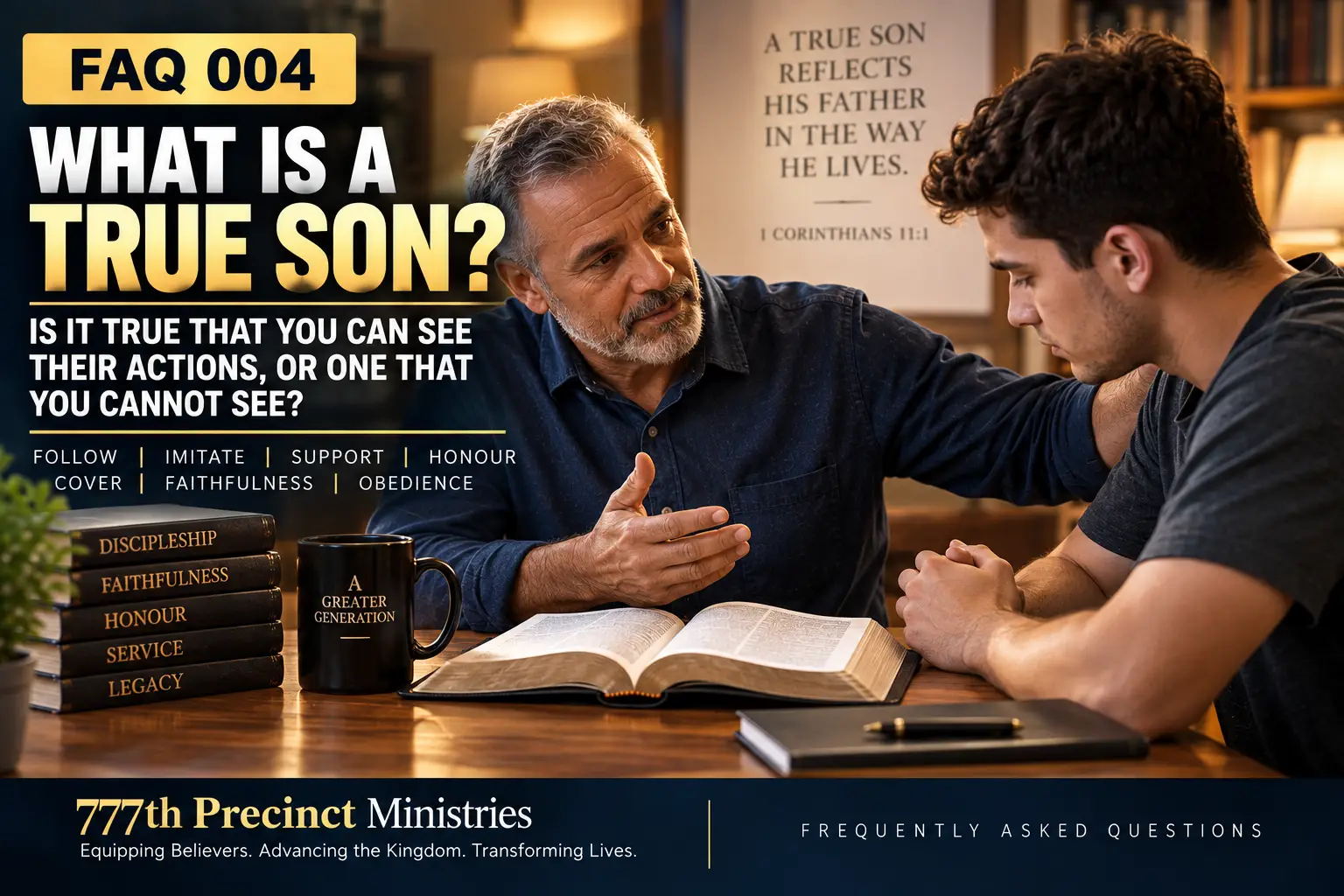
FAQ 004
WHAT IS A TRUE SON?
Can True Sonship Be Seen in a Person’s Actions?
Likeness • Faithfulness • Service • Honour • Maturity
1. Introduction
The language of spiritual fathers and sons appears throughout the New Testament. Paul called Timothy his beloved and faithful child in the Lord and described the father-son quality of their ministry relationship. Yet biblical sonship is deeper than using a title. It is demonstrated through relationship, character, shared life, faithfulness and maturity.
The original question asks two things: What is a true son? And can true sonship be seen in a person’s actions, or is it something hidden that others cannot see?
Scripture gives a balanced answer. True sonship produces visible fruit, but it is not a performance for public recognition. Some of the most meaningful acts of faithfulness may be known only to the father and to God. Over time, however, genuine sonship becomes evident through a proven manner of life.
QUESTION
What is a true spiritual son? Is true sonship visible in a person’s actions, or can it exist without visible evidence?
SHORT ANSWER
A true spiritual son is a believer who has entered a genuine relational process of formation, shares Kingdom purpose, receives instruction, demonstrates proven faithfulness, serves without selfish ambition, honours the relationship and grows toward maturity in Christ.
Yes, true sonship should eventually be visible in fruit and actions. Timothy’s sonship was visible in his proven character, service, care for people and faithfulness to Paul’s ways in Christ. However, true sons do not need to advertise every act of loyalty or generosity. The evidence is a sustained life, not a public performance.
Most importantly, a spiritual son is first a son of God. Human spiritual fathering is healthy only when it helps the believer become more like Christ rather than more dependent upon a human leader.
2. A True Son Is First a Son of God
Galatians 4:6 (BSB)
And because you are sons, God sent the Spirit of His Son into our hearts, crying out, “Abba, Father!”
Before discussing relationship with a spiritual father, the believer’s primary identity must be established. Our deepest sonship is not created by a ministry leader. It is created by God through Christ and the work of the Holy Spirit.
A spiritual father must therefore never compete with the Heavenly Father. His role is to nurture, model, correct, equip and release the believer into deeper obedience to Christ.
3. A True Son Becomes Like-Minded in Kingdom Purpose
Philippians 2:19-22 (BSB)
Now I hope in the Lord Jesus to send Timothy to you soon, that I also may be cheered when I learn how you are doing. I have nobody else like him who will genuinely care for your needs. For all the others look after their own interests, not those of Jesus Christ. But you know Timothy’s proven worth, that as a child with his father he has served with me to advance the gospel.
Paul trusted Timothy because Timothy carried the same concern for the people. Like-mindedness did not mean that Timothy had no personality or independent thought. It meant that their hearts were aligned around Christ, the gospel and the welfare of the church.
A true son does not merely repeat the father’s vocabulary. He begins to carry the father’s burden for people and Kingdom purpose.
- He cares for people rather than merely seeking position.
- He protects the purpose of the gospel rather than his own ambition.
- He can be trusted to represent the same biblical values when the father is absent.
- He increasingly understands the heart behind the instruction, not only the instruction itself.
4. A True Son Follows a Proven Way of Life
2 Timothy 3:10-11 (BSB)
You, however, have observed my teaching, my conduct, my purpose, my faith, my patience, my love, my perseverance, my persecutions, and the sufferings that came upon me in Antioch, Iconium, and Lystra. What persecutions I endured! Yet the Lord rescued me from all of them.
Timothy did not know Paul only from sermons. He had observed Paul’s doctrine, conduct, purpose, faith, patience, love, perseverance and suffering. Biblical fathering therefore involves a life that can be seen and a son who is willing to learn from that life.
True sonship is not merely agreement with teaching. It is formation through shared life.
5. A True Son Is Faithful
1 Corinthians 4:17 (BSB)
That is why I have sent you Timothy, my beloved and faithful child in the Lord. He will remind you of my way of life in Christ Jesus, which is exactly what I teach everywhere in every church.
Paul could send Timothy because Timothy was faithful. Faithfulness meant that he could be entrusted with people, doctrine, responsibility and representation.
A true son is not faithful only while the father is watching. His faithfulness becomes evident when responsibility is placed in his hands.
- He keeps his word.
- He handles entrusted responsibilities carefully.
- He does not abandon the relationship whenever correction becomes uncomfortable.
- He represents truthfully rather than exaggerating his authority.
- He remains dependable in both visible and hidden service.
6. A True Son Imitates the Father Only as the Father Imitates Christ
1 Corinthians 4:15-16 (BSB)
Even if you have ten thousand guardians in Christ, you do not have many fathers; for in Christ Jesus I became your father through the gospel. Therefore I urge you to imitate me.
1 Corinthians 11:1 (BSB)
You are to imitate me, just as I imitate Christ.
This is one of the most important safeguards in spiritual fathering. Paul never asked believers to imitate him independently of Christ. His own imitation was submitted to Christ.
Therefore, a true son does not imitate a father’s weaknesses, sinful habits, personality preferences or cultural peculiarities simply because they belong to the father. He imitates what reflects Christ.
Likewise, a spiritual father should never demand that a son copy him in areas where Scripture gives liberty. The goal is not to produce clones. The goal is to see Christ formed in mature sons and daughters.
7. A True Son Serves With the Father in the Gospel
Philippians 2:22 (BSB)
But you know Timothy’s proven worth, that as a child with his father he has served with me to advance the gospel.
Timothy did not merely sit at Paul’s feet. He served with Paul. Mature sonship moves from receiving to participating.
A true son eventually begins to carry responsibility. He contributes to the work, solves problems, strengthens people and advances the mission rather than remaining permanently dependent upon the father.
8. A True Son Cares for the People Entrusted to the Father
Paul’s confidence in Timothy was connected to Timothy’s sincere care for the Philippians. This reveals an important test of sonship: does the son love only the father, or does he also love the people and purpose the father serves?
True sonship is not a private alliance around a personality. It is participation in God’s purpose. A son who claims loyalty to a father while mistreating the people entrusted to that father has missed the heart of the relationship.
9. A True Son Receives Correction and Continues to Mature
Hebrews 12:10-11 (BSB)
Our fathers disciplined us for a short time as they thought best, but God disciplines us for our good, so that we may share in His holiness. No discipline seems enjoyable at the time, but painful. Later on, however, it yields a harvest of righteousness and peace to those who have been trained by it.
Sonship includes teachability. A true son is not someone who never makes mistakes; he is someone who can be corrected, learn, adjust and grow.
At the same time, human fathers are not infallible. Hebrews openly acknowledges that earthly fathers discipline “as they thought best,” while God disciplines perfectly. A son must therefore remain submitted first to God and Scripture.
10. A True Son Honours and Supports the Spiritual Household
Galatians 6:6 (BSB)
Nevertheless, the one who receives instruction in the word must share in all good things with his instructor.
2 Corinthians 9:7 (BSB)
Each one should give what he has decided in his heart to give, not out of regret or compulsion. For God loves a cheerful giver.
The original teaching connects true sonship with bringing the tithe to the storehouse and financially supporting the father. The underlying principle of material honour is biblical: those who receive spiritual instruction should share with those who faithfully teach and labour.
However, Scripture does not explicitly define the Malachi storehouse as an individual spiritual father. Within a father-son ministry framework, the storehouse may be applied to the spiritual household in which a believer is genuinely planted, but this should be presented as an application rather than as the literal meaning of Malachi 3:10.
A true son is generous and responsible, but his giving should never be extracted by pressure. Financial support is an expression of honour and stewardship, not a purchase of access, status or favour.
11. A True Son Helps With Practical Needs
2 Timothy 4:13 (BSB)
When you come, bring the cloak that I left with Carpus at Troas, and my scrolls, especially the parchments.
The original document correctly points to Paul asking Timothy to bring practical items, although the reference is 2 Timothy 4:13 rather than 2 Timothy 2:14. This small detail reveals something valuable: their relationship was practical, not merely theological.
A true son is attentive to legitimate needs. He is willing to serve in ordinary matters and does not believe that only visible platform ministry has value.
At the same time, a spiritual father should never turn this principle into entitlement. Sons are not personal servants. Practical service should flow from love, relationship and mutual honour.
12. A True Son Protects the Father’s Dignity Without Concealing Sin
Genesis 9:23 (BSB)
Then Shem and Japheth took a garment and placed it across their shoulders. Walking backward, they covered their father’s nakedness; their faces were turned away so that they did not see their father’s nakedness.
The original teaching uses this passage to describe a son who does not exploit or publicise the father’s weaknesses. There is a valuable principle here: true sons do not build themselves by humiliating the father, gossiping about private weaknesses or exposing human limitations for personal advantage.
But “covering the father’s nakedness” must never be used to conceal serious ongoing sin, abuse, fraud, criminal conduct or behaviour that endangers others. Honour and accountability are not enemies. A true son can protect dignity while still speaking truth and following biblical process when correction is necessary.
A mature son does not gossip, but neither does he become an accomplice to wrongdoing.
13. A True Son Does Not Compete With the Father
Immature relationships often become competitive. A son may begin by receiving from a father and later feel the need to prove that he is greater, more gifted or more successful. A true son can grow beyond the father in certain areas without dishonouring the relationship that helped form him.
Healthy fathers are not threatened by mature sons, and healthy sons do not need to diminish fathers in order to demonstrate maturity.
14. A True Son Does Not Idolise the Father
Honour must never become idolatry. A spiritual father is a servant of Christ, not a replacement for Christ. A true son can love, honour and receive from a father while maintaining direct accountability to God.
If a father begins to demand loyalty that competes with obedience to Christ, the relationship has moved outside healthy biblical boundaries.
15. A True Son Becomes Mature Enough to Be Sent
One of the clearest marks of Timothy’s sonship is that Paul could send him. The relationship produced maturity, not permanent dependence.
The purpose of spiritual fathering is therefore not to keep sons close forever. It is to form believers who can carry responsibility faithfully wherever God sends them.
3 John 4 (BSB)
I have no greater joy than to hear that my children are walking in the truth.
A father’s joy is not merely that sons remain near him, but that they walk in truth.
16. Can True Sonship Be Seen in Actions?
Yes. Scripture describes Timothy’s “proven worth,” faithful service, care for people, shared gospel labour and consistent way of life. These are visible fruits.
But true sonship should not become a performance for other sons. A person does not need to advertise every act of service, generosity or loyalty in order to prove that he is a son.
Matthew 6:3-4 (BSB)
But when you give to the needy, do not let your left hand know what your right hand is doing, so that your giving may be in secret. And your Father, who sees what is done in secret, will reward you.
In context, Jesus is speaking about charitable giving, but the principle helps us recognise the danger of performing righteous deeds for recognition. The father may see acts of faithfulness that others never see, and God sees what even the father does not see.
Therefore, the best evidence of sonship is neither hidden claims nor public display. It is consistent fruit over time.
17. What Does a True Son Look Like?
- He is first rooted in his identity as a son of God through Christ.
- He is teachable and willing to receive correction.
- He becomes like-minded around Christ and Kingdom purpose.
- He follows a proven way of life, not merely words.
- He is faithful and trustworthy with responsibility.
- He imitates the father only where the father imitates Christ.
- He serves with the father rather than merely receiving from him.
- He genuinely cares for the people and mission entrusted to the ministry.
- He honours and supports the spiritual household without manipulation or compulsion.
- He notices practical needs and serves without entitlement.
- He protects dignity and confidentiality without concealing serious sin.
- He refuses rivalry, flattery and personality worship.
- He matures enough to stand, serve and be sent.
- His actions bear witness to sonship even when he does not advertise them.
18. What a True Son Is Not
- A person who merely uses the title “son.”
- A follower who agrees with everything a father says without biblical discernment.
- Someone whose loyalty is bought by access, money, position or opportunity.
- A person who protects wrongdoing in the name of honour.
- A permanent dependent who never matures into responsibility.
- A clone who loses his God-given identity and calling.
- Someone who performs visible acts of loyalty only to gain recognition.
- A rival waiting for an opportunity to displace or dishonour the father.
19. Safeguards for Spiritual Fathers
The question of a “true son” must never be used as a test for controlling people. Spiritual fathers also carry responsibilities.
- Do not demand personal loyalty above loyalty to Christ.
- Do not call legitimate questions rebellion.
- Do not use financial giving as proof of worth or access.
- Do not demand secrecy around misconduct.
- Do not keep sons permanently dependent.
- Do not reproduce your personality; help Christ be formed in them.
- Create room for sons to mature, differ in nonessential matters and fulfil their own callings.
- Rejoice when mature sons become capable of carrying responsibility and reproducing spiritual life in others.
20. 777th Precinct Ministries – Position Statement
777th Precinct Ministries understands spiritual sonship as a relational process of formation under Christ. A true son is not identified merely by a title, proximity to a leader, financial contribution or public expressions of loyalty. True sonship becomes evident through Christlike character, proven faithfulness, teachability, shared Kingdom purpose, service, honour and increasing maturity.
We affirm the biblical value of spiritual fathers who model a life worthy of imitation, impart wisdom and doctrine, correct with love, nurture maturity and release sons into purpose. We equally affirm that every human father remains under the authority of Jesus Christ and Scripture.
We therefore reject controlling models of fathering in which sons are treated as possessions, required to imitate personal preferences, pressured financially, prevented from maturing independently, or instructed to conceal serious wrongdoing.
The true goal of fathering is not to create permanent followers of a man, but mature sons and daughters who walk in truth, carry the nature of Christ, fulfil their God-given calling and become capable of nurturing others.
21. Conclusion
A true son can be seen – not through noise, titles or public performance, but through the fruit of a faithful life.
Timothy was recognised as Paul’s true son because he was like-minded in Kingdom purpose, had proven character, followed Paul’s ways in Christ, cared sincerely for people, served in the gospel, carried practical responsibility and could be trusted when sent.
Some acts of sonship may remain unseen by others. Genuine sons do not need to advertise everything they do. Yet over time, sonship produces evidence.
The greatest evidence is not that a son becomes more like a human father in every detail. It is that, through healthy relationship and formation, he increasingly becomes like Christ.
A healthy father can therefore say, “Follow me as I follow Christ.” A healthy son can respond with faithfulness, honour, discernment, service and maturity. And both father and son remain under the lordship of Jesus.
Grace to you.
Scripture quotations are from the Berean Standard Bible (BSB), public domain.
OTHER PUBLICATIONS BY THIS AUTHOR CAN BE FOUND AT: