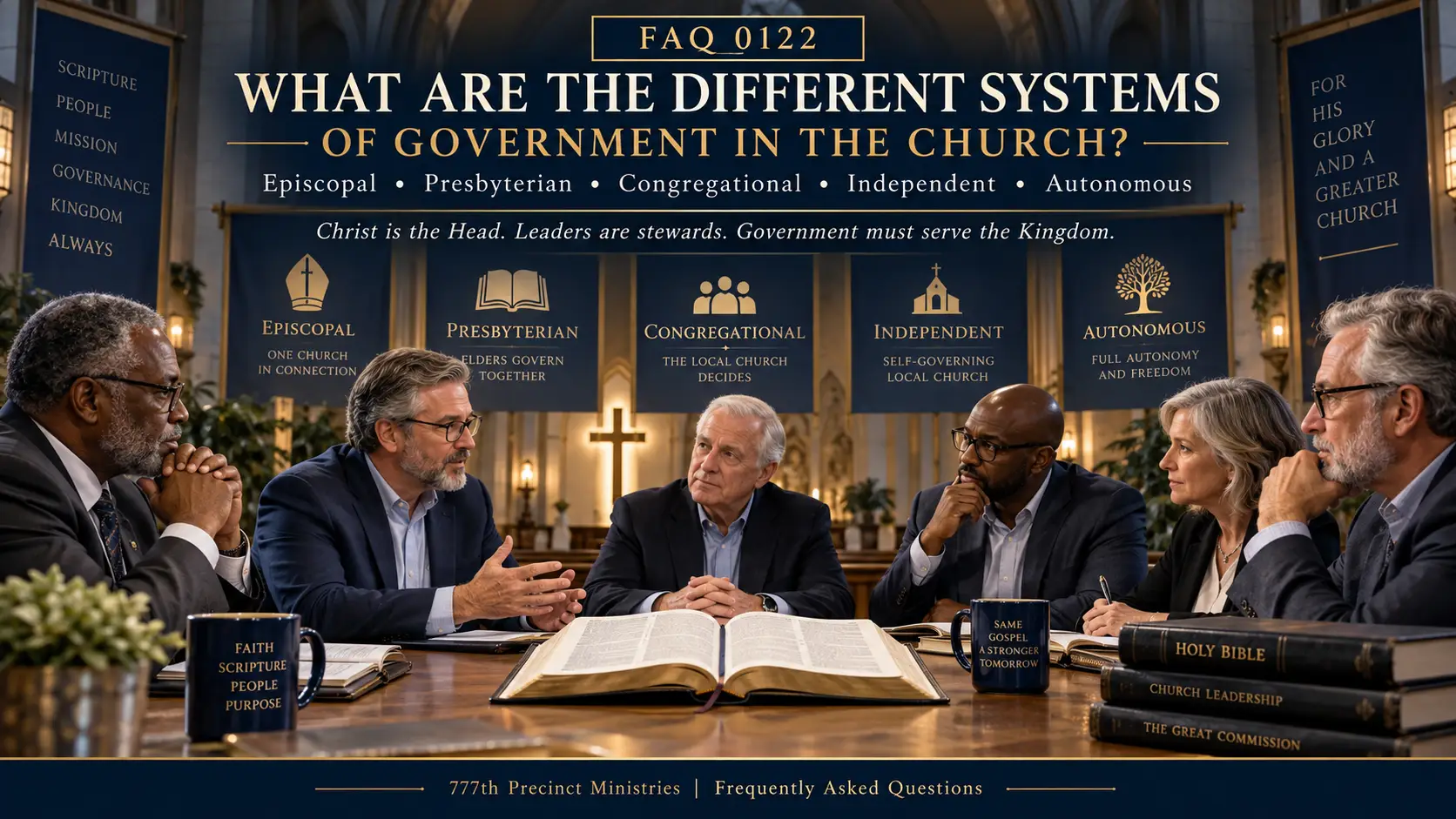
FAQ 0122
WHAT ARE THE FIVE DIFFERENT SYSTEMS OF GOVERNMENT IN THE CHURCH?
Episcopal • Presbyterian • Congregational • Independent • Autonomous
Church government describes how authority, oversight, decision-making, accountability, property and ministry responsibility are ordered within the church. Different traditions have developed different structures. This FAQ explains five common models and evaluates them through the biblical principles of Christ’s headship, qualified elders, servant leadership, local responsibility, accountability and sensitivity to the Holy Spirit.
1. Introduction
The New Testament gives clear principles for church leadership, but it does not present a single modern constitutional manual using labels such as episcopal, presbyterian or congregational. Those labels developed in church history as Christians organised oversight, authority and accountability in different ways.
The supplied teaching identifies five systems: Episcopalian, Presbyterian, Congregational, Independent and Autonomous. The first four are evaluated for characteristic strengths and dangers, while the autonomous elder-led local church is presented as the preferred model.
A careful biblical treatment should distinguish between what Scripture explicitly says and what later systems infer from Scripture. The central question is not simply, ‘Which label is correct?’ but, ‘Does this form of government preserve the Lordship of Christ, biblical leadership qualifications, accountability, servant leadership and the freedom of the Holy Spirit to direct the church?’
| QUESTION |
| What are the different systems of government in the church? |
| SHORT ANSWER |
| Five commonly discussed systems are Episcopal, Presbyterian, Congregational, Independent and Autonomous. Each places authority in a different location: a hierarchy of bishops, councils of elders, the congregation, a dominant individual leader, or a self-governing local eldership. Within the framework of this FAQ, the preferred pattern is an autonomous local church led by a plurality of qualified elders, with a recognised lead elder or set man carrying vision and direction while remaining accountable to Christ, Scripture and fellow elders. |
2. Foundational Biblical Principles of Church Government
Before comparing systems, several New Testament principles should govern the discussion:
- Jesus Christ is the Head of the Church.
- Leadership exists to serve, shepherd, equip and protect God’s people.
- Elders must meet clear character and doctrinal qualifications.
- Local churches ordinarily function with a plurality of elders rather than with unaccountable one-man rule.
- Leaders are accountable to God for the flock entrusted to them.
- The congregation is not a possession of the leader; it belongs to Christ.
- Decisions should be formed by Scripture, prayer, wisdom and the leading of the Holy Spirit.
- Healthy churches maintain both local responsibility and meaningful relational accountability.
| Colossians 1:18 (BSB)
And He is the head of the body, the church; He is the beginning and firstborn from among the dead, so that in all things He may have preeminence. |
| 1 Peter 5:2-3 (BSB)
Be shepherds of God’s flock that is among you, watching over them not out of compulsion, but because it is God’s will; not out of greed, but out of eagerness; not lording it over those entrusted to you, but being examples to the flock. |
3. The Episcopal System
The episcopal form of church government is hierarchical. Authority is ordered through levels of recognised oversight, normally involving bishops who supervise clergy and congregations within defined regions.
Different episcopal traditions organise this hierarchy differently. The Roman Catholic Church includes a papal structure; Anglican and Episcopal traditions operate through bishops and dioceses; some Methodist traditions also use forms of episcopal oversight, although their structures are not identical.
Potential strengths include:
- clear lines of authority and responsibility;
- continuity across congregations and regions;
- shared doctrinal and administrative standards;
- external accountability for local leaders; and
- capacity to coordinate mission, training and resources on a large scale.
Potential dangers include:
- bureaucracy that becomes distant from local spiritual realities;
- institutional preservation replacing Holy Spirit sensitivity;
- an unhealthy clergy-laity divide;
- property or denominational control being used coercively; and
- a culture in which authority flows downward while accountability does not flow upward.
The problem is not simply that a system has bishops. The New Testament itself uses the language of overseers. The danger arises when hierarchy becomes domination, when institutional procedure suppresses biblical truth, or when believers are treated as passive subjects rather than mature members of Christ’s body.
4. What About Nicolaitanism?
| Revelation 2:6 (BSB)
But you have this to your credit: You hate the works of the Nicolaitans, which I also hate. |
| Revelation 2:15 (BSB)
In the same way, some of you also hold to the teaching of the Nicolaitans. |
Some ministry traditions use the term ‘Nicolaitanism’ to describe leaders who conquer, dominate or rule over the laity. That application captures a genuine biblical warning against domineering leadership.
However, the popular explanation that ‘Nico’ means conquer and ‘laity’ means people should not be treated as a certain lexical definition of the biblical group. Revelation condemns the works and teaching of the Nicolaitans, but the precise historical identity of the group is not fully explained in the text.
The safer principle is this: whatever the original Nicolaitan error involved, Christ clearly rejects corrupt leadership and corrupt teaching. No church system should be used to justify domination of God’s people.
5. The Presbyterian System
Presbyterian government places leadership in representative councils of elders. In a typical form, a local session or eldership governs the congregation, representatives participate in a regional presbytery, broader matters may be considered by a synod, and a general assembly may serve the wider denomination.
Historically this system became strongly associated with Reformed and Presbyterian traditions, including those influenced by John Calvin.
Potential strengths include:
- plural leadership rather than solitary rule;
- shared accountability among elders;
- representative participation beyond the local congregation;
- doctrinal stability; and
- a mechanism for correcting local leadership problems.
Potential dangers include:
- boards or councils becoming more political than spiritual;
- the lead minister becoming unable to act without excessive procedural approval;
- voting replacing prayerful discernment;
- institutional policy overriding local mission; and
- leadership responsibility becoming diffused so widely that nobody carries clear vision.
6. Does 1 Samuel 8 Condemn Presbyterian Government?
| 1 Samuel 8:6-7 (BSB)
But when they said, ‘Give us a king to judge us,’ their demand was displeasing in the sight of Samuel; so he prayed to the LORD. And the LORD said to Samuel, ‘Listen to the voice of the people in all that they say to you. For it is not you they have rejected, but they have rejected Me as their king.’ |
The passage concerns Israel’s demand for a monarchy like the surrounding nations. It is not a direct biblical description of presbyterian church government.
Nevertheless, it provides an important principle: God’s people can become so dependent upon visible human structures that they substitute human control for God’s kingship. Every system, including an elder-led system, must therefore remain under divine rule rather than merely reproducing political structures.
7. The Congregational System
Congregational government places final human decision-making authority in the gathered local congregation. Local churches normally govern their own membership, leadership appointments, finances, property and major decisions without an external hierarchy.
This approach is common among many Baptist, independent evangelical and congregational traditions, although the exact role of pastors, elders and deacons varies considerably.
Potential strengths include:
- strong local ownership and responsibility;
- recognition of the priesthood of all believers;
- protection against distant external control;
- meaningful congregational participation; and
- the ability to hold leaders accountable.
Potential dangers include:
- majority opinion becoming more important than spiritual discernment;
- consumer expectations governing ministry direction;
- popular personalities or factions controlling decisions;
- difficulty making courageous decisions when they are unpopular; and
- the pastor becoming an employee of the congregation rather than a shepherd responsible before Christ.
8. Does the Crowd Choosing Barabbas Prove Congregational Government Is Wrong?
| Matthew 27:21 (BSB)
Which of the two do you want me to release to you? asked the governor. ‘Barabbas,’ they replied. |
The crowd’s choice of Barabbas demonstrates that a majority can be wrong. That is a valid warning against assuming that numerical agreement automatically equals the will of God.
However, the passage is not a direct teaching about congregational church polity. It should therefore be used as an illustration of the danger of crowd pressure, not as proof that every congregational system is inherently unbiblical.
9. What About Laodicea and ‘The Rights of the People’?
| Revelation 3:20 (BSB)
Behold, I stand at the door and knock. If anyone hears My voice and opens the door, I will come in and dine with him, and he with Me. |
The name Laodicea is sometimes used symbolically in teaching to suggest ‘the judgment’ or ‘rights of the people.’ That wordplay can be homiletically useful, but Revelation 3 does not state that the church voted Jesus out.
The central biblical warning is stronger and more personal: a congregation can become self-satisfied, spiritually lukewarm and functionally independent of Christ while still imagining itself to be healthy.
10. The Independent One-Man System
The supplied framework uses ‘independent’ in a narrower sense than simply ‘non-denominational.’ Here it refers to a church dominated by one leader who rejects meaningful accountability.
Such a leader may control doctrine, finances, appointments, discipline and relationships without genuine peer oversight. The danger is not independence from a denomination; the danger is independence from accountability.
Typical warning signs include:
- the leader cannot be questioned;
- all disagreement is labelled rebellion;
- finances are not transparent;
- leaders are appointed only for loyalty to the central figure;
- members are treated as belonging to the leader;
- the church exists to build the leader’s name; and
- people who leave are threatened, shamed or excluded.
11. Diotrephes as a Warning Against Pre-Eminence
| 3 John 9-10 (BSB)
I have written to the church about this, but Diotrephes, who loves to be first, will not accept our instruction. So if I come, I will call attention to his malicious slander against us. And unsatisfied with that, he refuses to welcome the brothers and forbids those who want to do so, even putting them out of the church. |
Diotrephes is a powerful biblical warning against leadership driven by pre-eminence. He loves to be first, rejects apostolic correction, speaks maliciously and uses exclusion as a weapon.
Any church government that gives one person enough unchecked power to behave in this way is spiritually dangerous. True spiritual fathering produces mature sons; domination produces dependants and fear.
12. The Autonomous System
Within the framework of this FAQ, the autonomous local church is the preferred model. Autonomous does not mean isolated, unaccountable or disconnected from the wider Body of Christ. It means the local church carries real responsibility for its own life under Christ rather than being controlled by an external bureaucracy.
The autonomous church is described as self-governing, self-supporting and self-propagating. It is governed by a plurality of qualified elders while recognising a lead elder, chief elder or set man who carries primary responsibility for vision and direction.
This model seeks to combine clear leadership with plurality, local responsibility with Kingdom relationships, and authority with accountability.
13. Antioch as a Model of Spirit-Led Local Church
| Acts 13:1-3 (BSB)
Now in the church at Antioch there were prophets and teachers: Barnabas, Simeon called Niger, Lucius of Cyrene, Manaen (who had been brought up with Herod the tetrarch), and Saul. While they were worshiping the Lord and fasting, the Holy Spirit said, ‘Set apart for Me Barnabas and Saul for the work to which I have called them.’ And after they had fasted and prayed, they laid their hands on them and sent them off. |
Antioch displays several important characteristics: plurality of ministry, prayer, fasting, sensitivity to the Holy Spirit, mission beyond the local church and the release of leaders into apostolic work.
Within the teaching framework supplied, Barnabas is treated as the principal or lead figure at Antioch. It should be noted, however, that Acts 13 itself does not explicitly give Barnabas the title ‘chief elder.’ The principle of a recognised lead figure is therefore an interpretation of the leadership pattern rather than a direct title stated in the passage.
14. Plurality of Elders and a Recognised Lead Elder
| Titus 1:5 (BSB)
The reason I left you in Crete was that you would set in order what was unfinished and appoint elders in every town, as I directed you. |
The New Testament frequently speaks of elders in the plural. Plurality protects the church from the weaknesses of solitary leadership.
At the same time, biblical narratives often show a recognisable point leader: James speaks decisively at the Jerusalem council, Peter frequently takes initiative among the Twelve, and Paul carries apostolic responsibility in the churches he plants.
The phrase ‘first among equals’ can therefore describe a healthy lead elder: a leader who carries distinct responsibility without becoming an unaccountable ruler.
15. The Set Man Is Not the Head of the Church
A set man may be the custodian of a local vision, but he is not the head of the Church. Christ alone holds that position.
The set man’s authority must therefore be:
- derived rather than absolute;
- biblical rather than personal;
- servant-hearted rather than domineering;
- accountable rather than isolated;
- relational rather than bureaucratic; and
- directed toward equipping the saints rather than preserving personal control.
16. Autonomy Does Not Mean Isolation
A healthy autonomous church can participate in apostolic networks, relational oversight, shared mission, conferences, training and mutual accountability without surrendering its local stewardship to external control.
The distinction is between relationship and ownership. A network should strengthen local churches, not possess them. Outside voices may counsel, warn and help, but local elders remain responsible before God for the congregation entrusted to them.
17. How Should Decisions Be Made?
No biblical leadership structure should depend only on one mechanism. Healthy decision-making normally involves Scripture, prayer, wisdom, spiritual discernment, consultation, mature counsel and clear responsibility.
Voting may sometimes be useful as an administrative tool, but a vote does not automatically reveal the will of God. Likewise, one leader’s strong conviction does not automatically equal the voice of God.
The goal is Spirit-led agreement under Scripture, with recognised leaders willing to carry responsibility for decisions and willing to be corrected when necessary.
18. Property, Money and Government
Church property structures differ widely. A denomination may own property centrally, a local congregation may own it, a trust may hold it, or another legal entity may administer it.
Scripture does not identify one modern property-registration model as inherently holy. The biblical concern is faithful stewardship, honesty, accountability and the use of resources for God’s purposes.
Property must never become a tool by which leaders or institutions coerce a congregation.
19. No System Is Safe Without Character
A perfect constitution cannot compensate for corrupt hearts. Episcopal systems can become authoritarian. Presbyterian boards can become political. Congregational churches can become populist. Independent churches can become dictatorships. Autonomous churches can also become abusive if a lead elder refuses accountability.
The health of church government therefore depends not only on structure but also on the character of the people operating that structure.
| 1 Timothy 3:2 (BSB)
An overseer, then, must be above reproach, the husband of but one wife, temperate, self-controlled, respectable, hospitable, able to teach. |
Character qualifications are not secondary to governance. They are part of governance.
20. Comparison of the Five Systems
| SYSTEM | PRIMARY HUMAN AUTHORITY | STRENGTH | MAJOR RISK |
| Episcopal | Bishops / hierarchy | Continuity and wider oversight | Bureaucracy or clerical domination |
| Presbyterian | Councils of elders | Plurality and representative accountability | Board control or political decision-making |
| Congregational | Local congregation | Participation and local responsibility | Populism or majority rule |
| Independent | Dominant individual leader | Speed and clarity of leadership | Isolation and unaccountable control |
| Autonomous | Local plurality of elders with recognised lead elder | Local responsibility with clear vision | Can still become authoritarian if accountability is absent |
21. Which System Is the Most Biblical?
The New Testament gives stronger support to principles than to one later denominational label. We repeatedly see local elders, plural leadership, apostolic relationship, recognised leaders, congregational participation, financial stewardship and Spirit-led mission.
Within the ministry framework of this FAQ, the autonomous elder-led model with a recognised set man is preferred because it seeks to hold several of these principles together:
- Christ remains the Head;
- the local church carries real responsibility;
- there is a plurality of elders;
- a recognised leader carries vision and direction;
- the church is not owned by an external bureaucracy;
- the leader is not controlled merely by popular vote;
- the set man is not free to become an unaccountable dictator;
- the Holy Spirit remains central to direction and mission; and
- relationships with the wider Body remain voluntary, covenantal and Kingdom-centred.
This conclusion should be presented as the considered position of the 777th Precinct Ministries framework, not as though the words ‘autonomous set-man government’ appear as a complete constitutional formula in a single New Testament text.
22. 777th Precinct Ministries – Position Statement
777th Precinct Ministries recognises that Christians have historically organised church government through several structures. We believe no system should be evaluated merely by its title, but by whether it reflects the Lordship of Jesus Christ, the authority of Scripture, the work of the Holy Spirit, qualified leadership, accountability and servant-hearted stewardship.
Within our ministry framework, we favour an autonomous local church governed by a plurality of elders with a recognised lead elder or set man who carries the primary vision and direction of that local house.
We reject hierarchical bureaucracy when it silences local obedience to God; board government when it reduces spiritual discernment to politics; congregationalism when majority preference becomes lord; and independent one-man rule when a leader refuses accountability.
We also reject any use of the set-man principle to create authoritarian leadership. The set man is a steward, not an owner. He must lead under Christ, with fellow elders, with financial and moral accountability, and with a heart to equip mature sons and daughters rather than produce dependence.
23. Conclusion
Church government matters because structure shapes culture. The question is not merely who signs documents or owns property. It is who carries responsibility, how leaders are corrected, how the voice of the Holy Spirit is discerned, how people are protected and how Christ remains practically pre-eminent.
Every system contains strengths and dangers. A healthy church therefore requires more than the right organisational chart. It requires righteous leaders, mature believers, biblical accountability and continuous submission to Christ.
The preferred model in this FAQ is a self-governing, self-supporting and self-propagating local church led by a plurality of elders, with a recognised set man carrying vision and direction. Its success depends on one decisive safeguard: the set man, elders and congregation must all remain under the government of Jesus Christ.
Christ is the Head. Leaders are stewards. The church is His.
Grace to you.
Scripture quotations are from the Berean Standard Bible (BSB), public domain.
OTHER PUBLICATIONS BY THIS AUTHOR CAN BE FOUND AT: