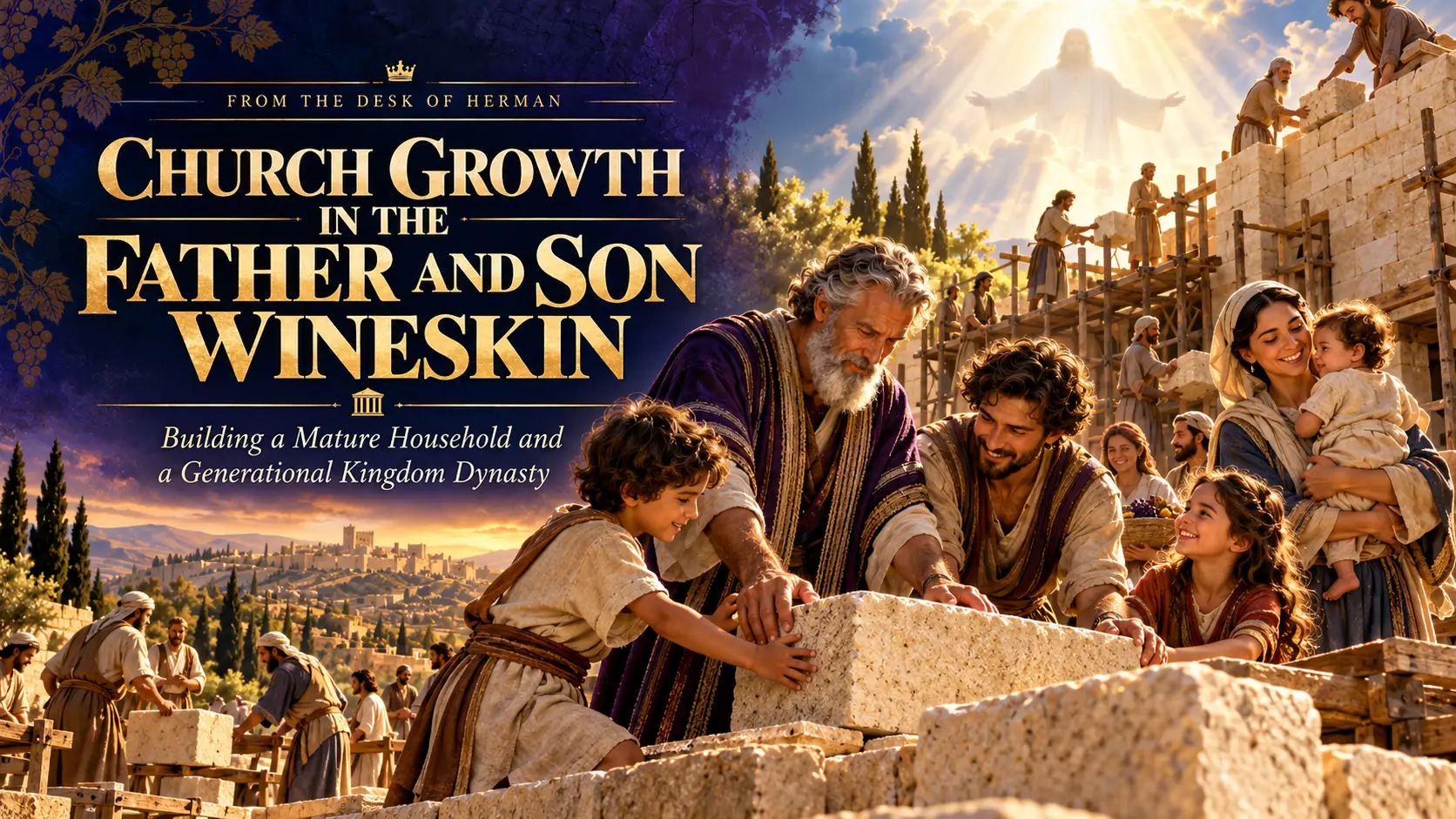
From the Desk of Herman — Part 6 of 6
Building a Mature Household and a Generational Kingdom Dynasty
Church growth must be measured by more than attendance, programmes, buildings or visibility. Biblical growth is seen when Christ is formed in people, the household matures, every part functions and faithful people reproduce faithful people across generations.
Church Growth Defined by Christ
Christ Builds and God Gives the Growth
Jesus did not surrender the ownership or authorship of His Church. He said, I will build My church. Paul used agricultural and architectural language to make the same point. One servant plants, another waters, but God gives the growth. Ministers are fellow workers; the people are God’s field and God’s building. Every leader therefore builds under Christ, upon Christ, and for Christ (1 Corinthians 3:5 to 11).
1 Corinthians 3:6 to 7 “I planted the seed and Apollos watered it, but God made it grow. So neither he who plants nor he who waters is anything, but only God, who makes things grow.”
Human beings can gather a crowd, improve communication, organise events, and expand a platform. Only God can impart life, produce repentance, reveal Christ, join people into a spiritual body, and form mature sons. Administration and strategy are valuable servants, but they cannot become the source of life. The Church must work diligently while remaining dependent upon God.
Numbers Matter but Numbers Are Not the Whole Measure
Acts records numbers because every number represents a person reached by the gospel. Three thousand were added on the Day of Pentecost, the Lord added people daily, the number of disciples multiplied, and churches increased daily (Acts 2:41 and 47; 4:4; 6:1 and 7; 16:5). Numerical fruit should be received with thanksgiving. It is not spiritual to be indifferent to people being saved.
Scripture also refuses to treat size as proof of health. Crowds followed Jesus and later withdrew when His word challenged them (John 6:60 to 66). The Corinthian church possessed gifts but remained carnal and divided (1 Corinthians 1:4 to 7; 3:1 to 4). Sardis had a reputation for being alive while Christ declared it dead (Revelation 3:1 to 3). A church may become larger without becoming more mature, more truthful, more relational, or more capable of reproducing faithful people.
A Whole Definition of Church Growth
Biblical church growth is the God-given increase of Christ’s life, rule, people, relationships, function, witness, and generational continuity in and through a local household. Healthy growth has several related dimensions. If one dimension expands while the others are neglected, the house becomes vulnerable.
A healthy church therefore asks more than how many people attended. It asks whether people met Christ, whether truth governs the house, whether relationships are being healed, whether believers are becoming responsible, whether gifts are serving the body, whether new leaders are being formed, whether the poor and vulnerable are treated justly, and whether the gospel is being carried into another community and generation.
The Growth Vocabulary of Acts
Luke uses several words and descriptions to show that church growth is more than one event. The Church is added to, multiplied, strengthened, built up, spread, and made effective. These movements provide a balanced language for evaluation.
The Acts 2 Foundation
Acts 2:42 “They devoted themselves to the apostles’ teaching and to the fellowship, to the breaking of bread and to prayer.”
The first Jerusalem church grew around devotion, not novelty. The apostles’ teaching established truth. Fellowship created shared life. The breaking of bread kept covenant visible. Prayer maintained dependence upon God. Signs, generosity, hospitality, worship, public favour, and daily salvation flowed within this environment (Acts 2:43 to 47). Growth was both public and house to house, both spiritual and practical, both numerical and relational.
The Acts 6 Adjustment
When the number of disciples increased, a neglected group raised a legitimate complaint. The apostles did not call the problem persecution or dismiss administration as unspiritual. They protected prayer and the ministry of the Word while appointing qualified servants to oversee the distribution. The Word then spread and the disciples multiplied greatly (Acts 6:1 to 7).
Growth exposes the limitations of yesterday’s structure. A household must add capacity without losing its spiritual centre. Wise administration protects people from neglect, releases leaders to remain faithful to their grace, and creates room for further multiplication. Disorder is not evidence of life. Order should serve life.
The House Belongs to God
Psalm 127:1 “Unless the LORD builds the house, its builders labor in vain; unless the LORD protects the city, its watchmen stand guard in vain.”
The local church is the household of God, the body of Christ, a temple of the Spirit, and a community of living stones (1 Timothy 3:15; 1 Corinthians 12:27; Ephesians 2:19 to 22; 1 Peter 2:4 to 5). A spiritual father may carry a God-given vision for a house, but he does not own the people. A son may build within that vision, but he does not inherit ownership of people. Christ remains the Head, the Chief Shepherd, the cornerstone, and the source of every grace.
This foundation protects the father and son wineskin from becoming a hierarchy of possession. Fathers serve God’s purpose in sons. Sons honour the grace of God in fathers. Both remain accountable to Scripture, the Holy Spirit, the body, and the Lordship of Jesus. Growth that transfers dependence from Christ to a human leader is not maturity.
Stewards and Fellow Workers
Paul described ministers as servants through whom people believed and as fellow workers belonging to God (1 Corinthians 3:5 to 9). Peter instructed elders to shepherd willingly and eagerly, not lording it over those entrusted to them, but becoming examples to the flock (1 Peter 5:2 to 3). Biblical authority therefore carries responsibility, truth, discipline, protection, and direction, but it never becomes personal ownership.
The Father and Son Wineskin
A wineskin is a relational structure capable of carrying what God is presently pouring into His people. The father and son wineskin describes a covenantal and formative relationship through which identity, doctrine, ways, character, responsibility, and Kingdom purpose pass from one generation to another. It is not created by titles. It is proved by relationship, transformation, shared labour, responsible freedom, and reproduction.
Malachi 4:6 “And he will turn the hearts of the fathers to their children, and the hearts of the children to their fathers. Otherwise, I will come and strike the land with a curse.”
1 Corinthians 4:15 to 17 “Even if you have ten thousand guardians in Christ, you do not have many fathers; for in Christ Jesus I became your father through the gospel. Therefore I urge you to imitate me. That is why I have sent you Timothy, my beloved and faithful child in the Lord. He will remind you of my way of life in Christ Jesus, which is exactly what I teach everywhere in every church.”
What a Spiritual Father Does
Gives identity and belonging He helps believers understand who they are in Christ and where they are planted, without making himself the source of their identity.
Forms through truth and example He teaches sound doctrine and demonstrates a way of life in Christ that can be examined and imitated (1 Corinthians 11:1; 2 Timothy 3:10 to 11).
Discerns grace and potential He recognises what God has placed within sons and creates opportunities for faithful development.
Corrects and protects He addresses error, immaturity, and danger with truth, love, patience, and clear boundaries (2 Timothy 4:2; Hebrews 12:10 to 11).
Entrusts responsibility He moves sons from observation to participation and from participation to accountable leadership.
Shares inheritance He gives access to wisdom, relationships, resources, lessons, and opportunity rather than guarding ministry as private property.
Releases maturity He does not preserve dependence. He sends equipped sons to fulfil God’s purpose and rejoices when they become fruitful.
What a Mature Son Does
Receives the Father’s purpose He listens for the purpose of God carried by the father and tests all things by Scripture.
Learns the Father’s ways in Christ He receives doctrine, conduct, faith, patience, love, and perseverance rather than copying mannerisms or personality.
Carries responsibility He does not remain a consumer. He accepts real responsibility for people, work, resources, and outcomes.
Builds the family He strengthens belonging, brotherhood, reconciliation, care, and mutual honour.
Builds the house He helps establish doctrine, culture, ministry, administration, stewardship, mission, and succession.
Protects the inheritance He resists doctrinal drift, rivalry, waste, and division while refusing possessiveness or fear.
Extends the work He brings faithful initiative, solves problems, develops others, and carries the assignment into new fields and generations.
Spiritual Sonship and Gender
In the New Testament, sonship describes covenant identity, maturity, inheritance, and representation in Christ. All who are led by the Spirit are sons of God, and all who belong to Christ are heirs according to promise (Romans 8:14 to 17; Galatians 3:26 to 29). The father and son language in this teaching therefore includes men and women who mature into responsible heirs and builders under Christ. It must not be used to diminish the dignity, gifting, or participation of women in the household of God.
The Growth Pathway Within the Wineskin
The Builder Son
1 Chronicles 28:10 “Consider now that the LORD has chosen you to build a house for the sanctuary. Be strong and do it.”
A son is a builder of the family and house of the father. This statement does not mean that a son builds a human personality, preserves a private brand, or serves personal ambition. It means that a mature son accepts responsibility for the God-given household and assignment carried through the father. The father prepares, forms, equips, and entrusts. The son discerns, embodies, builds, preserves, and extends. Both serve the house that belongs to God.
The David and Solomon Pattern
David received the desire and pattern for the temple, gathered materials, organised leaders and workers, and instructed Solomon. Solomon was chosen to build and had to set his heart to the task (1 Chronicles 22:5 to 19; 28:5 to 21; 29:1 to 9). The assignment moved across generations without losing divine authorship. David could prepare what he would not personally complete. Solomon could build what he did not personally originate.
This pattern corrects two common errors. A father must not insist on doing everything himself in order to remain indispensable. A son must not despise preparation or act as though the work began with him. Church growth accelerates when fathers release responsibility and sons honour the history, cost, revelation, and preparation already invested in the house.
Building the Family and Building the House
The family and the house are related but distinct. The family describes covenant relationships, belonging, shared life, care, honour, reconciliation, and identity. The house describes the ordered expression that enables the family to fulfil its assignment: doctrine, culture, discipleship, worship, leadership, administration, stewardship, communication, mission, and succession.
Family without an ordered house may possess affection but lack direction, accountability, and capacity. A house without family may possess structure but become cold, controlling, and institutional. Healthy growth joins relationship and government. Love gives order its spirit; order gives love a sustainable expression (Ephesians 4:15 to 16; 1 Corinthians 14:40).
The ABC Davidic Church and Church Growth
The Accurate Building Concepts treatment of the Davidic Church reads 1 Samuel 17 as a corporate pattern for a God-centred and governmental church. David is not the substance or final model. Jesus Christ is the Head, Builder, and full expression of the Church. David’s conduct provides a prophetic pattern of a proceeding-word, God-appointed, sent, servant, relational, discerning, authentic, faith-filled, practical, governmental, and finishing people.
This pattern is highly relevant to church growth because it addresses the kind of people and operating system required to carry increase. Growth cannot be sustained by an obsolete Saul system marked by fear, borrowed armour, institutional dependence, and human strength. A Davidic household grows from God’s presence, Word, appointment, covenant identity, authentic grace, faith, and completed obedience.
The Nineteen Characteristics Applied to Growth
The Sent Son Carries Bread Before Seeking a Platform
David went because his father sent him. He carried bread, checked the welfare of his brothers, and brought back an assurance before he confronted Goliath (1 Samuel 17:17 to 22). This is a powerful picture of the builder son. His first concern is not public conquest but faithful representation of the father’s heart toward the family. He feeds, serves, observes, reports, and then acts when the Kingdom assignment becomes clear.
Church growth becomes distorted when sons seek platforms without carrying bread, authority without service, public victories without private responsibility, or independent movement without sending. The Davidic order joins apostolic sending with a servant spirit and household responsibility.
Authentic Grace Instead of Borrowed Armour
Saul’s armour was impressive but untested in David’s life. David removed it and used the tools formed through his shepherding experience (1 Samuel 17:38 to 40). A church should learn from others, but copying another house’s language, culture, programme, brand, or measurement system cannot replace the grace God has formed locally. Borrowed methods become restrictive when they prevent a people from walking accurately.
Authenticity does not mean resisting all outside wisdom. It means testing every method, refusing mixture, and adapting useful tools to the call, people, scale, and season of the house. The proceeding Word and the written Word govern the strategy.
Five Fold Ministry Equips the Whole Body
Ephesians 4:11 to 13 “And it was He who gave some to be apostles, some to be prophets, some to be evangelists, and some to be pastors and teachers, to equip the saints for works of ministry and to build up the body of Christ, until we all reach unity in the faith and in the knowledge of the Son of God, as we mature to the full measure of the stature of Christ.”
Five-fold ministry is not a platform class that performs while the congregation watches. Its purpose is to equip the saints until the whole body ministers and matures. The clearest evidence of effective five-fold ministry is not the prominence of the five-fold minister. It is the increasing competence, unity, discernment, service, and Christlikeness of the people.
A Finishing Church
David did not merely announce victory or stun Goliath. He completed the assignment (1 Samuel 17:50 to 51). Churches often begin initiatives, announce visions, and create language without establishing the truth in practice. A finishing culture translates revelation into teaching, relationships, policies, stewardship, deployment, and measurable responsibility. Completed obedience creates an inheritance that the next generation can receive.
From Legacy to Kingdom Dynasty
A legacy records what remains after a leader. A Kingdom dynasty reproduces the life, truth, nature, and assignment of Christ through a spiritual household across generations. The word dynasty must be handled carefully. In this teaching it does not mean a biological ruling family, nepotism, hereditary titles, or the preservation of a ministry brand. It describes generational continuity through formed and faithful people.
The Four Generation Pattern
Second Timothy 2:2 contains four generations of transmission: Paul, Timothy, reliable people, and others whom they will teach. The truth does not stop with the first recipient. It is entrusted to people whose character and competence make them capable of transmitting it accurately. Church growth becomes dynastic when the house can reproduce doctrine, nature, relationships, responsibility, and mission without requiring the original father to control every movement.
This pattern is stronger than succession to one position. It creates a stream of many faithful people. The father does not merely search for a replacement. He develops a culture in which builders can become fathers and raise another generation.
Abraham and the Trained Household
Genesis 14:14 “When Abram heard that his relative had been captured, he mobilized the 318 trained men born in his household, and they set out in pursuit as far as Dan.”
Abram’s household contained trained people capable of coordinated action. They were born in the house, developed in the house, and mobilised for a covenant purpose. The strength of the household was visible in formed people, not only in Abram’s personal gifting. In Christ, those of faith are children of Abraham and heirs according to promise (Galatians 3:7 and 29). A Kingdom household should likewise form people who can carry responsibility when a crisis or mission requires it.
Continuity Without Cloning
Isaac reopened the wells dug in Abraham’s days and restored the names his father had given them. He also dug new wells in his own generation (Genesis 26:18 to 22). Healthy sons preserve the source and substance of the inheritance while allowing faithful new expressions. They do not change doctrine to appear original, and they do not copy every method to prove loyalty. Continuity without cloning protects both inheritance and present obedience.
Co Regency and Shared Labour
Generational transfer becomes safer when responsibility is shared before a crisis of succession. David presented Solomon publicly, gave him instruction, provided resources, and involved the leaders and assembly in the work (1 Chronicles 28 to 29). Paul took Timothy into real ministry, sent him to churches, trusted him with representation, and expected him to develop others (Philippians 2:19 to 23; 1 Corinthians 4:17; 2 Timothy 2:2).
Co-regency is mature participation under Christ. It is neither passive dependence nor premature independence. A father supplies counsel, access, correction, and authority appropriate to the assignment. A son supplies loyalty to Christ, tested character, initiative, truthful communication, and responsible execution. Shared labour reveals capacity before full transfer.
Sons Become Fathers
The aim of fathering is not to keep sons permanently beneath one personality. Mature sons should eventually carry a fathering capacity toward others. The pattern can be stated clearly: a father builds sons; mature sons build the house; builder sons become fathers. This multiplication creates a dynasty of Christlike responsibility rather than a pyramid of dependence.
Principles for Sustainable Church Growth
Keep Christ and His Presence at the Centre
The restored tabernacle of David points ultimately to a people ordered around the presence and government of Christ (Acts 15:16 to 17). Growth that makes a ministry name more visible while making Christ less central has lost its purpose. Worship, preaching, leadership, resources, and mission must direct people toward the Lord. The set man serves God’s centrality; he does not replace it.
Build on Apostolic Doctrine
A growing house must be teachable and doctrinally anchored. The early believers devoted themselves to the apostles’ teaching, and Paul warned elders that distorted teaching would arise even from among them (Acts 2:42; 20:28 to 31). Sound doctrine gives language to truth, exposes error, and creates a common foundation for behaviour. A dynasty cannot transmit what it has never clearly understood or practised.
Make Disciples Rather Than Gather Consumers
Jesus commanded His followers to make disciples, baptise them, and teach them to obey everything He commanded (Matthew 28:18 to 20). Consumers ask what the house will provide for them. Disciples submit to Christ, learn His Word, change their conduct, serve others, and accept mission. A growth strategy that attracts attendance but does not produce obedience will eventually exhaust leaders and weaken the household.
Establish Covenant Relationships
The New Testament uses the language of body, family, household, flock, temple, and brotherhood. These images require relationship. Believers are called to love, forgive, confess, bear burdens, restore the fallen, honour one another, and maintain the unity of the Spirit (John 13:34 to 35; Galatians 6:1 to 2; Ephesians 4:1 to 3; James 5:16). People are retained and matured through genuine shared life, not through manufactured loyalty.
Equip Every Member to Function
Ephesians 4:16 says the body grows through the work of each individual part. First Corinthians 12 teaches that every member has a place and that no part can dismiss another. Church growth slows when ministry is concentrated in a platform class and the majority become spectators. Leaders must identify grace, train people, create appropriate opportunities, and review fruit. Participation should grow with character and competence.
Develop Servant Leaders and Builder Sons
Jesus rejected leadership that imitates Gentile domination. Greatness in His Kingdom is expressed through service (Mark 10:42 to 45). Builder sons do not merely occupy roles. They make the family stronger, improve the house, solve real problems, protect people, steward resources, and develop others. Their authority grows from character, service, truth, competence, and recognised grace.
Join Spiritual Life and Strategic Administration
Prayer, revelation, and spiritual gifts do not remove the need for planning, communication, records, finance, safeguarding, delegation, and evaluation. Joseph stored grain through wise administration, Moses delegated judgments, David organised worship and service, and the apostles appointed qualified servants when distribution failed (Genesis 41:33 to 49; Exodus 18:17 to 26; 1 Chronicles 23 to 26; Acts 6:1 to 7). Administration is Kingdom service when it protects people and enables the assignment.
Integrate Evangelism and Household Formation
The gospel must move outward, and those reached must be joined inward. Acts shows public proclamation, house-to-house fellowship, baptism, teaching, care, and the formation of local churches. Evangelism without integration can produce decisions without discipleship. Internal formation without mission can produce a closed family. Healthy growth welcomes the lost, forms disciples, establishes them in covenant, and releases them into witness.
Practise Righteous Stewardship
Money, property, influence, information, and opportunity must be handled transparently. Paul arranged the administration of a generous gift so that nobody could discredit the ministry and so that what was right would be done in the sight of the Lord and people (2 Corinthians 8:19 to 21). Financial secrecy, personal enrichment, exploitation of sons, and unaccountable control can destroy trust faster than numerical success can build it.
Measure Fruit and Correct Course
Jesus said that a tree is recognised by its fruit (Matthew 7:16 to 20). Measurement should therefore serve discernment, not vanity. Attendance and giving can reveal useful trends, but they should be interpreted alongside conversion, baptism, doctrinal stability, relational health, ministry participation, leadership development, community witness, financial integrity, and generational reproduction. What leaders measure repeatedly will influence what the house values.
Reproduce and Send
The church at Antioch worshipped, fasted, heard the Spirit, and released Barnabas and Saul (Acts 13:1 to 4). A mature house does not measure success only by what it gathers. It also measures whom it forms, whom it entrusts, whom it sends, and what new works become stable. Sending should emerge from divine direction, tested character, covenant relationship, and adequate preparation.
A Church Growth Scorecard
The following scorecard is not a substitute for prayer or spiritual discernment. It provides practical questions that help a household look beyond one measure. Leaders can review these areas periodically and identify both fruit and weakness.
Enemies of Healthy Church Growth
Numerical Success Without Formation
A crowd can gather around need, novelty, personality, or spectacle without becoming a mature body. When attendance becomes the dominant measure, leaders may avoid truth that challenges people, rush unformed workers into responsibility, or conceal unhealthy culture. The answer is not to reject numbers. It is to insist that addition must lead to discipleship, covenant, function, and reproduction (Acts 2:41 to 42; Colossians 1:28).
Personality Dependence
Corinth divided around Paul, Apollos, and Cephas. Paul answered by directing the church back to Christ and describing leaders as servants (1 Corinthians 1:10 to 13; 3:5 to 9). A house becomes fragile when one person’s presence, voice, relationships, or approval is required for every decision. Fathers must develop capacity in others. Sons must receive responsibility without creating private factions around themselves.
The Clergy Spectator Divide
When a few perform all ministry, the body cannot grow through every part. The five-fold graces must equip the saints rather than replace them (Ephesians 4:11 to 16). The correction requires training, supervised opportunity, honest feedback, and clear pathways from membership to ministry and from ministry to mature leadership.
Orphan Thinking and Rivalry
Orphan thinking competes for visibility, protects territory, fears replacement, and struggles to celebrate another person’s fruit. The older brother in Luke 15 remained in the house but did not share the father’s joy. Corinthian jealousy and strife revealed immaturity (1 Corinthians 3:1 to 4). Secure sons know their place in the Father, honour grace in others, and build the common house.
Control Disguised as Fathering
Spiritual fathering becomes abusive when loyalty to a person replaces obedience to Christ, questions are treated as rebellion, access to God is controlled, private information is used to manipulate, or leaving an assignment is threatened with shame or spiritual punishment. Biblical fathers lead by truth, example, service, correction, and accountable stewardship. They do not lord it over people (Mark 10:42 to 45; 1 Peter 5:2 to 3; 2 Corinthians 1:24).
Borrowed Armour and Imported Measures
A house may copy the practices of a large or admired ministry without asking whether those methods fit its grace, people, mission, and season. It may also adopt market measures that reward visibility while ignoring holiness and covenant. David removed Saul’s armour because he had not tested it (1 Samuel 17:38 to 40). Leaders should learn widely, test carefully, and build authentically.
Doctrinal Drift
Growth creates access, and access can bring competing teachings. Paul warned the Ephesian elders to guard themselves and the flock because distorted teaching would arise (Acts 20:28 to 31). A dynasty must preserve the apostolic foundation through clear teaching, theological examination, correction, and leaders who can refute error (Titus 1:9). Relationship cannot replace truth, and truth should be carried relationally.
Administrative Neglect
Acts 6 shows that overlooked people can become the hidden cost of growth. Poor communication, unclear responsibility, weak financial controls, and dependence on memory may work in a small group but fail as the house expands. The answer is not bureaucracy for its own sake. It is sufficient order to ensure that people are served fairly and the mission remains effective.
Outward Extension Without Covenant Continuity
Jair had thirty sons who rode thirty donkeys and controlled thirty towns, yet after his death Israel again did evil in the sight of the Lord (Judges 10:3 to 6). Visible extension, family size, property, and influence did not guarantee covenant faithfulness. A dynasty is not proved by how much territory carries a name. It is proved when another generation knows God, walks in truth, and carries His purpose.
Failure to Finish and Transfer
Unfinished initiatives consume energy and create cynicism. Untransferred knowledge creates crisis when a leader changes role or season. A finishing house documents what matters, establishes responsible people, reviews commitments, closes ineffective work, and prepares successors. David prepared for Solomon, Jesus finished the work the Father gave Him, and Paul could say that he had finished the race (1 Chronicles 22; John 17:4; 2 Timothy 4:7).
Safeguards for the Father and Son Wineskin
Christ remains the Head No father, set man, apostle, or son replaces the direct Lordship of Jesus Christ over His people (Colossians 1:18).
Scripture remains the final standard Teaching, prophecy, vision, and relational expectations must be examined by the written Word (Acts 17:11; 1 Thessalonians 5:20 to 21).
Authority remains stewardship Leaders answer to the Chief Shepherd for people entrusted to their care and must not treat them as possessions (1 Peter 5:2 to 4).
Honour does not silence truth A son can honour a father and still raise a truthful concern. Paul confronted Peter publicly when the gospel was compromised (Galatians 2:11 to 14).
Covenant does not mean coercion Commitment must be real, but it cannot be manufactured through fear, isolation, financial pressure, or threatened rejection.
Correction must be redemptive The aim is repentance, protection, restoration, and maturity, with appropriate boundaries where harm or persistent sin exists (Galatians 6:1; 2 Timothy 2:24 to 26).
Finances require transparency More than one trustworthy person should share oversight where practical, and leaders should avoid even the appearance of impropriety (2 Corinthians 8:20 to 21).
Gifting never excuses character Leaders and emerging sons must meet biblical standards of integrity, self-government, family responsibility, and sound doctrine (1 Timothy 3:1 to 13; Titus 1:5 to 9).
Release proves fathering Healthy fathers develop sons who can hear God, obey Scripture, carry responsibility, and reproduce others without permanent dependence.
Inheritance belongs to Christ What passes through a father must be received as a trust from God. It must never become a private franchise, dynasty of flesh, or entitlement to office.
A Practical Growth Framework for the Local House
The following framework can be adapted to the size and season of a local church. The order is intentional. Identity and doctrine precede deployment. Relationship and character accompany responsibility. Reproduction is planned from the beginning rather than added at the end.
1. Clarify the God-given vision of the house under the Lordship of Christ. State whom the house is called to serve, what it is called to build, and what biblical convictions will govern the work.
2. Discern the proceeding Word for the present season. Test it by Scripture, communicate it clearly, and translate it into practical priorities rather than leaving it as inspirational language.
3. Strengthen the Acts 2 foundations of apostolic teaching, fellowship, breaking of bread, prayer, worship, generosity, and house-to-house life.
4. Establish a clear discipleship pathway from conversion and baptism through doctrine, spiritual disciplines, relational integration, service, and mature responsibility.
5. Identify spiritual fathers and mothers by fruit, character, capacity to form others, and accountable relationship. Do not manufacture titles where fathering grace is absent.
6. Teach sonship as identity, covenant, responsibility, inheritance, and representation in Christ. Confront entitlement, passivity, rivalry, and dependence.
7. Create supervised opportunities for service. Entrust tasks with defined authority, resources, reporting, and review so that faithfulness can be observed and capacity can grow.
8. Equip the saints through the five-fold graces. Measure equipping by the maturity and ministry of the body, not only by the quality of public preaching.
9. Build the family through pastoral care, brotherhood, reconciliation, shared meals, burden bearing, prayer, and practical generosity.
10. Build the house through accurate administration, finance, safeguarding, communication, role clarity, records, and succession planning. Keep systems proportionate to the actual need.
11. Integrate evangelism with formation. Ensure that new believers are followed up, baptised, taught, connected to relationships, and given a path toward service and witness.
12. Identify builder sons who strengthen both people and structures. Invite them into shared labour, counsel, problem solving, and appropriate decision making before formal succession is required.
13. Review the whole growth scorecard. Celebrate fruit, address neglect, stop activities that no longer serve the assignment, and complete what God has clearly commanded.
14. Send and reproduce. Release tested teams, support new works relationally, and require each mature leader to develop reliable people who can teach and lead others.
Questions for Fathers and Senior Leaders
Am I building people who can carry God’s purpose, or gathering people who remain dependent upon me?
Can I name the sons and daughters to whom I am intentionally transferring doctrine, ways, relationships, responsibility, and opportunity?
Have I made the vision clear enough for others to build it without imitating my personality?
Do our systems protect people, or do they mainly protect position and image?
Can questions and correction reach me without fear or political cost?
What responsibility am I still holding that a tested son should now share?
What part of the assignment must I prepare for another generation even if I will not complete it personally?
Would the house continue in truth, covenant, and mission if my role changed unexpectedly?
Questions for Sons and Emerging Leaders
Do I seek responsibility or merely recognition?
Have I understood the father’s God-given vision, or am I building my private interpretation beside it?
Do I strengthen relationships as carefully as I improve structures?
Can I receive correction without withdrawal, blame, flattery, or rebellion?
Do I bring solutions, accurate information, and completed work?
Am I preserving sound doctrine and covenant culture while developing faithful new expressions?
Do I honour the father’s labour without turning honour into personality worship?
Who is becoming more mature because I am intentionally serving and developing them?
Questions for the Whole Household
Are new people being saved and integrated into real relationships?
Is Christ becoming more visible in our character, speech, use of power, and treatment of people?
Does every member have a realistic pathway toward function and maturity?
Are we carrying one another’s burdens and addressing conflict truthfully?
Do our finances, decisions, and appointments withstand honest examination?
Are the five-fold graces equipping the body or concentrating ministry around a few personalities?
Are builder sons emerging who can carry both family and house?
What must be sent, multiplied, or transferred in the next season?
Teaching Summary
Christ builds His Church, and God gives the growth. Leaders are stewards and fellow workers.
Biblical growth includes numerical addition, spiritual maturity, doctrinal stability, covenant relationships, every-member function, wise government, mission, and generational reproduction.
The father and son wineskin forms mature heirs who accept responsibility rather than remaining dependent followers.
A son is a builder of the family and house of the father. He strengthens people and helps establish the ordered expression of the household under Christ.
The Davidic Church grows through the proceeding Word, divine appointment, sending, service, responsibility, relationship, discernment, authentic grace, faith, five-fold equipping, God-centred purpose, and a finishing mentality.
A Kingdom dynasty is formed when faithful people reproduce faithful people across generations. It is not a biological empire, personal brand, or inherited title.
Healthy fathers build sons, mature sons build the house, and builder sons become fathers.
Church growth must be protected by Scripture, accountable authority, financial integrity, redemptive correction, responsible release, and the continuing Headship of Christ.
The goal is a church that can receive increase without losing Christ, carry relationship without losing government, exercise authority without control, preserve inheritance without cloning, and extend the work without rivalry. Such a household does more than survive a generation. It forms people who know God, embody His nature, build His house, and entrust His truth to others.
Corporate Declaration
We confess that Jesus Christ is the Head and Builder of His Church. We receive the Holy Spirit as the source of life, power, wisdom, and growth. We submit our doctrine, relationships, leadership, resources, and mission to the written Word of God. We will build people rather than platforms, households rather than empires, and mature sons rather than dependent followers. We will honour fathers, receive correction, carry responsibility, protect the family, strengthen the house, and finish the assignments entrusted to us. We will preserve the inheritance of Christ and faithfully extend it into another generation.
Prayer
Father, reveal Your Son in Your Church and turn the hearts of fathers and children toward one another. Give us a proceeding word rooted in Scripture, a servant spirit, accurate discernment, tested faith, and strength in You. Deliver us from ambition, rivalry, control, passivity, borrowed armour, and the fear of people. Form mature sons and daughters who love Your family, build Your house, steward Your resources, and carry Your purpose with integrity. Give fathers grace to prepare, entrust, and release. Give sons grace to receive, embody, build, preserve, and reproduce. Let every part supply what You have given, let the Word spread, let disciples multiply, and let the body build itself up in love. Establish a Kingdom dynasty in which one generation commends Your works to another and Jesus Christ remains the centre, inheritance, and glory. Amen.
Scripture Index
Source and Attribution Note
The Davidic Church section applies the principal headings in ABC Curriculum 1a, Lesson 13, The God Centred Church, by Dr S. Y. Govender; it is not a verbatim reproduction. The father and son, builder son, co-regency, and Kingdom dynasty applications are developed from the ministry teaching framework of Herman Bouwer.
Primary biblical translation for direct quotations: Berean Standard Bible. Scripture references are provided throughout so that each principle can be examined in context.
Series: From the Desk of Herman — Father and Son Wineskin Teaching Series, Part 6 of 6.
Unless otherwise indicated, Scripture quotations are from the Berean Standard Bible (BSB).
Herman Bouwer
777th Precinct Ministries